Ripple wins a partial victory, the securities status of XRP remains undecided, and the SEC may continue to appeal

 The ruling has sparked new calls from the crypto industry for legislation to provide clear rules for tokens, urging Congress to clarify the status of digital assets.
Written by: Mary Liu, Bitpush News
On July 13, local time, U.S. District Judge Analisa Torres ruled that Ripple Labs Inc. did not violate federal securities laws by selling XRP tokens on public exchanges and through algorithms. This is the first favorable ruling for Ripple by a U.S. judge, which may set a precedent for future token classification cases, leading to cheers from the crypto community.
The price of XRP tokens surged accordingly, with Bitpush terminal data showing that XRP rose nearly 80% to $0.81 on the day, reaching a new high in over a year. Various tokens that the SEC had previously considered securities, such as Solana (SOL), Polygon (MATIC), and Cardano (ADA), also saw increases of 15% following the news.
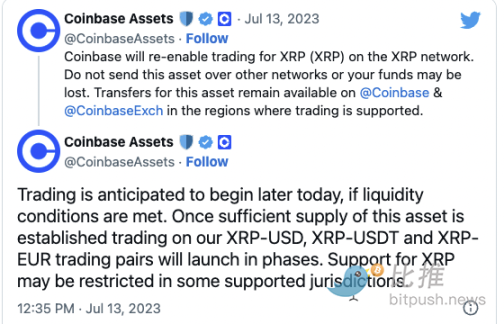
Coinbase had previously delisted XRP from its trading platform but announced on Thursday afternoon that it would allow trading of the asset again. Another U.S. exchange, Gemini, stated that it is "exploring the listing of XRP for spot and derivatives trading."
Ripple founder Garlinghouse celebrated the outcome in a tweet, stating, "Thanks to everyone who helped us achieve today's decision—this decision is for all crypto innovation in the U.S., and there will be more to come."
Complex Ruling: Is XRP a Security or Not?
Bitpush previously reported that on December 22, 2020, the SEC officially filed a lawsuit against Ripple and its founders Brad Garlinghouse and Christian A. Larsen. The document stated that since 2013, Ripple and its founders had sold over 14.6 billion units of the digital asset security "XRP" in exchange for over $1.38 billion, and the defendants did not register their offers and sales of XRP, nor did they obtain any registration exemptions, violating the registration provisions of federal securities laws.
The new ruling does not represent a complete victory for Ripple, as the judge also made rulings favorable to the SEC.
Analisa Torres ruled that Ripple's direct sale of $728.9 million in XRP to institutional investors constituted unregistered securities sales, violating federal securities laws. The ruling stated, "After considering the economic realities and the overall circumstances of the institutional sales, the court concludes that Ripple's XRP institutional sales constitute unregistered offers and sales of investment contracts, violating Section 5 of the Securities Act."
Stephen Palley, a partner at the law firm Brown Rudnick, analyzed in his article that the view that XRP is clearly not a security is incorrect.
The lawyer noted that the ruling is divided into three parts analyzing the factual circumstances surrounding XRP sales: institutional sales, algorithmic sales, and "other distributions," such as employee compensation.
When it comes to "Ripple selling XRP to complex individuals and institutional entities," the court sided with the SEC, stating these are securities transactions constituting investments. However, when discussing "programmatic" sales or sales conducted through trading algorithms and other issuance methods, Ripple won.
Palley emphasized another important issue: whether cryptocurrency exchanges like Coinbase need to register themselves as securities exchanges. The SEC has made it clear that most traded crypto assets should be considered securities. However, Palley stated that the court did not reach a conclusion on this matter, which is another (implicit) victory for Ripple.
Chris Martin, research director at Amberdata, stated in a CNBC interview, "Today's ruling is a significant step forward for the industry. By determining that the sale of XRP by exchanges is not a security, we begin to clarify what constitutes a security and what constitutes a commodity— the SEC will have to modify their strategy in several ongoing cases, and I expect this ruling will apply to several other tokens as non-securities."
Martin added, "The determination that Ripple's institutional sales of XRP constitute securities also has a huge impact on the industry, and some ICOs may now come under scrutiny. It remains unclear how this ruling will affect exchanges embroiled in SEC lawsuits, as most of them only participated in secondary sales. But as we see from today's prices, the market is very optimistic about this ruling."
SEC's Response
The SEC responded to the court's ruling. The SEC told Fox News that it is satisfied with parts of the ruling but is still weighing the court's final decision.
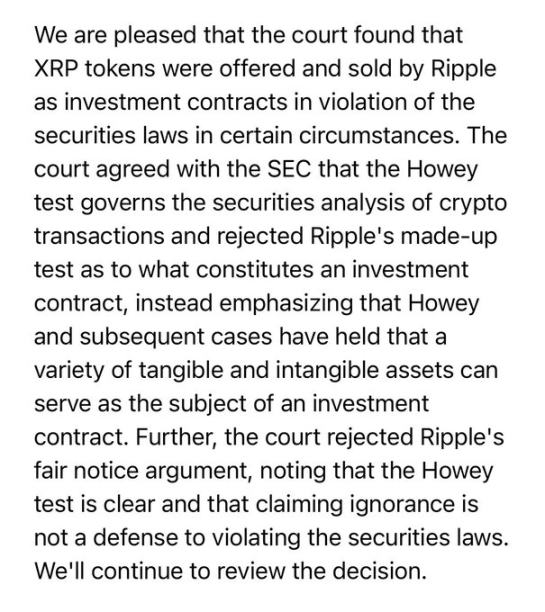
The SEC stated, "The court found that Ripple provided and sold XRP tokens in the form of investment contracts that violated securities laws in certain circumstances. We are satisfied with this part of the ruling, as the court agreed with the SEC's view that the Howey test can be used to analyze whether crypto transactions are securities, and rejected Ripple's self-test on what constitutes an investment contract, emphasizing that Howey and subsequent cases have ruled that various tangible and intangible assets can serve as subjects of investment contracts. Furthermore, the court dismissed Ripple's fair notice argument, stating that the Howey test is clear, and claiming ignorance cannot serve as a defense against violating securities laws. We will continue to weigh the court's decision."
Bill Hughes, a lawyer at ConsenSys, predicted in his tweet that the SEC would likely appeal to the Second Circuit Court. He said, "The SEC's enforcement strategy has been severely undermined, and the pseudo-legislation conducted through overly broad rule-making has been significantly damaged. The credibility of the SEC chair on government and Capitol Hill will be at an all-time low."
Some cases are still pending, with the SEC accusing Garlinghouse and Larsen of aiding and abetting Ripple's illegal activities, including selling products to institutional investors. The judge declined to rule on this part of the case, meaning that unless both parties reach a settlement or the SEC withdraws, this accusation will remain for jury trial, with no specific trial date set.
Legislative Calls
The Ripple case is far from over, and today's ruling is a decision from the trial court, some of which may be appealed and overturned. However, the ruling has sparked new calls for legislation, with the crypto industry urging lawmakers to provide clear rules for tokens and asking Congress to clarify the status of digital assets.
Gary DeWaal, a lawyer at Katten Muchin Rosenman, stated that this ruling could assist Coinbase's lawsuit, noting that the market reaction indicates that this outcome is "a significant event for the industry," and also signifies that Congress must legislate standards for digital assets.
House Majority Whip and Republican Tom Emmer tweeted that this resolution indicates "tokens are separate and distinct from investment contracts, and they may or may not fall under investment contracts. It is time for legislation."
 Risk warning Risk warning