








NGC Ventures: Intent-Centric Design in Blockchain Systems
 The paradigm shift based on intent is not just a technological advancement, but also a change in value preferences.
Original article by: Adam Arreola @NGC Ventures
Translation: Tudd Cai & Henry Zhang @NGC Ventures
Introduction
At the current stage, using blockchain solutions for transactions is overly complex for the average user. Users may know what their goals are, but the complicated steps hinder their process of achieving their intent. Recently, a solution known as "intent-centric design" has garnered attention from the community. Through intent, users can describe the outcomes they expect rather than listing every step required to achieve that goal. For example, if a user wants to receive a certain amount of Ethereum (ETH) and is willing to pay a certain amount of Bitcoin (BTC) to receive it, an intent-centric solution can achieve this without requiring the user to specify the exact steps for cross-chain transactions.
This article will explore the emerging intent-centric designs and how they will simplify blockchain interactions, detailing the lifecycle of intent, the current implementations of related designs, and the future applications of this technology. In addition to assessing the risks and challenges posed by intent-centric systems, this article will evaluate the value flows within them, providing a comprehensive examination of this innovation that is rapidly changing the blockchain landscape.
Users Need a Simplified Blockchain Interaction Process
The complexity of blockchain transactions creates an unfair competitive environment where only the most savvy users stand a chance of profiting. Experienced participants such as market makers, high-frequency trading firms, and MEV searchers leverage advanced resources, systems, and algorithms to compete for maximum profits.
Intent-centric design helps create a fair competition by simplifying how users conduct on-chain transactions while improving the overall capital efficiency of the system. For experienced participants, considering their existing capabilities, becoming a solver in an intent-centric system is not a significant shift, as they already possess the necessary skills. Intent-centric systems provide better UIs, optimized Gas fees, slippage handling, and improved composability.
Users only need to describe the effect they want to achieve, and they can easily reach their goals. Users do not need to know or understand the underlying processes required to achieve their goals; they only need to know what the desired outcome is. This makes on-chain transactions more accessible to ordinary participants. Providing users with an improved and more user-friendly interface can increase the demand for blockchain systems, thereby enhancing overall liquidity and making the blockchain ecosystem healthier.
Delving deeper, intent-centric systems eliminate common frustrations users face when dealing with Gas fees and slippage. For instance, in traditional blockchain transactions, users must pay Gas fees, which can be a foreign experience for novice users accustomed to the abstraction of such fees in traditional financial systems. Account abstraction (introduced through ERC-4337) allows users to pay Gas fees using any ERC-20 token or to have protocols sponsor and pay Gas fees on behalf of their users, making the payment of Gas fees more flexible. This not only simplifies the interaction process but also enhances control over transactions. Intent-centric systems can optimize the Gas fees required for each transaction to achieve the desired effect without forcing users to painfully estimate the necessary Gas. Similarly, users are often affected when estimating slippage. Intent-centric systems can abstract and optimize slippage settings and timing of trades to minimize price impact on users.
The Lifecycle of Intent
While intent simplifies the trading experience for users, the technology behind it is quite complex. Multiple teams are working on building intent systems, but the typical intent-centric trading process is as follows:
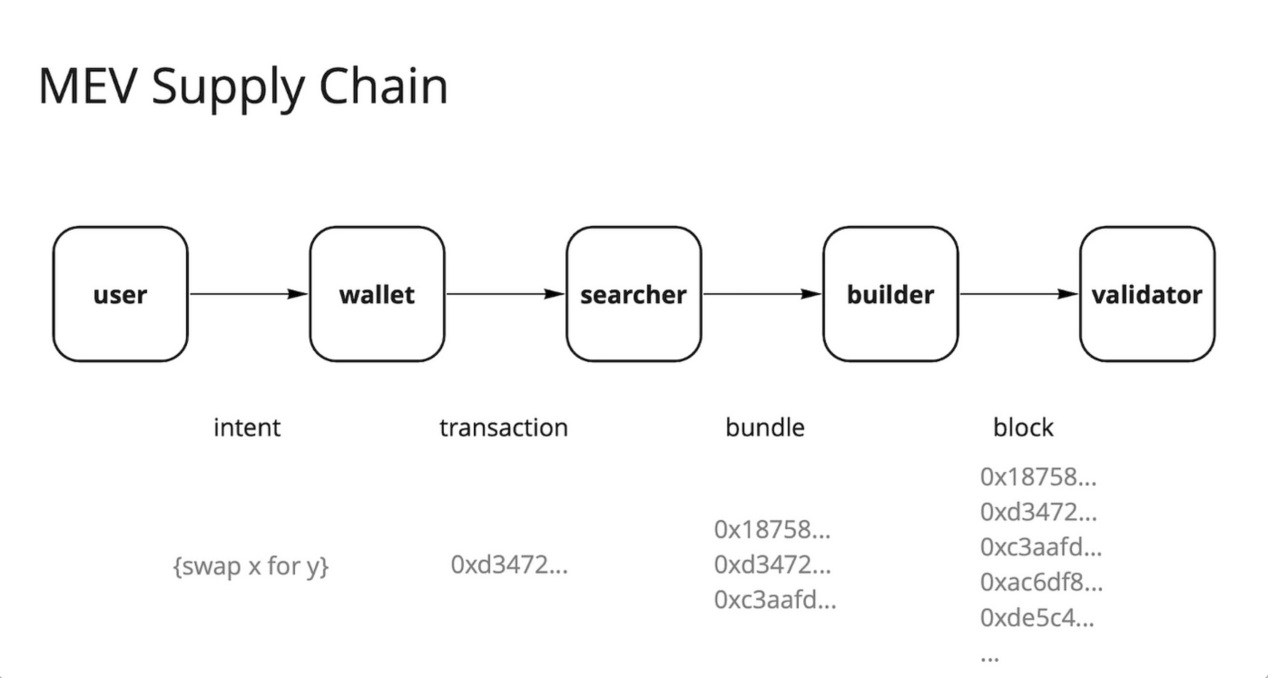
Image from Flashbots' article "MEV Supply Chain: A Glimpse into the Future of the Industry"
Off-chain Submission: Users submit their intent using a wallet.
Entering the Mempool or Sending to Block Builders: Transactions can either enter the mempool or be sent directly to block builders to expedite execution. The choice of using an alternative mempool, standard mempool, or completely bypassing the mempool depends on the specific requirements of the intent. For example, high-value swaps, especially those adhering to the ERC-4337 standard, are often designed to completely bypass the public mempool. This is to mitigate risks associated with harmful MEV-related issues such as front-running and sandwich attacks. Instead, these transactions are sent directly from the bundler (which typically acts as the block builder), ensuring a faster and safer transaction process.
MEV Searchers Look for Opportunities: If a transaction enters the mempool, MEV searchers will see the data in the mempool and look for the best path to realize the intent and profit. MEV searchers can choose to handle the transactions themselves or sell the information they find to "solvers." In most cases, MEV searchers not only discover opportunities but also act as solvers themselves.
Solvers Compete for Optimal Transaction Execution and Bundling of Intents: Solvers act as market makers while competing to provide users with the best transaction execution. Users naturally seek the cheapest and fastest solutions to achieve their intents, and solvers who can provide that solution can earn fees. Solvers aggregate multiple intents into bundles, allowing them to execute in a single transaction, and then forward these bundles to block builders for inclusion in the upcoming block.
Block Building and Validation: Block builders select bundles and package them into blocks. These blocks are then sent to validators to be included in the blockchain. This stage represents the final assembly and validation of intents, ensuring they are executed correctly and recorded on the blockchain.
Existing Intent-Related Projects
Early forms of intent-centric design can already be seen in existing applications and blockchains. Notable projects include:
Cow Protocol + Cow Swap
Cow Protocol is a permissionless trading protocol that utilizes batch auctions to discover prices. By finding opportunities for "coincidence of wants" (the situation where two users each have something the other wants) and aggregating all available on-chain liquidity sources, it maximizes liquidity. Unlike traditional trading protocols, the solvers of Cow Protocol compete to provide users with the best solutions to realize their intents.
Cow Swap is the front-end interface of the Cow Protocol developed by the same team. It is a decentralized exchange (DEX) that uses an intent-centric approach to help users find the lowest trading prices from all DEXs and aggregators. Additionally, Cow Swap's intent-centric design protects users from front-running and other harmful MEV. The new feature, Cow Hooks, allows developers and advanced traders to write custom operations (such as trading, cross-chain, staking, deposits, etc.) that can be executed before or after a trade, all contained within a single transaction, fully embodying intent.
Soul Wallet
Soul Wallet (one of NGC Ventures' portfolio companies) is an upcoming user-friendly smart contract wallet that utilizes account abstraction to enhance flexibility in Gas fee payments and sponsorships. It also enables social recovery as a secure mechanism for recovering crypto wallets without using mnemonic phrases. Users or trusted friends and family members (referred to as "guardians") can sign recovery agreements for the wallet, helping users regain access. In addition to social recovery, Soul Wallet offers dual verification, allowing users to specify another wallet to approve transactions. Furthermore, Soul Wallet abstracts the underlying blockchain mechanisms to provide a seamless experience when using Ethereum and its various Layer-2 solutions. Soul Wallet's One-Click Secure Swap utilizes account abstraction to allow users to trade without worrying about security risks and manual token approvals.
UniswapX
Uniswap’s new product, UniswapX, addresses some of the most pressing challenges in the DeFi space through its intent-centric architecture.
One of UniswapX's goals is to solve the issue of fragmented liquidity. By aggregating various liquidity sources, such as Uniswap V2 and V3 pools for different asset pairs, UniswapX meets each user's intent to find assets and provide the best asset prices. This is driven by third-party fillers, who utilize liquidity from these different pools or their own private liquidity to execute trades.
UniswapX also provides users with a gasless trading experience by allowing fillers to cover the Gas fees of swaps and include them in the transaction price. This eliminates the need for users to pay for failed transactions or hold native network tokens to cover Gas fees, further simplifying the Uniswap user experience.
UniswapX's intent-centric design also helps mitigate harmful MEV. For example, UniswapX reduces user losses by returning surplus generated from orders in a price-optimized manner. Additionally, UniswapX's design protects users from front-running and sandwich attacks by using Permit2 and Reactor Contract to ensure trades align with user expectations and adjust trades that do not meet user expectations. UniswapX employs time-dependent execution Dutch auction orders to encourage competition among fillers, minimizing harmful MEV occurrences.
Looking ahead, UniswapX plans to introduce additional features aligned with its intent-driven philosophy. Upcoming support for Uniswap V4 is a noteworthy development, but more groundbreaking is the introduction of gasless cross-chain transactions. Users will be able to specify the assets they wish to receive on their target chain, thereby avoiding the high fees and delays associated with cross-chain transactions.
Upcoming Intent Protocols
Anoma
Anoma (another portfolio company of NGC Ventures) is a multi-functional intent solution being developed by Heliax that will allow transactions with additional conditions. The protocol seeks to find the best match for users' intents across different blockchains, ensuring transactions are completed according to user-specified conditions. This is achieved through a decentralized counterparty discovery mechanism, which eliminates the protocol's reliance on centralized third parties, thereby reinforcing the protocol's alignment with the decentralized spirit of blockchain.
Through a distributed approach, Anoma allows solvers to compete to fulfill user intents. The decentralized counterparty discovery fosters direct and trustless interactions established among parties, while the distributed solution leverages the collective computational resources of solvers to effectively realize user intents.
Additionally, Anoma's multi-chain atomic settlement capability optimizes digital asset transactions across multiple blockchains by compressing processes into a single transaction. This feature eliminates the hassle of manually conducting a series of transactions, enhancing the efficiency of cross-chain transactions and the overall user experience.
SUAVE Powered by Flashbots
SUAVE (Single Unified Auction for Value Expression) is a product developed by Flashbots (another portfolio company of NGC Ventures) that separates the roles of mempool and block builders from existing blockchains, providing a highly specialized and decentralized plug-and-play alternative. SUAVE aims to facilitate the decentralization of block building to reduce the potential for block builders within the blockchain ecosystem to engage in censorship and abuse of power. As of the week of August 25, 2023, the top five block builders on Ethereum have already built approximately 90% of blocks, with about 48% of built blocks complying with OFAC requirements. This has led to risks of centralized censorship for users, undermining the decentralized and anti-censorship principles established by Ethereum.
SUAVE is developing MEVM, a specialized version of EVM that enables developers to create MEV applications as smart contracts in a flexible and expressive programming environment. MEVM consists of three main components: Universal Preference Environment (UPE)%20UPE,-The%20first%20component), which is a chain and mempool designed to express and aggregate preferences (intents) across different chains; Optimal Execution Market (OEM), where solvers compete to provide the best execution for user-submitted intents; and a decentralized network of block builders that merges encrypted user intents into blocks. This architecture facilitates the easier development of new MEV applications, encourages competition to resolve intents, and decentralizes the MEV supply chain.
SUAVE's roadmap (divided into three phases: Centauri, Andromeda, and Helios) outlines their plans to reshape the MEV landscape through intent-centric design. In the Centauri phase, SUAVE introduces privacy-aware order flow auctions, allowing users to reclaim MEV generated by their trades. In the Andromeda phase, the launch of SUAVE's mainnet will enable users to express intents within SUAVE's execution market, employing SGX mechanisms to enhance the efficiency and privacy of auctions and block generation. The Helios phase will further decentralize the building network and lay the groundwork for cross-domain MEV solutions. This intent-centric approach aligns with SUAVE's mission to create a neutral home for users, searchers, builders, and validators across different blockchains.
Essential
Essential is developing intent-based infrastructure that consists of a suite of three products: a domain-specific language (DSL) for intent expression, a new intent-centric account abstraction ERC standard, and a modular intent layer.
Currently, there is a lack of standardized languages for intents to communicate across blockchain systems. This can lead to cross-chain intents being misinterpreted, resulting in poor outcomes, such as incorrect token swaps. Essential aims to address this issue by generating a domain-specific language (DSL) for intents, enabling users to effectively communicate intents across different systems, which can then be interpreted by solvers.
According to the project team, Essential's new ERC standard differs from ERC-4337 in that it assigns solvers the task of constructing effective transactions to meet user intents. As of August 25, 2023, the team has not shared further details about the upcoming ERC standard mechanism. This new solution will bring the advantages of intent-centric design to EVM-compatible blockchains, extending intents beyond Ethereum and creating a smoother experience for the broader blockchain ecosystem.
Finally, Essential aims to take it a step further by creating a modular intent layer. Intents will be grouped into batches, and the modular intent layer will handle each new block as a solution for a batch of intents. Essential's modular intent layer will guide all order flows through a unified network of solvers, facilitating transparent order flow aggregation and ensuring they have access to as much information as possible to process transactions. Additionally, by encouraging competition among solvers to provide the best realization of intents for users, the modular intent layer will be able to resist harmful MEV in transaction-centric design systems. The modularity of this layer will allow the protocol to integrate into various ecosystems, creating pathways for effective cross-chain intent execution.
Future Potential Applications of Intent
Many novel intent applications are being developed and will be available to users in the future;
Conditional intents will allow operations to execute based on specific conditions, such as the outcome of certain governance decisions or price points reached.
Continuous intents will allow operations to be repeatedly executed through a single intent, facilitating tasks like cost balancing or market making.
Multi-step intents will enable a series of operations to be executed by expressing a single intent, where the completion of one operation prompts the subsequent operations to execute in sequence.
Intent-centric design can also be combined with other unique technologies, such as artificial intelligence. For example, by leveraging account abstraction with intent-centric design, users can enjoy personalized and automated investment strategies. This allows each user to have a tailored blockchain experience, making on-chain operations easier while opening doors for new innovative applications and services. Moreover, AI can enhance the capabilities of solvers, helping them optimize transaction execution and adapt more effectively to market conditions.
Another intriguing potential application of intent is its integration with real-world assets (RWA):
● If users want to convert traditional financial assets into tokenized blockchain assets, intents can be used to bridge traditional finance and DeFi.
● Intents can be employed in lending protocols where users express intent to use RWAs as collateral for DeFi loans. The protocol can tag the assets for users and use them as collateral without requiring users to specify every transaction needed to achieve their goals.
● In cases where users want to earn returns from real estate tokenization, intents can help users generate RWA returns. The protocol can invest in properties on behalf of users, earning returns from rental income or property appreciation.
Additionally, intent-centric design has the potential to be applied beyond the blockchain space, fundamentally transforming many aspects of daily life. For example:
● Intent-centric solutions can aggregate ride-sharing applications like Uber and Lyft, allowing users to express their travel intents and enabling the system to find the best ride options across multiple platforms.
● When booking flights, intent-based systems can analyze user preferences, such as travel dates, preferred airlines, and budget constraints, to find the best flight options for users.
● Through intent-centric design, users can find the best prices across many online stores, enhancing the online shopping experience.
Unlike traditional aggregators like Expedia that can only compile options, intent-centric systems consider and interpret users' potential needs. While aggregators provide a fixed set of options based on predefined criteria, intent-centric systems actively cater to each user's unique preferences, dynamically adjusting to provide more personalized solutions.
Risks and Challenges
Despite optimizing the user experience process, intents also bring a range of risks and challenges. First, intents rely on outsourcing decision-making to third parties—solvers and block builders. This means users must place a certain degree of trust in these parties and the systems connecting them. Users need to be wary of solvers and block builders abusing their power to charge high fees for executing intents or prioritizing intents that offer the highest rewards. This could lead to users paying excessively to execute intents, resulting in inefficiencies in the system. Similarly, if a small group controls the execution of most intents, the system faces the risk of a few individuals deciding terms, setting prices, or censoring transactions. This could lead to issues such as reduced competition, increased user costs, and a lower overall level of decentralization. To prevent these factors from stifling innovation and undermining user experience, crypto users must demand system designs that can resist centralization and incentivize good behavior from intermediaries through transparency and cryptoeconomic incentives, helping to build a trustworthy and neutral ecosystem.
Users interacting with intent-centric systems also face the risk of their intents being misinterpreted, leading to unintended consequences from executing incorrect operations. Builders should be cautious in developing standardized communication forms for intent-centric systems (for example, the Essential project is working on a universal domain-specific language) to avoid this risk.
Finally, with the emergence of intent-centric systems, new security threats may arise. For instance, accidentally granting unauthorized account access, data breaches leading to user privacy leaks, and information leaks that enable other traders to front-run or manipulate the market. In such cases, expecting solvers to behave fairly is unrealistic. Just as today's MEV searchers exploit the system for profit, solvers in intent-centric systems will also have incentives to cheat if it is profitable. Therefore, architects of these systems have a responsibility to build a framework that prevents malicious behavior while promoting outcomes that are most beneficial to users.
The Evolving Value Flows in Intent-Centric Systems
In an intent-centric architecture, the interests of MEV searchers, solvers, block builders, and validators align with the realization of user intents. Currently, the value in intent-centric blockchain systems primarily flows to MEV searchers, solvers, and block builders, as they work together to convey and execute the best possible outcomes for users and profit from this process.
Clearly, MEV searchers and solvers accumulate value. They are the first to see intents and are the individuals who discover the maximum value in either individual scattered intents or potential groupings of intents they can batch process. Solvers effectively act as market makers, competing to provide users with the best transactions. Users want to achieve their intents in the cheapest and fastest way possible. Realizing intents in the best way is not only a service but also a profitable opportunity for these individuals, helping to incentivize them to deliver the best outcomes. The alignment of interests among users, MEV searchers, and solvers helps the system operate efficiently and transparently, fostering a competitive environment that benefits all participants.
A significant portion of value also flows to block builders. Block builders are responsible for constructing and determining the formation of blocks, playing a crucial role in realizing each user's intents. As searchers, solvers, and users rely on block builders to fulfill intents, the role of block builders becomes particularly valuable as the system grows more complex.
However, as competition intensifies among searchers, solvers, and builders, value is expected to be redistributed to validators, stakers, and users, reflecting the evolving nature of the MEV ecosystem.
Validators and stakers will reap substantial benefits from the fierce competition among searchers, solvers, and builders. As more solvers, searchers, and builders enter the MEV space, individual profit margins will decrease. As the transparency of on-chain intent-centric architectures continues to improve, and as parties combine algorithms that replicate each other, Gas fees may ultimately erode most of the profits that solvers hope to gain. Notably, value does not disappear but is redistributed to validators and stakers. This shift is crucial for the long-term stability of the network. A well-compensated validator can enhance the network's security budget, while higher staking rewards incentivize further staking, improving the overall security of the network.
Moreover, as the system becomes increasingly efficient and competitive, users (the initiators of transactions) will also benefit. The reduction in solvers' profits and Gas fees enables users to execute their intents at lower costs. Additionally, the intensified competition among solvers to provide the best execution paths brings better prices and faster transactions for users.
Conclusion
The paradigm shift towards intent-based systems is not just a technological advancement but a transformation in value preferences. Project teams should focus their development efforts on realizing user intents rather than on complex operations. Intent-centric systems provide a pathway to build a composable blockchain landscape that values user needs, efficiency, and transparency. Furthermore, the enhanced user experience can accelerate the adoption of crypto applications, bringing complex blockchain technology closer to users' everyday habits.
Research on intents allows us to glimpse the future: the alignment of interests among users, MEV searchers, solvers, and block builders can simplify blockchain interactions and drive the development of the entire crypto ecosystem. By prioritizing the realization of user intents, developers pave the way for a more equitable and user-centric blockchain landscape, where the flow of value is intertwined with the realization of human intent. The rise of intent-centric design marks a transformative moment and the beginning of a new era for blockchain, turning a complex technological maze into a user-oriented frontier.
 Risk warning Risk warning

Popular articles





