Can inscriptions disappear? How powerful are the permissions of Bitcoin Core developers?

 "Defend" or "Sacrifice"? Do early Bitcoin Core developers really have the right to make inscriptions disappear?
Original authors: Jaleel, Kaori, BlockBeats
Original editor: Zhang Wen, BlockBeats
On December 6, Bitcoin Core developer Luke Dashjr posted on social media that "inscriptions" are exploiting a vulnerability in the Bitcoin Core client to send spam to the blockchain. Since 2013, Bitcoin Core has allowed users to set a size limit for additional data when forwarding or mining transactions. By obfuscating its data as program code, inscriptions bypassed this limit.
In simple terms, this experienced Bitcoin client developer believes that the inscription track represented by ORDI, which has entered the top 50 by market capitalization, is a bug that can be fixed.

Luke Dashjr stated, "This vulnerability was recently fixed in Bitcoin Knots v2.5.1. Due to severe disruptions in my workflow at the end of last year (v2.4 was completely skipped), the fix took longer than usual. The upcoming v2.6 version of Bitcoin Core still has vulnerabilities. I can only hope it will be finally fixed before next year's v2.7."
In a reply to a comment under the tweet, Luke Dashjr explicitly stated that if this bug is fixed, Ordinals inscriptions and BRC-20 tokens will cease to exist.
As a Bitcoin OG, Luke Dashjr has been a vocal critic of the Ordinals protocol. In February of this year, Dashjr tweeted that "the Ordinals protocol is an attack on Bitcoin." In May, when the first wave of inscription fever emerged, Dashjr and Bitcoin Core's opposition was seen as a source of uncertainty for the development of inscriptions.
However, the previous quarrels did not spark widespread discussion, as Ordinals was still a product of market bias. But now, with ORDI having surged 20,000 times, it has become a meme for everyone, and with just one statement from Luke Dashjr, ORDI's market value evaporated by $300 million in a matter of minutes.
The reason for the market's fear is clear: does the Bitcoin Core team really have the power to arbitrarily change the code?
Luke Dashjr: An early developer who joined in 2011
Does Luke Dashjr have the qualifications to comment on Bitcoin? Of course he does. Luke Dashjr encountered Bitcoin in 2011 and soon joined the project as a developer. His programming knowledge allowed him to quickly become a major Bitcoin developer, helping to realize the early construction of Bitcoin. His early contributions to Bitcoin software focused primarily on troubleshooting the security, performance, and advanced features of Bitcoin Core.
As of now, ranked by the number of commits, Luke Dashjr is ranked 14th among Bitcoin Core code contributors.

As an early developer, Luke Dashjr was involved in nearly all significant early events in Bitcoin.
Due to software bugs in Bitcoin Core, Dashjr was one of the first to discover the Bitcoin hard fork in 2013. In 2014, Dashjr began to play a larger role in the Bitcoin ecosystem, as the modified version of BFG Miner he used allowed miners to operate at higher performance than other miners at the time.
In 2016, Dashjr introduced BIP-2, a significant improvement to the BIP format proposed by another Bitcoin developer and renowned cryptographer Amir Taaki. During 2016 and 2017, Dashjr was also a key participant in activating Segwit in Bitcoin. Other contributions Dashjr made to Bitcoin's development include BIP-22 and BIP-23, aimed at optimizing block generation structure and improving efficiency within mining pools, respectively.
Luke Dashjr; Image source: Crypto Times
Returning to the earlier point, when Luke Dashjr mentioned, "This vulnerability was recently fixed in Bitcoin Knots v2.5.1, and I hope it will be finally fixed before next year's v2.7," Bitcoin Knots is indeed a complete Bitcoin client, with the original idea also coming from Luke Dashjr.
Luke Dashjr is also a cybersecurity extremist. In fact, he believes that Bitcoin has security vulnerabilities under the current network state because its network is not yet fully decentralized. For this reason, he invites everyone using Bitcoin to install their own full nodes.
Why dislike Ordinals?
Luke Dashjr's aversion to Ordinals stems from his firm belief in preserving Bitcoin fundamentalism.
At the end of 2022, software engineer Casey Rodarmor created the "Ordinals" protocol, which numbers the smallest unit of Bitcoin, "satoshi," and stores file metadata through Taproot, thereby creating a unique NFT. On March 8, an anonymous developer named @domo released the BRC-20 protocol based on this, which allows for the creation of fungible token standards on top of the Ordinals protocol. This subsequently sparked this year's inscription craze and led to a massive explosion in the Bitcoin ecosystem.
On February 1, the Bitcoin mining company Luxor claimed to have mined the largest Bitcoin block ever, with a size of 3.96 MB, just below Bitcoin's 4 MB limit. This block contained an NFT based on the original "magic internet money" meme, named Taproot Wizards.
Luke Dashjr and other Bitcoin ecosystem developers believe this will cause the Bitcoin blockchain size to rapidly expand, significantly increasing the requirements for running full nodes, leading to a decrease in the number of full nodes across the network and a decline in censorship resistance. At the same time, the unexpectedly large transactions and blocks will impact wallets, mining pools, browsers, and other ecosystem facilities, causing some facilities to malfunction, such as certain transactions failing to parse correctly. Additionally, mining pools or miners may choose not to download or validate these transactions and blocks to reduce synchronization and validation time, posing security risks.
They even harshly criticized the behavior of Taproot Wizard, stating, "This is an attack on Bitcoin. The Bitcoin block has a 1 MB limit, and the 4 MB data of Taproot Wizard is on-chain in the witness, bypassing the 1 MB limit. If 4 MB is acceptable, then 400 MB is too! In this sense, this is not innovation; it is an attack on a vulnerability!"
On February 28 of this year, Luke Dashjr stated on social media that an auction site was using his name and code to create and sell "misleading" NFTs without his consent. Screenshots showed that the NFT contained an image of code he wrote, being sold on the auction site for 0.41 Bitcoin.
"I did not participate in the creation and sale of this or any other NFT, and I do not agree to the use of my code or my name for this purpose," Luke Dashjr clarified on Twitter, worsening the criticism, "Due to the false statements involved and the confusion for actual buyers, I strongly request that 100% of the auction proceeds be refunded to the buyers."
It is clear that Luke Dashjr is a developer with an almost obsessive high standard for the healthy ecosystem of Bitcoin. Dashjr believes that Ordinals are not just spam clogging the network; they are also an attack on Bitcoin's fungibility, and accepting their existence would undermine the Lightning Network and CoinJoin.

This is also the result that Bitcoin maximalists find most unacceptable. In May, Luke Dashjr wrote on his GitHub account that he was very annoyed by the hype surrounding BRC-20 and meme coins, stating, "To address Ordinals, corrective measures need to be taken immediately, and these measures should have been provided long ago."

Luke Dashjr GitHub interface; Image source: Community
In emails sent to other Bitcoin developers and miners, Dashjr proposed integrating a "spam filter" mechanism into Taproot transactions to prevent the spread of Ordinals and BRC-20 tokens in the Bitcoin network. He stated, "Action should have been taken months ago. Spam filtering has always been a standard part of Bitcoin Core. The existing filters not extending to Taproot transactions is a mistake, as this is a bug fix that does not actually require waiting for a major version release."
In Dashjr's view, people can have NFTs and collectibles on Bitcoin without sending spam or attacking the network; "Taproot actually makes this easier." On the Bitcointalk forum, many discussed taking a soft fork to "enforce strict Taproot verification script size" and how the protocol could filter what they consider "spam," even considering a hard fork to revoke Taproot. But how easy is it to hard fork Bitcoin?
Does the development of Bitcoin depend on developers?
Before discussing "who needs to nod for a piece of code to be merged into the Bitcoin codebase?" and "who controls the core codebase of Bitcoin?", it is essential to clarify what it means to control a GitHub codebase.
For open-source projects' GitHub codebases, developers with these two permissions have the most "power": merge permissions and commit permissions.
Having merge permissions means that their keys are added to the "trusted key list" on GitHub, granting them specific permissions. For the Bitcoin Core project, when a developer's key is added to this list, they gain the ability to merge code. This means they can merge code changes that have been reviewed and approved into the Bitcoin Core codebase.
Therefore, having the ability to merge code means they can directly influence the final version of the Bitcoin Core software. This is a recognition of trust and responsibility for developers, as the ability to merge code allows them to directly impact the final version of Bitcoin software. Developers with this permission are typically experienced and reputable contributors who must follow strict quality control and review processes when merging code.
The difference between commit permissions and merge permissions is that merge permissions allow developers to decide which code will ultimately be included in the project's main branch. Thus, while commit permissions are an important milestone, merge permissions play a more critical role in project decision-making and the formation of the final product. Both are important, but in terms of influence and responsibility, merge permissions are generally regarded as the highest level of authority.
Who controls the core code of Bitcoin?
Who can merge code into the Bitcoin Core GitHub repository?
Among Bitcoin Core developers, those with direct permissions to merge modifications to the Bitcoin codebase are typically project maintainers or long-term contributors. For example, Wladimir J. van der Laan, as one of the main maintainers of the project, has merge permissions.
Previously, among the five developers with the highest permissions in the Bitcoin codebase, Pieter Wuille and Marco Falke left on July 8, 2022, and February 23, 2023, respectively, relinquishing their maintenance permissions and requesting the removal of their keys from the trusted key set via Bitcoin GitHub.
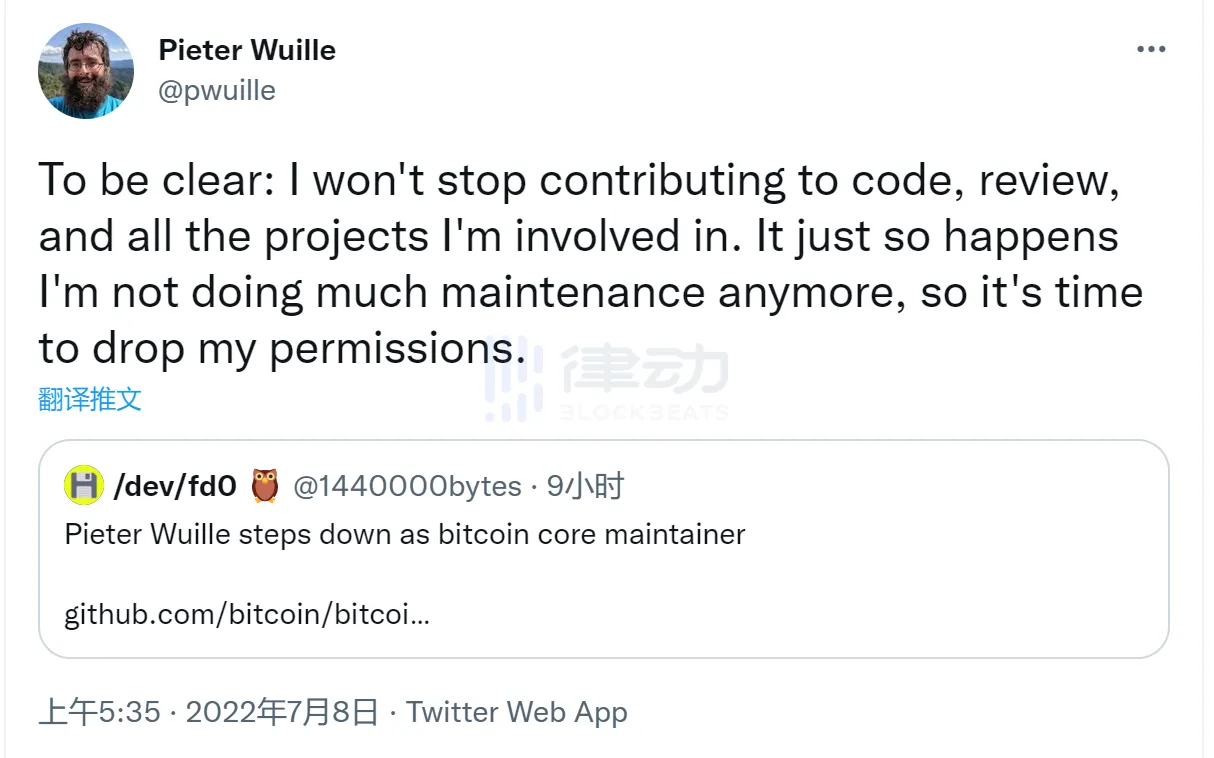
After Pieter Wuille and Marco Falke's departure, currently, only Wladimir J. van der Laan, Michael Ford, and Hennadii Stepanov have modification permissions for the Bitcoin Core code.
However, even though these developers have the authority to merge code, they typically follow strict code review and community consensus processes. Their work is more about coordinating and reviewing contributions rather than making unilateral changes. The Bitcoin community places a high value on consensus and transparency, and any significant code changes are widely discussed and reviewed within the community.
What does it take for a piece of code to be merged into the Bitcoin codebase?
For a piece of code to be merged into Bitcoin's codebase, it must go through a rigorous and detailed process that ensures the quality of the proposal and community consensus. The main steps of this process are as follows:
Proposal and Code Writing: First, developers need to write a detailed proposal document. This document should clearly describe the motivation for the proposal, technical details, impact assessment, and any potential issues or challenges.
Community Discussion: After the code proposal is submitted to the Bitcoin community, community members (including developers, miners, investors, and users) will discuss and review it. This stage is crucial for ensuring the feasibility of the proposal and gathering feedback.
Modification and Improvement: Based on community feedback, the author of the code may need to modify and improve the proposal.
Voting and Consensus: For some important improvements (especially those involving changes to the Bitcoin protocol itself), community members need to reach a certain level of consensus. This often involves support from miners, who need to signal their support for the proposal by including specific signals in the blocks they mine.
Code Implementation: Once consensus is reached, the code will be reviewed by the Bitcoin Core developer team. This step ensures the quality and security of the code.
Merge into the Codebase: After passing the review, the code will be merged into Bitcoin's official codebase.
Deployment and Activation: Finally, the new code needs to be deployed by miners and node operators to their systems. For protocol-level changes, there is usually an activation threshold, and the improvement will only take effect when a sufficient number of network participants upgrade to the new version.
From the past block size wars, it can be seen that no single individual or entity can directly confirm and decide whether a BIP has reached consensus or can be merged into the codebase. Instead, this is a process involving the Bitcoin community, with collaboration and consensus from multiple key groups, in addition to developers and reviewers:
In particular, miners play a decisive role for BIP proposals involving protocol changes. Miners express their support for a BIP by including specific signals in the blocks they mine. If a specific threshold of miners does not choose to support the proposal, it is typically not considered to have reached consensus.
Full node operators also play an important role in the consensus formation process, as they express support by upgrading to software versions that support the new BIP, and an increase in the number of nodes indicates broad community acceptance of the proposal. Additionally, while Bitcoin users and community members do not directly participate in the decision-making for code merges, their opinions and discussions are crucial for forming consensus, and they can express their views through community forums, mailing lists, and social media platforms.
Is Bitcoin returning to the fork moment of 2017?
Of course, as mentioned earlier, the most influential group is still the miners.
Although miners do not have management rights over the Bitcoin Core code, they own mining machines, and miners decide which version of Bitcoin software their machines will run. Moreover, the miner community is growing, and they now have the ability to negotiate with developers. In 2015, a Bitcoin Core developer proposed changing the block size limit from 1 MB to 2 MB, but this proposal was rejected by Chinese miners, who argued that China's bandwidth could not support 2 MB blocks. Miners are service providers in this system; they package every Bitcoin transaction, allowing the Bitcoin system to function normally, and they occupy a very important position.
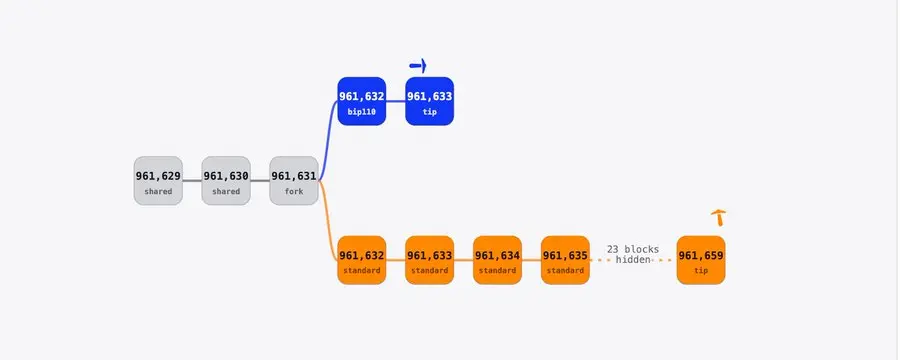
Then there was the historic day, the most famous hard fork in the Bitcoin community. On August 1, 2017, at 8 PM, a fork led by BCH miners began, starting from block height 478558, and six hours later, the ViaBTC mining pool mined the first BCH block, officially giving birth to Bitcoin Cash.
Even if a hard fork occurs, everyone will vote with their own real money to choose the Bitcoin that meets their expectations. Therefore, although Bitcoin Core developers have management rights over the code, due to the open-source nature of Bitcoin software and its decentralization, no single team or person can fully control Bitcoin.
Miners' wallets are untouchable
In short, miners cannot make inscriptions disappear.
As the third-largest mining pool operator, the voice of F2Pool co-founder Shen Yu has always been regarded as representing the miners' position. Following Luke Dashjr's view that inscriptions exploit vulnerabilities in Bitcoin Core to send spam to the blockchain, Shen Yu has repeatedly commented in the community: "Bitcoin is not Ethereum; developers do not have the final say."

It is reported that the top Bitcoin mining pool by hash rate, Foundry USA, is a supporter of Luke Dashjr, but the second-ranked AntPool and the fourth-ranked ViaBTC have consistently opposed him, making the position of the third-ranked F2Pool crucial.
In the previous bull market, miners' earnings were worry-free. However, in the bear market, miners' earnings have become somewhat bleak.
In June 2022, Bitcoin miners' daily income was only $27.19 million, a 56% drop compared to the daily income of about $62 million in November 2021. Due to poor miner income, the overall hash rate level of Bitcoin was also affected, with BTC hash rate dropping over 10% at that time, and the number of blocks generated per hour also reduced to 5.85 BTC.
Moreover, with the Bitcoin block reward halving in 2024, if BTC prices do not perform well, Bitcoin miners will face potential profitability issues.
However, the emergence of BRC-20 and the booming inscription transactions have provided miners with a significant increase in fees amid the uncertainty of the bear market, making mining machines easier to sell, and they are direct beneficiaries.
On-chain data shows that in May, due to BRC-20 transactions, the average transaction fee for BTC began to rise sharply, from an initial $2 to a peak of $31. According to The Block Pro data, Bitcoin miners' income increased by 30.1% to $1.15 billion in November, and Blockworks Research data indicated that there were a record 8.34 million Ordinals-related transactions in November, generating about $38.7 million in revenue for Bitcoin miners.

Bitcoin miners' fees in 2023; Image source: BitInfoCharts
Bitcoin OG, former eToro executive, and founder of Quantum Economics, Mati Greenspan, stated in a media interview: "I spoke with a miner yesterday, and he said his income doubled, which is great, especially before the halving, so this is beneficial for miners." Clearly, as the biggest beneficiaries after the explosion of the Bitcoin ecosystem, miners will not let inscriptions disappear from the Bitcoin ecosystem.
What voices are there in the community to defend inscriptions?
A statement from Luke Dashjr has stirred up a wave of discussion in the community.
The mainstream view in the Chinese community believes that the explosion of the Bitcoin ecosystem has led to soaring miner profits, and that miners dominate the BTC ecosystem: "Asian inscriptions are booming, American miners are making big money, while European and American developers do not recognize this, leading to a potential conflict between European and American developers and miners." Most people are watching the developments with a sense of spectacle.
Evilcos, founder of SlowMist Technology, believes there is no need to fix this bug, stating, "The impact of this Pandora's box opened by the introduction of Taproot (a good thing) is not just a pile of spam, but also the vibrancy of the Bitcoin ecosystem, which is not just about inscriptions. Of course, if it is fixed, there could be a compatible solution to better open up the Bitcoin ecosystem, but a short pain is better than a long one."
Crypto analyst @thecryptoskanda commented in the replies to Luke Dashjr's tweet, "We do not see Satoshi's vision here. What we see is a developer trying to impose their pathological good or bad woke values on Satoshi's original consensus. After this, how can you still call Bitcoin the most decentralized currency?"

Influenced by the recent fervor for inscriptions, the Chinese community has largely taken an unrecognized stance towards Luke Dashjr's views. Crypto KOL @11dizhu stated, "No one can represent Bitcoin; you have your ideas, and others have theirs. If it doesn't work, hard fork."
In the English community, many have pointed out that the current Bitcoin network is severely congested, and users need to pay very high gas fees, bluntly stating, "I hope developers can find a way to fix the vulnerability being exploited." Cryptographer @Elder24601 referred to "inscriptions" as a kind of dust attack that could be fixed by increasing the default threshold (currently 546 sats).
Moreover, some crypto users commented that they support Luke Dashjr's censorship regime because they missed the entire BRC-20 explosion.

As mentioned earlier, this is not the first time the crypto community has had disputes over the existence of Ordinals NFTs and BRC-20, and the opposing voices at that time believed that if Ordinals continued to have a significant impact on the Bitcoin network, a fork could be chosen to modify or remove the Taproot option.
In May of this year, Chris Blec, founder of DeFi Watch, stated that if enough participants in the Bitcoin ecosystem (users, node operators, miners) reach a consensus that Bitcoin should fork to reduce spam transactions, then it is not censorship. "You can still mine and use the current fork and mint your silly jpg there."

These debates are not just about technical differences; they are more deeply rooted in the purpose of Bitcoin and the philosophical ideas behind it. Governing decentralized open-source projects remains a challenge.
We all know that Bitcoin does not have a single controlling entity; its governance structure consists of users who pay transaction fees, miners who build the Bitcoin blockchain, and node operators who validate transaction ledgers. This decentralized structure ensures Bitcoin's security and decentralization to some extent but also poses challenges for governance. The positions of miners are self-evident, primarily driven by incentives, as they choose their consensus on Bitcoin's future based on the incentives they receive.
Although Luke Dashjr's position is clear, it is evident that the Bitcoin community has differing voices regarding the future of inscriptions, and the power of Bitcoin Core developers cannot make inscriptions disappear.
Even in the worst-case scenario, the Bitcoin community may face a fork event similar to that of 2017 again. However, compared to that year, community members have now accumulated valuable experience and insights. This time, everyone will approach potential challenges with a deeper understanding and more mature strategies.
"Defend" or "sacrifice" inscriptions? The story of Bitcoin is far from over.
 Risk warning
 Risk warning