The new project of crypto veterans Analog: raised $16 million, with airdrop expectations
 Register for the Analog testnet to gain early access and increase airdrop chances.
Original Author: Meteor, ChainCatcher
Original Editor: Marco, ChainCatcher
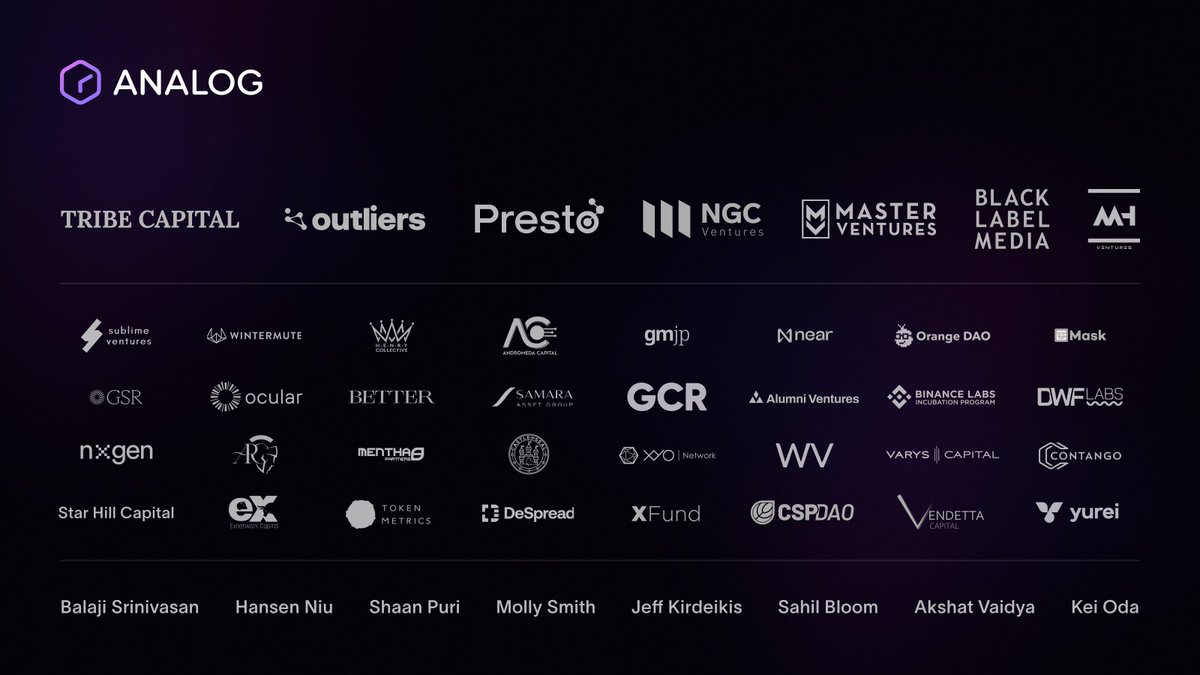
Recently, the cross-chain interoperability protocol Analog has entered the public eye due to its disclosure of $16 million in funding, with investment institutions including Tribe Capital, NGC Ventures, Wintermute, GSR, NEAR, Orange DAO, as well as Mike Novogratz's alternative asset management company Samara Asset Group, Balaji Srinivasan, and others.
At the end of 2023, Analog gained some attention in the community when it announced an open testnet registration event on the X platform and released social tasks on Galxe, attracting the attention of some new project KOLs and yield farmers.
"Zero-yield projects, airdrop expectations, and a luxurious investment lineup," combined with the recent market activity of full-chain protocols like LayerZero, Zetachain, Wormhole, and Axelar, will also bring more attention and growth opportunities to the full-chain protocol track in 2024.
New Projects by Crypto Veterans
Behind the favor of numerous investment institutions is the fact that Analog's team members have experience working on several key projects in the crypto industry.
Founder Victor Young is a key figure in leading and developing the Analog protocol and is also a general partner at X Fund.
According to the white paper, Young invests in promising startups in fields such as Web3, shipping, logistics, payments, markets, and mobile and connected devices. His areas of involvement include cryptography, security, distributed systems, full-chain frameworks, and privacy. Additionally, Young is an investor in multiple institutions and has years of blockchain development experience.
Analog's business lead Eric Wang previously worked at Injective Labs and the Polkadot ecosystem development organization, and he is still a part-time venture partner at ROK Capital, serving as an advisor at Equilibrium.
ROK Capital is a large blockchain incubator in South Korea that previously collaborated with the Solana Foundation to launch a $20 million ecosystem fund aimed at developing the Solana blockchain ecosystem and incubating more local Solana ecosystem projects.
Analog's product lead Avneet Singh previously served as a product manager at Chainlink; another product manager, Sanchal Ranjan, was a startup supported by the well-known venture capital firm Y Combinator.
Some members of the Analog team have previously worked at the Polkadot ecosystem development organization Parity Technologies.
Four Core Concepts
Analog is a full-chain interoperability protocol based on Proof of Time (PoT), built on Timechain, and the Analog network also employs zero-knowledge proofs (ZKP) to enhance security. The Analog protocol proposes four core concepts: Timechain, Proof-of-Time, Analog Watch, and GMP.
Timechain is a Layer 0 network supported by PoT consensus, designed to provide a unified solution for seamless cross-chain communication, meeting the needs of platform and dApp developers, allowing users and dApp developers to extract maximum value from all connected blockchain ecosystems.
For example, platform builders can easily link their sovereignty to all other ecosystems. Similarly, dApp developers only need a simple application programming interface (API) to communicate and obtain liquidity across the entire blockchain ecosystem. This allows cross-chain transactions to flow seamlessly between different networks, enabling users to integrate dispersed liquidity while accessing dApps on other chains.
Timechain acts as an accountability layer for published collections or views, allowing anyone to use the hashes stored on Timechain to prove the deployment or verify the accuracy and tamper-proof nature of queried data.
According to Analog's plans, Timechain will eventually be replaced by the PoT protocol.
PoT is a fully decentralized consensus algorithm where any node (user) can join and propose/confirm blocks without being hindered by hardware or funds.
The way PoT works is by selecting validators based on ranking scores and fixed staking. Unlike the typical proof-of-stake (PoS) mechanism where validators need to stake a large amount of tokens to reach consensus, PoT's fixed staking allows any node to participate as a validator by staking a fixed amount of ANLOG and obtaining a ranking based on time nodes. The ranking score is an algorithmic weighted measure based on each block validator's historical record (the accuracy of node validation data) and the numerical weighting measure assigned by validators to other validators.
Analog Watch is a full-stack indexing and querying protocol built on Timechain, which includes an open-source Watch SDK and hosting services (Watch UI). It addresses the data accessibility issues in Web3 through decentralized and encrypted solutions that index data in listed smart contracts. Typically, most smart contracts only allow users to retrieve data using relevant unique identifiers, requiring prior knowledge of the unique identifier to query specific details about the smart contract. However, with the Watch SDK, users can now summarize most Web3 data accessibility and achieve more advanced functionalities with just a few lines of code, including:
- Creating and managing keys.
- Deploying and querying collections.
- Deploying and querying views.
Analog GMP is a composable interoperability platform within the Analog ecosystem, built on its Timechain, aimed at expanding cross-chain dApps in a multi-chain ecosystem, allowing smart contracts on different chains to pass arbitrary messages on the platform (achieving GMP). It enables cross-chain messages or tokens to flow freely and securely on-chain, allowing developers to build multi-chain/full-chain dApps using Analog GMP.
Analog GMP avoids inherent cross-chain interoperability risks, with its security stemming from Timechain supported by non-permissioned nominated proof-of-stake (NPoS), which has no single point of failure. Other features of Analog GMP include threshold signature schemes (TSS), which allow Timechain to act as a single entity to verify and sign cross-chain messages and custom application-level security controls.
Potential Airdrop Opportunities
According to the tokenomics disclosed by Analog, a significant portion is allocated for airdrops or staking rewards. Additionally, Analog plans to officially launch its testnet in Q1 2024 and will soon launch its mainnet. Currently, the testnet is also the primary way for users to gain airdrop opportunities.
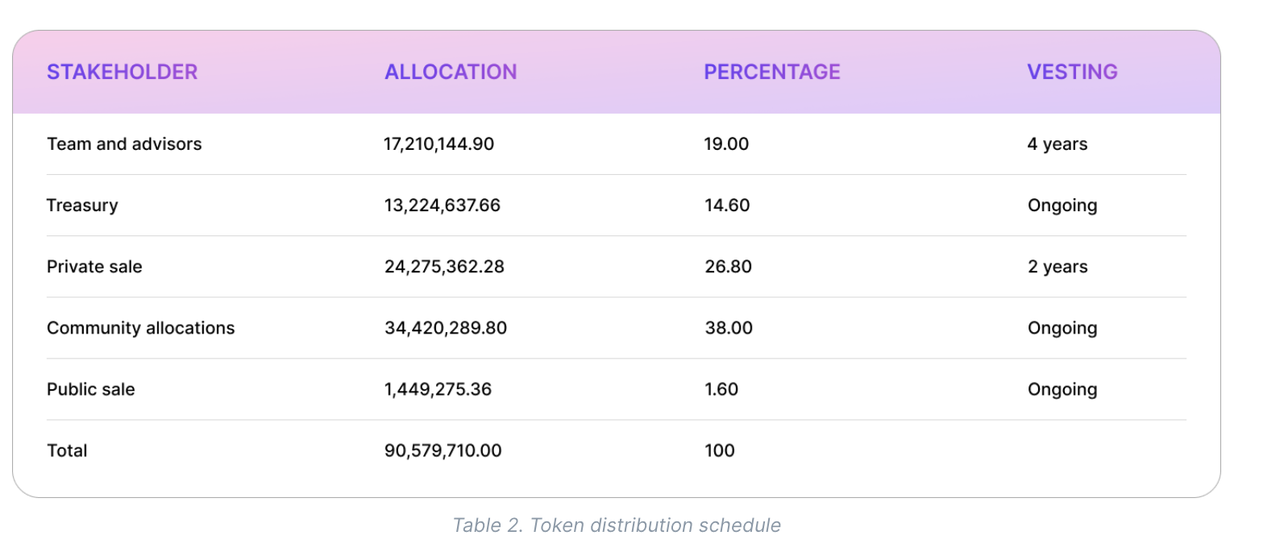
The maximum supply of Analog tokens is 90,579,700, with the following allocations:
Team and advisors: approximately 17.21 million, accounting for 19%, with a 4-year vesting period;
Treasury: approximately 13.22 million, accounting for 14%, unlocked immediately upon launch;
Private sale: approximately 24.27 million, accounting for 26%, with a 2-year vesting period;
Community allocation: community allocation includes ecosystem funds, staking rewards, or airdrops directed to the Analog community, approximately 34.42 million, accounting for 38%, unlocked immediately;
Public sale: approximately 1.44 million, accounting for 1.6%, unlocked immediately.
Recently, Analog has reopened the testnet registration window, and users can currently register for the testnet via email to gain early access qualifications. After registration, users should complete the current social tasks on its official website as prompted to earn points.
 Risk warning Risk warning