








Spot ETF and Cancun upgrade, will Ethereum usher in a breakout?

 The spotlight is on Ethereum this time.
Written by: Tuo Luo Finance
The narrative around Bitcoin spot ETFs continues, and against the backdrop of Bitcoin's surge, Ethereum is also stepping into the spotlight.
From an external perspective, the ETF narrative has once again turned to Ethereum. In addition to Grayscale, six institutions, including BlackRock, Fidelity, and VanEck, have submitted applications to the SEC for the issuance of spot ETFs, with a recent wave of approvals expected in March.
Internally, the certainty of the upcoming Cancun upgrade for Ethereum is imminent; the resurgence of re-staking protocols at the beginning of the year has also drawn significant attention to Ethereum, which had been relatively quiet for a while. On February 20, Ethereum's price briefly broke through $3,000, setting a new record since April 2022.
From various performances, it seems that the spotlight is indeed shining on Ethereum.
01 The ETF Game Has Now Come to Ethereum
While Bitcoin has broken through $53,000, Ethereum is not to be outdone. On February 20, Ethereum briefly surpassed $3,000; although it later fell back to around $2,900, currently reported at $2,958, it still successfully set a new high for nearly two years. In fact, unlike the 2023 trend where Bitcoin led the market growth, Ethereum has outperformed Bitcoin this year, with Ethereum rising 28% as of February 22, compared to Bitcoin's 21%. It can be seen that, from a certain perspective, the current crypto narrative is gradually shifting towards Ethereum.

Ethereum's price trend over the past 7 days, source: OKX
From the narrative standpoint, there are currently two main driving factors for Ethereum: the wave of spot ETF applications and the upcoming Cancun upgrade. At this stage, the most important factor is undoubtedly the ETF, which can attract traditional capital into the market.
From Bitcoin's perspective, since the approval of 11 Bitcoin spot ETFs, despite experiencing a brief sell-off for profit-taking, over $5.2 billion has net flowed into the Bitcoin ETF market with institutional support, helping Bitcoin successfully recover its losses, currently reported at $51,759.
Due to the successful experience of Bitcoin ETFs, the narrative around Ethereum ETFs is also receiving widespread attention. So far, in addition to Grayscale applying for a convertible spot ETF within its existing trust, six other institutions, including BlackRock, Fidelity, Invesco, Hashdex, 21Shares, and VanEck, have submitted applications for Ethereum spot ETFs. Previously, the SEC postponed the first and second rounds of applications for all applicants, with the upcoming approval date being March 5, and the latest approval date being in July, with March and May being intensive approval periods.

Overview of Ethereum spot ETF applications, source: Bloomberg
Looking at Bitcoin's application history, the period leading up to the approval date is often when prices are most easily driven up and accumulated, and this is also a contributing factor to Ethereum's short-term rise. From an external environment perspective, Ethereum is in a very similar situation to Bitcoin previously: first, the futures ETFs have already been approved and listed as regulated futures contracts on the Chicago Mercantile Exchange; second, the applying institutions are quite consistent, with large financial giants involved.
However, there are still differences in the predictions regarding approval outcomes within the industry. Institutions that are generally optimistic about approval argue that since futures have been approved, it would be difficult to reject spot ETFs. After all, in Bitcoin's application, this point successfully pushed for the approval of Bitcoin spot ETFs. Bloomberg analyst Eric Balchunas stated that the probability of Ethereum ETF approval is 70%, as the SEC cannot reject a spot ETF based on the approval of futures ETFs, or it would invite lawsuits. Brokerage firm Bernstein indicated that the likelihood of Ethereum spot ETF approval in May is about 50%, and it is almost certain to be approved within the next 12 months. Standard Chartered even directly believes that the SEC will approve the Ethereum spot ETF on May 23.
From the rejection standpoint, the current situation facing Ethereum is slightly different from Bitcoin, with the core issue being the classification of Ethereum's attributes.
In the crypto space, the debate over whether it is a commodity or a security has been ongoing for a long time. The security classification usually means adhering to stricter regulations, and as one of the typical mainstream coins, Ethereum's classification is significant. In public statements, the SEC has clearly stated that Bitcoin is a commodity, but due to characteristics such as staking, SEC Chairman Gary Gensler stated last March that tokens using staking protocols should be considered securities under U.S. law.
However, it is worth noting that in last year's lawsuit against Binance, the SEC explicitly classified over a dozen tokens as securities, including but not limited to Solana (SOL), Cardano (ADA), Polygon (MATIC), Coti (COTI), Algorand (ALGO), Filecoin (FIL), Cosmos (ATOM), Sandbox (SAND), Axie Infinity (AXS), and Decentraland (MANA). However, throughout the lawsuit, the SEC did not mention Ethereum, and when questioned about its classification, the SEC chairman avoided the topic, making Ethereum's regulatory status increasingly ambiguous.
In this context, many institutions believe that the approval of Ethereum spot ETFs is unlikely to be smooth. A report from JPMorgan stated that it is unlikely for Ethereum spot ETFs to be approved in the next three months, supporting the view that Ethereum should be classified as a commodity, but believing that the SEC is unlikely to make a decision before May. Regarding the claim that Ethereum spot ETFs will be approved by the end of March 2024, Bloomberg analyst James Seyffart bluntly stated on platform X, "I bet 4 ETH that this won't happen."
The debate continues to this day. Recently, the SEC sought opinions on Grayscale's application to convert its Ethereum Trust (ETHE) into a spot ETF. Coinbase, in a 27-page comment letter, argued from legal, technical, and economic perspectives that the SEC should approve the application, asserting that the current market consensus clearly identifies ETH as a commodity rather than a security, while emphasizing that ETH's proof-of-stake (PoS) possesses significant governance capabilities, demonstrating strong characteristics in ownership concentration, consensus, liquidity, and governance, thereby reducing the risks of fraud and manipulation. Economic theory also indicates that both ETH and BTC are resilient in meeting the SEC's ETP approval standards, capable of addressing systemic and market risks.
Of course, the SEC has yet to respond.
02 Cancun Upgrade: The Certainty Narrative for Ethereum
Compared to the ongoing game around spot ETFs, Ethereum's second major narrative is quite clear— the Cancun upgrade (Dencun).
Upgrades have been one of the important drivers for Ethereum over the years, especially after transitioning to PoS, as upgrades typically benefit many scalability sectors. Looking at the price performance before each upgrade proposal, researchers Cesare Fracassi and Moazzam Khoja from the University of Texas at Austin found that Ethereum's price tends to rise by 18% in the weeks leading up to the last Ethereum conference call before major proposals. The facts generally align, as during last year's Shanghai upgrade, despite facing selling pressure from staking unlocks, Ethereum's price rose to $2,100.
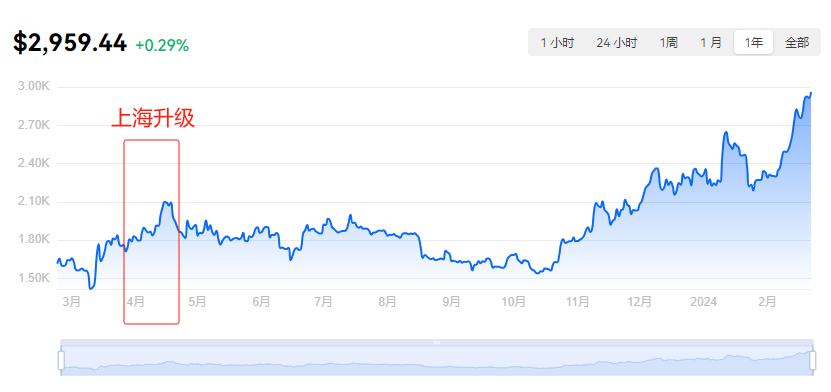
Ethereum's price trend over the past year, source: OKX
Specifically, the Cancun upgrade was originally scheduled for October 2023 but has been postponed for various reasons. According to the latest news, the Cancun upgrade is planned for March 13, 2024. To this end, the Ethereum client Geth released version v1.13.12 on February 9, laying the groundwork for the Cancun hard fork on the Ethereum mainnet. This upgrade is key for Ethereum to achieve further scalability, increasing the transaction volume the Ethereum network can respond to per second, and will usher in a new phase of development for Ethereum's data storage and retrieval capabilities. After the upgrade, the gas fees required for digital asset transactions on Ethereum Layer 2 networks will be significantly reduced, potentially by up to 14 times. It is evident that the performance improvements brought by the upgrade will greatly benefit Ethereum's long-term development.
In addition to the upgrade, the recent popularity of re-staking protocols has also driven market attention towards Ethereum. According to data from DefiLlama, after temporarily lifting the staking cap, re-staking protocols have rapidly grown, currently ranking sixth among various protocols, with a total TVL exceeding $6.99 billion. Taking the typical project EigenLayer as an example, EigenLayer's TVL grew from $2.15 billion on February 5 to $6.05 billion on February 10.
03 The Speculation Around Ethereum Has Already Begun
With the accumulation of the aforementioned expectations, Ethereum has once again lived up to the hype, breaking through $3,000. From the market perspective, large institutions have also demonstrated their bullish trend on Ethereum through actions. According to on-chain tracker Spotonchain, a large number of whales have started accumulating Ethereum, with data showing that approximately 65,000 ETH were purchased by unknown wallet addresses over the past three days. The supply of stablecoins also reflects a similar trend, with DefiLlama data indicating that since January 1, the supply of Ethereum stablecoins has increased by 4.4%, rising from $68 billion to $71 billion.
While everything seems positive, many industry insiders have expressed other concerns. After the approval of Bitcoin ETFs, Bitcoin quickly dropped by 15%, only returning to its highs a month later, leading many to believe that Ethereum will also face significant sell-offs after the approval of its ETF. Additionally, considering the existence of the staking mechanism, analysts from S&P Global have stated that Ethereum ETFs may "bring new centralization risks to the blockchain network," as institutional custody would concentrate control over ETH, despite the current decentralized protocol Lido already holding 31% of Ethereum's share.
Nevertheless, the speculation surrounding Ethereum has already begun. A typical data point is that since BlackRock first submitted its application for an Ethereum spot ETF on November 9, 2023, Ethereum's price has risen by 27.9%. Previously, after BlackRock first submitted its application for a Bitcoin spot ETF, Bitcoin surged by 55%.
From this perspective, before the ETF applications are finalized, opportunities and risks coexist, and participants can only remain vigilant and manage their positions, as ultimately, regardless of external FOMO, the burden of profit and loss still rests on themselves.
 Risk warning
 Risk warning




Popular articles





