Exploring the Frenzied Crypto Market: Where is the Next Narrative Heading?

 What is our current state, and what will happen in the coming months? I believe there are some crypto-native driving factors that can continue to be bullish.
Author: Ignas
Compiled by: Luccy, BlockBeats
Editor's Note: With the Ethereum Dencun upgrade approaching and Bitcoin halving on the horizon, the sentiment in the crypto market is rising as Bitcoin breaks through $60,000. In this context, crypto researcher Ignas provides an in-depth analysis and observation of the current dynamics in the cryptocurrency market, offering insights into the future of major blockchain projects like Ethereum, Bitcoin, and Solana.
The article explores the technological upgrades, market performance, and potential risks of different blockchain projects, expressing unique insights into key trends and developments in the cryptocurrency space. BlockBeats compiles the original text as follows:
Cryptocurrencies are on the rise, airdrops are coming in continuously, but the euphoric feeling of a market peak has yet to arrive.
So, what state are we in now, and what will happen in the coming months?
I believe there are some crypto-native drivers that can continue to push the market upwards. But first, I want to share this week's airdrop farms.
This Week's Airdrop Farms
- Ethena: If you hold stablecoins, there’s finally a farm for you. Ethena's USDe generates a 27% annualized yield through a triangular arbitrage strategy. Exchange for USDe and provide LP to the Curve pool to earn points. I will share more thoughts on Ethena in this blog.
- FlashTrade: Flash trade allows trading of gold, silver, forex, and cryptocurrencies. A low-development protocol on Solana. Their unique feature is dynamic NFTs based on trading history evolution, and they currently have no tokens.
- Nostra: Lending and trading on Starknet. I’m bullish on it because the Cairo development language limits the deployment of Aave and other major lending protocols on Starknet. This will make Nostra (or zkLend) a major liquidity hub on Starknet.
- Merlin Chain: A new, popular BTC Layer 2 solution supported by OKx. Stake BTC, ETH, stablecoins, or Bitcoin-native assets to earn points through farming. 20% of the total MERL supply will be distributed through airdrops.

This is my third cryptocurrency cycle, and each cycle seems to become crazier. Numbers no longer matter, as irrational panic buying attracts retail players who do not understand market capitalization or fully diluted valuations.
I wrote an article in November 2023 sharing experiences on how to navigate a crazy bull market.
We are not there yet; the meme proxies of the market peak have not appeared: the Coinbase app has not topped the Apple Store, there are no cryptocurrency ads during the Super Bowl, and retail FOMO has not emerged.
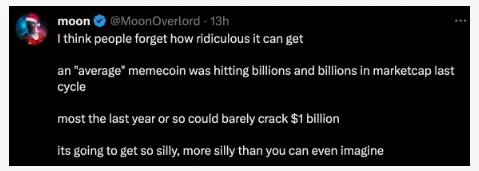
How Severe is Inflation in the Current Market?
In my personal experience, the second most important article focuses on how we can get more tokens at higher valuations by creating new narratives.
In 2017-18, the entire cryptocurrency market bubble was inflated by ICO tokens. These tokens lacked technological innovation and were supported only by white papers and compelling stories.
The bull market of 2020-21 was more complex.
In the DeFi and CeFi space, leverage accumulated rapidly. Leverage on Grayscale's "Widowmaker" trade accumulated quickly, while centralized lending companies borrowed from each other with little knowledge of where the funds were actually going.
DeFi expanded due to innovations in liquidity mining (rewarding you governance tokens for providing liquidity) and lending protocols (like Aave and Maker) that enabled on-chain leverage.
We also invented new token models, such as Olympus OHM (3,3) Ponzi schemes and SNX (for minting sUSD), to leverage their ecosystems.
The problem is that with each bull market, we have made token printing easier. Before ERC20, token printing was complex. Bitcoin forks, such as Bitcoin Cash, SV, and Gold, required expensive POW machines.
So, what state are we in within the 2024-25 bull market bubble?
Yes, there is always the formation of bubbles in cryptocurrencies.
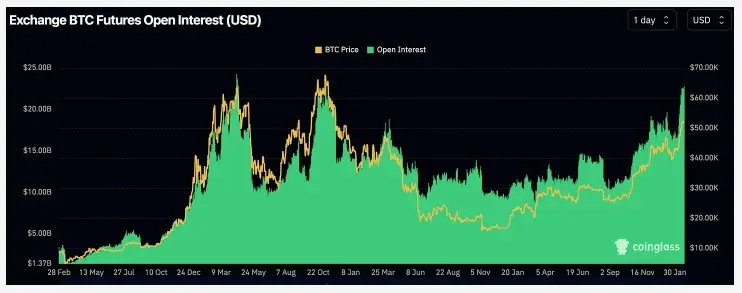
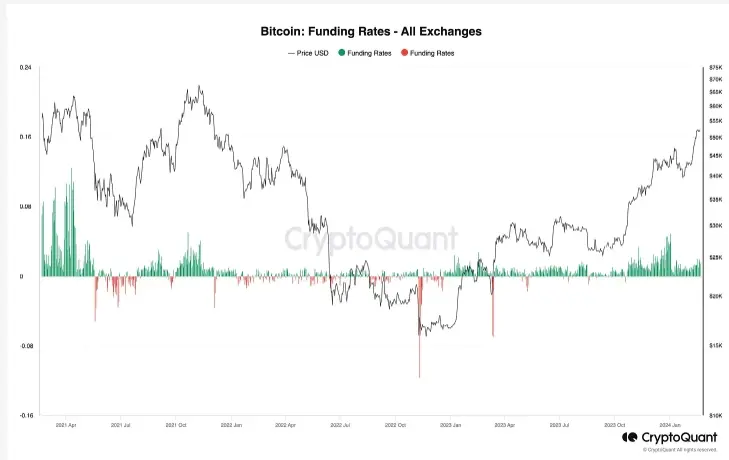
All CEX Bitcoin funding rates have reached historical highs, which is concerning. We have positive funding rates, which is bullish, as traders bet that the market will rise. As long as the market does not drop significantly and the longs are not liquidated.
On-chain DeFi data is healthier and more bullish, as leverage seems lower (but is growing).
Aave, as the most liquid lending market, is quietly seeing its TVL rise. Typically, borrowers deposit ETH/BTC and other assets to borrow stablecoins for purchasing more ETH/BTC or using stablecoins for other tax-efficient purposes.
DeFi's TVL has reached $75 billion, still 270% below the historical peak of $175 billion on November 11, 2022. However, in the DeFi space, borrowing rates are rising across the board. The Ipor index shows that the annualized borrowing rate can be as high as 10%.
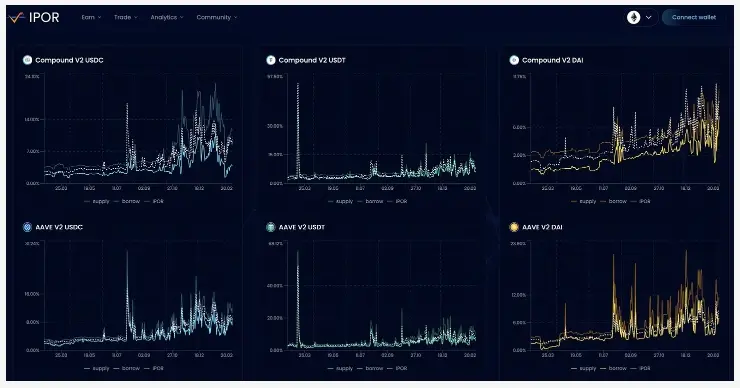
Another important factor to watch is the on-chain liquidation situation. Defillama has a dashboard, but it hasn’t been updated for several weeks.
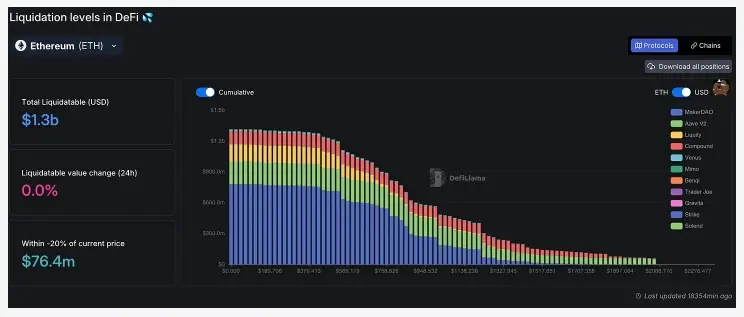
Where is Our Current Inflation Mainly Occurring?
There are several points of concern regarding market inflation and leverage.
The first "inflation" here is the issuance of new tokens. I can create 1 billion IGNAS tokens and sell 1 for $1 to you, which would give IGNAS a total market cap of $1 billion.
For more information on this, please refer to the thread below.
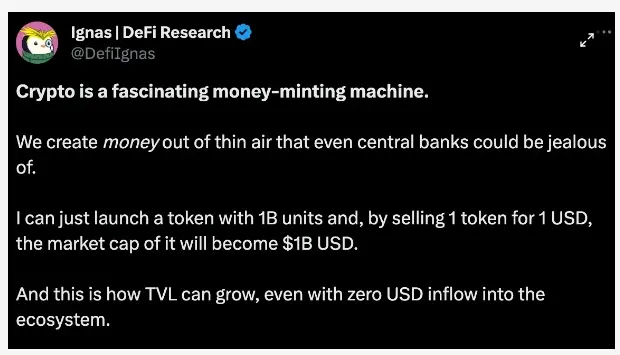
The issue here is convincing you to buy my tokens. To do this, I will create a new "Research4YouBaby" protocol, launch points, and sell you a very appealing story.
You will deposit ETH/SOL/stablecoins into my protocol to earn points because you want to claim the airdrop, thinking it's free money. Other speculators are doing the same. The higher the TVL, the stronger the market's confidence in the protocol as the financial future.
This is good news for my protocol because I have just built a loyal community, and I collect fees from all the TVL. The Research4YouBaby protocol has found product-market fit (PMF).
But I am not the only clever protocol developer, as everyone is issuing points, and it’s a feast.
Of course, points are expanding at a crazy rate, but points are not tokens. My goal is to wait for the peak of the hype before launching my token. Jito timed the issuance of JTO well, and Jupiter did even better.
However, both tokens are being dumped.
The initial hype led to very high fully diluted valuations (but low circulation), as those who missed the airdrop eventually bought from the secondary market. Continuous unlocking will have a significant impact on the price.
You might have bought JTO or JUP because there are some hot tokens available. But in 2021-22, all tokens were boring, and no one wanted to buy them.
However, for every hot airdrop, someone needs to buy into the narrative that "this protocol is the financial future" and purchase the tokens. If you bought JTO, JUP, and are currently at a loss, you might reconsider buying new hot tokens in the future.
Fortunately, the rise in BTC and ETH prices provides momentum for the market, as speculators can sell their BTC/ETH to buy junk coins. But once BTC and ETH start to decline, you can imagine what will happen.
A bit off-topic, but the protocols issuing tokens are becoming complacent.
They think that the longer they hold points, the more users and TVL they will gain. However, the more tokens issued in the market, the less cash people have to buy their junk coins, making timing the market crucial.
So, we are issuing tokens.
You need to track the price movements of new tokens to determine market demand for them. Currently, the market is sending mixed signals, as JUP and JTO prices are falling, but DYM, TIA, and PYTH are performing well.
The narratives of TIA, PYTH, and DYM are stronger than those of JTO and JUP, as holding TIA, PYTH, and DYM makes you believe you will receive more junk coin airdrops. This may work for a while, but at some point, airdrops will become fewer and fewer, until no one cares about receiving a few dollars from airdrops. If they do not provide other value propositions, people will sell TIA, PYTH, and DYM.
In short, with each new hot token, the amount of capital invested and user attention is being diluted. At some point, we will reach a stage where the amount of capital entering the market will not be enough to sustain the number of tokens being issued, at which point we will face a severe collapse.
While we are not there yet, we are rapidly issuing new tokens. Here are the two main categories driving token issuance:
· RaaS (Rollup as a Service) allows for easy launching of chains or protocols in minutes. Dymension, AltLayer, Caldera, and even Arbitrum L3 chains, with Dymension alone expected to have hundreds of RollAps. Think about who will buy these tokens?
· Restaking is a multi-layered token issuance machine:
AVS: The ETH that is restaked to enhance the utility of dApps is called AVS. For example, AltLayer is also an AVS protocol. Multiple AVS are set to launch, and more will come after the Eigenlayer mainnet goes live.
LRT Protocol: Each liquidity restaking protocol will have a token.
Then there is a second type of inflation and leverage in the system, coming from token derivatives.
LRT (Liquidity Restaking Tokens)
LRT is the most obvious one, and I believe it could pose some systemic risks.
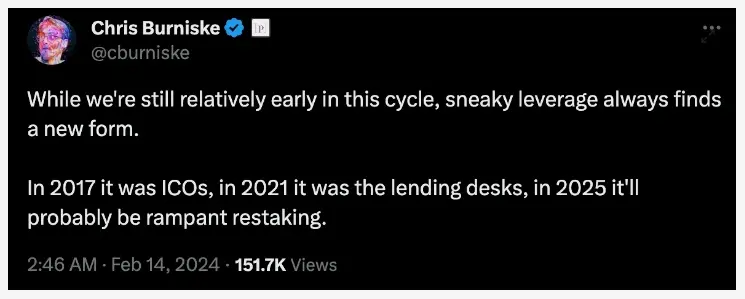
If you don’t know what LRT is, please check my previous post.
LRT ETH, like KelpDAO's rsETH, is a complex ETH derivative asset influenced by:
· Multiple ETH LSTs (like ETHx, stETH, etc.). If a certain LST has a vulnerability, rsETH will also be affected.
· Multiple AVS protocols. The ETH supporting rsETH will ultimately be used to secure AVS protocols. You could lose your ETH in a penalty event.
· Eigenlayer itself. Let’s hope Eigenlayer hasn’t been hacked.
Now, we see LRT ETH being integrated into the DeFi 1.0 ecosystem. I believe we will soon see Aave and multiple stablecoin protocols accepting LRT, as they offer higher yields.
Restaking + liquidity restaking has entered the top ten TVL, and Eigenlayer hasn’t even fully launched yet. God bless us all.
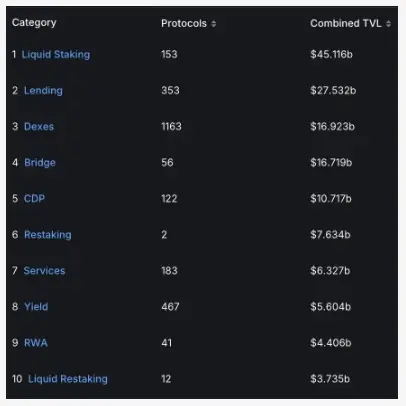
But I don’t think it poses any systemic risk at the moment. For more information on the risks, please read this research.
Ethena------The New Hot Stablecoin
Secondly, a new non-Ponzi scheme protocol has emerged in town: an old trick, namely stablecoins.
Ethena has the backing of half the crypto industry insiders, and you might see a lot of posts about it.
In fact, it is built on a simple yet powerful concept: deposit stETH to mint USDe stablecoin at a 1:1 ratio. It maintains price peg by shorting ETH across various DEX and CEX platforms, thus keeping a hedged position.
This USDe will generate stETH yield (about 4%) and provide different annualized yields based on the positive funding rates of exchanges. Due to a tendency to hold long positions, the funding rate remains positive, with longs paying shorts. If you are unsure how funding rates work, please check the post below, which has a simple explanation.
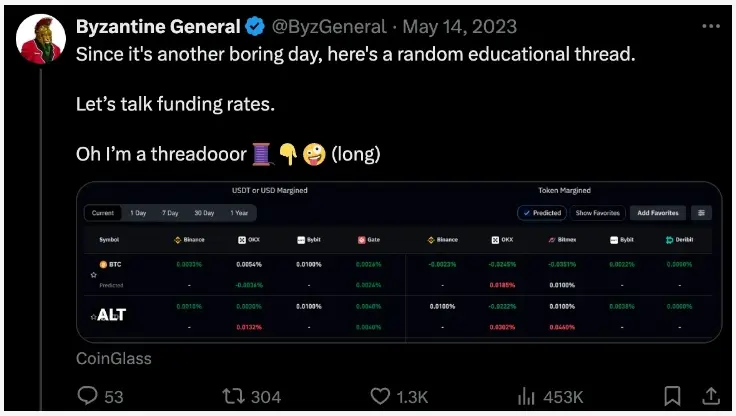
The shorting part is tricky, as some funds must be deposited into CEXes, but there are also many decentralized perpetual futures exchanges.
What happens if one of the exchanges goes bankrupt? What happens if withdrawals are closed? What happens if the funding rate turns negative? These are all points of concern on X.
Ethena is currently relatively small, having issued 250 million USDe. However, with its cleverly designed points (called fragments) and a referral program that offers a 10% reward for referring others and using the referral, backed by well-known investors like Binance, it will grow significantly.
It could even become "too big to fail."
Currently, Ethena's dominance in the open contracts of selected exchanges is 3.57%, but what will happen when their dominance grows? The impact will be significant, but its effect on the market will take time to manifest.
In any case, this directly increases market leverage through open contracts and increases reliance on stETH.
What problems might arise? I don’t know, but my principle is to start farming early. Additionally, if you hold stablecoins in this market and are on the sidelines, this is a new hot opportunity for you. They will conduct a three-month campaign or until the USDe supply reaches $1 billion.
Please note that you cannot mint USDe yourself with stETH (as this also requires KYC), so you need to buy USDe and deposit it into one of the Curve pools to earn 20x points.
Increasing Risks, Circular Farming?
Finally, there may be some risks of over-leverage, where airdrop farmers cycle their positions on lending protocols to maximize points. You can deposit SOL on MarginFi to borrow USDT, then exchange USDT for more SOL on Jupiter, and then deposit SOL into Kamino to borrow more USDT.
What happens next? There are at least a few important drivers for the three major blockchains.
Ethereum
Ethereum has at least four bullish factors.
First, with the arrival of Bitcoin ETFs, market attention is starting to shift towards Ethereum ETFs.
Second, Ethereum will undergo a significant Dencun upgrade in March or April, including nine EIPs, with EIP-4844 (proto-danksharding) being the most important.
Proto-danksharding aims to reduce L2 transaction costs and lower the cost of data availability by introducing a new segment space called "blobs." It will reduce L2 transaction fees by tenfold, potentially increasing network activity on L2 and boosting L2 token prices.
Not only that. Shortly after the upgrade (perhaps not too soon), Uniswap v4 is set to launch. V4 requires EIP-1153: "temporary storage," which is crucial for Uniswap v4 to lower network costs.
Uniswap v4 introduces "hooks," which are programmable contracts that operate at different stages of the liquidity pool lifecycle. It transforms Uniswap from a protocol into a platform that developers can build on.
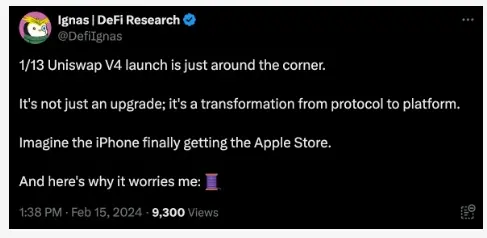
For more on Uniswap v4 and other exciting releases, refer to my previous blog post.
The launch of V4 could drive UNI prices (in the short term, as the token is difficult to hold long-term).
Third, Eigenlayer will launch on the mainnet in the first half of 2024.
The APY for ETH will rise, attracting more attention to ETH. It is evident that as riskier assets begin to fall out of favor, and the crazy players redirect their attention back to ETH, I believe that pushing more tokens into the market will further enhance bullish sentiment towards ETH, as profits from these tokens will ultimately flow into ETH and BTC.
Thanks to LRT, we can earn Ethereum staking yields (about 5%) + Eigenlayer restaking rewards (about 10%) + LRT protocol token issuance (about 10% or more). When Eigenlayer is fully launched, we can expect about 25% APY for ETH. On Pendle, you can already earn 40% APY, refer to "Restaking Continues to Heat Up, LRT War Overview and Participation Guide."
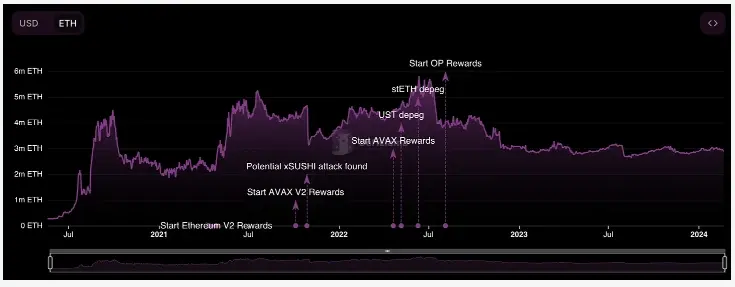
Finally, the amount of staked ETH is increasing. This is a key indicator, as ETH stakers show confidence in the long-term price increase of ETH.
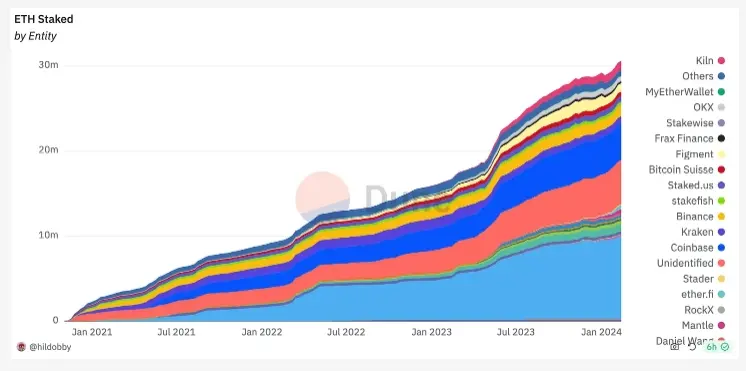
I believe tracking the dynamics of withdrawals versus deposits is a useful indicator if you want to time the market top.
Bitcoin Halving
"Halving" is both an interesting meme and a serious business.
The meme aspect is obvious, as Bitcoin's value rises around halving events. However, it also has a serious side with multiple facets.
First, the block reward will decrease from 6.25 bitcoins to 3.125 bitcoins, reducing the "sell-off" capacity by about $225 million per month. Second, the halving will enhance the narrative of the Bitcoin ecosystem, and its effects are already evident.
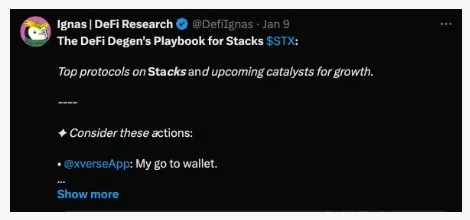
Stack's STX rose 75% in a week as the team prepares for the Nakamoto upgrade. This will reduce block time from the unusable 10 minutes to 5 seconds. This is a significant upgrade that finally makes Stacks fun. I expect more dApps and airdrops in the Stacks ecosystem.
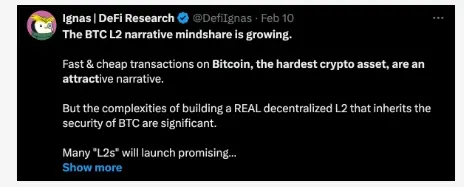
Stacks is not the only (but possibly the main) Bitcoin L2 solution. The narrative around Bitcoin L2 is becoming increasingly prominent, especially with multiple L2s, particularly Merlin, planning to launch around the halving event.
But these L2s are complex, so do your own research.
Ultimately, at the moment of halving block 840,000, the founder of Ordinals Theory will launch the Runes protocol. It will usher in a new era of coin trading, one that even Solana players will envy.
Overall, with institutional investment flowing into Bitcoin ETFs and the heightened frenzy brought by BTCFi, the future of Bitcoin looks promising.
Solana
I must admit, Solana has disappointed me and actually made me quite sad.
It has been producing blocks without interruption for almost a year. This has led to a decline in bullish sentiment around Solana, but Solana Firedancer has an important catalyst to restore market confidence. Solana Firedancer aims to make Solana faster, safer, and improve its level of decentralization. This is a new version of the software used by validators (nodes that process transactions) on the Solana network.
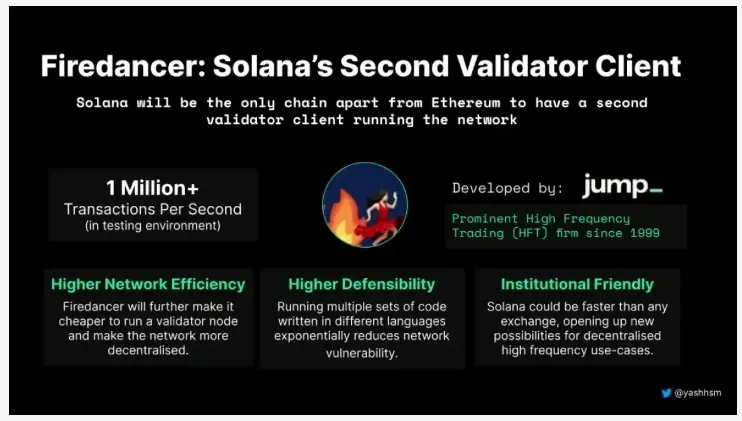
This is important because it helps Solana handle more transactions at once, aiming for 1 million transactions per second. This could make Solana faster than many traditional payment systems like Visa.
Firedancer also focuses on making the network more secure by changing how different parts of the network interact, which could help prevent hacks and make it more stable. Firedancer is developed by Jump Crypto and is planned for a full launch in the summer of 2024.
Overall, Mert's strategy seems applicable here: before Firedancer goes live, Ethereum may steal the spotlight from Solana.
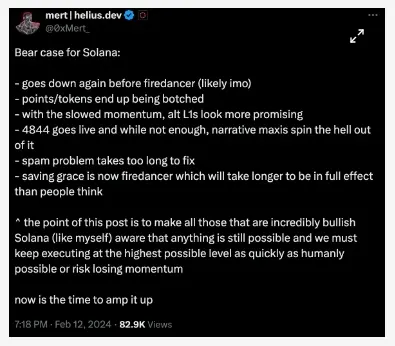
But that is not a guarantee. It is also possible that Solana continues to experience failures even after the Firedancer upgrade.
 Risk warning
 Risk warning