








How profitable can short dramas be in Web3?

 Who will foot the bill for the Watch to Earn short drama?
Author: Tuo Luo Finance
When it comes to vertical short dramas, everyone is familiar with them.
Since last year, short dramas have fully invaded short video platforms, featuring "3 twists in 1 minute, rebirth to take revenge, and wealthy family melodrama." Various short, frequent, and fast content has quickly captured the hidden desires of humanity, stimulating users and becoming a cash cow that users willingly spend money on. This trend has even sparked a wave of mental opium overseas.
This year, users who have had enough of wealthy family feuds have shifted their focus to supporting side characters, with "Wang Ma" and "Li Butler" gaining popularity. The short drama industry has also moved away from its wild growth phase towards standardization and quality improvement under the refinement of rules.
Recently, it seems that the wind of short dramas has finally reached Web3.
01 Multiple Short Dramas Launched, Web3 Sparks a Short Drama Trend
Recently, a piece of information about short dramas was frequently shared on platform X, stating that the first Web3 native short drama "Rebirth: I Am a Big Shot in the Crypto World," funded by IBGTGVC and produced by TShow2008, will officially launch on the Huobi Live platform on May 22. Prior to this, the drama had already gained some attention in the industry due to a "Satoshi Nakamoto" joke during its opening ceremony, claiming "Chinese people are inherently smart."

Poster of Rebirth: I Am a Big Shot in the Crypto World, Source: Platform X
Although it has not yet premiered and is still in the discussion phase, this is not the first short drama in Web3. As early as April 26, "Back to the Future: I Am the King of Bitcoin," released on the BitRealms platform, had already begun airing, and by May 7, this 50-episode Web3-themed short drama had concluded. However, perhaps due to promotional issues, it wasn't until the popularity of "Rebirth: I Am a Big Shot in the Crypto World" rose that this short drama truly stepped into the spotlight of Web3. The similarity in names even led some to mistakenly believe they were the same work, which also brought some traffic to "The King of Bitcoin."
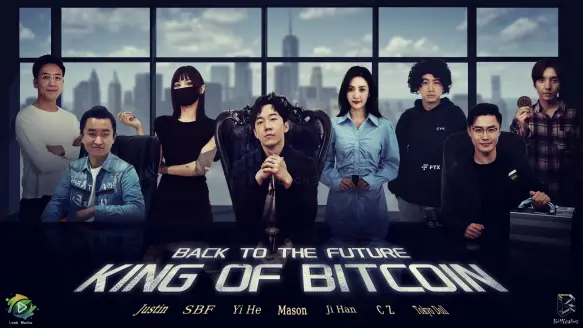
Poster of Back to the Future: I Am the King of Bitcoin, Source: Public Information
From the two dramas, both inherit the "爽文" (feel-good story) tradition of short dramas, coincidentally choosing the rebirth and counterattack format. "Rebirth: I Am a Big Shot in the Crypto World" follows the story of Satoshi Nakamoto's entrepreneurial journey after a liquidation rebirth, while "The King of Bitcoin" revolves around Mason's revenge after being betrayed by his wife and best friend. Both present the nearly 15-year history of blockchain in a humorous way, focusing on significant events and figures in the Web3 field.
In terms of specific techniques, both dramas primarily use celebrity references and seek real-life stand-ins as their main methods. To be honest, from a sensory perspective, regardless of the unreleased big shot, the narrative logic of the aired "Back to the Future: I Am the King of Bitcoin" is quite melodramatic, with exaggerated character traits not significantly different from typical short dramas, and there are some borderline details. However, based on user feedback, many people still appreciate it, which may be part of the charm of short dramas.

He Yi's casting joke, Source: Platform X
02 How Will Web3 Short Dramas Develop? The Business Model is Key
Returning to Web3 itself, in terms of themes, presenting the ups and downs of the crypto field over the past fifteen years in a dramatic format is highly feasible. Whether it's the wealth of an English teacher, the rise of a beef boss, or a foreigner facing the cold winds in Shanghai, these are classic stories in the crypto world. The rise and fall of miners, the fierce competition among exchanges, and the myriad public chains all provide excellent narrative and reversal potential.
But why have short dramas only started to gain popularity with Web3 now? On one hand, there are naturally niche characteristics in the crypto field, but on the other hand, the profit model has become crucial.
In traditional short dramas, aside from a small portion of advertising revenue and e-commerce channel income, the vast majority of revenue comes from subscription models, where users pay for episodes or bundled content. From the cost perspective, aside from daily expenses for actors, filming, editing, etc., 80-90% of costs must be spent on promoting on short video platforms. Depending on the quality of production, the cost of making a short drama is around 200,000 to 500,000 yuan, and an ROI of over 1.2 is generally required to achieve profitable self-sustainability.
However, this approach is often seen as very un-crypto, as most profits are captured by centralized platforms, and the revenue-sharing channels are not wallets but WeChat or Alipay, which can be considered a purely Web2 scenario. Nevertheless, a significant portion of the target audience for Web3 short dramas is precisely the crypto community. Therefore, combining the existing framework with the unique mechanisms of Web3 has naturally become a primary consideration for issuers.
From BitRealms' perspective, in "Back to the Future: I Am the King of Bitcoin," they adopted a "Watch to Earn" model similar to NFT airdrops that aligns very well with crypto characteristics. After linking wallets on their official platform to watch the short drama, users will receive a 100% random drop of the token IBOSS. If they hold the platform's airdropped Popcorn Pass, the drop rate increases to 15-30 times. In simple terms, the Popcorn Pass is akin to an acceleration chip for mining machines, enhancing the mining efficiency through watching on the platform. According to official sources, the drama has already garnered over 1.5 million views across the internet.
From the above description, it seems that the producers' profit model only has two avenues: launching project tokens on the secondary market or selling Popcorn Passes. In terms of token performance, IBOSS has currently launched on Solana, with a total supply cap of 1 billion tokens. After its launch on May 7, the price surged to $0.0088578 but has since fallen back to $0.0007007, slightly above the opening price on May 7.

IBOSS price trend, Source: Geckoterminal
To sustain the operation of the token, the platform has reached a strategic cooperation with the Web3 short video social application Whistle, and it is also expected to collaborate with traditional short drama platforms like Dianzhong Technology and Qimao for secondary distribution, exploring ways to return profits to the community targeting Web2 user groups. As of now, the project has generated $2,000 in profits on Whistle, and the platform has announced that it will use this for token buybacks. However, this amount is undoubtedly a drop in the bucket for a MEME pump.
Although a one-time profit model is quite normal in the crypto world, to sustain development, issuers must enhance their self-sustainability and maintain token liquidity. BitRealms also admitted in an interview that the Popcorn Pass has not contributed to revenue since it has not launched on the secondary market, and the current primary profit model focuses on undertaking project advertisements, earning income through customized content and scene services for project parties.
In this context, the initial funding has become the absolute majority of short drama production costs, making the investment from capital particularly important. In this regard, another drama "Rebirth: I Am a Big Shot in the Crypto World" encountered a mishap, as the production team announced on April 15 that filming was suspended due to financial contract liquidation that led to unpaid actor wages, becoming a highly characteristic joke of the crypto world.

Announcement from producer Li Er Chai Si, Source: Platform X
Of course, some individuals have questioned whether this behavior was staged, as the producer Li Er Chai Si has a history. Although many may not be familiar with him now, Li Er Chai Si was once a well-known internet promoter in China, having launched Guo Meimei and orchestrated the hype around false events such as "Monk Boat Quake Gate" and "My Sugar Daddy Took Me to the Olympics." Due to excessive exploitation of public opinion, he was sentenced to four years in prison for illegal business operations and fined 150,000 yuan.
Now, Li Er Chai Si has transformed into a producer of short dramas. On the positive side, his promotional tactics are likely to be superior to those of other short dramas, which will be a significant advantage in the crypto world where traffic determines everything. Indeed, despite "Back to the Future: I Am the King of Bitcoin" being released first, the most well-known short drama in the industry currently remains "Rebirth: I Am a Big Shot in the Crypto World."
In terms of profit models, "Rebirth: I Am a Big Shot in the Crypto World" has not yet disclosed any information, but from its main investors, Aibi Capital, and the cooperative platform Huobi, it appears that project advertising and platform traffic generation remain core objectives. From a certain perspective, short dramas and exchanges have a certain degree of compatibility, as exchanges have a high demand for traffic and are absolute capital holders in the industry. Short dramas, on the other hand, are direct channels for traffic generation and have a certain effect of breaking the circle, making their collaboration a win-win model. Analyzing this, if the trial is successful, this cooperation model could become a primary avenue, and subsequent short dramas led by exchanges and large project capital may also hope to see development.
In summary, the current production of Web3 short dramas primarily relies on advertising as the main profit model. This model is not unfeasible, as traditional short dramas also rely on it for primary income, but it inherently possesses a high degree of fragility, depending on the project party's advertising budget and the actual effectiveness of traffic generation. Coupled with the additional costs brought by tokens, maintaining long-term operations for short dramas is quite challenging. Under the limited scale and complex threshold operations of Web3, it is difficult to form the flywheel effect seen in traditional short dramas. Over time, the development of Web3 short dramas will either revert to Web2 traffic or form a closed ecosystem centered on token appreciation.
From the producers' perspective, both short dramas are stepping into ecological development through short dramas. BitRealms has revealed plans to use short dramas and games as a foothold to create a fair launch platform based on the assetization of entertainment content. Meanwhile, the other production company, TShow, plans to launch its platform token once its fan base reaches 21 million, aiming to implement a model where users pay in U to watch dramas, hold tokens to share in U, and participate in burning.
03 Everyone Earns, Web3 Short Videos Are Hard to Last
In fact, from an industry perspective, the video scenarios of Web2 have also been replicated in Web3 before. If we look at the development of video platforms in the Web3 field, adhering to the belief that everything in Web2 can be rebuilt in Web3, short video platforms similar to Douyin have appeared and disappeared multiple times in Web3. Huo Niu and Mi Le are typical representatives.
In 2018, the short video platform "Huo Niu," based on the "Blockchain + Douyin" model, was once very popular. On Huo Niu, watching, publishing videos, inviting new users, or tipping could earn users points called "Huo Zuan," and all users holding Huo Zuan could share 80% of the platform's revenue. Excluding the more challenging video publishing, Huo Niu opened a recharge platform, allowing users to earn Huo Zuan simply by recharging, enabling them to directly enjoy cash dividends, which had a somewhat "everyone holds shares, daily dividends" feel.

Huo Niu video white paper dividend content, Source: Public Information
Despite claiming to use blockchain technology, this platform had no blockchain properties at all, lacking wallets, withdrawals, or content on-chain, and dividends were distributed in RMB. However, with this model, at its peak, Huo Niu video had over 14 million users, with an annualized return rate as high as 3000%. With such high returns, users flocked to invest and recharge, and the founder was rumored to have made 800 million yuan in just two months. However, the Ponzi scheme of passing the buck could not be sustained; within three days, Huo Niu's dividend ratio dropped to one-thousandth of what it was before, leaving users with nothing, and Huo Niu video faded away.
A similar operation occurred with Mi Le short video, which launched in 2020. It once topped the free download charts in the Apple App Store in China, reaching an MAU of 20 million within six months, with a total user base exceeding 50 million, becoming very popular in lower-tier markets. Mi Le, like Huo Niu, claimed that users could earn platform points called "Mi Dou" by watching short videos for free, but still required recharging and inviting others to achieve higher returns. Unlike Huo Zuan, Mi Dou could also be traded on the secondary market, with the market once driving the worthless Mi Dou up to over 20 yuan each. In the end, the company raked in over a billion in harvesting fees, leaving users with a mess.
Mentioning Huo Niu and Mi Le is not to disparage Web3 short dramas, as Web3 short drama platforms have clear distinctions from the aforementioned. Firstly, both Huo Niu and Mi Le were merely using "blockchain" as a gimmick, essentially borrowing the concept of mining for a RMB funding game; secondly, as video platforms, their content was of low quality, mostly replicated videos sliced from other platforms, lacking content stickiness; finally, their traffic entry points were evidently much larger than Web3, covering a broader audience. In contrast, Web3 short dramas' biggest difference lies in the value content output and the involvement of on-chain assets. However, regardless of how it is explained, history does have its similarities; a purely "Watch to Earn" model is hard to sustain. After all, everyone earns, and ultimately, someone has to pay, and that payer can only be the later buyers.
Ultimately, in the Web3 field, due to the cumbersome wallet operations and decentralized traffic entry points, the cost of acquiring effective traffic and building on-chain apps is inherently higher than in Web2. To achieve a positive ROI, project parties need to obtain higher returns than in Web2, harvesting from other directions, with the ultimate goal often pointing directly to token issuance. In reality, this model is evidently inefficient; if it were to appear in traditional internet, such a high-cost business model would lack competitiveness. In Web3, the core of achieving this lies in assessing whether on-chain services can be worth exchanging trust for efficiency. It can be said that many Web3 projects lack commercial viability from the outset, and the reality reflects this; looking at Web3 projects, very few can achieve self-sustainability.
Of course, as an industry insider, the arrival of short dramas in Web3 is indeed a good thing. Through this, although slightly distorted, outsiders can gain a better understanding of the blockchain world through dramas. In the end, the audience gains emotional value, the project parties gain traffic, and the issuers gain themes and income—what's not to be happy about?
 Risk warning
 Risk warning

Popular articles





