








Is the stormy Friend.Tech a hidden long-term opportunity?

 Phenomenal Application Friend.Tech: A Multi-Faceted Structure of Technology, Trading, and Strategy
Friend.Tech is a decentralized social platform deployed on the second-layer network "Base chain" founded by Coinbase, featuring tight integration with the X platform (formerly Twitter) and Web2 authentication.
The integration method of Friend.Tech allows users to engage in potential profit-making activities based on their existing social media identities. On this platform, users' social influence and engagement can be directly priced in the market through tokenization.
As one of the most successful Web3 applications in the SocialFi space, Friend.Tech demonstrated strong financial performance in its first month of launch, achieving the highest revenue-to-net-deposit ratio in history, with revenue exceeding $2 million corresponding to $33 million in net deposits.
In the context of the growing importance of decentralized social media, the success story of Friend.Tech provides a powerful example of how to effectively combine social media dynamics with blockchain technology.
01
Successful SocialFi Fan Economy Model
The core operation of Friend.Tech lies in the fan economy, where users need to join via an invitation code and deposit 0.01 ETH to activate their accounts, which is used to purchase shares of influence from other users.
These shares, also known as "Keys," not only represent the user's social influence but can also serve as tickets to enter private chats. After purchasing Keys, users can engage in one-on-one conversations with the influencers they have invested in. This model not only enhances interaction between fans and idols but also allows fans to potentially earn from the growing popularity of the content creators they support.
For content creators (KOLs), they can earn a 5% fee from each transaction of shares (Keys), providing them with ongoing financial incentives. The platform, Friend.Tech, also takes a 5% cut from each transaction, resulting in a total fee of 10% for each transaction. This mechanism not only supports the platform's continued operation but also ensures that content creators receive direct financial returns from their efforts.
02
Momentum: User-Friendly
Friend.Tech effectively utilizes users' Web2 social networks by integrating Apple ID or email login and connecting Twitter accounts, significantly reducing the migration cost for new users.
In the early stages of social applications, migrating existing social relationships to a new platform is a challenge. Friend.Tech draws on successful Web2 cases, such as Meta's strategy of interconnecting Instagram accounts when launching Threads, to alleviate user migration resistance.
Additionally, by issuing a limited number of invitation codes and gradually increasing the distribution, Friend.Tech creates a sense of market scarcity and rapid growth of initial users, further emphasizing the importance of Web2 platforms in the early startup phase of social media.
In terms of simplifying user experience, Friend.Tech embeds the official Base bridge page, allowing users to connect wallets like Metamask and conduct transactions directly within the app, significantly lowering the entry barrier and operational complexity.
Moreover, by adopting the PWA (Progressive Web App) implementation, users can save the webpage to their desktop without needing to download and install, simplifying the program development and regulatory listing process. The collaboration with Privy for the MPC wallet ensures higher security and user experience, eliminating the need for signature operations for each transaction.
03
Development: Speculation Driven
The pricing model is one of the core mechanisms that attract users to Friend.Tech.
Users initially purchase their first key at a price of 0, and the subsequent key prices increase according to the formula S^2/16000, where S represents the total number of keys.
This design not only drives up prices but also intensifies the price push from later entrants, resulting in a price curve that exhibits discrete rather than continuous characteristics, triggering speculative behavior among users.
Furthermore, by distributing 100 million points over the next six months, Friend.Tech stimulates user participation and rapid growth of TVL, which also sparks widespread discussions on social platforms, enhancing the integration of social media and financial attributes.
04
Refinement: Value Building
As transaction demand increases, an ecosystem around Friend.Tech gradually forms. Developers have created various dashboards and automation tools, such as FriendMEX provided by Paradigm engineers, for visualizing KOL token prices and monitoring new users and transactions. The emergence of the ETF-style FT fund enriches the entire ecosystem, providing more opportunities for value exchange and speculation.
In terms of user experience, newer platforms like Tomo and New Bitcoin City showcase improvements and supplements to Friend.Tech by offering smoother experiences, richer features, and more secure wallet designs. The emergence of these platforms not only diversifies user experiences but also strengthens the integration of social and financial attributes, further promoting the development of the SocialFi space.
Friend.Tech effectively combines social media and blockchain technology through its innovative design and strategies, becoming a phenomenal application. Its success lies not only in technical implementation and market strategies but also in its ability to capture users' social and economic needs, creating a new type of social platform that is both speculative and practical.
05
Key Dynamics Overview
【Beta Release and User Growth】
On August 11, 2023, Friend.Tech launched its beta version, immediately attracting widespread attention and discussion.
After the release, new users surged by over 64,000, and trading volume exceeded 24,000 ETH. This significant growth not only demonstrates Friend.Tech's strong capability in attracting new users and promoting blockchain participation but also shows its broad appeal among non-cryptocurrency users.
Amidst praise in the cryptocurrency field, many acknowledge the app's excellent performance in guiding a large number of individuals to join the blockchain. However, some forward-looking voices began to discuss the potential fatigue users might experience, reflecting concerns about the platform's sustainable development.
【Paradigm Seed Round Financing and Financial Performance】
Friend.Tech announced on its official Twitter that it secured seed round financing from Paradigm. Against the backdrop of poor overall market performance, this financing brought significant funding and traffic support to Friend.Tech. The project has accumulated over 11 million transactions within two months, with user addresses exceeding 500,000, achieving over $21 million in revenue. These figures not only validate the effectiveness of its business model but also showcase its ability to achieve financial self-sufficiency in a short time, which is particularly rare in the prevailing market environment.
【Controversy Over Social Media Strategy】
In April 2024, Friend.Tech's social media strategy sparked widespread controversy.
In a series of tweets posted on its official Twitter, the platform claimed, "Users of Friend.Tech are all wealthy; those without money should stay away from Friend.Tech," which drew significant attention and discussion within the community.
Initially, these tweets were thought to be the result of a hacked account, but subsequent tweets were clearly intentional, suggesting that the upcoming V2 version would focus on the high-end market. This aggressive social media strategy, while increasing attention for the V2 version, also caused tension within the community and raised questions about the platform's values.
【Release of V2 Version and Challenges】
On May 4, 2024, with the launch of the V2 version, Friend.Tech attempted to enhance user governance and interaction by introducing new features and changes.
The core feature of the V2 version is the introduction of the $FRIEND token, marking the platform's move towards a more decentralized and community-driven direction.
However, the release of the new version faced criticism for unclear user interface and lack of user guidance. Particularly, the newly introduced "Club" feature, although aimed at enhancing community feeling and participation, encountered difficulties for users in claiming airdrops, joining clubs, or finding established clubs due to its implementation process and user experience issues.
【Developing Friendchain and Maintaining Base Cooperation】
In June and July 2024, Friend.Tech announced plans to collaborate with Conduit to develop Friendchain, which would use FRIEND as a Gas Token. This plan initially indicated a shift from relying on existing blockchain platforms to establishing its own chain. However, following extensive community feedback, Friend.Tech decided that the FRIEND token would not migrate from the Base chain. This decision highlighted the importance of valuing community opinions and emphasized the significance of maintaining 100% community control over the token.
【Airdrop Claim and Community Feedback】
On May 3, 2024, Friend.Tech opened the airdrop claim for the FRIEND token. Previously, the platform announced on the X platform that it would optimize the token claim process in response to user requests for shared airdrops. This decision showcases Friend.Tech's responsiveness to user needs and its willingness to adjust strategies based on community feedback.
Conclusion
Friend.Tech demonstrates clear advantages in community-driven token design, deepening social interactions, and innovating platform governance. At the same time, the platform faces challenges related to user experience, community controversies, and execution uncertainties, all of which collectively influence users' judgments about its long-term value.
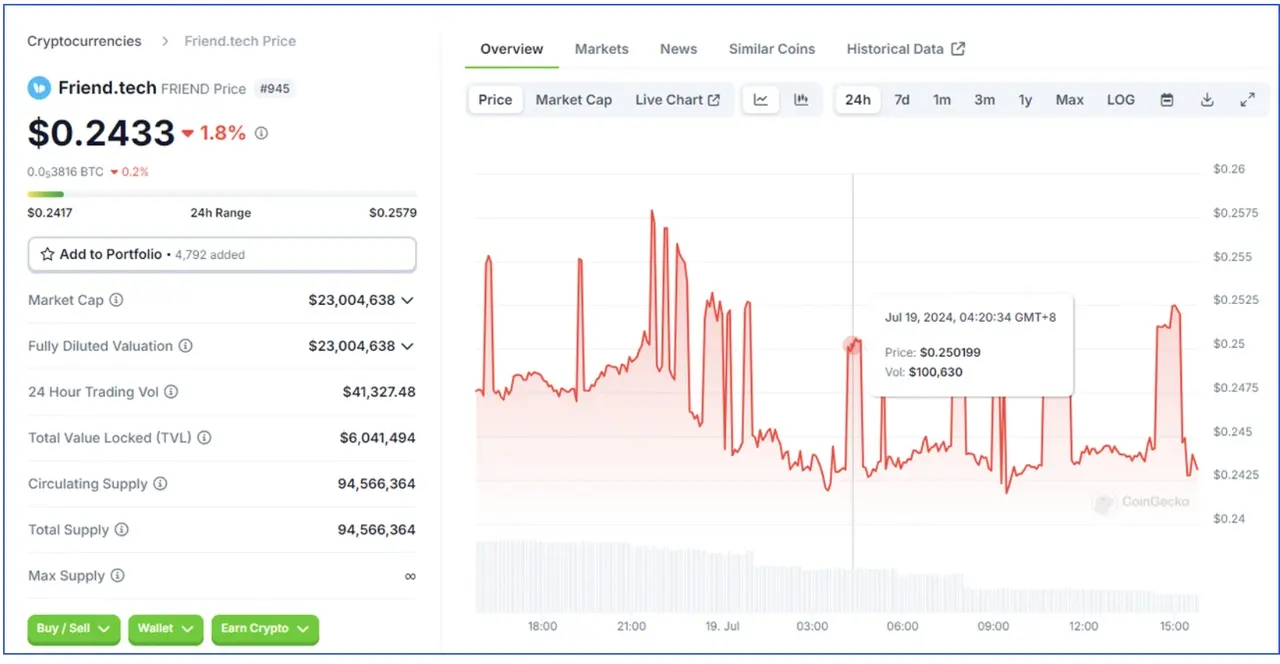
In the future, Friend.Tech should continue to advance technological updates and feature expansions, potentially solidifying its position in the blockchain social media market.
Currently, for investors and users, Friend.Tech may represent a hidden growth opportunity or a high-risk choice that requires caution. In this context, for users who wish to gain deeper insights and participate, the most practical approach may be to engage directly in the social circles of interest, experiencing its services and features through actual use to better assess its true value and potential.
 Risk warning Risk warning


Popular articles





