A Guide to Earning Stablecoin Yield

 Currently, the main categories of income generation through stablecoins are as follows. This article will further analyze each category of income in detail.
Author: JacobZhao
Recently, the cryptocurrency market has been lackluster, and conservative and stable returns have once again become a market demand. Therefore, combining my investment insights from recent years and the concentrated research results in the stablecoin field at the end of last year, I would like to discuss the age-old yet evergreen topic of stablecoin yields.
The current categories of stablecoins in the cryptocurrency market mainly include the following:
USDT, which is conditionally compliant but has the highest market share: Its application scenarios are broad enough (trading pairs on exchanges, salary payments for crypto industry companies, real international trade, and offline payment scenarios), and users hope for a large entity that cannot fail, with Tether having the ability to back it up.
Compliance stablecoins pegged 1:1 to fiat currency: USDC has the most chain and application scenario support, making it a true on-chain dollar, while other compliant stablecoins like PayPal USD and BlackRock USD have certain limitations in their application scenarios.
Over-collateralized stablecoins: Mainly represented by DAI from MakerDAO and its upgraded version USDS under Sky Protocol; Liquity's LUSD has become a competitor with its zero-collateral lending rate and a low collateralization ratio of 110%.
Synthetic asset stablecoins: The most representative in this cycle is the phenomenal USDe from Ethena. Its funding rate arbitrage model for obtaining yields will also be one of the stablecoin yield models analyzed in this article.
RWA project stablecoins backed by US Treasury bonds: The most representative in this cycle are USD0 from Usual and USDY from Ondo. The USD0++ from Usual provides liquidity for US Treasury bonds, similar to how Lido does for ETH staking, which is innovative.
Algorithmic stablecoins: After the collapse of Terra's UST, this track has basically been discredited. Luna lacked real value support, leading to severe price fluctuations and a death spiral of sell-offs and crashes. FRAX combines algorithmic stablecoins and over-collateralization models, still having some application scenarios, while other algorithmic stablecoins have lost market influence.
Non-dollar stablecoins: Euro stablecoins (Circle's EURC, Tether's EURT, etc.) and other fiat stablecoins (BRZ, ZCHF, HKDR, etc.) currently have minimal impact on the dollar-dominated stablecoin market. The only way for non-dollar stablecoins to survive is through payment services under a compliant regulatory framework rather than being applied in the native crypto community.
 Stablecoin Market Cap Ranking Source: https://defillama.com/stablecoins
Currently, the main categories of yield generation through stablecoins are as follows, and this article will further analyze each type of yield:
 Stablecoin Yield Categories
1. Stablecoin Lending & Borrowing:
Lending, as the most traditional financial yield model, derives its returns primarily from interest paid by borrowers. It is necessary to consider the security of the platform or protocol, the probability of borrower default, and the stability of returns. The stablecoin lending products currently available in the market include:
Cefi platforms mainly consist of interest-bearing products from leading exchanges (Binance, Coinbase, OKX, Bybit).
Leading DeFi protocols are primarily represented by Aave, Sky Protocol (the brand after MakerDAO's upgrade), Morpho Blue, etc.
The platform security of leading exchanges that have undergone cyclical tests and the security of leading DeFi protocols are relatively high. During bullish market periods, strong lending demand can easily drive U's interest rates above 20%, but during quiet market periods, returns generally remain low at around 2%-4%. Therefore, flexible interest rates serve as a straightforward market activity indicator. Fixed interest rate lending sacrifices liquidity, so it generally yields higher returns than flexible rates, but it cannot capture the surges in flexible rates during active market periods.
Additionally, there are some minor innovations in the overall stablecoin lending market, including:
Fixed-rate lending DeFi protocols: The highly representative Pendle protocol, which started with fixed-rate lending and evolved into yield tokenization, will be detailed later in this article. Early fixed-rate DeFi projects like Notional Finance and Element Finance, although they did not succeed, have design concepts worth referencing.
Introducing rate tranching and subordination mechanisms in lending;
Providing leveraged lending DeFi protocols;
DeFi lending protocols aimed at institutional clients, such as Maple Finance's Syrup, which derives income from institutional lending.
RWA brings real-world lending business yields on-chain, such as Huma Finance's on-chain supply chain finance products.
In summary, lending, as the most traditional financial yield model, is easy to understand and will continue to be the primary stablecoin yield model due to its capacity to handle large amounts of capital.
2. Yield Farming Returns:
Represented by Curve, its returns come from AMM trading fees distributed to LPs and token rewards. Curve, as the holy grail of stablecoin DEX platforms, has stablecoins supported in Curve Pools as an important indicator of new stablecoins' adoption in the industry. The advantage of Curve mining lies in its high security, while its disadvantage is low yields that lack attractiveness (0-2%). If non-large and long-term funds participate in Curve's liquidity mining, the returns may not even cover the trading gas fees.
Uniswap's stablecoin pool trading pairs face the same issue, as Uniswap's non-stablecoin trading pairs may incur liquidity mining losses. Other smaller DEX's stablecoin pool trading pairs, even with higher yields, still have rug pull concerns, which do not align with the cautious and stable principles of stablecoin investment. We can see that the current DeFi stablecoin pools are still primarily based on lending models, with Curve's classic 3Pool (DAI USDT USDC) only ranking in the top twenty for TVL.
 Stablecoin Pool TVL Ranking Source: https://defillama.com/yields?token=ALLUSDSTABLES
3. Market Neutral Arbitrage Returns:
Market-neutral arbitrage strategies have long been widely used by professional trading institutions. By simultaneously holding long and short positions, the net market exposure of the investment portfolio approaches zero. Specifically in crypto, this mainly includes:
Funding Rate Arbitrage: Perpetual futures have no expiration date, and their prices align with spot prices through the funding rate mechanism. The funding rate needs to be paid periodically, shortening the short-term price difference between spot and perpetual contracts.
When the perpetual contract price is higher than the spot price (contango), longs pay shorts, and the funding rate is positive.
When the perpetual contract price is lower than the spot price (backwardation), shorts pay longs, and the funding rate is negative.
Historical drawdown data shows that the probability of a positive funding rate is long-term greater than that of a negative funding rate. Therefore, the yield mainly comes from buying spot in a positive funding rate scenario, shorting perpetual contracts, and collecting fees paid by longs.
 Ethena Historical Funding Rate Statistics, the probability of a positive funding rate is long-term greater than that of a negative funding rate
- Cash-and-Carry Arbitrage: This strategy utilizes the price differences between the spot market and the futures market to lock in profits through hedged positions. The core concept is "basis", which is the difference between the futures price and the spot price. It is typically operated in contango (futures price higher than spot) or backwardation (futures price lower than spot) markets. Cash-and-carry arbitrage is suitable for investors with large capital who can accept a lock-up period and are optimistic about basis convergence, commonly seen among traders with traditional financial thinking.

Cross-Exchange Arbitrage: This involves utilizing price differences between different exchanges to construct neutral positions. It was a mainstream arbitrage method in the early days of the crypto industry, but currently, the price differences for mainstream trading pairs between different exchanges are minimal, requiring automated arbitrage scripts and being more suitable for high-volatility markets and small-cap coins, making it difficult for retail participants. One can refer to the Hummingbot platform.
Additionally, there are triangular arbitrage, cross-chain arbitrage, and cross-pool arbitrage strategies in the market, which will not be further elaborated on in this article.
Market-neutral arbitrage strategies, due to their high level of professionalism, are mostly limited to professional investors. However, the emergence of Ethena in this cycle has brought the mature model of Funding Rate Arbitrage on-chain, allowing ordinary retail users to participate.
Users can deposit stETH in the Ethena protocol to mint an equivalent amount of USDe tokens. At the same time, they can open equivalent short positions on centralized exchanges to hedge and earn positive funding rates. According to historical statistical data, over 80% of the time, the funding rate is positive, and in negative funding rate scenarios, Ethena will use its reserves to cover losses. More than 65% of Ethena's income hedges the funding rate, and there are also some Ethereum staking, on-chain, or exchange lending yields (35%) as supplementary income. Additionally, user assets are held by third-party custodians OES (Off Exchange Settlement), which regularly issues audit reports, effectively isolating exchange platform risks.
 Ethena Protocol Flowchart
Regarding the risks associated with Ethena, aside from uncontrollable factors such as platform and custodian incidents, smart contract security issues, or de-pegging of anchor assets, the more critical core point lies in "losses in long-term negative funding rate scenarios that cannot be covered by the protocol's reserved funds." Based on historical drawdown data, we can understand that this probability is relatively low. Even if it occurs, it would mean the failure of the widely applicable "funding rate arbitrage" trading strategy in the industry. Therefore, under the premise that the team does not act maliciously, the Ethena protocol is unlikely to experience the death spiral model of Terra's algorithmic stablecoin. Instead, what may occur is a gradual decline in high yields subsidized by tokens, returning to the normal range of arbitrage yields.
At the same time, we must acknowledge that Ethena has achieved the highest level of data transparency, allowing users to clearly check historical yields, funding rates, positions on different exchanges, and monthly custody audit reports on its official website, surpassing other funding rate arbitrage products in the market.
Aside from Ethena's "Funding Rate Arbitrage" model, the Pionex exchange also offers stablecoin investment products with a "Term Arbitrage" model. Unfortunately, apart from Ethena, there are currently not many market-neutral arbitrage products available for retail clients to participate in with low thresholds.
4. US Treasury Bill Yield RWA Projects
The Federal Reserve's interest rate hike cycle from 2022 to 2023 has pushed the dollar interest rate above 5%. Even though it has now shifted to a gradual rate cut, dollar interest rates above 4% remain a rare asset target in the traditional financial industry that balances high safety with relatively high returns. RWA businesses have high compliance requirements and operational models, and US Treasury bonds, as standardized assets with high trading volumes, are among the few RWA products with sound business logic.
 US Treasury RWA Growth Trend Chart: Source: https://app.rwa.xyz/treasuries
Ondo, with US Treasury bonds as the underlying asset, offers USDY for non-US retail clients and OUSG for qualified US institutional clients, both yielding 4.25%. It is the leader in the RWA track in terms of multi-chain support and ecological applications, but it is slightly lacking in regulatory compliance compared to Franklin Templeton's FOBXX and BlackRock's BUIDL. The Usual protocol, which has emerged in this cycle, has added liquidity tokens USD0++ on top of USD0, which is backed by a basket of US Treasury bonds, providing liquidity for 4-year locked US Treasury bonds and allowing participation in stablecoin liquidity mining or lending pools for additional yields.
 Usual Protocol USD0 and USD0++ Yield Illustration
It is important to note that most US Treasury RWA projects maintain stable yields around 4%, while the higher yields of Usual's stablecoin pool mainly come from Usual token subsidies, Pills (Point) incentives, liquidity mining, and other speculative extra yields, which are not sustainable. As the most complete RWA project in the DeFi ecosystem, it still faces the risk of gradually declining yields but is unlikely to face a catastrophic failure.
Although the de-pegging and sell-off event caused by the adjustment of the redemption mechanism for USD0++ in early 2025 stemmed from the misalignment of its bond attributes with market expectations and governance errors, its liquidity design mechanism remains an industry innovation worth referencing for other US Treasury RWA projects.

5. Structured Products
Currently, structured products and dual currency strategies popular on most centralized exchanges originate from options trading strategies like "selling options to earn premiums," specifically Sell Put or Sell Call strategies. U-based stablecoins mainly utilize the Sell Put strategy, with returns coming from the option premiums paid by option buyers, allowing for the stable earning of USDT option premiums or purchasing BTC or ETH at lower target prices.
In practical operations, selling options strategies are more suitable for range-bound markets, where the Sell Put target price is set at the lower limit of the range and the Sell Call target price at the upper limit. For unidirectional bullish markets, option premium returns are limited, making it more suitable to choose Buy Call; for unidirectional bearish markets, Sell Put can easily lead to continuous losses after buying at a mid-point. Newcomers to selling options trading may easily fall into the trap of pursuing short-term "high option premium returns" while ignoring the risk exposure brought by significant price declines, but setting the target price too low can lead to a lack of attractiveness in option premium returns. Based on my years of options trading experience, the Sell Put strategy is mainly set at lower buy target prices during market downturns with widespread panic to earn high option premium returns, while during bullish market periods, choosing exchange flexible lending yields is more attractive.

As for the recently popular Shark Fin principal protection strategy on exchanges like OKX, it employs a Bear Call Spread strategy (Sell Call to collect option premiums + Buy Call at a higher strike price to limit upside) + Bull Put Spread (Sell Put to collect option premiums + Buy Put at a lower strike price to limit downside), allowing the entire options portfolio to earn option premium returns within the range, while outside the range, buying and selling options hedge each other without additional returns. For users who prioritize principal safety and do not seek to maximize option premiums or coin-based returns, this is a suitable U-based investment solution.
 OKX SharkFin Structured Product Illustration
The maturity of on-chain options is yet to be developed. Ribbon Finance was once the leading options vault protocol in the previous cycle, while top on-chain options trading platforms like Opyn and Lyra Finance also allow for manual trading of option premium strategies, but they have since lost their former glory.
6. Yield Tokenization
The highly representative Pendle protocol in this cycle began with fixed-rate lending in 2020 and evolved into yield tokenization in 2024. By splitting yield-bearing assets into different components, it allows users to lock in fixed yields, speculate on future yields, or hedge yield risks.
Standardized Yield Tokens (SY) can be split into Principal Tokens (PT) and Yield Tokens (YT).
PT (Principal Token): Represents the principal portion of the underlying asset, which can be redeemed at a 1:1 ratio at maturity.
YT (Yield Token): Represents the future yield portion, which decreases over time and has a value of zero at maturity.
Pendle's trading strategies mainly include:
Fixed Income: Holding PT until maturity to obtain fixed income, suitable for risk-averse individuals.
Yield Speculation: Purchasing YT to bet on future yield increases, suitable for risk-tolerant individuals.
Risk Hedging: Selling YT to lock in current yields and avoid market downturn risks.
Liquidity Provision: Users can deposit PT and YT into liquidity pools to earn trading fees and PENDLE rewards.
Currently, its promoted stablecoin pool, in addition to the native yields of the underlying assets, also adds YT speculative yields, LP yields, Pendle token incentives, and Points to make its overall yield attractive. One downside is that Pendle's high-yield pools generally have shorter durations, making it impossible to operate once and for all like staking or liquidity mining or lending pools; frequent on-chain operations are required to switch yield pools.
7. Basket of Stablecoin Yield Products:
Ether.Fi, as the leading protocol for Liquid Restaking, has actively embraced change and product transformation by launching various yield products in BTC, ETH, and stablecoins after entering a saturated downward trend in the Restaking track, maintaining its leading position in the entire DeFi industry.
In its Market-Neutral USD pool, it provides users with a basket of stablecoin yield products through actively managed funds, including lending interest (Syrup, Morpho, Aave), liquidity mining (Curve), funding rate arbitrage (Ethena), yield tokenization (Pendle). For users seeking stable on-chain yields, with insufficient capital and unwilling to operate frequently, this is a method that balances high yields and diversified risks.
 Ether.Fi Market-Neutral USD Asset Allocation
 Ether.Fi Market-Neutral USD Participating Protocols
8. Stablecoin Staking Yields:
Stablecoin assets do not possess staking properties like ETH on POS public chains. However, the AO network launched by the Arweave team accepts on-chain staking of stETH and DAI in its Fair Launch token issuance model, with DAI staking offering the highest AO yield capital efficiency. We can categorize this type of stablecoin staking model as an alternative stablecoin yield model, which ensures the safety of DAI assets while earning additional AO token rewards for small investments, with the core risk lying in the development of the AO network and the uncertainty of token prices.
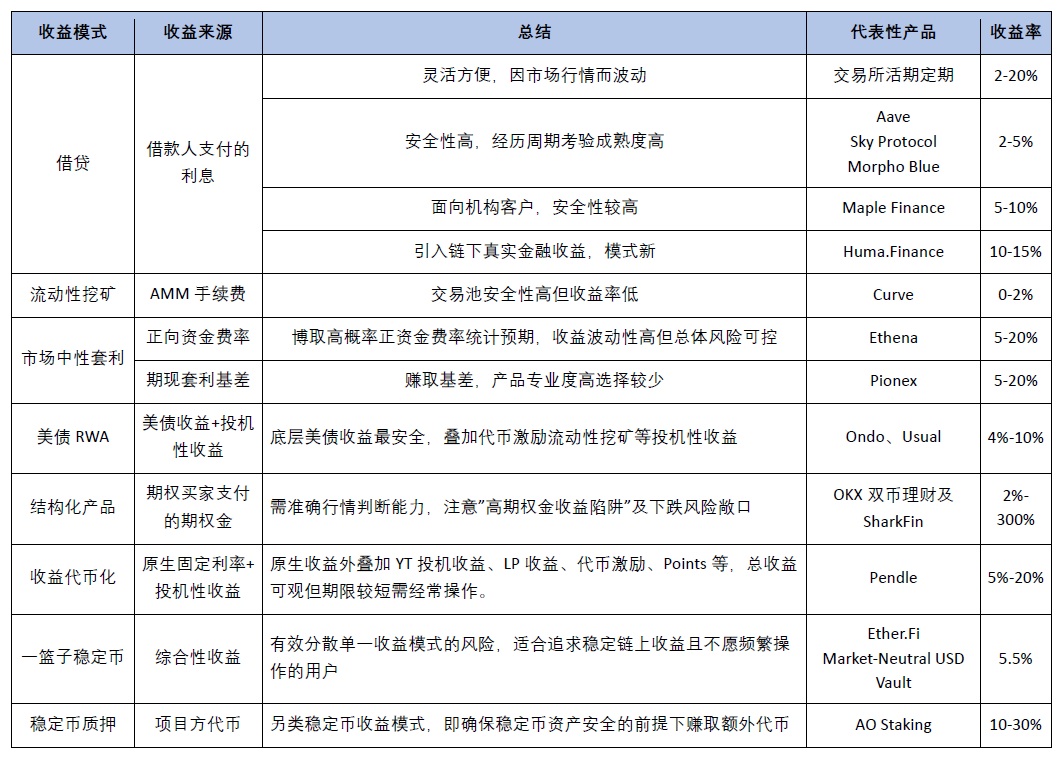
In summary, we have summarized the mainstream stablecoin yield models currently available in the cryptocurrency market in the table above. Stablecoin assets are the most familiar yet easily overlooked market for cryptocurrency practitioners. Understanding the sources of stablecoin yields and making reasonable allocations can help better cope with the uncertainties and risks of the cryptocurrency market on a solid financial foundation.
 Risk warning
 Risk warning