








Story: Is it really necessary to put intellectual property on the blockchain?

 Reconstructing the IP management system in the AI era.
1. Why Story Protocol?
For a long time, intellectual property (IP) management has faced issues such as complex structures, high costs, and a heavy reliance on centralized intermediaries. With the explosive growth of AI-generated content, these traditional bottlenecks are rapidly evolving into uncontrollable risks, bringing challenges in originality verification, attribution tracing, and large-scale, fair licensing.
Story Protocol proposes a new solution for the digital and AI-driven creative economy:
It embeds on-chain attribution tracing deeply into the content creation process through a programmable IP licensing mechanism and builds flexible licensing modules, making the recreation and commercialization of IP more transparent and easier to operate.
Story has chosen not to build on existing blockchains (such as Ethereum or Solana) but has instead proactively created a dedicated Layer 1 chain designed specifically for IP. While this means higher infrastructure costs and promotional barriers, it also brings complete control over the underlying architecture.
For example, the core functions of Story Protocol include:
- Precise tracking of value flow in recreation
- Royalty splitting under multi-party collaboration
- Native embedding of legal terms in licensing agreements
These mechanisms rely on specialized data structures, customized recomputation processes, and the ability to support legal logic at the base level --- which is precisely the part that general-purpose public chains struggle to natively support.
Story does not simply adhere to the "code is law" ideology of crypto fundamentalism; rather, it deeply integrates the binding force and enforceability of real-world legal systems into its institutional design, striving to achieve a more mature balance between decentralization and legal compliance.
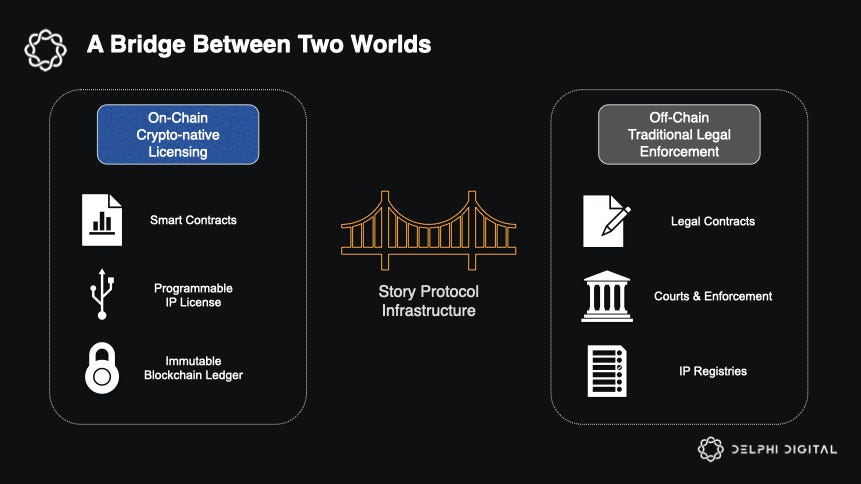
Story Protocol is becoming a key bridge connecting real-world legal systems and crypto-native infrastructure. It allows content creators and original IP owners to transition to blockchain systems with greater peace of mind, empowering them to achieve sustainable creation and value recovery in the Web3 world.
This report will delve into whether Story Protocol possesses genuine sustainable architectural advantages and whether these advantages are sufficient to support the complexity and ambition of building a dedicated Layer 1 chain. We will analyze from the following dimensions: market positioning, technical design, real-world application scenarios, AI integration strategies, and potential risks.
2. Towards a New Era of AI-Driven IP
The rapid development of AI is posing a huge challenge to the traditional IP system. The current system largely relies on offline, enforcement-based mechanisms, which cannot cope with the new ideas and proprietary results emerging at machine speed. The biggest challenge now is not just "who owns the rights," but how to effectively track contributions and fairly distribute value in large-scale creation.
Story Protocol was born to address this changing landscape. It aims to achieve on-chain transparent tracing and automated incentive distribution mechanisms, creating a native IP infrastructure aimed at AI.
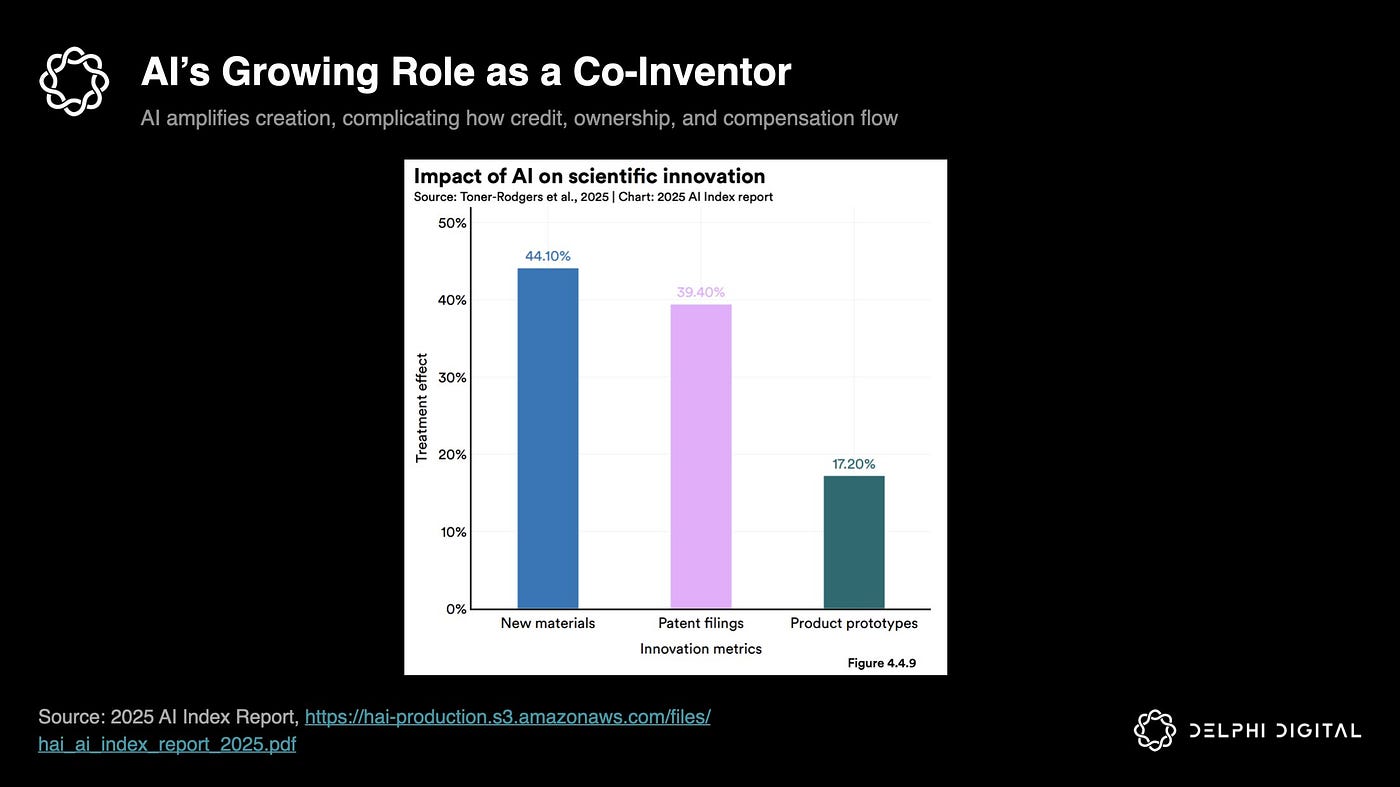
A study involving 1,018 scientists found that scholars using AI-assisted research had 44% more breakthroughs in materials science and a 39% increase in patent applications. This clearly demonstrates the important role of AI in driving knowledge creation.
However, with AI becoming a "co-inventor," a more complex question arises: when the creation of IP is partially or entirely completed by non-human entities, how do we decide who should receive credit and benefits?
The design of Story is precisely aimed at answering this question. The tools it provides support precise attribution in "human-machine co-creation" scenarios, ensuring that both AI and human creators receive due rewards for their contributions. In a future where AI can autonomously generate content and improve upon previous works, whether original creators receive recognition and incentives will be more important than ever.
Many believe that the infinite content production capabilities brought by AI will marginalize the intellectual property system. If creation is no longer scarce, the enforceability of copyright and IP will gradually diminish. However, the future is not yet determined, and we need ownership structures that align with new content paradigms.
Story Protocol enters a market dominated by three types of IP management systems. Although each has its advantages, they all struggle to meet the needs for combinability and dynamic incentives inherent in AI-native creation.
- Traditional IP frameworks rely on centralized registration and post-facto accountability, which are clearly unsuitable for the fast-paced collaborative digital content ecosystem.
- DRM systems (such as Adobe and Marlin) focus on content access control and theft prevention, offering little support for remix licensing, contribution tracking, and automated royalties.
- Blockchain platforms like IBM's IPwe tokenize IP assets but lack key capabilities such as programmable licensing, derivative tracking, and royalty distribution.
In contrast, Story provides a more flexible and transparent framework, supporting the flow and monetization of IP across NFTs, DeFi, and a broader crypto ecosystem through cross-chain interoperability, while still retaining ownership within the Story registration system (logically similar to restaking in DeFi).
Looking ahead, this underlying infrastructure will also lay the groundwork for IPFi. Whether it is IP fractionalization, collateralized lending, or revenue right derivatives design, all these financial innovations require clear creative ownership and combinable protocol structures, which are precisely the capabilities that Story provides.
Story is also preparing for AI-native interactions, with its specialized Agent access mechanism supporting programmable interactions between AI and IP assets. Leveraging broader technological trends such as open-source, decentralization, and automation, Story Protocol is attempting to build long-term infrastructure for the AI-driven intangible asset economy.
2.1 "Ghibli-ization" and the Ethical Boundaries of AI Art
With the launch of GPT-4o's newly upgraded image generation capabilities, a new wave of enthusiasm and controversy surrounding AI art has emerged. This further highlights the potential necessity of the underlying infrastructure provided by Story Protocol. Many users are excited about GPT-4o's high fidelity to iconic styles (such as the classic aesthetics of Studio Ghibli), while deep ethical concerns have been expressed within the creative industry regarding this trend. Some voices criticize the AI's reproduction of Ghibli's style as a theft of the creative spirit, echoing Ghibli founder Hayao Miyazaki's stance that "AI creation is an insult to life."
These intense discussions reflect deeper anxieties about intellectual property, the replacement of human creativity, and the ethical boundaries of AI content. The foundational capabilities built by Story --- which make the attribution relationships of works clear and embed usage terms natively into the IP assets themselves --- provide practical protection tools for creators and IP-based businesses.
3. Dedicated Infrastructure Born for IP
The core design intention of Story Protocol is to create an infrastructure that makes rights easy to enforce and highly interoperable. It addresses the most "chaotic realities" in IP licensing: multi-party royalty splitting, overlapping licensing relationships, cross-chain asset circulation, and legally compliant protocol execution.
To achieve this goal, Story has built a complete set of tightly coupled dedicated modules, with several key components as follows:
Main Execution Core: An EVM-compatible execution environment optimized for IP transaction scenarios.
IP Core: Handles complex licensing processes and royalty flows, relying on two major mechanisms:
- Proof of Creativity (PoC)
- Programmable IP Licenses (PIL)
Story Orchestration Service (SOS): Builds an interactive bridge between on-chain assets and off-chain legal and financial systems.
These components together form the technical backbone of Story Protocol, enabling it to provide an AI-native, combinable, and compliance-friendly IP licensing system. Next, we will further dissect how these systems work together to support a truly programmable IP economy.
3.1 Native IP Execution and Cross-Chain Interoperability
The architecture of Story is designed to support highly unique and practical "native IP" functionalities, such as:
- Recursive Licensing: Licensing terms can be passed backward with derivative works.
- Multi-hop Royalty Distribution: Payment paths can traverse multiple layers of creator chains.
- Composable Attribution Trees: Attribution chains can be reused, programmed, and expanded.
Even on faster blockchains like Solana, handling royalty distribution for multi-layer derivative works typically requires specialized application layer code and multiple on-chain data calls. This complexity and high cost are not areas where general-purpose public chains excel. In contrast, Story natively supports these complex workflows from the ground up, making remixing, monetization, and attribution management smoother.
To extend these capabilities to off-chain ecosystems, Story has simultaneously built a robust cross-chain interoperability mechanism. It uses the Cosmos IBC protocol for native communication within the Cosmos ecosystem while integrating cross-chain messaging protocols such as LayerZero, deBridge, and Stargate to achieve broader multi-chain communication. This design allows IP assets to flow freely between different ecosystems, opening up space for liquidity, combinability, and authorized use of IP in DeFi applications, NFT platforms, and other crypto scenarios.
3.2 Connecting On-Chain IP with Real-World Systems
To truly unlock the full potential of "programmable IP," Story has built a dedicated core module to directly connect on-chain IP assets with the off-chain world. Unlike traditional general-purpose oracles, Story's Off-Chain Synchronization Core focuses on the fine interaction needs required by IP workflows.
For example, when an independent artist licenses their digital work through Story, the Story Orchestration Service (SOS) automatically performs off-chain identity verification, links traditional payment channels for royalty collection, and generates legally binding licensing documents.
Although SOS provides a highly valuable set of off-chain functions (including identity verification, legal document generation, and payment integration), detailed technical documentation explaining its specific operational mechanisms has not yet been publicly disclosed. For potential users, fully trusting these off-chain services remains a challenge without direct communication with the team.
With this in mind, the table below outlines the differences between Story's dedicated oracle framework and general solutions in key IP processes.
This targeted architecture is particularly useful in handling scenarios such as infringement --- if an IP asset registered with Story is used without authorization, SOS can automatically collect necessary off-chain evidence and generate legally binding materials for rights protection. This significantly enhances the efficiency of infringement detection and resolution while reducing the administrative burden of collecting evidence, initiating lawsuits, and removing infringing content in traditional rights protection.
Technicians often overestimate the capabilities of their systems, especially when faced with the complexities of the real world. However, in the case of Story, the design that integrates traditional oracle logic with automated processes is the true core value. It builds a seamless experience connecting off-chain needs with on-chain visions for users, especially in the wave of AI content that brings a large volume of transactions. Story is expected to simplify management processes through automation, allowing creators and businesses to focus on creation, distribution, and commercialization.
3.3 Proof of Creativity (PoC) and Programmable Licensing (PIL)
The core highlights of Story, and the key to its sustained differentiation, lie in the "Proof of Creativity" (PoC) and "Programmable IP Licenses" (PIL).
As mentioned earlier, traditional IP systems are far behind the speed and complexity of contemporary knowledge creation, especially in a context where AI can rapidly generate large amounts of digital assets, making it difficult for humans to track content ownership in a timely manner.
The core of the PoC protocol is that every asset minted on-chain is automatically embedded with attribution, ownership, and licensing information. While the on-chain storage of this metadata is not new, Story combines this metadata with a "programmable licensing mechanism," achieving automated contracts and execution at the protocol level, a capability that is unprecedented.
The following diagram illustrates how various modules of Story work together to ensure that asset registration, attribution, and compliant licensing are not washed away by the large-scale generation of content by AI.
What is truly important about this approach is the practical effects it brings: automated royalty distribution, transparent and auditable records, and self-executing licensing terms without the need for human oversight. Collaborations with several innovative enterprises also indicate that Story provides not just a future vision but a set of current, actionable, and commercially viable solutions.
Of course, there are still unknowns: Will the infringement claims initiated by Story be accepted by the courts? Do its dispute resolution and proof mechanisms possess the recognition and stability of global legal systems? These remain to be seen.
However, it is certain that Story does not shy away from the complex nature of its business. If its operational efficiency and practical implementation effects are strong enough, PoC and PIL could very well become important components of a new property order driven by AI. For now, Story has already captured a real pain point that many non-crypto competitors have yet to address with its precisely targeted and clearly differentiated solutions.
3.4 User Interface and Developer Tools
The success of Story Protocol ultimately depends on its practicality rather than the elegance of its technology. To lower the barriers for developers and non-technical users, Story provides two complementary interfaces:
- Story SDK & IP Kit: The SDK provides underlying access to the complete IP licensing stack of Story, while the IP Kit abstracts complex operations into standardized "plug-and-play" processes. Just as Stripe allows small merchants to achieve a smooth payment experience without building payment infrastructure, the IP Kit enables developers to provide creators with a simple and consistent interface for registering, licensing, and monetizing IP without building the underlying logic from scratch.
- IP Portal: A no-code interface that allows creators to manage their IP assets without deep crypto knowledge. This is particularly important for artists, studios, and rights holders accustomed to traditional workflows, helping them smoothly "go on-chain."
Below is a screenshot of the IP Portal frontend interface:
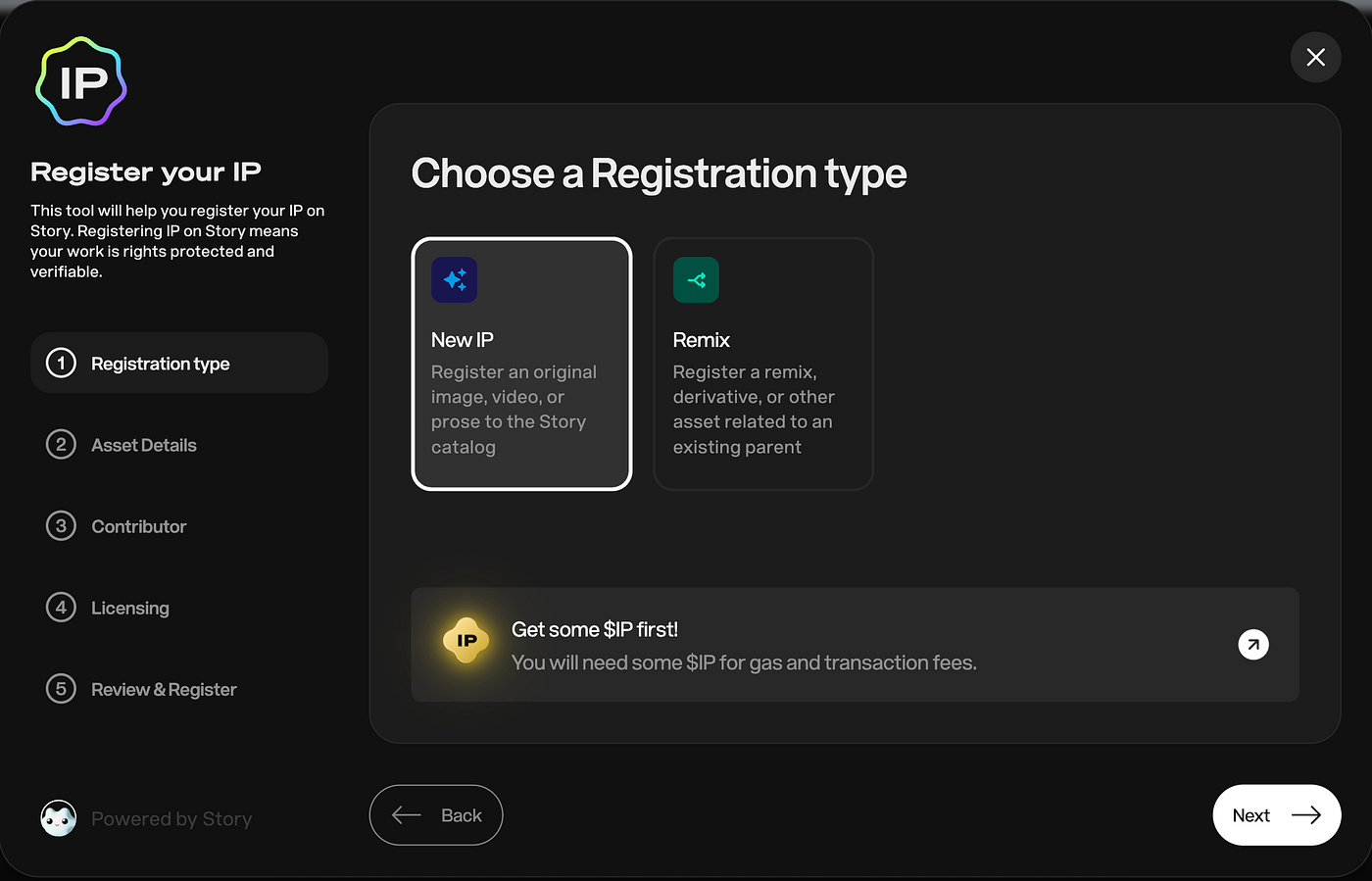
Although Story's user interface design is simple and intuitive, true usability still depends on whether these tools align with real IP workflows. These components together build a dedicated, IP-native infrastructure, which is the key distinction between Story Protocol and general chains or platforms.
Currently, more and more members of the crypto community are calling for a shift in focus from redundant infrastructure building to creating truly powerful application layer products, pushing the industry towards a "broadband moment." In this context, Story's existence is particularly reasonable: it is not pursuing foundational layer construction to enhance valuation but is providing a systematic solution to a real and increasingly severe problem.
To further understand why certain business models "can only be realized on Story," we will next showcase the practical value of Story through specific case studies.
4. Practical Implementation of Programmable IP
Before entering the case analysis, here is an overview of the general user experience differences between using and not using Story:
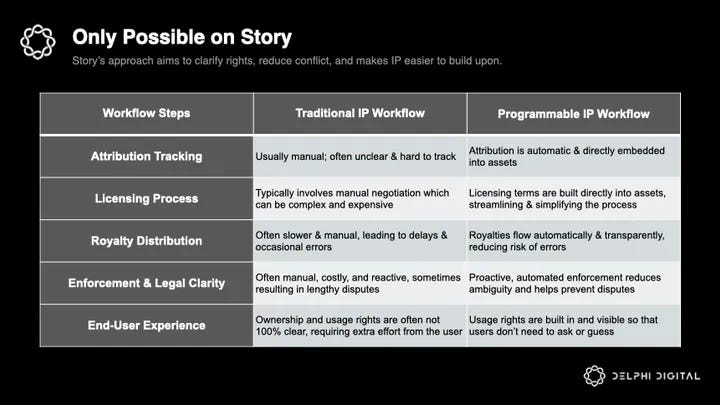
The next two cases demonstrate how Story reshapes the creative and data-driven ecosystem, especially in areas where existing IP frameworks are ineffective or completely absent.
4.1 Magma --- Protecting Artists' Rights and Facilitating Collaborative Creation
Problem: Digital artists have always faced challenges in protecting the ownership of their works. The identification and tracking of creative sources are often informal, remix works are difficult to count, and income relies on platforms (intermediaries) or manual licensing processes. Once in a collaborative creation scenario, rights ownership becomes even more ambiguous.
Solution: Magma leverages Story to embed licensing terms directly into each registered and on-chain work. Their 3 million users can set their own remix licensing scope, attribution tracking standards, and automated royalty distribution mechanisms.
Actual Impact: Artists can finally control how their works are used and earn income from derivative works. Collaborating in a smart contract-protected environment is far more reliable and transparent than relying on platform policies to safeguard rights.
4.2 Mahojin --- Transparent AI with Traceable Value
Problem: In the current AI ecosystem, data providers and model builders generally lack effective infrastructure to assert data ownership, track model reuse, or participate in the distribution of its derivative value. Datasets are often collected, adapted, and used to train models, but original contributors are frequently uncredited and unable to receive any economic returns --- their contributions "evaporate" in the black box training process.
Solution: Mahojin utilizes Story Protocol to register datasets and AI models as on-chain intellectual property assets (IP Assets), embedding usage terms and revenue rules within them. When a model is fine-tuned and generates income downstream, the protocol automatically distributes payments along the contribution chain, without manual coordination.
Through this mechanism, every dataset, every model parameter, and even every fine-tuning operation has verifiable tracing logic and value attribution. This not only enhances industry transparency but also allows data to become programmable and monetizable asset units for the first time.
Actual Impact: In the past, once data entered the training process, it seemed to disappear into a black box, lacking transparency and incentives or returns. Mahojin, through a protocolized approach, gives datasets and models "on-chain life" --- they are no longer passive resources but can actively participate in value circulation and receive revenue shares.
In this mechanism:
- Model builders can embed incentive rules to achieve fairer value distribution;
- Data providers can track the flow and use of their assets;
- Downstream developers can also obtain clear authorization, avoiding infringement disputes.
Mahojin establishes an executable value chain for collaborative AI development, making previously "invisible" contributions visible, traceable, and monetizable.
In the above cases, we clearly see a common theme: Story Protocol is transforming fragmented, manual IP management processes into a programmable, executable systemic architecture.
It can:
- Automatically complete the recording and identification of creative ownership;
- Simplify complex licensing and permission processes;
- Complete royalty and revenue settlement distribution without intermediaries.
These capabilities are precisely the weakest and most dispute-prone parts of traditional IP systems.
As AI content creation and intelligent agent systems gradually take over production processes, relying solely on human collaboration is no longer sufficient. We need an IP infrastructure that "can operate normally without human coordination," and Story Protocol is building such a new paradigm.
The following chapters will further explore: When IP is no longer just "recordable information," but directly embedded in the behavioral logic of intelligent agents, how will the Story model take root and flourish in an AI-native environment?
5. Rethinking IP Coordination Mechanisms at Machine Scale
Story Protocol introduces two ambitious foundational mechanisms aimed at providing structural support for IP collaboration in AI-native environments: Chain of Intelligence and Agent TCP/IP. The former is used to establish executable economic and legal relationships between datasets, models, and generated content, while the latter empowers agents to autonomously negotiate licenses, execute complex transactions, and fulfill IP agreements with minimal human intervention. Together, these two systems build a new "machine-native" IP infrastructure, characterized by value flow and rights execution occurring at the protocol layer. However, their performance under large-scale operations remains to be validated.
5.1 Intelligent Chain: Attribution Tracking Mechanism in AI Pipelines
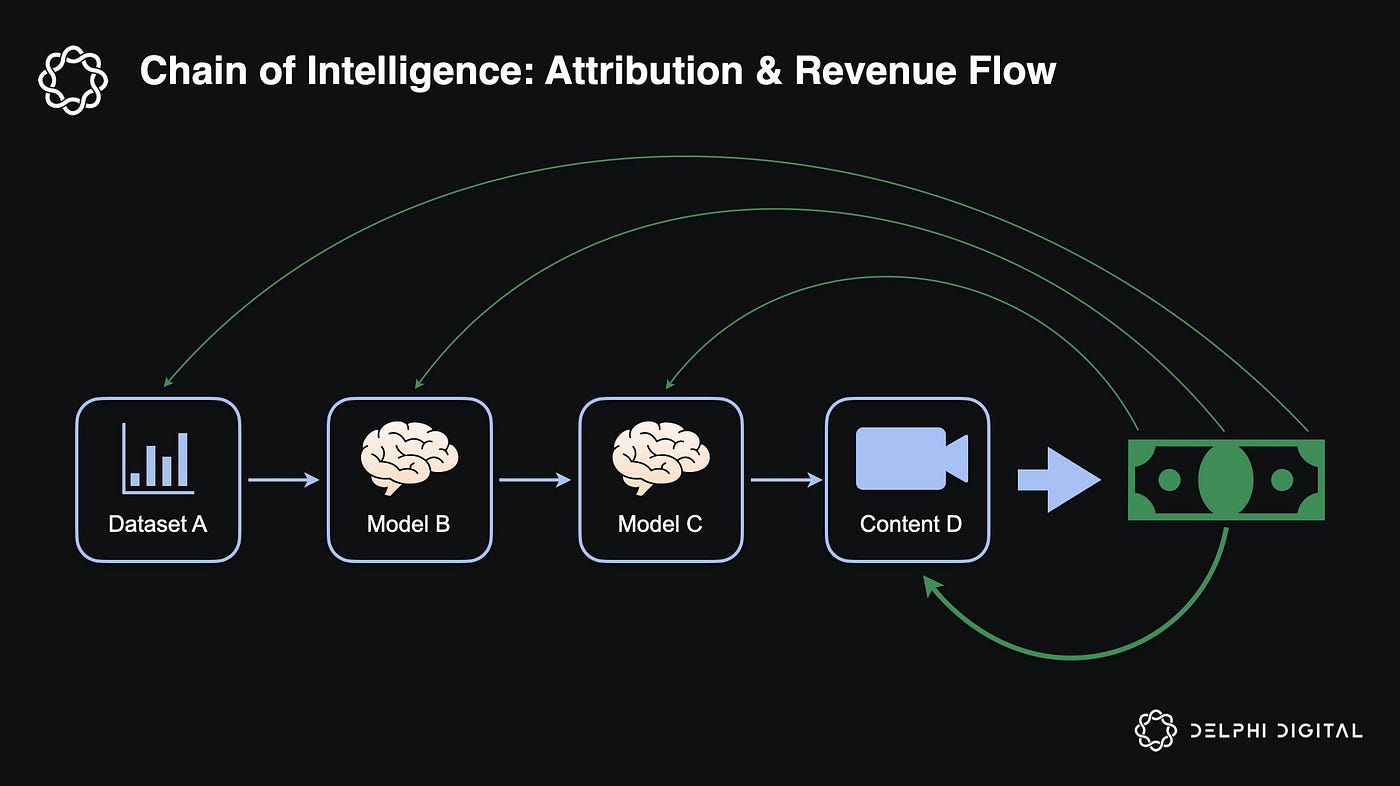
Generative AI systems increasingly rely on layered asset relationships: datasets train base models, base models are fine-tuned into specialized models, and specialized models generate content, which may become training inputs for the next generation of systems. In such a dynamic pipeline, accurately tracking and reasonably incentivizing upstream contributors becomes technically complex and economically critical.
Story attempts to provide a systematic solution to this issue by directly encoding usage rights and royalty terms into each asset. As derivative models or output content generate income, the protocol automatically distributes revenue back to the entire contribution network based on the licensing logic.
Example: Dataset A is used to train model B, model B is fine-tuned into model C, and model C generates content D. When content D generates income, the protocol will distribute the revenue to the contributors of dataset A, model B, and model C according to the preset programmable licensing terms.
Developers can register datasets and models through Story's SDK and API. The IP Portal also integrates the Story Attestation Service to compare generated prompts and results with registered IP, marking potential misuse and ensuring that IP owners and contributors receive corresponding credit and revenue shares. To support this machine-scale licensing flow, Story plans to launch a specially optimized AI-native execution core to handle high-throughput licensing computation needs.
5.2 Agentized IP Commerce: Enhanced Autonomous Protocol Toolkit
The Agent TCP/IP launched by Story aims to provide intelligent agents with a complete set of autonomous tools, enabling them to negotiate licensing terms, execute complex transactions, and fulfill agreements with minimal real-time human intervention. Interactions between agents are achieved through structured multi-round negotiations managed by smart contracts. The standardized interaction structure allows agents to repeatedly propose terms, bargain, modify details, and continuously forge licensing drafts, ensuring that the entire negotiation process has clear on-chain records and traceability.

To participate in the network, agents must stake $IP tokens and face token penalties or reputational losses for unauthorized use of unlicensed assets. These designs aim to strengthen incentive alignment, ensuring that even under high autonomy of agents, the entire protocol remains compliant, reliable, and secure.
Example: A weather forecasting agent initiates a licensing negotiation with a dataset provider agent through the Story protocol. The dataset agent initially proposes terms that include an upfront payment and ongoing royalties. The weather agent uses the negotiation tools provided by Story to adjust the royalty percentage and payment timing. In each round of negotiation, the agent records the proposed terms as on-chain licensing drafts. Ultimately, when both parties reach an agreement, the system will mint the agreement as a binding licensing token. Future income generated from weather forecasts will be automatically returned to the original dataset provider according to the terms. The entire negotiation process leaves a clear and auditable record on-chain.
Compared to general chains, Story's advantage lies in its deep vertical integration in negotiation, coordination, and compliance layers. This type of dedicated architecture is particularly critical for intelligent agent ecosystems that rely on complex, multi-round interactions, especially in scenarios where human oversight is difficult to scale.
6. $IP Token
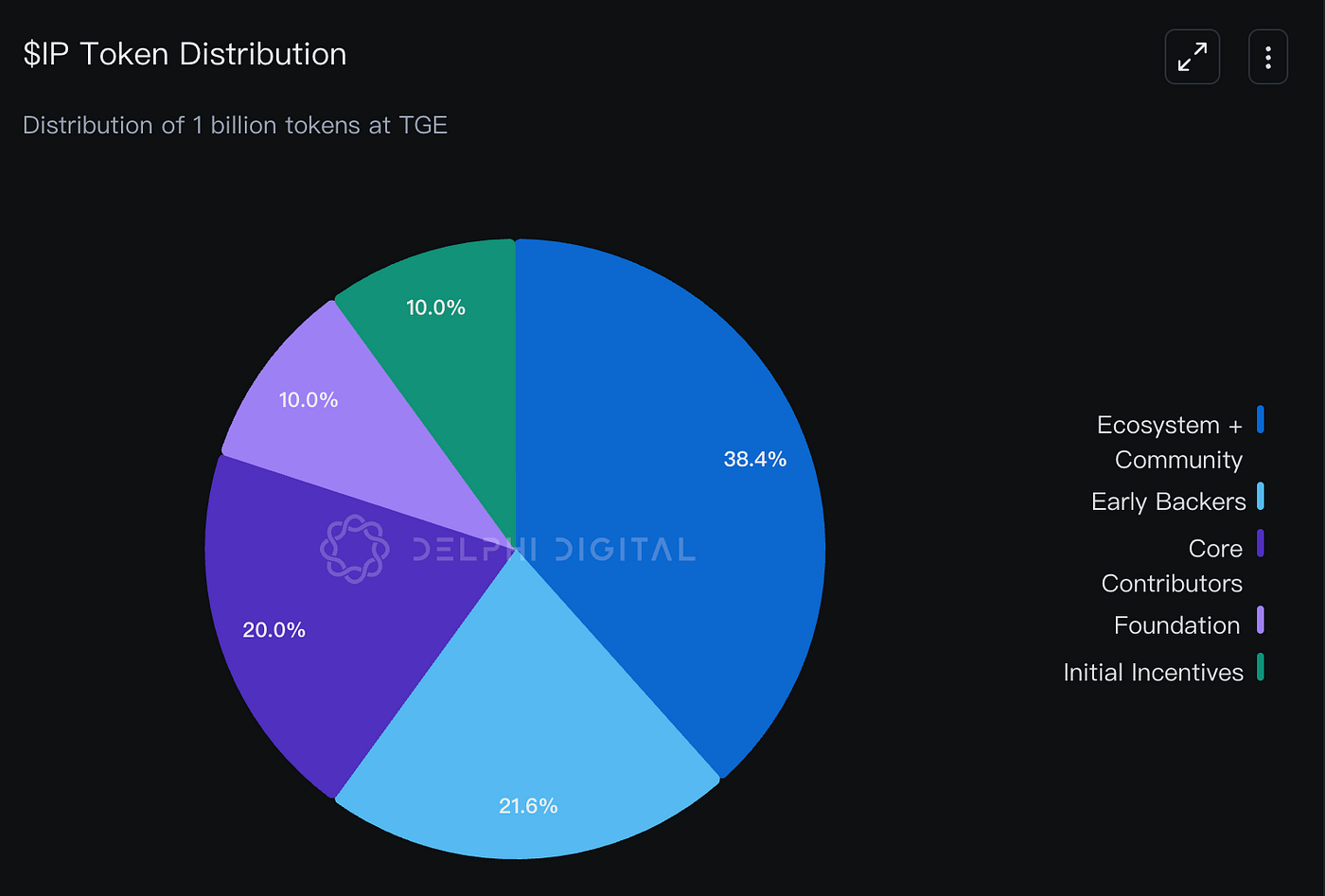
$IP is the core token driving the Story Protocol ecosystem, used to fund protocol development, community operations, and contributor incentives. Of the initial issuance of 1 billion tokens, over 58% are explicitly allocated for the aforementioned purposes. Tokens for early supporters and core team members will begin to unlock in mid-February 2025 and will be gradually released over the next 40 months.
6.1 Token Distribution
7. Logical Validation
Story Protocol proposes an ambitious model of "programmable IP infrastructure." However, no matter how excellent the architectural design, it cannot avoid the frictions and risks present in the real world. To test its long-term viability, we must subject this theory to substantial "stress testing" under high-pressure conditions.
7.1 Legal and Regulatory Risks
The PIL (Programmable License) introduced by Story greatly simplifies complex IP processes, but innovation itself does not guarantee acceptance by existing legal systems. Currently, licensing mechanisms based on cryptographic technology have hardly undergone substantial testing in global courts, and their legal enforceability remains uncertain. More complex is the significant variation in attitudes and regulations regarding new technologies across different jurisdictions, posing real obstacles to global compliance expansion.
At the same time, in IP markets dominated by patents, such as biotechnology or closed-source software, the deep involvement of AI also creates uncertainty in determining "inventorship." Regulatory agencies and patent offices in various countries are still exploring how to define AI's role in the innovation process, and the combination of cryptography and AI further complicates cross-regional applicability.
For example:
- Germany's eIDAS regulatory framework has very strict verification standards for electronic identities and records. If a court determines that blockchain records fail to meet its verifiability standards, then Story's on-chain licenses may be deemed invalid in infringement cases, especially in patent scenarios where AI-generated innovations frequently arise.
- Singapore, on the other hand, explicitly supports crypto transactions through the Payment Services Act. This more open attitude allows Story's framework to more naturally integrate into local compliance operations, opening convenient pathways for its application.
These examples clearly demonstrate that the same technology may face smooth sailing in one market while encountering significant obstacles in another. Although Story's open design lowers the entry barrier, achieving global scalability still requires precise alignment with local regulations.
For "programmable licenses" to gain widespread recognition, Story needs to establish trust with courts, regulatory bodies, and rights holders. This requires not only clear judicial precedents but also in-depth education and ecosystem collaboration. Otherwise, cultural skepticism and procedural delays may slow down the actual application pace of the protocol.
This map reveals the significant gap between public perception and legislative action globally in the face of emerging technologies like AI:

7.2 AI-Related Structural Risks
The explosive growth of AI content and innovation is challenging existing IP frameworks in all dimensions. From artistic works to algorithm patents, from scientific breakthroughs to generative code, AI's creative capabilities blur the lines of "rights ownership" and complicate the mechanisms of "economic value distribution."
The "Proof of Creativity" proposed by Story aims to address this dilemma through on-chain registration and tracing, systematically tracking content origins, derivative relationships, and revenue attribution. However, whether this mechanism can truly support the enormous scale and complexity required by AI remains an open question. If "attribution tracing" becomes unfeasible or its economic incentives lose practical significance, the foundation of the Story protocol may be undermined.
Especially in fields like drug design and diagnostic algorithms that heavily rely on AI, the involvement of AI greatly blurs the boundaries between "originality" and "co-invention." If courts ultimately determine that AI inventions lack attributable ownership or borrow too much from existing innovations, not only will Story's positioning be challenged, but the entire economic foundation of the patent system may also be shaken.
As @lex_node pointed out, this is not just a crisis of IP law but may touch upon a deeper discomforting proposition: in an AI-dominated future, does the meaning of intellectual property or even "property" itself still hold?
7.3 Adoption and Integration Risks
Although Story's technical architecture is specifically designed for IP scenarios and is significantly innovative, this also means it may face higher barriers in user adoption and platform integration.
Compared to traditional IP registration and management systems, Story's "programmable licensing" and "automated attribution tracking" tools may initially be unfamiliar to users, resulting in a higher learning curve. If its interface design and user experience do not achieve extreme intuitiveness, even with clear technical advantages, users may still choose to continue using simpler centralized platforms.
Additionally, how Story addresses infringement detection remains an unresolved challenge. Artistic creation is inherently influenced by style, theme, and composition --- if a creator's style closely resembles that of Miyazaki, is it homage or infringement? Can Story's "Proof of Creativity" mechanism effectively identify such subtle differences? If the system cannot accurately distinguish between "inspiration" and "plagiarism," creators may hesitate to use Story due to uncertainty.
Moreover, mainstream IP holders (such as well-known artists, research institutions, and universities) typically prefer robust and trustworthy systems. If Story cannot clearly demonstrate its tangible benefits (such as cost reduction or revenue enhancement), its initial adoption will face structural resistance.
Story is aware of these challenges and has adopted a proactive incubation strategy, providing technical support, market guidance, and resource linkage to early ecosystem projects. This approach differs from "money-spraying" support, focusing more on deep binding and collaboration between projects and the protocol.
In an increasingly competitive on-chain ecosystem, attention and liquidity are essentially scarce resources. To retain developers and users, Story must develop a batch of "native applications that can only be realized on Story."
7.4 Challenges in the Competitive Landscape
The real competition faced by Story comes from three types of mature systems: traditional IP frameworks, digital rights management (DRM) systems, and general-purpose public chains.
- Traditional IP systems: Still dominate in legal enforcement and industry trust, although they poorly support dynamic licensing and content derivatives.
- DRM platforms (such as Adobe): Have been widely adopted, lacking flexibility and openness, but their stability and compliance still constitute natural advantages.
- High-performance chains (such as Solana): Although not specifically designed for IP, they have a well-developed development ecosystem and can provide "sufficient" IP tools, with low barriers to entry and high acceptance.
If Story cannot clearly convey its "irreplaceable" core value to the market, its technical advantages may be misunderstood as "over-engineering" or "complexity."
Therefore, "positioning," "usability," and "narrative clarity" are not just embellishments but are core variables determining whether Story can fulfill its grand vision.
8. A Rational Bet on Story Protocol
Story Protocol presents an exciting vision: to reconstruct the IP management system in the AI era. It does not attempt to patch the loopholes of traditional systems but instead carves out a new path by building a dedicated underlying chain that fundamentally addresses key issues such as ownership confirmation, revenue distribution, and programmable licensing --- which are precisely the most vulnerable parts of the current system. The innovation of Story lies in its direct embedding of compliance into the protocol layer, bridging the Web3 native architecture with real-world legal environments. This technical design reflects a profound consideration of practical enforceability and legal viability, positioning it as a potential central component connecting the on-chain world with real IP practices.
However, this dedicated chain model inevitably brings some challenges. Compared to more general and user-familiar mainstream chains or platforms, Story's architecture involves trade-offs in adoption barriers, integration complexity, and user experience. Ultimately, Story's success depends on whether it can clearly and powerfully communicate its unique value and demonstrate in practice:
- Simple and intuitive usability;
- Deep and genuine creator engagement;
- Quantifiable operational and revenue advantages.
Despite these challenges, Story Protocol still shows promising potential for the future, especially in the current context of "unlimited AI content flooding and increasingly blurred boundaries of creativity." Story's mission is not just to solve copyright issues but to protect expressions that embody human emotion and creativity from being overwhelmed by algorithmically generated hollow content.
If it can gain trust and achieve substantial progress in the ecosystem it serves, Story is not only expected to reshape the global IP coordination system but may also become an important infrastructure supporting a "human-centered, clearly valued" new internet.
"The enemy is everywhere; they have won in countless futures. But I see a way out… there is a narrow path."
--- --- Paul Atreides, "Dune: Part Two" (2024)
 Risk warning Risk warning


Popular articles





