








Why have many crypto payment cards emerged in this cycle?

 As an essential demand in the crypto ecosystem, payment cards are becoming a consumption vehicle for the crypto community.
Written by: Pzai, Foresight News
With the booming development of the cryptocurrency asset market, we are facing an era of "big payment cards," where it seems that every protocol is eager to have its own crypto card business, aiming to maximize user retention within the protocol. Behind the dazzling array of choices are countless payment providers bridging the gap between crypto and traditional payment methods. Moreover, the unique asset environment on-chain and the variety of yield options provide ample support for the growth of payment cards. Why are there so many payment cards in this cycle? This article will analyze from multiple perspectives.
Operation Model Analysis
Crypto payment cards are essentially a bridge connecting the cryptocurrency ecosystem with traditional payment networks. The entire system involves multiple participants, including users, issuers, custodial service providers, payment channels, merchants, and card organizations. Users first apply for a crypto payment card from the issuer, which connects with card organizations like Visa and Mastercard through issuing intermediaries to complete card issuance. Meanwhile, custodial service providers manage users' cryptocurrency assets and may invest part of the funds elsewhere to generate returns, forming a complete financial management loop.
When users spend using their crypto payment cards, the system automatically executes real-time conversion from cryptocurrency to fiat currency. The specific process is as follows: users swipe their cards at merchants, the payment request is processed through the payment channel, the system deducts the equivalent amount of cryptocurrency from the user's custodial account and converts it to fiat currency, ultimately completing the payment to the merchant. For merchants, the entire process is no different from traditional card payments, while users achieve the goal of directly using digital assets for daily consumption.
Current crypto payment card products have widely integrated mainstream payment methods, including Google Pay, Apple Pay, and Alipay, greatly enhancing usability. Major products in the market include Crypto.com Visa Card, Binance Card, Bybit Card, Bitget Card, etc., which are typically launched by large cryptocurrency exchanges. On the technical side, some issuers have also integrated DeFi protocols like Ethena, Morpho, and USUAL to provide users with asset appreciation services, building a complete financial service ecosystem from payment to wealth management.
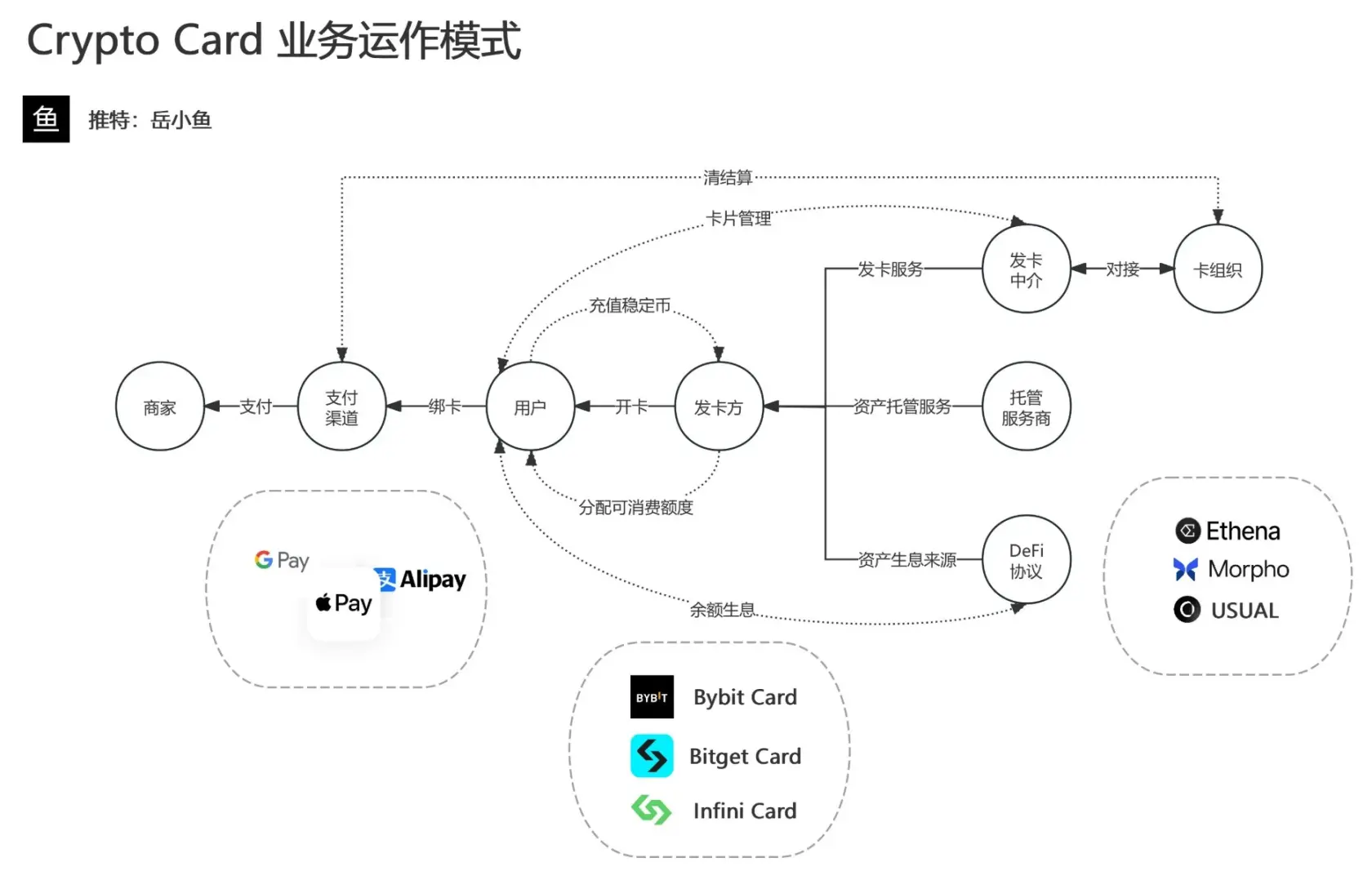
Image source: X: Yue Xiaoyu
Growth Tool: Booming Demand Side
According to a report by The Brainy Insights, the global crypto credit card market was valued at $25 billion in 2023, and it is expected that the crypto payment card market will exceed $400 billion by 2033. The influx of major protocols into the payment card business is essentially a growth battle. Although the profit share of payment cards themselves is relatively limited for protocols, the payment card business holds extremely high strategic value in user acquisition, ecosystem building, and capital retention. Therefore, exchanges, asset management companies, and Web3 project parties are still willing to invest, as it can bring broader user and business growth, and even further ecosystem expansion.
For the crypto field, the underlying demand based on payments has spawned many PayFi products. However, a survey by Bitget Wallet shows that despite the unique advantages of cryptocurrency payments in speed (46% of users chose this), cross-border costs (37% value low fees), and financial autonomy (32% pursue decentralization), the actual application scale still shows a significant gap compared to traditional payment systems. Currently, the traditional payment market is worth trillions of dollars, covering the vast majority of daily transactions globally, while crypto payments occupy only a tiny share, mainly concentrated in niche scenarios like cross-border remittances and digital asset trading.
The core reasons for users' preference for traditional payment methods can be summarized in three points:
- Trust and Security: Crypto users are concerned about the security risks of crypto payments (such as hacking and fraud), while traditional payments rely on mature banking systems, legal protections, and dispute resolution mechanisms, significantly reducing transaction risks.
- Stability and Convenience: Price volatility makes crypto payments difficult to serve as a stable medium of exchange, while the stability of traditional fiat currency is more suitable for daily consumption. Additionally, users believe that insufficient merchant acceptance limits the practicality of crypto payments, whereas traditional payments achieve seamless coverage through widespread POS terminals and online integrations.
- User Experience Inertia: Traditional payment tools have a low operational threshold, and users have formed long-term usage habits, while the complexity and technical barriers of crypto wallets become obstacles to widespread adoption.
Thus, as a bridge connecting crypto assets with the traditional payment ecosystem, the core utility of payment cards lies in leveraging existing merchant settlement networks to instantly convert crypto assets into fiat currency for transactions, thereby extending the utility of on-chain assets + real-world payment scenarios while reducing cross-border channel costs and price volatility risks.
Regulatory "Arbitrage": Avoiding Off-Chain Risks and Reducing Costs
Geographically, payment settlement providers are more concentrated in Europe due to the need to balance the dual compliance characteristics of cryptocurrencies and fiat currencies. According to research by Adan.eu, European countries have an average cryptocurrency adoption rate of over 10%, particularly prominent among young demographics and active fintech regions. Consumers' preference for flexible payment methods, combined with the expansion of the stablecoin ecosystem, makes crypto payment cards an important bridge connecting traditional finance with the Web3 world.
Moreover, due to the strong cross-regional circulation of the US dollar and euro, and the fact that payment cards often involve stablecoin payments, using crypto payment cards in certain countries to avoid systemic banking risks can help people achieve more flexible financial services. On the tax front, the process of cashing out crypto assets directly through channels with payment cards avoids some tax levies during transactions, which has become an opportunity for some users to use crypto cards.
In the context of imperfect regulation on the settlement side and on-chain, the existence of gray areas has attracted many payment providers, leading to potential money laundering and regulatory evasion. However, in terms of compliance, both Europe and the US are quickly advancing and implementing legislation related to the crypto market (for example, the EU's MiCA requires relevant business companies to apply for compliance licenses within EU member states to continue providing services, with restrictions on the scope of services), and such models will no longer persist.
Business Model: Connecting On-Chain and Off-Chain Asset Entry
On the settlement side, crypto payment cards exhibit diversified operational forms, among which the stablecoin - credit card/prepaid card form is the most common. The debit card model, due to its involvement in more complex fund management and risk control mechanisms, is only achievable by a few payment cards. When users have spending needs, they need to first recharge stablecoins into their accounts, and the corresponding spending limit in the card increases, allowing users to make various purchases with that limit. In this flow of funds, the conversion between cryptocurrency and fiat currency is involved, and issuers earn income through exchange rate differences, fees, etc. In the process of converting cryptocurrency to fiat currency, issuers generally charge a fee of 0.5% - 1%, making the recharge fees generated during user recharges an important source of income for the payment card business.
On-chain, some payment cards adopt a model that integrates with DeFi protocols, bringing idle funds in users' cards into yield-generating mechanisms. For example, through integration with DeFi protocols like Morpho, Infini can automatically deploy users' unspent stablecoin balances into yield protocols, allowing users to earn on-chain returns during consumption. In this model, issuers can not only obtain transaction revenue from traditional payment channels but also share part of the profits from DeFi earnings, forming a dual profit model. At the same time, users enjoy asset appreciation services that traditional bank cards cannot provide while benefiting from payment convenience.
Thus, from a revenue perspective, the model of crypto payment cards mainly consists of two parts:
On-Chain Tax: Reserve Asset Interest Income / Product Income
Stablecoin issuers earn interest by holding reserve assets (such as US Treasury bonds). In Q1 2025, Coinbase's stablecoin-related revenue was approximately $197 million, with annualized interest rates typically ranging from 2% to 5%. For users, before the advent of on-chain payment cards, there was no way to access such earning opportunities while using payment tools, and the integration of on-chain protocols eliminated this gap, providing a new idea for crypto issuers to innovate capital sinking channels while reducing the cost of capital introduction and transforming into alternative "asset management." After achieving a certain TVL scale in the future, crypto issuers can further innovate asset types and investment paradigms to create more value for users.
Off-Chain Tax: Fee Sharing Between Payment Card Operators and Issuers
When users pay using USDC through the payment card network (such as Visa), Visa typically charges an interchange fee of 1.5% to 3% of the transaction amount, which is generally borne by the user. Additionally, issuers may charge extra fees such as a 2% foreign transaction fee or ATM withdrawal fee. In these processes, most fees go to the settlement side, while issuers mainly bear part of the conversion process between cryptocurrency and fiat currency.
Future of Payment Cards: From Payment Tools to Ecosystem Entry Points
With the rapid development of blockchain technology and cryptocurrencies, crypto payment cards are no longer just simple payment tools but are gradually evolving into important traffic entry points for the crypto ecosystem. In the wave of the "on-chain liquidity battle," payment cards are not only consumption channels but also strategic strongholds for promoting the large-scale adoption of blockchain technology. Crypto payment cards allow on-chain assets to directly enter real-world consumption, shortening the path for users to enter Web3, such as:
- Users from the traditional financial world need to go through complex processes to transfer funds into the crypto market, while crypto payment cards allow them to use crypto assets more easily, achieving rapid off-chain integration.
- Exchanges and DeFi platforms are promoting the popularization of crypto payment cards, and while increasing channel traffic, they can organically combine with business operations to innovate and extend protocol functions to create profit points. For example, payment card users may receive platform points or token rewards with each purchase, which can further be used for on-chain investments, DeFi mining, or other ecosystem services, forming a positive feedback loop between users and platforms.
- New users can first use crypto payment cards for consumption and gradually enter the on-chain ecosystem. This "consumption-driven" user guidance approach is expected to become a mainstream traffic entry strategy for Web3.
Looking ahead, the competition for crypto payment cards will further shift from a single payment tool to an ecosystem-oriented, integrated financial platform. Project parties need to break the "short-lived" curse of crypto payment cards through technological innovation, compliance construction, and user experience optimization. Future crypto payment cards will not only be consumption tools but will also be comprehensive financial platforms integrating payment, investment, credit assessment, and ecosystem incentives. Through deep integration with Web3 elements such as DeFi, NFTs, and on-chain governance, payment cards will become the core entry point for users to enter the decentralized world.
 Risk warning
 Risk warning




Popular articles





