








The adult tiger transforms, Ethereum is undergoing a "rebirth."

 The revolution has begun.
Author: Fairy, ChainCatcher
Editor: TB, ChainCatcher
Ethereum is undergoing a profound "transformation."
On one side, the foundation is downsizing and cutting expenses, with an engineering focus becoming central; on the other side, capital-intensive layouts are emerging, acquiring public shells and making large purchases of ETH, building an Ethereum version of "MicroStrategy."
Foundation Begins "Surgery"
The Ethereum Foundation has begun "surgery." Recently, the EF has faced two major criticisms from the community: frequent coin sales and lack of transparency in accounts; and a team that is "retired" and inefficient. Now, the foundation is attempting to turn this situation around.
At the beginning of the year, the leadership of the Ethereum Foundation underwent a "major overhaul." However, just a couple of days ago, the foundation announced layoffs and directly renamed the "Protocol R&D" team to "Protocol," restructuring around three strategic goals: L1 scaling, blob scaling, and user experience optimization. Each direction has a clear person in charge and introduces a stronger accountability mechanism. In other words, EF will enter the "KPI" era, shifting from "talking vision" to "making products." (Related reading: 7 personnel adjustments, three new organizations, can Ethereum's "self-rescue" achieve rebirth?)

Bigger moves are happening at the financial level. Last night, the foundation updated its financial policy: annual expenditures cannot exceed 15% of treasury assets and are planned to be compressed to 5% over the next five years. Whether to sell ETH will be based on the operational buffer period (currently set at 2.5 years) and the fiat currency reserve ratio, dynamically adjusted each quarter, implemented through on-chain or fiat channels.
At the same time, the foundation has introduced the "Defipunk standard" to evaluate projects, emphasizing principles such as open-source, self-custody, permissionless access, and privacy protection.
This transformation from structure to system signals a deep transition. The Ethereum Foundation believes that 2025-2026 will be a critical phase for Ethereum, perhaps marking the beginning of Ethereum's efficiency engine restart.
SharpLink Enters, "Reform" Signals Emerge?
Ethereum is becoming a battleground for a new round of strategic funding. OGs are teaming up with the US shell company "Cash" to enter the market and attempt to connect with sovereign capital, and the funding landscape for ETH seems to be quietly becoming active.
The ETH version of "MicroStrategy" has begun to launch. On May 27, SharpLink Gaming announced the completion of a $425 million private placement and included ETH in its treasury. Shortly after, on May 31, the company plans to raise another $1 billion to increase its holdings. However, the private placement involved established institutions like Consensys, ParaFi, Pantera Capital, and Galaxy Digital, which heavily invested in Ethereum in its early days, indicating that a strategy led by OGs and resonated by top players is emerging for ETH.
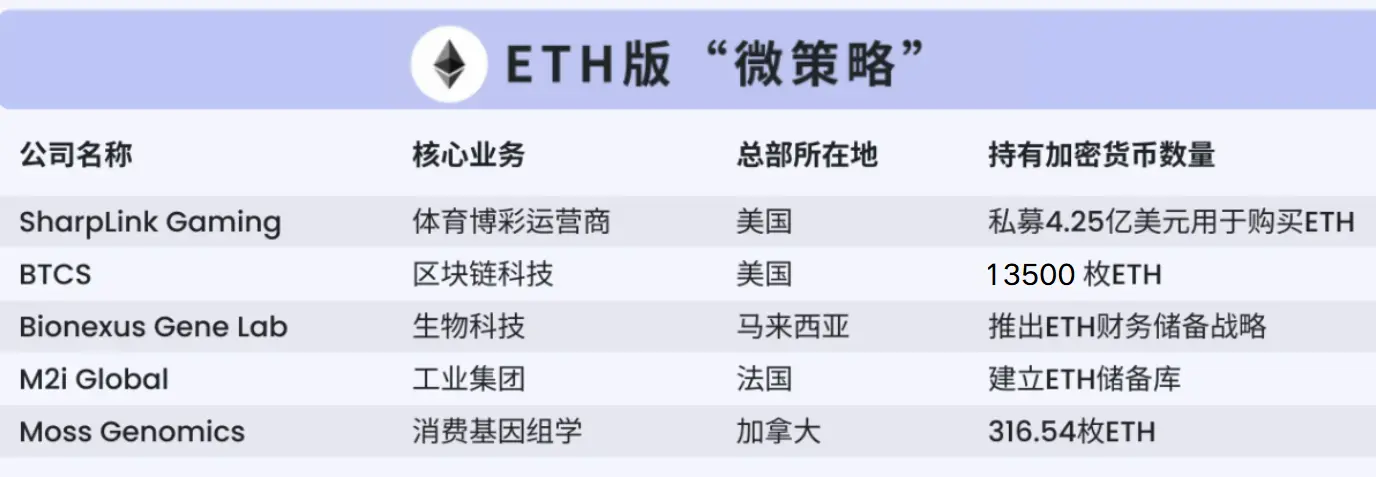
ETH version "MicroStrategy" collection
Meanwhile, Ethereum co-founder and Consensys CEO Joe Lubin stated that the company is in talks with a sovereign wealth fund and banks from a "major country" to explore building financial infrastructure on the Ethereum ecosystem. He hinted that these institutions may involve both layer one and layer two infrastructures, signaling the release of sovereign capital.
Funds in the market are also actively moving. Last night, a suspected Consensys-related address purchased $320 million worth of ETH from Galaxy Digital. It has currently staked $120 million worth of ETH through Liquid Collective, reflecting a long-term allocation intention.
Investment firm Trend Research has openly taken a long position on ETH, purchasing 8,846 ETH on May 27 for $23 million, with funds coming from borrowing against staked ETH on Aave to buy more, indicating leveraged accumulation.
Additionally, the US spot Ethereum ETF has recorded net inflows for 13 consecutive days, and the ETH/BTC ratio has risen about 30% over the past month, rebounding as much as 48% from the multi-year low of 0.01766 set on April 22.
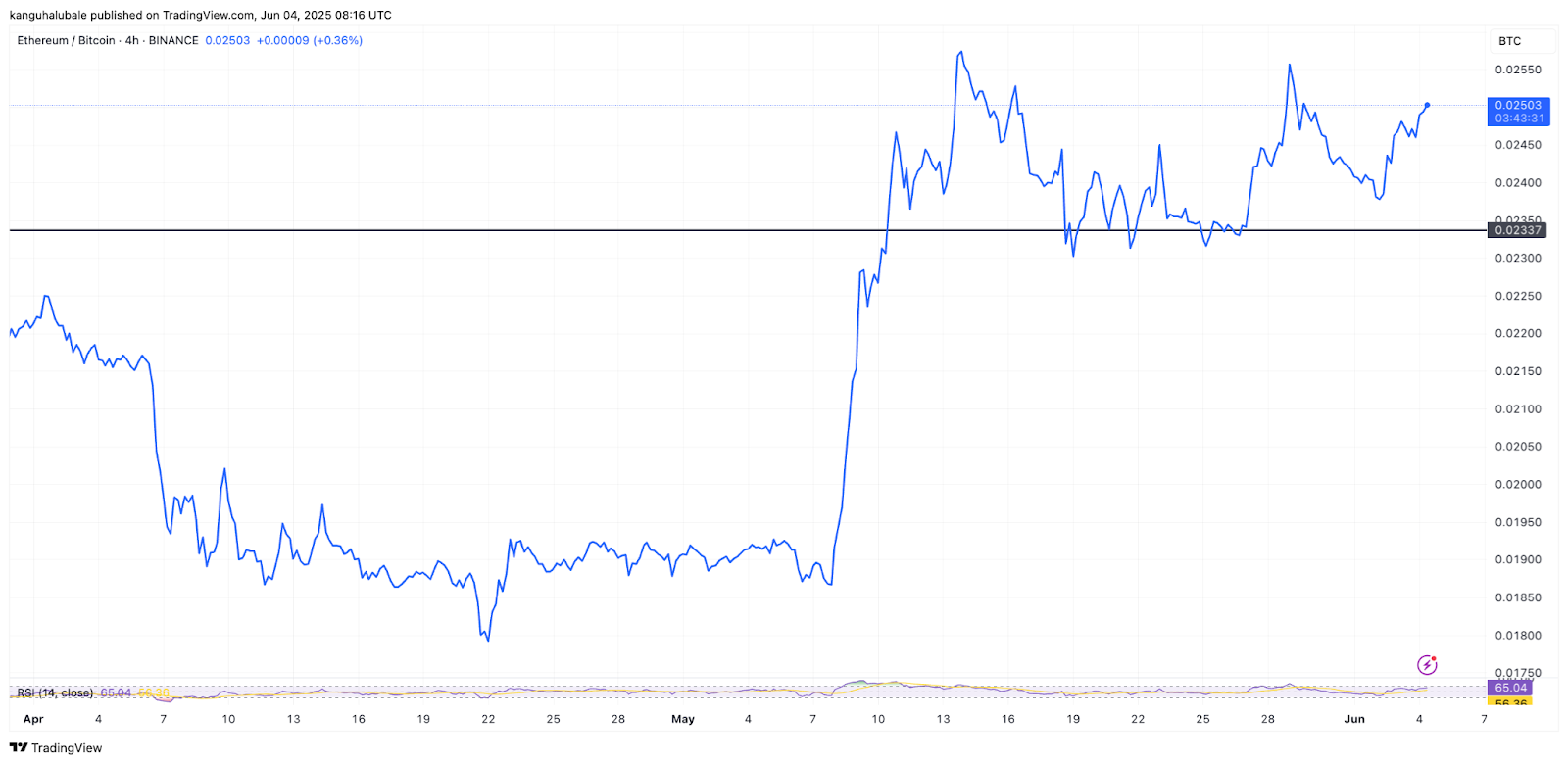
Optimistic Voices Resound Again
In the current context, more and more investors, institutions, and analysts are beginning to reassess Ethereum's potential and resilience.
10x Research pointed out in its latest market analysis that ETH's performance has far exceeded expectations. "Although we anticipated a pullback a few days ago, the actual performance has proven to be much more resilient than expected. From a technical perspective, Ethereum is approaching the apex of a large triangular consolidation structure, and the eventual breakout direction could push the price towards $2,000 or $3,000."
Institutional investors are increasing their bets. LD Capital founder Jack Yi stated that Ethereum's fluctuation cycle may be nearing its end, "we are basically fully invested," and have shifted strategies to ETH-based. He emphasized that as the Ethereum Foundation continues to optimize its growth strategy, the approval of ETFs, and the macro factors of M2 growth and interest rate cut expectations converge, the mid-to-long-term logic of ETH and its ecosystem is becoming increasingly clear.
The warming sentiment is also reflected in the community. KOL Blue Fox stated, "I originally thought Ethereum would take 5-10 years to reach a cognitive breakthrough moment like BTC in this cycle, but now it seems that it might be completed in 2-3 years; the world's frequency is accelerating."
However, confused voices also exist. Community user @diamondhandjs expressed, "From some indicators, ETH is not performing well, but OI continues to rise, as if something big is about to happen. Many third-party funds and bloggers on Twitter are bullish on ETH and have already bought in, but I have thought about it for a long time and still haven't grasped it."

Ethereum is striving to overcome its "midlife crisis."
The era driven by idealism and community faith may be coming to an end, as more pragmatic capital logic and institutional construction gradually take over the narrative. As a16z pointed out, the foundation model is struggling to adapt to the current pace of evolution; the crypto industry needs more efficient incentive mechanisms, clear accountability systems, and scalable structures.
 Risk warning
 Risk warning



Popular articles





