Overview of Characters in the Encrypted Dark Forest

 Provide a clearer perspective and learn to distinguish between narrative and reality.
Original Title: "Tokens are the new Herbalife. Parallelisms between crypto and Multi Level Marketing schemes"
Author: @VannaCharmer
Compiled by: Ismay, BlockBeats
Editor's Note: In the ongoing narrative flood of the expanding cryptocurrency market, tokens have long ceased to be merely vehicles for technological or financial innovation, instead becoming chips in a structural game. From exchanges, VCs, KOLs, to communities, airdrop players, and retail investors, everyone is caught up in a game of "who is the last buyer." This article does not attempt to deny the potential of crypto technology itself but reveals the obscured truths in the current token issuance and circulation mechanisms: how it operates like a multi-level marketing scheme and systematically concentrates benefits upwards. It is hoped that this article will provide you with a clearer perspective, helping you discern narrative from reality in a market interwoven with illusion and hope.
Here is the original content:
Cryptocurrencies are replaying the worst aspects of multi-level marketing—only this time, it's an internet-native version, more efficient in marketing but with lower transparency. Most tokens have evolved into a sophisticated pyramid scheme: those at the top extract maximum profits, while retail investors are left with a pile of worthless "air tokens."
This is not a coincidence, but a structural issue.

In traditional MLM schemes, such as Herbalife or Mary Kay, products are often overpriced and less effective than alternatives on the market. The core difference lies not in the products but in the sales method: instead of retail stores, individual agents purchase products first and then seek customers willing to buy from them.
The result quickly shifts from "selling products" to "recruiting others." Each person's motivation to buy products is not for personal use but to resell them at a higher price later. Ultimately, when the market is left with only "speculators" and no real users, the pyramid cannot sustain itself. Those at the top take all the asymmetric profits, while those at the bottom are left staring at a pile of unsold inventory.
Token Pyramid
The operational logic of crypto tokens mirrors that of multi-level marketing. Tokens themselves are the "products"—overpriced digital assets with almost no utility beyond speculation. Just like distributors in an MLM system, token holders do not buy tokens for use but to sell them to the next person at a higher price later.
This pyramid structure is similar to traditional MLM, but cryptocurrencies have their own unique ecosystem of participants, forming different tiers. Compared to traditional MLM products, tokens are a more ideal vehicle: they can leverage the internet and social networks more efficiently, are easier to trade and acquire, spread faster, and diffuse more widely. The operational logic is roughly as follows:
In traditional MLM, if you recruit downlines, you profit when they sell products or continue to purchase. The token play is the same: you get others to take your "goods" and recruit newcomers who join later than you. This benefits both you and those above you, as newcomers provide "exit liquidity," driving prices up. Meanwhile, newcomers, having also acquired tokens, will start promoting actively (now they have "goods" too!), while early holders can cash out at higher prices (the profit multiples increase!). This mechanism is identical to MLM, only more powerful.
The higher your position in the pyramid, the more motivated you are to continuously issue new tokens and push this play further.
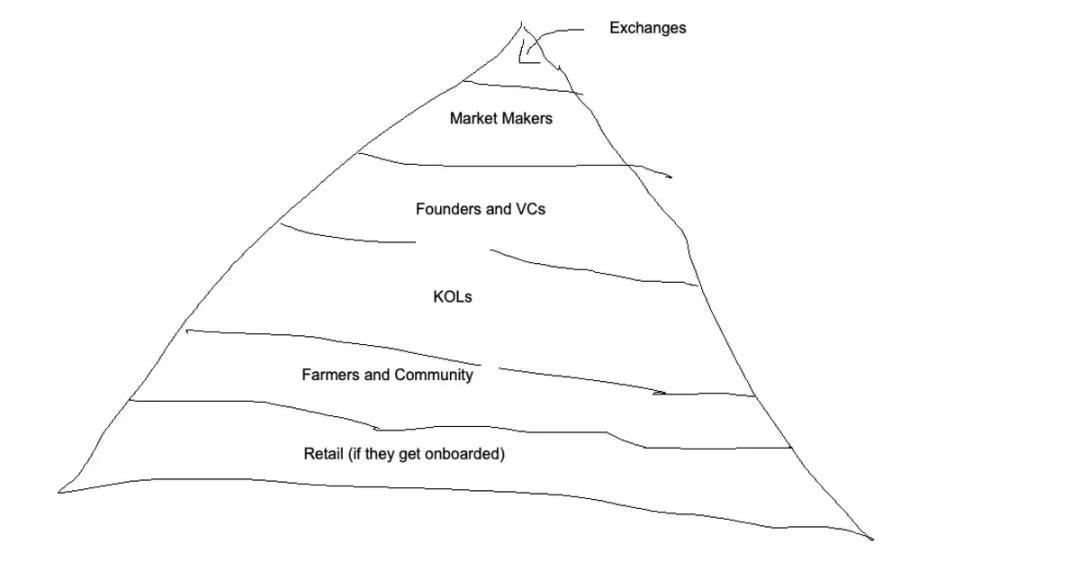
Divine Beings: Exchanges
At the top of the crypto pyramid are the true "deities"—the exchanges. Almost all "successful" tokens are underpinned by the deep manipulation of exchanges and their associated market makers. They control the distribution and liquidity of tokens; if a project wants to access the platform and gain distribution resources, they often must "tribute"—that is, give up a portion of tokens for free.
If you do not play by their rules, your token will not go live or will only remain in a liquidity-poor "hell," ultimately dying a quiet death. Exchanges can kick market makers out at any time, require project teams to provide tokens for their employees to cash out, and even unilaterally change service terms at the last minute. This hegemony is well understood by all parties, but they can only endure in silence—because this is the price paid for "liquidity" and "distribution."
For entrepreneurs, exchanges are an insurmountable wall. Whether or not a project can list on top exchanges often depends on "networks" rather than the quality of the project itself. This explains why so many projects today feature "invisible co-founders" or "former exchange employees" who are responsible for networking and channeling. Without experience or connections, navigating the listing process is nearly impossible.
Demigods: Market Makers
Market makers, theoretically, are roles that provide liquidity to the market, but in practice, they often help project teams secretly offload tokens through OTC while using their information advantage to harvest ordinary users. They typically hold a considerable portion of the total token supply (sometimes several percentage points) and use this to manipulate trading, gaining asymmetric arbitrage opportunities. For tokens with a small circulating supply, this influence is greatly amplified, placing them in an extremely advantageous position in trading.
Earning money solely from "providing liquidity" is extremely limited, but reverse trading against unsuspecting users can yield substantial profits. Among all market participants, market makers have the clearest understanding of a token's circulation—because they know both the real market fluctuations and hold a large amount of tokens. They are at the pinnacle of information advantage.
For project teams, evaluating a market maker's "quote" is also very difficult. Unlike services like haircuts that have clear pricing, the price of market-making services varies by individual. As a startup, you have no idea which terms are reasonable and which prices are inflated, leading to another gray phenomenon: the proliferation of invisible co-founders and "market-making consultants." They pose as advisors, facilitating connections for you, but further complicate the token issuance process and increase the cost of competition.
Kings: VCs and Project Teams
Below the exchanges are project teams and VCs, who capture most of the value during the private placement phase. Before the public has even heard of a project, they acquire tokens at a very low price, then weave narratives to create an "exit liquidity" for offloading.
The business model of crypto VCs has become extremely distorted. Compared to traditional venture capital, achieving a "liquidity event" in the crypto industry is much easier, so they do not genuinely encourage long-term builders. In fact, the opposite is true—VCs can turn a blind eye to predatory token economic models as long as it benefits them. Many VCs no longer pretend to support sustainable businesses but systematically participate in and support various "pump-and-dump" speculative behaviors.
Tokens have also spawned a peculiar incentive mechanism: VCs, motivated to increase fund management fees, have an incentive to artificially inflate the valuations of their portfolios (essentially "harvesting" their LPs). This is particularly common with low-circulation tokens—they can use FDV to mark up the market cap, thereby inflating project valuations. This practice is highly unethical because once the tokens are fully unlocked, it is impossible to exit at those inflated prices. This is also one of the key reasons many VCs will struggle to raise new funds in the future.
While platforms like Echo have slightly improved this reality, behind the scenes of the crypto industry, there are still numerous opaque operations that ordinary investors cannot see.
Opinion Leaders: KOLs
Next down the hierarchy are KOLs, who typically receive tokens for free when a project launches in exchange for promotional content. "KOL financing rounds" have become the norm in the industry—KOLs participate in investments and receive full refunds after the TGE. They leverage their communication channels to obtain free tokens and then brainwash their followers, who ultimately become their "exit liquidity."
Soldiers: Community Members and Airdrop Hunters
The "community" and airdrop players form the bottom layer of the pyramid's labor force. They undertake the most basic tasks: testing products, generating content, and creating activity in exchange for token distribution. However, even these activities have now been "industrialized": rewards are decreasing while the work required is increasing.
Most community members often realize after working for free for a long time that they are merely outsourced marketing departments for the project team—only to see the project start dumping tokens ruthlessly after the TGE. Once they realize this, anger spreads, and they "take up arms." This "angry community" is extremely detrimental to projects that genuinely want to build products, as it creates additional disruptions and noise.
Chives: Retail Investors
At the very bottom of the pyramid are the ideal retail investors—the "exit channel" for everyone above. They are fed various narratives and stories, endowing an asset with "meme premium," attracting more people to buy in so that upper players like foundations can smoothly offload.
However, this cycle is different from before; retail investors have not truly entered the market. Today's retail investors are more cautious and skeptical, leaving community members holding a pile of worthless airdrop tokens while insiders have already cashed out through OTC. I suspect this is also why you often see people on social media angrily complaining about token crashes or worthless airdrops: because in this cycle, retail investors haven't really taken the bait, while founders continue to profit.
Consequences
The current crypto industry is not focused on building products but on crafting stories—telling a narrative of "high illusionary returns" to entice others to buy a certain token. Focusing on product development has become an unencouraged behavior (although this is slowly changing).
The entire token valuation system has become completely distorted, no longer based on fundamentals but rather on "market cap comparisons." The core question of a project has shifted from "What problem does this token solve?" to "How much can it rise?" In this environment, projects can hardly be reasonably priced or evaluated. What you are buying is not a company under construction but a lottery ticket; this must be recognized when investing in cryptocurrencies.
The script for selling narratives is very simple: just concoct a "story that sounds reasonable but is actually unpriceable," such as:
"This is a stablecoin project backed by Peter Thiel, and its token can be seen as an indirect exposure to Tether equity. The appeal of this token lies in the fact that Circle has a market cap of $27 billion, while Tether's revenue and profits far exceed Circle's, with lower operating costs. Currently, there is no product on the market that allows you to invest directly in Tether, and this token perfectly fills that gap! They are also building infrastructure similar to Circle's payment network and plan to introduce privacy features. This is the future of finance, with a market cap potential of $100 billion!"
If you want your friends to buy a token, this kind of narrative is very effective. The key is: the story needs to be "clear enough," but also "leave room for imagination," so they can envision a high-valued future.
What to Do Next? Fixing the Market Structure of Tokens
I still firmly believe that the crypto industry remains one of the few fields that can bring significant asymmetric returns to ordinary people, but this advantage is gradually disappearing. Speculation is the core product-market fit (PMF) of crypto and was the initial hook that attracted market participants to what we are building. For this reason, we urgently need to fix the entire market structure.
The second part of this article will explore how platforms like Hyperliquid could potentially change the rules of this game entirely.
 Risk warning Risk warning



Popular articles