








4E Insights: Bitcoin fluctuates at a high level, the crypto market undergoes a rational correction, and macro policies become key indicators

 The cryptocurrency market is experiencing high-level fluctuations, with Bitcoin consolidating in the range of $108,000 to $110,000, while Ethereum shows stable performance. The market is significantly influenced by macro policies, with U.S. economic data and Federal Reserve movements becoming the focal points.
1. Market Review: Bitcoin Consolidates at High Levels, Mainstream Assets Show Resilience
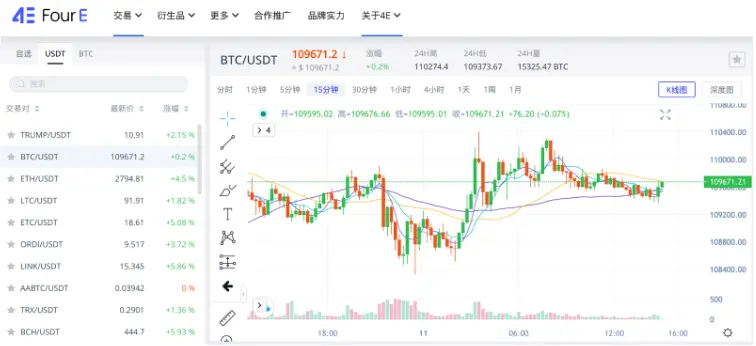
In the past week, the cryptocurrency market maintained a high-level consolidation pattern. Bitcoin (BTC) briefly broke through $112,000 in early June but lacked upward momentum, subsequently retreating to a consolidation range of $108,000 to $110,000. As of June 10, BTC was around $109,000, with the weekly increase narrowing to less than 2%. From a technical perspective, $105,000 has become a phase support, while $111,000 remains a significant short-term resistance.
Ethereum (ETH) showed relatively stable performance, hovering above $3,800. Notably, Ethereum-related investment products achieved net inflows for the seventh consecutive week, attracting $250 million in the latest week, indicating institutional confidence in ETH's long-term potential. Mainstream coins like Solana (SOL) and Chainlink (LINK) also recorded gains of 1%-3%, while some small-cap tokens like SUI and HYPE performed actively, with weekly increases exceeding 7%.
On-chain data further confirms a rational market trend: the balance of BTC on exchanges continues to decline, indicating that investors are opting for medium to long-term holding; meanwhile, the futures market has not seen large-scale liquidations, suggesting that the overall leverage ratio remains within a healthy range. Overall, while the current market lacks breakthrough catalysts, the fundamentals are stable and the structure is sound.
2. Macroeconomic Variables Influence Trends, Fed's Direction Becomes Market Focus
In the past week, the movements in the crypto market were largely influenced by macroeconomic expectations. In the U.S., investors are closely watching the upcoming May CPI and non-farm employment data. The market expects the CPI to remain around 3.3%, while the number of new non-farm jobs may slow to 130,000. If the data falls below expectations, it will further strengthen the market's bets on a rate cut by the Federal Reserve in September, which would be favorable for risk assets like Bitcoin and Ethereum.
Regarding the Federal Reserve, Chairman Powell's recent public statements have remained cautious, without making a clear stance on policy direction. However, based on the pricing of federal funds rate futures, the market's bets on at least one rate cut within the year are still rising. In this context, crypto assets, as tools for hedging against inflation and liquidity tightening, have once again become a "liquidity expectation barometer" in the eyes of institutions.
At the same time, the IPO plan of stablecoin issuer Circle has attracted widespread market attention. The company plans to list on the New York Stock Exchange this week, raising nearly $900 million, with a target valuation of about $7.2 billion. As the issuer of USDC, Circle's listing marks a new phase of integration between the crypto industry and traditional capital markets. Moreover, the "Payment Stablecoin Transparency Act" currently being advanced by the U.S. Congress, if passed smoothly, will provide a clear legal framework for the compliant use of stablecoins, further lowering the entry threshold for institutions.

3. International Easing Trends Emerge, Global Economic Outlook Under Pressure
In international finance, the European Central Bank (ECB) announced a 25 basis point cut in the main interest rate last week, marking the first rate cut since 2023. The decline in inflation and the slowdown in economic growth in the Eurozone are the main reasons for the shift in monetary policy. The market generally expects that if the Eurozone economy continues to weaken, the ECB will continue to release liquidity in the coming months, which will inject a mild easing signal into the global market.
Meanwhile, the World Bank has lowered its global GDP growth forecast for 2025 to 2.3%, warning that the global economy may be entering its weakest growth cycle since the 1960s. North America and Europe face higher structural risks against the backdrop of expanding fiscal deficits, geopolitical tensions, and rising trade frictions. In the UK, the latest unemployment rate has risen to 4.6%, a one-year high, reflecting the still fragile foundation of economic recovery.
For the crypto market, the global shift towards easing monetary policy is essentially a positive signal, especially as institutions seek non-traditional assets to optimize their asset allocation, enhancing the relative attractiveness of crypto assets. However, in an environment of high macro uncertainty, the market may still experience a period of volatility and fluctuations.
Opportunities in Rational Corrections
According to 4E observations, the crypto market is returning to rationality from overheating. Although there is a lack of strong catalysts in the short term, stable on-chain data, continuous institutional capital inflows, and a gradually clearer compliance path for stablecoins all provide support for the mid to long-term market.
In the coming week, market focus will center on: U.S. CPI and non-farm employment data, Circle's listing performance and regulatory progress, and subsequent actions of European monetary policy. Investors are advised to maintain a neutral position, focusing on mainstream assets like BTC and ETH, while being cautious of short-term corrections and waiting for the mid-term trend to clarify again.

About 4E: As the official partner of the Argentine national team, the 4E platform supports assets such as cryptocurrencies, gold, U.S. stocks, indices, and foreign exchange, offering one-stop trading for USDT. Recently, it launched a promotion for new users to receive 88U, providing trading benefits for investors. With 4E, investors can stay updated on market dynamics, flexibly adjust strategies, and seize every potential opportunity.
 Risk warning
 Risk warning



Popular articles





