








100,000 people left, those who lost money in Binance Alpha

 Will you continue to boost your score?
Author: shushu, BlockBeats
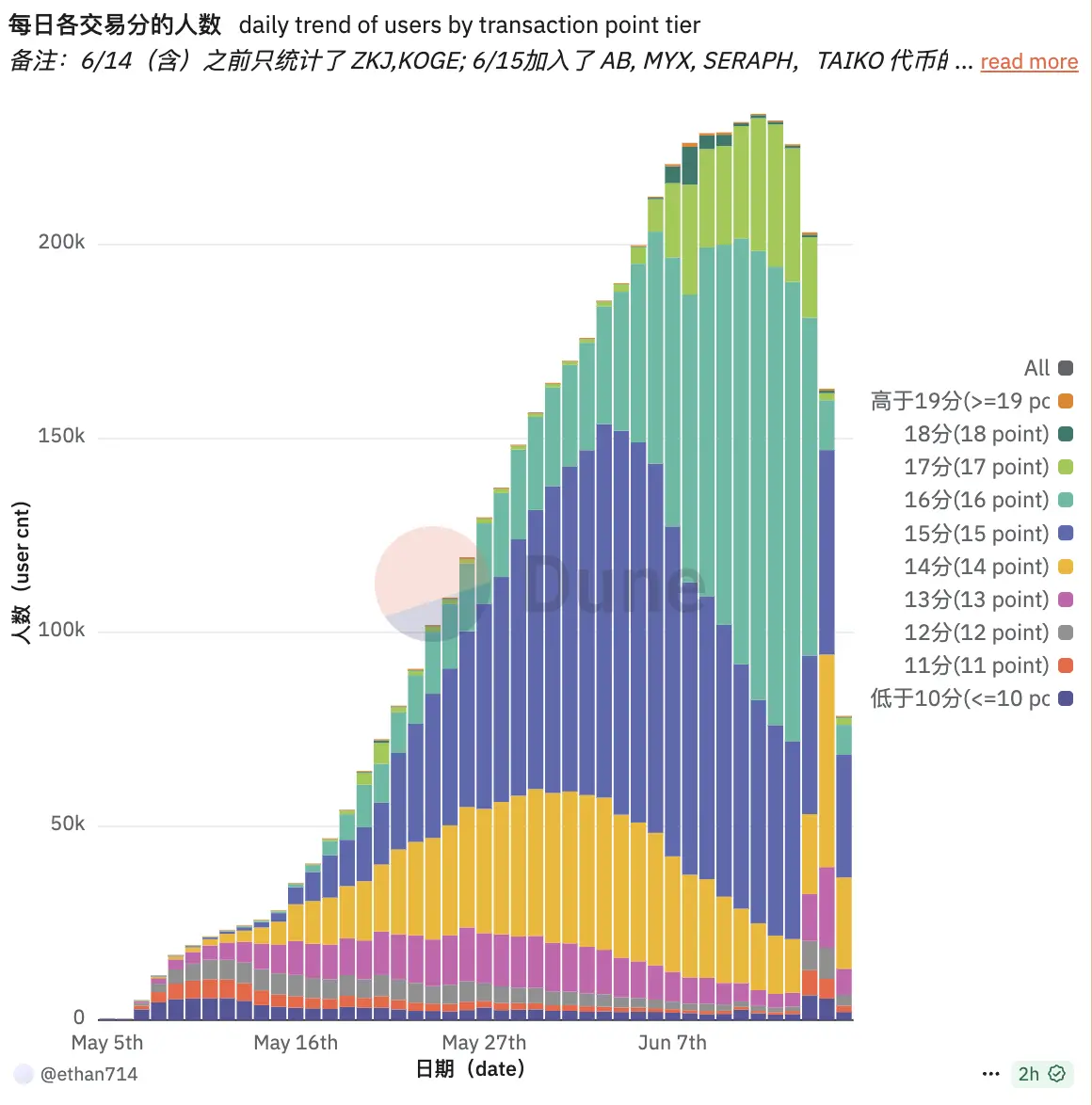
After the flash crash events of $ZKJ and $KOGE, the activity on Binance Alpha has significantly declined. According to Dune data, the number of Alpha trading users plummeted from a peak of 233,000 on June 12 to 195,000 on June 15, losing nearly 40,000 users in just three days, a significant drop. As of today, the actual number of users trading on the platform has further decreased to 70,000, indicating a sharp decline in user enthusiasm and willingness to participate. Meanwhile, the marginal cost of score manipulation has significantly increased, and the cost-effectiveness of Alpha games is rapidly deteriorating.
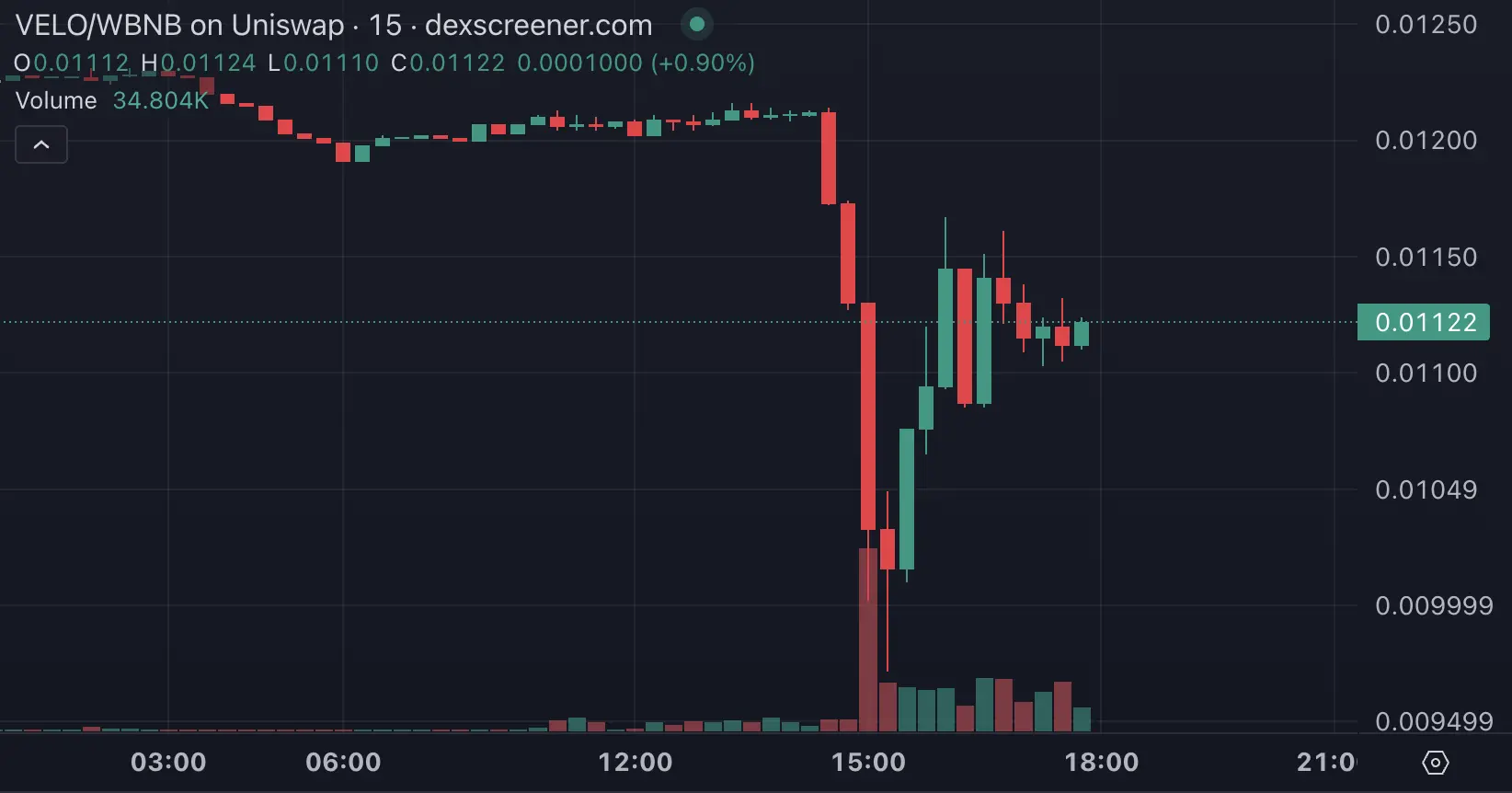
At the same time, some recently launched projects on Binance Alpha are showing signs of "immediate dumping" upon launch.
BlockBeats calculated the profits of the new points redemption project VELO on Binance Alpha. Under normal circumstances (with a $1,000 principal), the current Alpha user earnings are in a slight profit state. If trading between Alpha tokens is considered, daily trading wear and tear can reach $4, with expected earnings of $224 over 30 days, expected costs of $120 over 30 days, and expected profits of $104 over 30 days, averaging $3.5 per day.
Starting from June 17, 2025, at 00:00 (UTC), Binance Alpha officially implemented new rules, and the trading volume between Alpha tokens will no longer be counted towards Alpha Points calculation. This means that strategies relying on score manipulation pools like ZKJ/KOGE will no longer be effective, and users will face higher thresholds for obtaining points and more complex liquidity structures.
It is foreseeable that, affected by the sharp decline of $ZKJ, Binance Alpha's incentive model is entering an adjustment period. The direct consequence of this mechanism replacement is that a large number of users who were originally active in the Alpha ecosystem are choosing to leave. Some have lost money in the $ZKJ/$KOGE dual token pool, while others have found that the marginal returns from score manipulation have fallen below trading costs and are no longer willing to invest their efforts.
In this exclusive interview, BlockBeats spoke with several Alpha users, including LP providers who suffered actual losses during this round of decline and ordinary participants who attempted "score manipulation arbitrage" but did not achieve expected returns. Among them, some have decided to completely exit the Alpha game, while others are still hesitating whether to continue seeking new opportunities. Through their accounts, we can restore the true emotions and thoughts behind this "cliff-like exodus."
Those Who Gave Up
"The early returns were really high, and the transaction fees were low, especially since we were also benefiting from Adventure Island. By late May, I gradually added 20 accounts, and due to frequent face recognition, I handed over the account management to them, maintaining a daily actual trading volume of $16,000."
However, as the number of participants increased and competition intensified, Jiang Jiu noticed something was off by mid-June: "On the 14th, I sensed something was wrong; that day, a few accounts experienced significant losses, totaling 160 U, which was too unusual. But because I was troubled about how to change my strategy, I ignored the risks that might be coming or that I was unwilling to admit, and I still had too much hope."
Unfortunately, during the sharp decline of ZKJ, a friend of Jiang Jiu mistakenly thought he was urging him with the phrase "Have you finished manipulating scores?" and hastily increased his position in ZKJ, ultimately suffering a loss of up to 60%. Jiang Jiu recalled that he originally intended to wait for his friend to reply before reminding him not to continue manipulating scores and to observe the situation, but the other party misunderstood his intention and immediately entered the market. After buying, he found he could not sell smoothly and sought help from Jiang Jiu. Jiang Jiu did not have time to explain in detail how to quickly exit at a low price, ultimately leading to his friend helplessly watching the price drop. He admitted that the core of this loss was not luck but rather the costs of information judgment and communication.
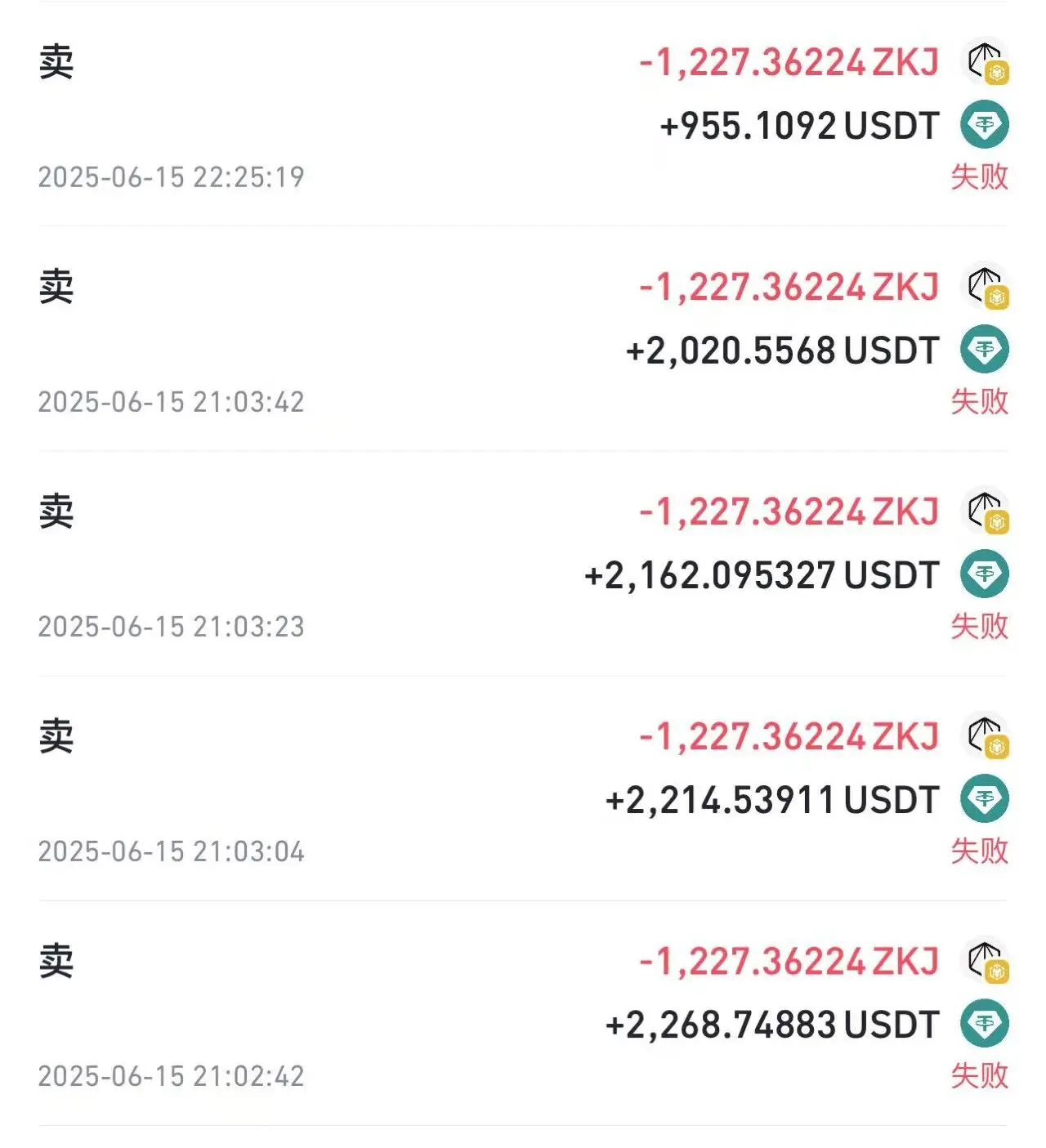
When asked if he had contacted the project team, Jiang Jiu stated that he had not sought feedback, "Such things are too common in the crypto circle. Unless the trading platform is willing to take the lead, otherwise retail investors losing money is just losing money, and there's no place to seek justice; one still has to be cautious."
He also added that since losing pools like ZKJ and KOGE, which had low transaction fees for score manipulation, the losses from score manipulation have significantly increased, with rewards dropping to around 50-60 U, while the score thresholds are getting higher. He is on the verge of giving up, "But I still want to struggle a bit to see the returns in the next few rounds; if it's unsatisfactory, I can only give up."
Unlike Jiang Jiu, Wen Xiang operates four accounts and had a total profit of about 5,000 U before the crash. He noticed the abnormal fluctuations in ZKJ the day before the crash, but because the price had rebounded at that time, it increased his sense of luck.
"The day before, I noticed ZKJ was fluctuating; I held on for an hour, saw it rebound, and even made a profit of 5 U. When the crash happened that day, I noticed the spikes were severe and thought it would be like the day before."
This sense of luck led Wen Xiang to continue entering the market with his second account after the first account was stuck with a loss of 30 U, "I thought it would be like the day before, with normal spikes, so I didn't move this account and continued with the second account for tasks worth 1,800 U, but then the second account also started to crash."
Ultimately, Wen Xiang decided to cut losses when the price fell to 0.8, with total losses exceeding 2,000 U, "I still didn't pay enough attention to the risks; I should have observed the pool size more. That day, there were indeed large withdrawals from the pool."
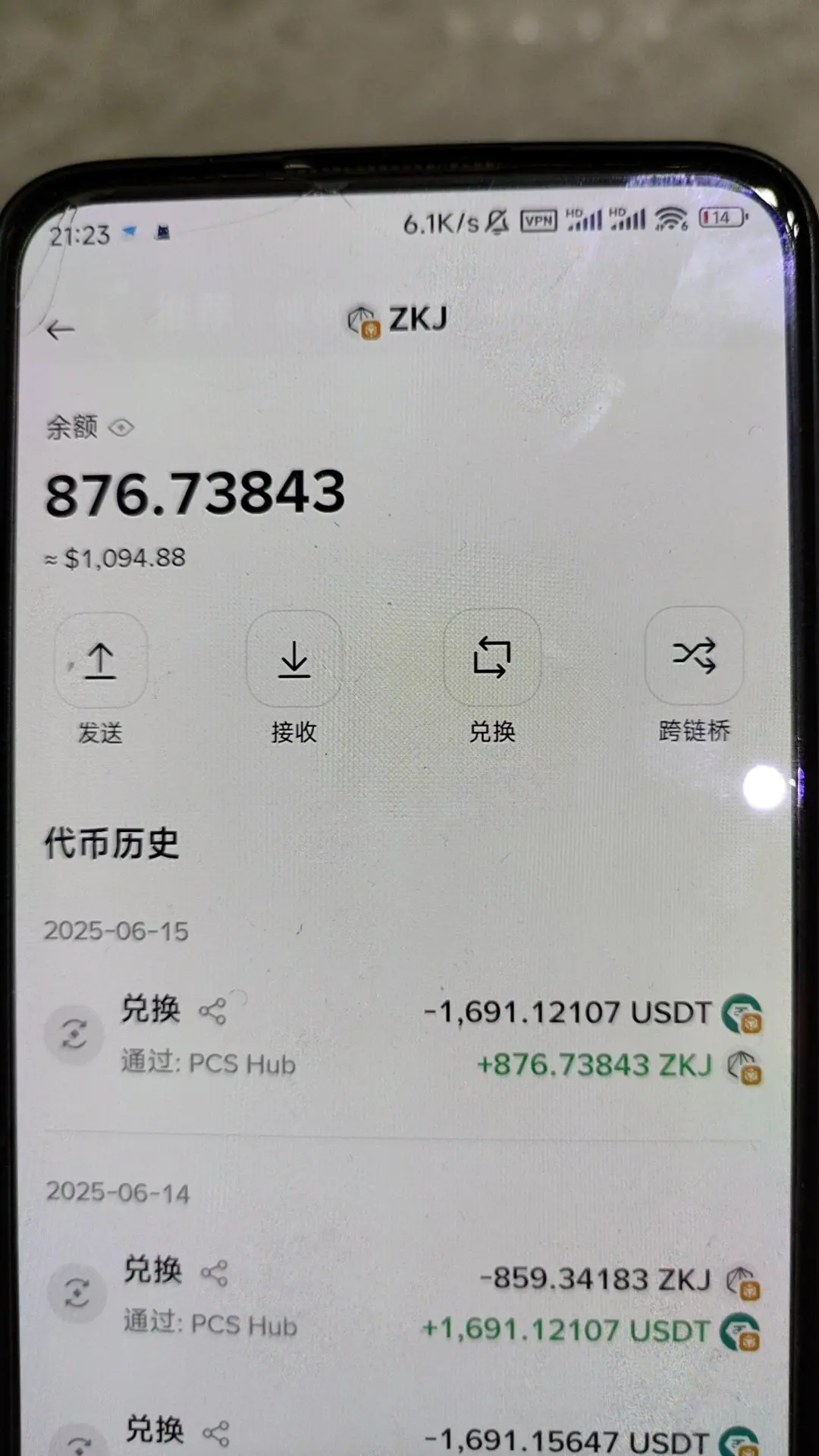
Wen Xiang believes the Alpha project is nearing its end, "The input and output are no longer proportional; being squeezed a few times makes it pointless. Today, all accounts have taken the minimum withdrawal."
Not only Wen Xiang, but several interviewees in BlockBeats also mentioned the declining input-output ratio of Binance Alpha, with many no longer choosing multi-account strategies.
The window of opportunity for Alpha may be closing.
Under Sunk Costs, Score Manipulation Continues
Jie Ge is a builder of a BSC ecosystem community and has been participating in Alpha activities since the initial Shell token offerings. As an information disseminator in the community, he also could not avoid this systemic risk.
"I felt it when 'stablecoins' were no longer stable; the price fluctuations would be significant. I actually sensed that a gray rhino was about to arrive. However, due to the management work of the accounts and the time spent on score manipulation, I couldn't control it in time," Jie Ge said.
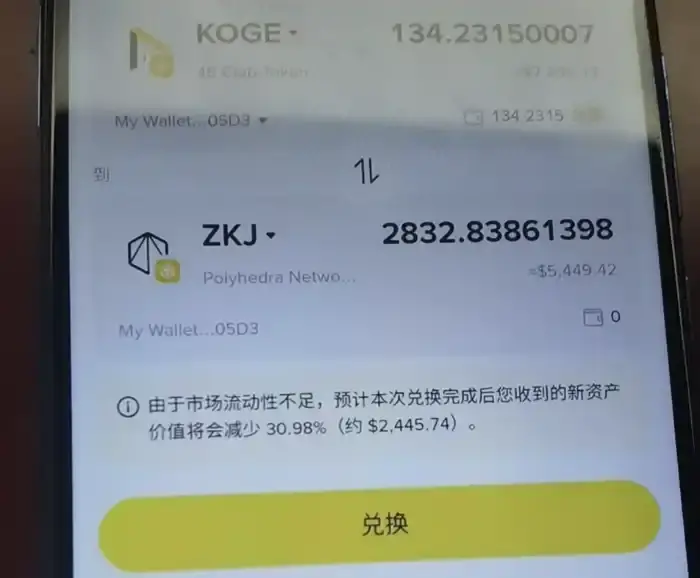
During the crash, Jie Ge immediately cut losses and notified group members, but still faced significant losses. He believes this loss cannot be entirely attributed to luck: "I can only say that I need to pay tuition to the market again. There are still many ways to avoid such situations. It's just that I happened to be doing large-scale score manipulation at this time, and both accounts were manipulating scores simultaneously, making it impossible to avoid being cut in half on the spot."
This experience made Jie Ge reflect on his risk control strategy, especially the importance of on-chain monitoring tools. He feels that he needs to introduce some on-chain monitoring tools in the future, "I felt the price of the coin immediately; as the pool's capacity decreases, the price will bring greater fluctuations."
Nevertheless, Jie Ge stated that he would continue to participate in Alpha, "If there are profits, it's worth continuing to work hard, and of course, I also look forward to more innovative and fair launch models from Alpha."
"The initial strategy was 33 times at the 60,000 level, then 66 times at the 130,000 level; I haven't calculated the profits in detail yet," Siner introduced. This high-frequency, high-amount trading strategy can bring considerable returns during stable price periods but also exposes greater operational risks.
His main losses did not come from market fluctuations but from human errors: "The losses mainly came from my own operational mistakes. The first was forgetting to sell Koge on the 16th, and then deciding to manipulate scores at the 130,000 level was a bit too aggressive. The account I forgot to sell has now dropped from 1,000 U to 400 U."
Large-scale account operations also brought efficiency challenges. "I usually finish all tasks in 1-2 hours, but the workload at the 170,000 level was too large, leading to continuous manipulation for four or five days, resulting in empty manipulations."
Unlike users who are leaving the market, Siner remains confident about Alpha's future. When asked if he would continue to manipulate scores in Alpha, Siner stated, "I must continue; I just found a no-loss method." This means he will continue to seek speculative opportunities in the Alpha ecosystem, even after the rule adjustments.
For Tian Ge, who did not suffer losses during the ZKJ crash, exiting Alpha means that the sunk costs of early investments cannot be recovered, "I already have a sunk cost of 200 points; if I give up, it would be like throwing everything away. Moreover, if a good project comes to Alpha later, I could recover everything in one wave."
Tian Ge summarized the mentality of participating in Alpha projects—"Manipulating scores and harvesting rewards are all garbage projects; don't get emotionally attached."
Conclusion
Jiang Jiu admitted that the returns from score manipulation in Alpha can no longer cover operational costs, "Now the rewards are only 50-60 U, the score thresholds are high, and the trading slippage is increasing; I might only earn three or four dollars in a day." The collapse of ZKJ/KOGE took away not just the principal but also a low-cost arbitrage path. Once Alpha projects cancel the rule of counting trading volumes between tokens towards points, users will face higher trading wear and more complex score competition structures.
Binance Alpha was once seen as an innovative mechanism to revive on-chain activity and user participation, but the current points model clearly overestimates the long-term incentive effectiveness of trading volumes and LPs while underestimating the risks of structural runs.
With the implementation of Binance's new rules, Alpha is gradually shifting from a score manipulation arbitrage tool to an incentive mechanism that emphasizes real interactions and value capture. This means that obtaining points will no longer only consider trading volume or LP amounts but will lean more towards dimensions like holding duration, interaction depth, and real demand.
However, for many users relying on low-cost score manipulation strategies, this shift forces them to reassess the meaning of participation. If Alpha wants to restart its growth engine in the future, it must find a new balance between fair distribution and risk control mechanisms.
For users still exploring the Alpha ecosystem, it is advisable to strengthen risk management awareness, pay attention to pool structures, token fundamentals, and LP concentration metrics to avoid becoming the ones left holding the bag during the next systemic risk exposure. After all, in this constantly trial-and-error Web3 world, the window for arbitrage always exists, but the cost of stepping on landmines has never decreased.
 Risk warning
 Risk warning



Popular articles





