








Facing financial difficulties, is it challenging crypto companies? Can "X hegemony" resist?

 ElizaOS is being extorted, Kaito pays 2 million dollars every month... with no way out but to comply.
Author: Golem, Odaily Planet Daily
Since June, the crypto projects have faced a wave of account bans on X, with some official project accounts and related personnel's accounts being frozen en masse without warning. This includes the official ElizaOS account and its founder Shaw's personal account, the GMGN official account and its founder haze's personal account, and the pumpfun official account and its founder Alon Cohen's personal account. Initially, the community speculated about the motives behind X's bans, including project exit scams, regulatory pressure, and associations with "Bubble Mart" meme images.

Bubble Mart
However, among the various speculations, a more plausible reason relates to the illegal use of third-party crawlers by crypto projects. Crypto KOL AB Kuai.Dong stated that a credible explanation for this wave of bans is that it targets data scraping activities that do not go through the official API interface. He pointed out that if a company retrieves 200 million tweets per month through X's official interface, it must pay over $200,000. Many projects, such as gmgn, ai16z, and eliza, opted to save costs by using third-party crawlers for data, leading to their collective bans.
On June 18, ElizaOS founder Shaw posted on the Farcaster platform accusing X of extorting him under the pretext of unblocking his account. He stated that X cited his open-source code, claiming that he violated certain terms of service, including selling data and bypassing the API key to sell certain content. He mentioned that if Shaw was willing to pay $50,000 per month for an enterprise license, they would stop harassing him. However, Shaw already pays $1,000 monthly for "yellow label" certification and $200 for developer licensing. Therefore, Shaw deemed this unreasonable and stated he was considering legal action.
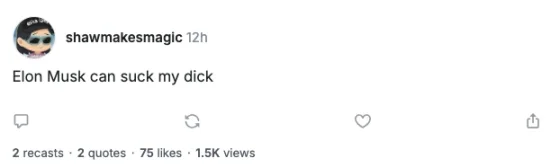
Shaw angrily criticizes Musk on the Farcaster platform
Following Shaw's revelations, the community speculated that the accounts of pumpfun and GMGN might have been unblocked or that they compromised on X's "unblocking conditions." After the unblocking, GMGN suspended its X monitoring and crawling tools, while Pumpfun removed its sniping/tracking features.
To get closer to the truth, Odaily Planet Daily sought confirmation from GMGN regarding the reasons for its ban and unblocking, but GMGN declined to make a public statement, saying, "We can't comment."
Is it a deliberate escape by crypto projects or X's greed?
Since Musk officially became the owner of Twitter (now renamed X) in October 2022, X canceled the free API and fully implemented a high-priced payment strategy in 2023. Since then, many companies have had disputes with X over hidden charges related to the API and forced upgrades to the enterprise version. However, this time, crypto companies have been collectively targeted.
In October 2024, Ervin Kalemi, founder of the social media management platform Publer, publicly protested X's hidden charges on the X platform. He stated that Publer had originally subscribed to X's enterprise-level API ($42,000/month), but starting November 1, 2024, X informed him that in addition to the original monthly fee, there would be an extra charge of "$1 per connected account/month," meaning Publer would have to pay tens of thousands of dollars more each month.
In early 2025, users reported that X began cracking down on companies that used user-provided API Keys (BYOK) to bulk pull X data for clients, including commercial data integration/ETL service providers like Fivetran, Airbyte, and Stitch. The requirement was that they must upgrade to the most expensive enterprise API, and some companies had already received legal letters from X's legal department.
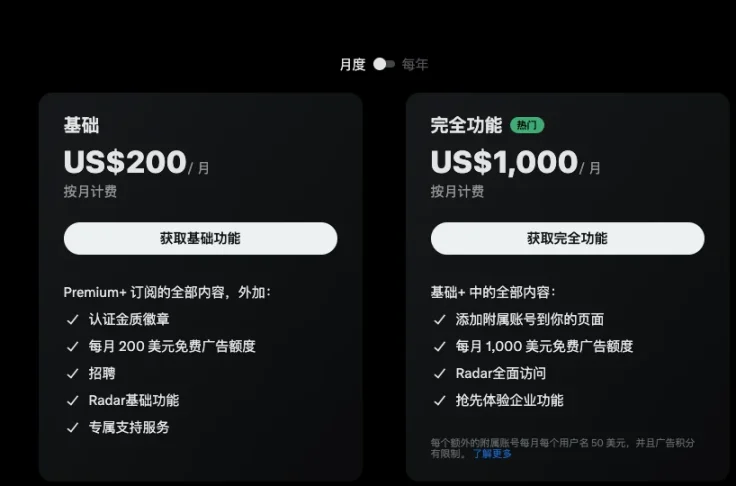
According to the pricing information released by X, upgrading an X account to the enterprise gold standard costs $200 per month for the basic version and $1,000 per month for the complete version.
Regarding API pricing, X's official pricing is mainly divided into three levels. The basic version costs $200 per month, the professional version costs $5,000 per month, and customized pricing is required for enterprises and large-scale projects.
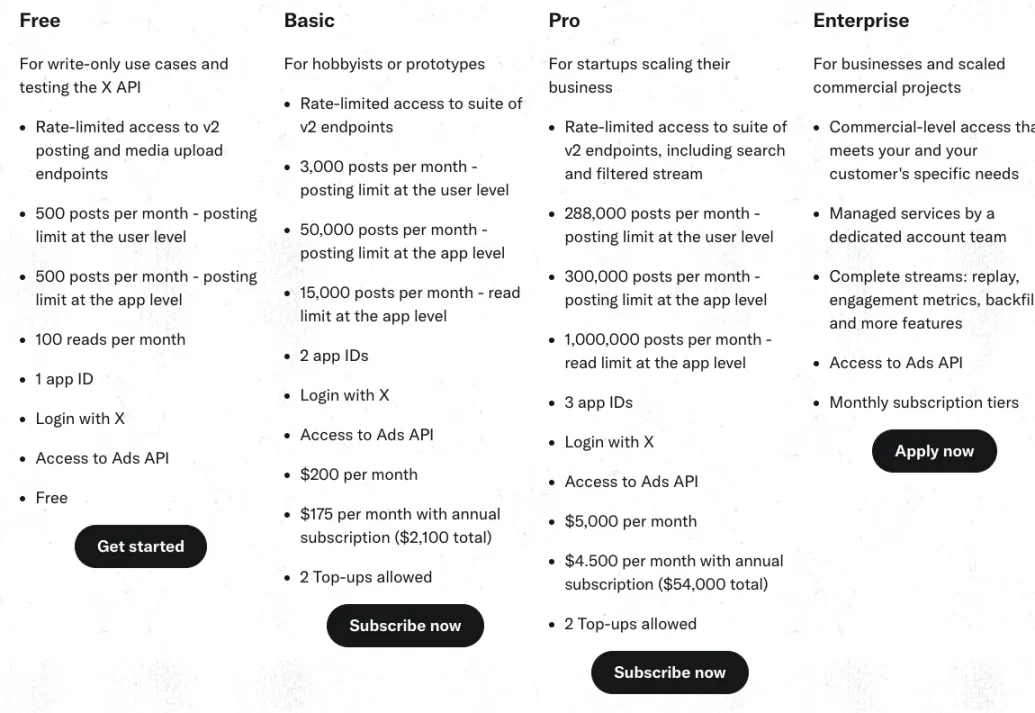
X platform API pricing standards
From the above pricing standards, it is evident that X may indeed have hidden charges and "extortion" practices against companies. The existing pricing standards do not provide detailed explanations of what scale and nature of companies need to apply for customization, and the pricing standards for customized enterprise versions are not publicly transparent. Is the API pricing for different companies merely dictated by X's monopolistic position? For companies, X holds the power of life and death over platform accounts and can ban accounts at will. If companies do not agree to the pricing scheme or delay negotiations, the ultimate victim is the company's interests. In such cases, most companies will choose to "pay up."
Financial Pressure Behind X Platform
Wielding the power to ban accounts as a threat to compel companies to pay may be a "dirty trick" devised by Musk to save the X platform. Before Musk fully privatized Twitter, the platform had been operating at a loss for years. Since its IPO in 2013, Twitter only turned a profit in 2018 and 2019, while the rest of the fiscal years were in the red. In the last fiscal year before Twitter was privatized by Musk—2021—the loss still reached $221 million.
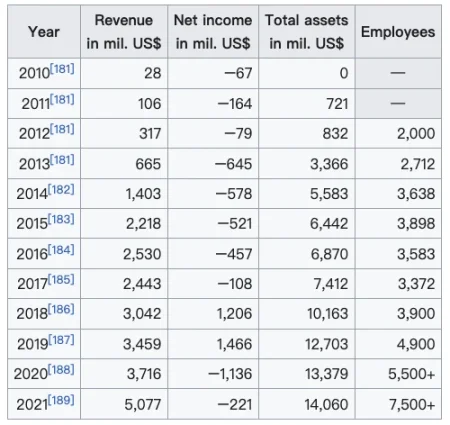
Twitter's profit and loss from 2010 to 2021, source: Wikipedia
Years of losses also led Musk to implement the X platform API charging model in March 2023. According to publicly available data, paid APIs contributed approximately $900 million in revenue to the X platform in 2023, accounting for 26% of total revenue; advertising revenue remained the primary source of income for X, amounting to about $2.5 billion, accounting for 75%; other income came from XPremium subscriptions and enterprise gold certifications. Although API charging began in 2023, Reuters reported that due to a 50% drop in advertising revenue and heavy debt burdens, Twitter's cash flow remained negative in 2023.
Since Musk privatized Twitter in 2022, he has not publicly disclosed financial data, but we can infer from third-party information that its financial situation in 2024 is also not optimistic. In February 2025, Musk stated in an email to employees, "Our user growth has stagnated, and revenue is disappointing; we are barely maintaining a balance." The bulk of its expenses comes from the high debt costs accumulated during Musk's acquisition of Twitter. By the end of 2024, X had paid over $1.3 billion in annual interest alone.
Therefore, under immense financial pressure, X officials chose to reach into the pockets of companies that rely on the platform's API to generate revenue.
X Platform's Hegemony, Choking the Throat of Crypto Communication
However, facing financial pressure is not a justification for X to wield the ban hammer and impose hegemony over companies.
X's users span the globe, covering various aspects of entertainment, politics, and business, making it a crucial channel for brand promotion and market updates for companies, especially crypto firms. According to a survey by CoinGecko, 41.7% of crypto users use X as their primary social media platform, followed by Telegram and YouTube, while 73.8% of crypto users choose to obtain crypto news through social media platforms.
With a large number of crypto users and social data, X has become a cornerstone of the crypto industry, similar to public chains like Ethereum. Therefore, about 90% of crypto companies and KOLs choose to publish brand promotion and product update information on the X platform. Many Web3 task platforms also select X as their primary community interaction platform. If crypto is banned, it effectively cuts off the channels for crypto companies and KOLs to promote themselves externally.
On the other hand, the emerging Meme, AI Agent, and InfoFi sectors in the crypto industry in 2024 are highly dependent on the X platform. The vast majority of Meme coins were not only born on X but also spread and fermented there, which is a primary reason for monitoring X with sniping tools. Most AI Agents' social training data comes from X, and Agents choose to be active on the X platform, such as AIXBT and Eliza; InfoFi platforms are even more reliant on X, with "mouth-rolling" and KOL ranking data sourced from X. If X does not allow InfoFi platforms to use the official API, this sector may not exist, which is why Kaito is willing to pay $2 million monthly to X to maintain its existence.
This deep dependency makes X not just a bridge but also a shackle of power, firmly constraining the pulse of the crypto world.
The crypto industry, which advocates for decentralization, is highly dependent on a centralized platform, akin to freedom fighters voluntarily putting on shackles, which is both disgraceful and frustrating. At such times, people often think of those once-hopeful decentralized social utopias, such as Farcaster and Lens. While they understand the needs of crypto and financialization, unfortunately, they do not grasp social interaction and product development, making it difficult to illuminate the main channel of crypto social interaction.
This morning, I noticed that ElizaOS founder Shaw has deleted his post accusing X on the Farcaster platform. Does this mean Shaw has leaned towards "submitting" to X? If the crypto industry continues to hand over information sovereignty to X, its hegemony may impose sanctions at any time. When crypto companies become targets again, they can only swallow their grievances—"We can't comment."
 Risk warning Risk warning
Popular articles





