Crypto IPO season is coming? Circle's stock price keeps hitting new highs, and these 13 crypto companies are accelerating their journey to Wall Street

 Circle successfully listed on the US stock market, with its stock price soaring, significantly increasing market attention on cryptocurrency concept stocks. Meanwhile, benefiting from the continuous optimization of the regulatory environment in the United States and favorable policies, the cryptocurrency industry is experiencing a wave of enthusiasm heading to Wall Street, with more and more cryptocurrency institutions actively planning to enter the US capital market.
Author: Nancy, PANews
Circle has successfully landed on the US stock market, with its stock price soaring, significantly increasing market attention on cryptocurrency concept stocks. Meanwhile, thanks to the continuous optimization of the regulatory environment in the United States and favorable policies, the cryptocurrency industry is experiencing a wave of institutions rushing to Wall Street, with more and more crypto organizations actively planning to enter the US capital market.
Circle's Stock Price Surges Nearly 600%, Investment Institutions Begin Cashing Out at High Levels
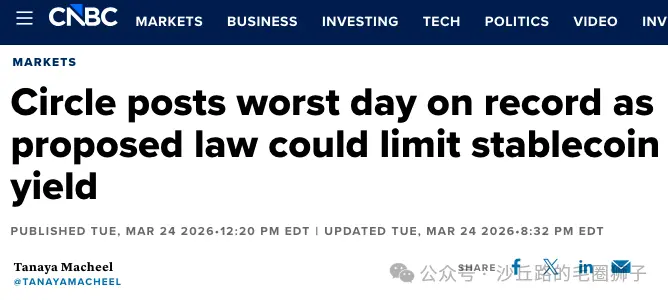
Recently, Circle's performance in the capital market has become the focus of the global financial market. Fortune magazine reported that Circle is one of the seven largest IPO underpricing cases in the past 40 years, and this stablecoin giant has skyrocketed since its listing, igniting market sentiment and demonstrating strong expectations for the future of the stablecoin industry.
As of the close on June 18, Circle (CRCL) stock price closed at $199.59, with a total market capitalization reaching $44.417 billion, approaching over 70% of the circulating market value of its stablecoin USDC (approximately $61.53 billion). On that day, the single-day trading volume reached an astonishing 63 million shares, surpassing the record of 60.7 million shares set on the second day of listing, marking a historical high. From the intraday high of $215.7, the cumulative increase from its IPO issue price of $31 reached as high as 595%, showcasing the enthusiasm of market participants.

In fact, since the first week of its IPO, Circle has consistently led the trading volume and increase rankings in the US stock market's cryptocurrency concept sector, driven by the premium narrative of stablecoins.
As Circle's stock price continues to rise, its CEO Jeremy Allaire recently emphasized on X that stablecoins may be the most practical form of currency in history, but the entire industry has yet to reach a critical juncture akin to the "iPhone moment." Once the stablecoin industry enters this phase, developers will be able to unlock programmable digital dollars like unlocking programmable phones, at which point digital dollars will unleash tremendous potential on the internet and bring widespread opportunities. This era may not be far off.
The capital frenzy surrounding Circle is not a mere market celebration but a resonance of policy turning points and ecological trends.
First, the regulation of stablecoins in the United States is reaching a critical turning point, with Circle, the first stablecoin stock, becoming the most direct beneficiary and the best target for investors' current bets. On June 17, the US Senate officially passed the GENIUS Act, marking the first time the US has established a regulatory framework for dollar-backed stablecoins in legislative form. This act not only requires stablecoin issuers to have clear reserve proof and auditing mechanisms but also paves the way for the legitimate existence of dollars on the blockchain. The next step is for the House of Representatives to pass it and for the President to sign it, after which the act will take effect.
Trump also stated in a recent post on his social media platform that the Senate has passed the GENIUS Act, which will promote large-scale investment and innovation in the digital asset field in the US, calling for the House to quickly pass a "clean version" and submit it to the President for signing. Meanwhile, according to former Fox Business reporter Eleanor Terrett, the US House of Representatives is considering advancing the market structure legislation CLARITY Act alongside the stablecoin legislation GENIUS Act to align with Trump's set legislative deadline in August.
At the same time, a continuous stream of positive news surrounding Circle and USDC further amplifies the market's imagination regarding its valuation. For example, Coinbase's derivatives platform plans to include USDC as collateral for futures trading by 2026; financial infrastructure provider OpenPayd has partnered with Circle to utilize Circle Wallets' infrastructure to provide a unified fiat and stablecoin infrastructure layer for global enterprises; e-commerce platform Shopify is collaborating with Coinbase and Stripe to promote USDC stablecoin payments; ProShares and Bitwise have submitted ETF applications based on Circle stocks; World Chain has launched native USDC, among others.
However, beneath the fervent market sentiment, there are signs of rational profit-taking. According to public disclosures, early partners announced they had sold all their CRCL shares after criticizing the low allocation of Circle's IPO. Ark Invest also bought $373 million worth of CRCL stock on the first day of listing but has recently reduced its holdings by approximately $96.46 million over two consecutive days, selling 300,000 shares. Although some of the reductions are part of normal liquidity management, in the context of continuous high increases, these actions may be interpreted by the market as high-level cashing out, and investors need to approach FOMO sentiment rationally.
13 Institutions Queueing to Rush to Wall Street, Exchanges Become the Main Force of Crypto IPO Wave
Since the beginning of this year, the trend of cryptocurrency companies going public in the US has accelerated. PANews has compiled a list of 13 crypto-related institutions that have clear plans to list on the US stock market.

From the perspective of institution types, exchanges are the absolute main force in going public in the US, with a total of six, including Gemini, Kraken, Bullish Global, FalconX, and Bithumb. These institutions generally have strong cash flow, a broad customer base, and a stable business structure, making them potential top performers in the capital market under a clearer regulatory backdrop. Meanwhile, the other seven cover investment institutions, custody, and mining, all seeking valuation reassessment and capital support in the US stock market.
It is noteworthy that among these 13 institutions, those from Asian or European backgrounds account for a significant proportion, with representative projects including TRON, Bithumb, and Animoca. These institutions choose the US as their primary listing location not only due to considerations of liquidity and valuation systems but also reflecting that the US remains the most attractive capital high ground for global crypto companies in terms of regulatory framework, capital depth, and institutional participation.
From a timing perspective, 2025 has become the target window for most crypto companies to go public, including FalconX, Bithumb, BitGo, Animoca Brands, and American Bitcoin. Many of these projects had previously attempted IPOs but were forced to delay due to market conditions or regulatory obstacles. Now, they are accelerating again in a favorable environment of regulatory clarity and market recovery.
In terms of progress, some institutions have entered the substantive preparation stage for listing, including submitting prospectuses to the SEC, hiring underwriting teams, and restructuring equity structures, being at a critical "last step" period, ready to officially enter the market once the capital window opens.
In terms of listing paths, traditional IPOs remain mainstream, especially favored by institutions with strong compliance capabilities and mature customer structures, such as Gemini, Bullish Global, BitGo, and FalconX. However, the traditional IPO process is complex and lengthy, making it more suitable for mid-to-large platforms with clear business models and robust profit models.
In contrast, reverse mergers have become a shortcut for many small and medium-sized crypto institutions due to simplified processes and faster speeds. For example, TRON and Nakamoto quickly entered the US capital market through shell listings, effectively avoiding the cumbersome IPO process while enhancing flexibility.
Another noteworthy path is direct listing. Kraken, valued at up to $16.2 billion, chose the direct listing method, foregoing new financing to focus on establishing liquidity and shareholder exit channels. This model is suitable for highly profitable, well-recognized brands that are less reliant on financing.
US Regulatory Environment Supports Crypto Listings, While Hayes Predicts a Similar Outcome to EOS
In this context, crypto capitalization is entering the fast lane. Behind this wave of listings is a significant improvement in the US regulatory environment. In fact, as early as last year, The Information cited industry insiders stating that after Trump's victory, investment bankers from top Wall Street institutions like JPMorgan, Goldman Sachs, and Morgan Stanley had been meeting with executives from cryptocurrency companies to seek opportunities for potential IPOs post-election.
David Bailey, CEO of Bitcoin Magazine, bluntly stated that now is a golden opportunity for crypto companies to go public, mainly for two key reasons: first, crypto stocks are performing strongly on Wall Street, and second, the regulatory environment is improving with the shift in policy stance.
JPMorgan also pointed out in a recent report that the advancement of the GENIUS Act is expected to continue improving the US crypto regulatory environment, prompting more crypto companies to seek IPOs. So far this year, the number of crypto company IPOs has matched the levels seen during the 2021 bull market. This wave coincides with the SEC's withdrawal of lawsuits against some of the industry's largest companies, including Kraken, Binance, Ripple, and Coinbase.
Andrei Grachev, a partner at DWF Labs, believes that crypto projects should establish trading tools by listing on Nasdaq to attract traditional investors and convert them into long-term token holders through share sales, thereby aiding the development of the crypto market.
Meanwhile, Arthur Hayes, co-founder of BitMEX, recently revealed in an interview that his family office Maelstrom plans to raise investor funds to acquire specific crypto companies, especially those with very stable cash flows and strong profitability. The management structures of these companies may be restructured, while focusing on increasing new revenue sources. In the future, Maelstrom also plans to go public in the US through SPAC (Special Purpose Acquisition Company).
However, he also warned that the crypto industry is transitioning from the ICO boom of 2017 to an IPO frenzy from 2025 to 2027. This wave will end with a large IPO similar to EOS, which will attract a lot of fiat capital but perform poorly after opening. He believes that for new stablecoin issuers lacking channel support, even if they successfully go public, it will be difficult to maintain high valuations, and they may ultimately go to zero.
 Risk warning Risk warning