








Jump Crypto's Past and Present: The First Generation Crypto Gang of Wall Street, Evil Scythe or Paradigm Innovator?

 How do Chicago-style market makers become on-chain infrastructure promoters?
Author: Crypto Brave (@cryptobraveHQ)
There has been a hot topic online for a long time: Why does DeepSeek come from a quantitative company?
Few topics, like quantitative companies, have been discussed for years yet remain controversial:
Scalpers + Money Printing Machines vs. Tech Giants + Infrastructure Maniacs
From a technological perspective, it is the top institutions like Mirage Quant behind DeepSeek that relentlessly pursue microsecond advantages in high-frequency trading, delve into low-latency, high-performance trading systems, and leverage vast capital advantages, which directly foster the application of technologies like algorithms and AI in trading, thereby driving the paradigm shift in human technology.
There have been two previous paradigm shifts in the linkage between human currency trading and technological advancement. The quantitative company Jump Trading happens to be a participant and promoter of these two paradigm shifts.
The first shift was the transition of human financial trading activities from offline counter trading to online electronic trading. The internetization of trading enabled arbitrage and high-frequency trading through algorithms. At that time, three traders at the Chicago Mercantile Exchange sensed the opportunity and founded the predecessor of Jump Trading in 1999, quickly becoming a top global quantitative company.
The second shift was the rapid development of cryptocurrencies, which allowed many institutions to see the opportunities in this global, distributed cryptocurrency trading market, leading to the establishment of Jump Crypto. Jump brought Wall Street-style systemic trading strategies to crypto trading, market-making, investment, and project development, aiming to continue the glory of the previous version of traditional trading in the new version of Crypto and dominate the crypto market.
However, due to the collapse of the last cycle, Jump Crypto faced regulatory investigations for manipulating Terra (UST & LUNA), the sudden collapse of ally FTX, and the significant price drop of Solana, leading to a period of silence.
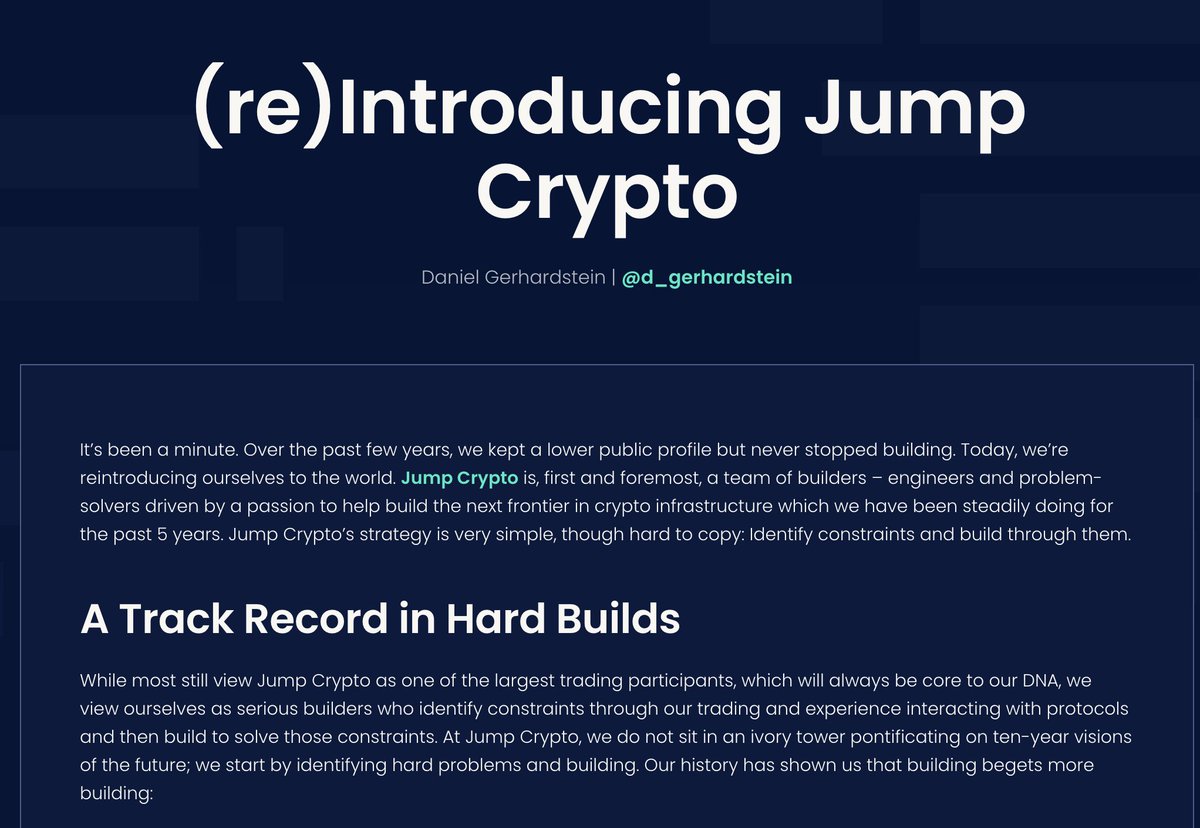
Recently, after a long silence, Jump Crypto @jump_ made its first high-profile statement, announcing a complete transformation from a liquidity provider to a core promoter of on-chain infrastructure, and rarely disclosing its progress in lobbying for U.S. cryptocurrency policy, attempting to rebuild market trust in the new crypto cycle through technological innovation and regulatory cooperation.
This article will be divided into three chapters to discuss the past and present of Jump Trading and the Jump Crypto series, with a total of about 4,000 words, no advertisements, and an estimated reading time of about 10 minutes.
Trade! Trade! Jump Born for Trading
In 2022, a report by Caixin titled "The 'Elephant in the Room' of China's Futures Market: Foreign High-Frequency Trading's Influence" publicly introduced the mysterious foreign high-frequency trading institutions, including Jump Trading, to the Chinese audience.
Jump Trading engages in specialized high-frequency trading by controlling a dozen "shell" companies under the name of trading firms, long occupying the top trading volume rankings for certain contracts on specific commodity exchanges in China's futures market. In 2020, Jump Trading's profits in China's futures market doubled year-on-year to 2 billion yuan. In the spot market, Jump Trading became the largest member of the Shanghai Gold Exchange, with a transaction amount in 2020 exceeding the combined total of ICBC and BOC.
This is just the trading scale and profits of Jump Trading in the mainland Chinese market. Jump Trading has teams in major global financial markets, ensuring its participation in trading on major global exchanges, covering various asset classes such as foreign exchange, stocks, futures, options, and cryptocurrencies.
Among these asset classes, Jump Trading's earliest and largest scale is in foreign exchange trading. The foreign exchange market and the cryptocurrency market share many commonalities: huge trading volumes, nearly 7*24 hour global markets, distributed decentralization, no mainstream unified licensed exchanges (most forex exchanges are registered in offshore jurisdictions or small countries), and numerous participants.
To maintain a competitive advantage in various complex and changing trading environments, Jump Trading has long invested substantial resources in algorithm development, data analysis, and high-performance computing (HPC), and has recruited top talents from mathematics, physics, and computer science globally to support its leading position in quantitative trading and fintech innovation.
To some extent, this also explains why DeepSeek comes from a quantitative company.
It is worth mentioning that another well-known derivatives cryptocurrency exchange, Bybit, also started with foreign exchange, but Jump Trading operates as a trading institution, while Bybit operates as an exchange.
Another interesting point is that due to the high similarity between the foreign exchange market and the cryptocurrency market, Jump Trading initially made tentative investments in the crypto field and treated its cryptocurrency business as a "testing ground" for interns, like a toy market, while isolating this part of the business from its main operations.
However, with the explosive rise of Bitcoin and the rapid emergence of the cryptocurrency market, this toy market for interns quietly changed everything.
Jump Crypto ------ The First Generation of Wall Street Crypto Gangsters
This year, there was a highly discussed post on Xiaohongshu where a Chinese student's parent mentioned that their child was interning at a quantitative institution in the U.S. with a daily salary of $7,500, shocking everyone. You read that right, a daily salary!
Moreover, this was not even the highest-paid intern, as finance interns from prestigious schools like NYU accumulated millions of dollars. This quantitative institution is Jump Crypto.
Interestingly, when Jump Trading established the Jump Crypto department in 2021, the new president Kariya was a 25-year-old Indian-American who had just a few months prior been an intern at Jump Trading.
During negotiations between Jump and Terra (UST), Kariya proposed a rescue plan that earned Jump a whopping $1 billion. A few months later, he was promoted to president.
After the establishment of the Jump Crypto department, it had three core businesses: trading/market-making, investment, and development, each of which has had a profound impact on the crypto industry. Some summarize it as: a Chicago-style high-frequency trading company, a venture capital firm, and a development studio.
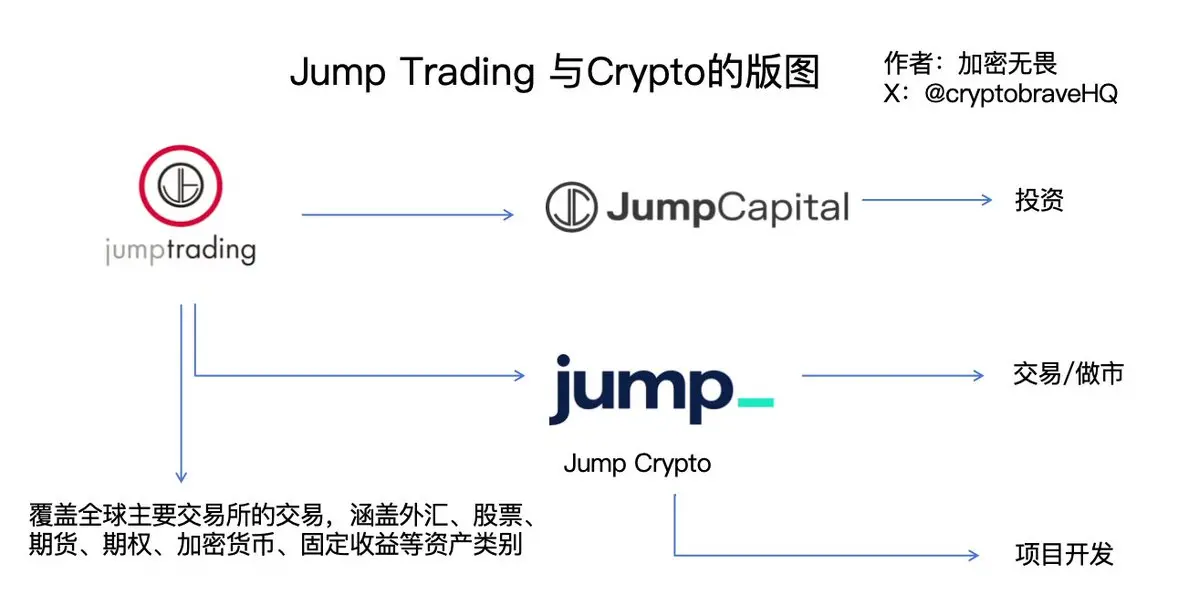
In trading and market-making, Jump Crypto was one of the largest market-making institutions by trading volume among major cryptocurrency exchanges in the last cycle.
Additionally, Jump Crypto's proactive market-making capabilities are absolutely top-tier in the industry. In multiple projects like LUNA and SOL, they have either openly or covertly taken positions, leveraging industry-leading market cap management capabilities to achieve substantial profits. By relying on strong capital, they reclaim circulating tokens of altcoins and then pump them to higher levels, profiting through derivatives; or they directly engage in mainstream coin trading based on subjective trading capabilities to gain significant profits.
Jump Crypto is also a major provider of on-chain liquidity, providing nearly a billion dollars in liquidity to stabilize UST, and investing heavily in DeFi and the on-chain world for mining, becoming one of the largest whales in mining, greatly expanding its industry influence.
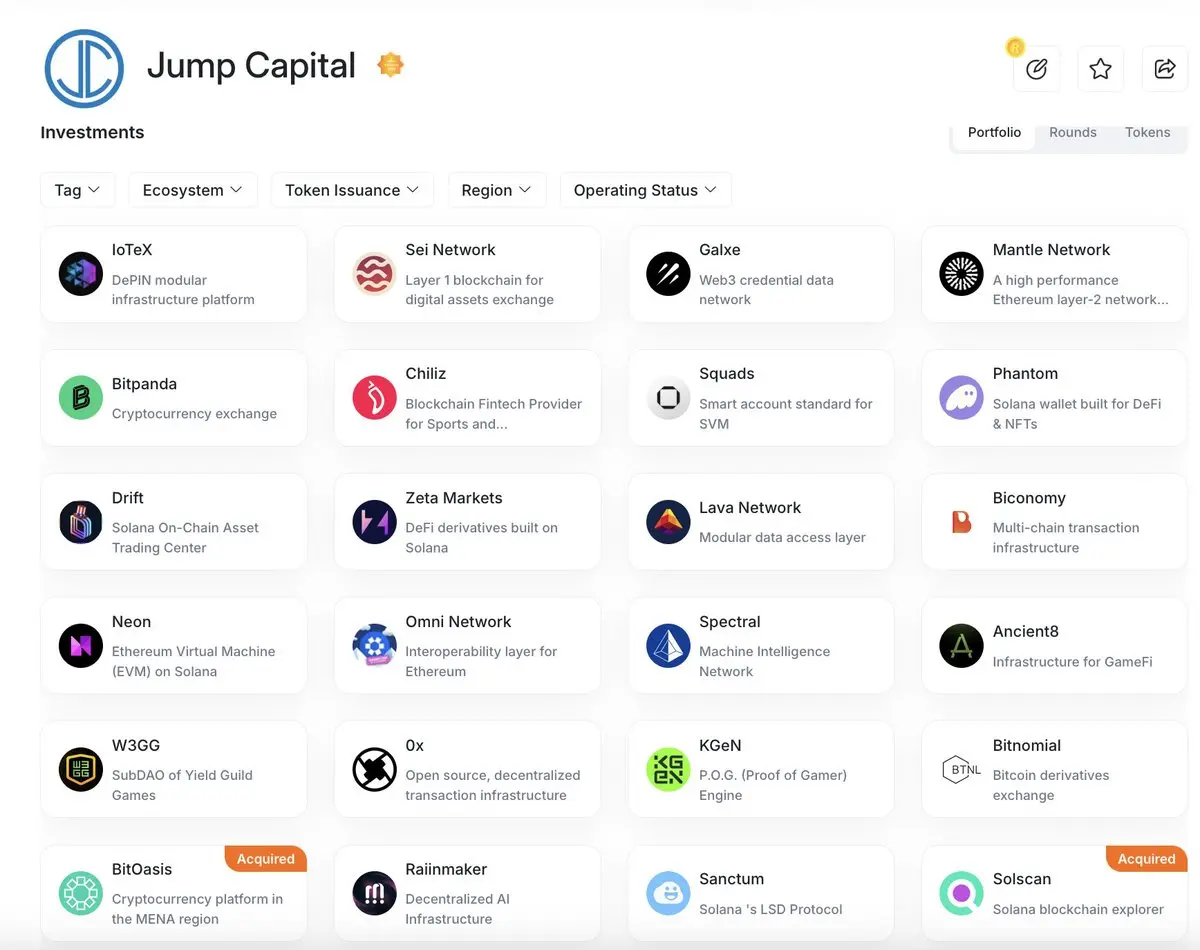
In terms of investment, Jump Capital has directly invested in hundreds of projects primarily in technology, AI, and blockchain, with over 40% being blockchain projects. Some star projects include: Phantom, the largest wallet on Solana; ConsenSys, a leading blockchain software company; Bitgo, an institutional-grade digital asset custody service provider; and TradingView, a price chart and analysis software.
In technical development, Jump Crypto has continued the trading mindset, internally developing projects like Firedancer, the next-generation client for Solana, as well as the oracle Pyth and the cross-chain bridge Wormhole.
It can be said that Jump Crypto covers almost all aspects from investment, trading/market-making, to project development, except for not operating an exchange, it is involved in everything related to trading.
The Wall Street-style systemic trading strategies it brought in the last cycle, relying on powerful capital operations combined with market-making and trading capabilities, opened up terrifying and diversified cash flow channels, making it the first generation of Wall Street crypto gangsters.
Driven by Trading to Build, Transforming into a Core Promoter of On-Chain Infrastructure
On May 22 of this year, at the Solana Accelerate 2025 event held in New York, the chief scientist of Jump Crypto's Firedancer studio presented a talk titled "Increase Bandwidth Reduce Latency," aimed at increasing bandwidth and reducing latency.
Supporters of Firedancer believe that this software, developed by Jump over several years, will give Solana an unmatched advantage in the race to attract global financial markets into blockchain. The theoretical speed of Firedancer is: one million transactions per second, several orders of magnitude faster than any current blockchain-based system.
However, so far, Firedancer has only launched some features, and the final version's release date has yet to be determined. Currently, only a small number of validators have adopted its early version.
But this has also drawn attention to a fact: Jump is crazily building infrastructure around crypto trading.
In 2022, after Jump Crypto faced regulatory investigations, Kariya, who had quickly risen from intern to president, also left Jump shortly thereafter. Jump Crypto gradually exited most of its crypto market-making business.
After that, the crypto market-making industry initially formed a triopoly among GSR, Wintermute, and Flow Trader, while other well-known market makers like DWF and Presto Labs also held a certain market share.
Despite subsequent reports that Jump Crypto was fully restoring its crypto market business, it has only been heard but not seen. If Jump Crypto wants to reclaim its market share in the crypto market-making field, it will likely face fierce competition.
Therefore, Jump Crypto has chosen to focus its full return on becoming a core promoter of on-chain infrastructure.
This is actually Jump's consistent approach: using trading to open up the situation and engineering solutions to address trading challenges. As Jump Crypto claims: Now is the best time to build a new financial track and a new organizational coordination layer.
These all stem from the limitations or challenges encountered in on-chain trading or construction processes in the real world. We will not accept these limitations but will solve them based on our motivations and beliefs.
In addition, Jump is not only involved in the development of infrastructure projects like Firedancer, Pyth, and Wormhole but has also laid out security-related infrastructure, including its self-developed self-custody wallet operating platform, Cordial Systems, which can provide enterprise-level digital asset wallet solutions for Jump and several centralized exchanges; the internally incubated security team Asymmetric Research has assisted in recovering over $5 billion in potential risks and has handled over 100 security incidents.
It is worth mentioning that Jump Crypto has rarely disclosed its progress in lobbying for U.S. cryptocurrency policy, attempting to rebuild market trust in the new crypto cycle through technological innovation and regulatory cooperation.
 Risk warning Risk warning





Popular articles





