The First Year of Global Stablecoins: A New Battleground Between China and the United States

 Onshore vs Offshore, Private vs Experimental Field, Chinese and American Giants Entering Stablecoins to Reshape Financial Order.
Written by: 1912212.eth, Foresight News
No one expected that during the pessimistic moment in the crypto space, where everyone was lamenting the lack of market innovation, the "stablecoin supercycle" mentioned by Paradigm founder Matt Huang would arrive. Since its listing on June 5, Circle, the first publicly traded stablecoin, has skyrocketed from $31 to over $298.99, achieving nearly a tenfold increase in less than half a month, with its exaggerated wealth effect once attracting insiders to rush into the crypto stock market for gold mining.
The heat of Circle's stock in the U.S. market has once again heightened the crypto community's attention to the stablecoin market.
Stablecoins were born in 2014 to address the issue of extreme price volatility in traditional cryptocurrencies. The USDT, launched by Tether, is one of the most representative stablecoins in the market, pegged to the U.S. dollar at a 1:1 ratio and supported by dollar asset reserves to maintain its value stability. The core idea of stablecoins is to use asset collateral to maintain value stability, allowing them to possess the convenience and decentralization characteristics of digital currencies while avoiding the trading risks brought by price fluctuations. In recent years, the adoption and application of stablecoins have grown exponentially, playing a key role in areas such as cross-border payments, DeFi, and RWA, with the DeFi sector becoming the foundational asset for lending, staking, and yield farming.
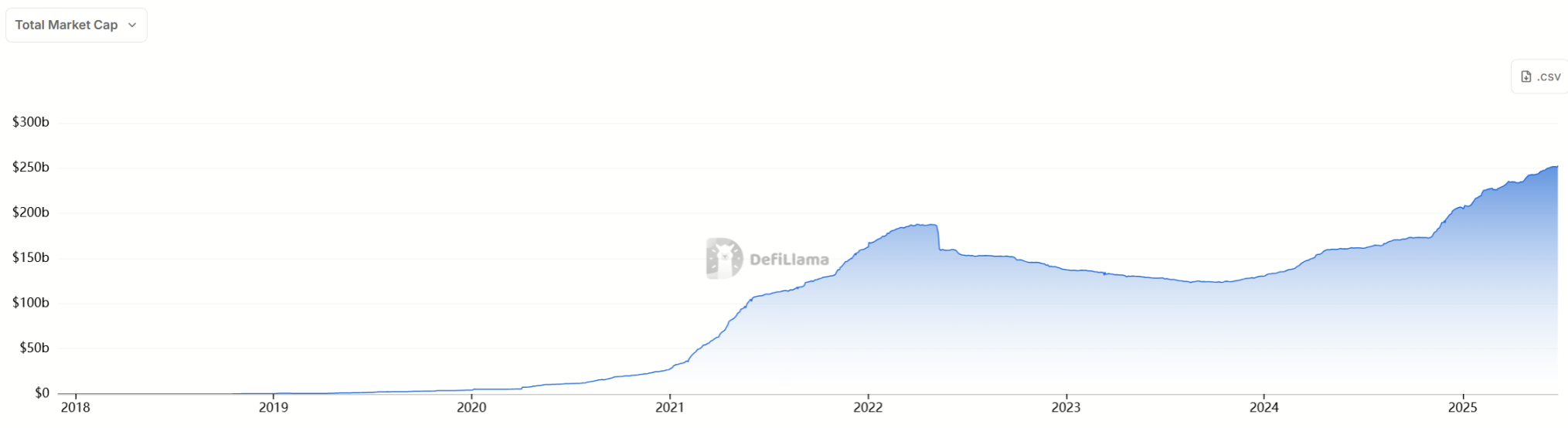
According to data from DefiLlama, as of June 25, 2025, the global stablecoin market size has surpassed approximately $252.9 billion, with USDT accounting for over 62% of the market share, followed closely by USDC, which together occupy more than 85% of the market. The on-chain trading volume of stablecoins reached approximately $20.2 trillion, nearly 40% of the transaction volume of global payment giant Visa, demonstrating their significant position in digital payments and cross-border settlements.
The craze for stablecoins has even reached the giants in China and the U.S. Since the beginning of this year, many global tech and financial giants have accelerated their layout in the stablecoin field, sparking a fierce competitive wave. In the U.S., PayPal announced that its dollar-pegged stablecoin PYUSD has been integrated into the Stellar network, focusing on cross-border remittances and financing for small and medium-sized enterprises; Walmart and Amazon are also actively exploring the issuance of their own dollar-backed stablecoins, aiming to reduce payment costs and create a closed-loop consumption ecosystem; Shopify has partnered with Coinbase and Stripe to support merchants in accepting USDC payments based on the Base chain, covering consumers in 34 countries.
The Asian market is equally lively, with Ant Group's Ant International and Ant Technology both applying for stablecoin licenses in Hong Kong, positioning Hong Kong as their global headquarters to promote the construction of compliant digital trading scenarios. JD Coin Chain Technology expects to obtain a license in the fourth quarter of 2025, planning to issue stablecoins pegged to the Hong Kong dollar and other currencies, focusing on cross-border payments, investment transactions, and retail payment scenarios.
The Trend of Stablecoins is Inevitable
Why have the giants from China and the U.S. chosen this moment to enter the stablecoin race? Is it a trend-following impulse or a well-considered strategic layout?
Fast, Low-Friction Characteristics, Naturally a Payment Tool
The traditional financial system faces many challenges in the digital economy era, especially in cross-border payments, fund clearing, and real-time settlement, where efficiency is low and cannot meet the rapidly developing needs of globalization and digitization. The traditional banking system relies on multiple intermediaries and cumbersome processes, resulting in cross-border transfers often taking several days and incurring high fees, severely restricting the liquidity and efficiency of funds. Additionally, traditional financial institutions need to redesign their business processes and product services during the digital transformation, and many users suffer from restrictions or even freezes on their bank cards due to policy factors.
In contrast, stablecoins supported by blockchain technology, with their value pegged to fiat currencies and stable prices, have become a more efficient and flexible "digital cash" in the digital age. Stablecoins can achieve fund transfers without intermediaries and with near-instantaneous settlement, significantly reducing transaction and time costs while improving fund utilization.
Imagine that you need to transfer millions of dollars to a friend in the U.S. All they need to do is provide you with a string of code, and within minutes, your funds will be transferred to their account, with fees under $1. No limits, no freezes, no hefty fees, no requirement for financial proof, and no days of waiting—these characteristics have absolute advantages in areas like cross-border payments.
In stark contrast, the arrogance of banks is everywhere. SIG partner Michael Yuan recently expressed his dissatisfaction with his experience at Singapore's DBS Bank, stating, "Just for receiving a bank transfer of 200 yuan, I was bombarded with inquiries. For a $1,000 bank transfer, I was asked to bring my passport to the bank headquarters and was questioned at the front desk."
Numerous users in mainland China have faced various inquiries from banks when withdrawing funds, often being required to provide various proofs to activate permissions, making headlines frequently.
Stablecoins possess programmability, making it easy to deeply integrate with innovative applications like DeFi, supporting cross-border payments, supply chain finance, retail consumption, and other multi-scenario applications. Research shows that replacing physical cash with stablecoins can not only maintain the credit intermediation function of the financial system but may also promote an increase in credit supply and drive the digital upgrade of the financial system. Therefore, stablecoins are gradually becoming an important bridge connecting traditional finance and emerging digital finance in the digital economy era.
The Battle for Digital Hegemony: Onshore vs. Offshore
The entry of giants from China and the U.S. into the stablecoin field is driven by a profound motivation: the competition for digital hegemony. U.S. Treasury Secretary Janet Yellen stated during a Senate hearing in June 2025 that stablecoins, especially those pegged to the U.S. dollar, will become an important tool for consolidating the dollar's position in the global financial system. Against this backdrop, some analysts predict that the market value of stablecoins could reach $2 trillion or even higher in the future.
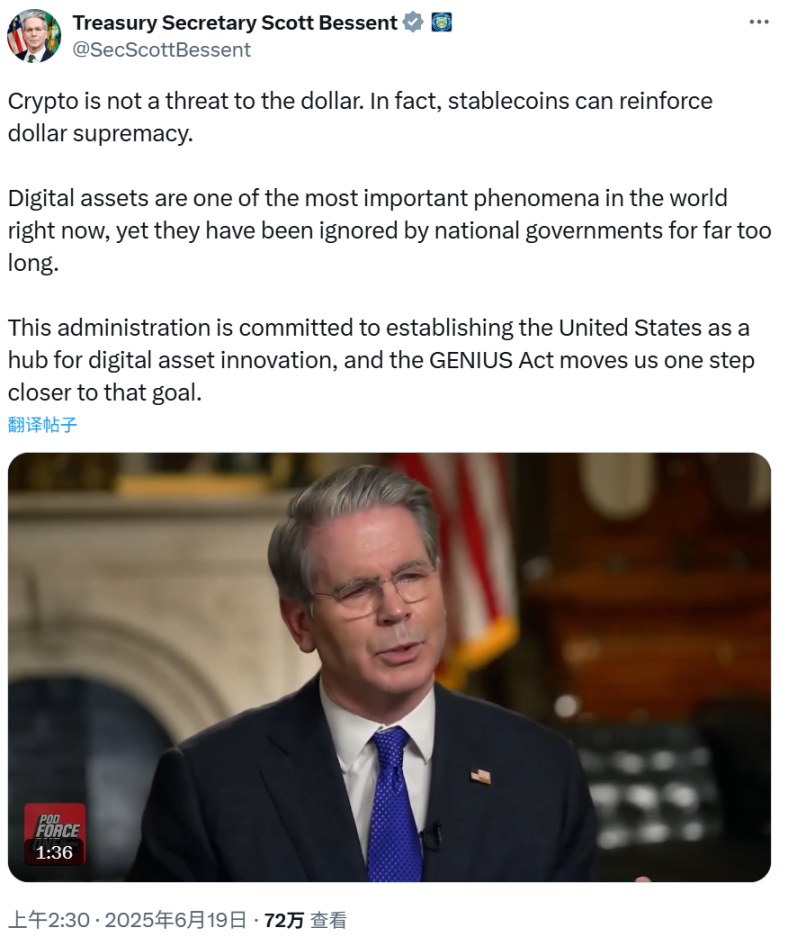
On June 19, Yellen even tweeted again, stating, "Cryptocurrencies do not pose a threat to the dollar. In fact, stablecoins can reinforce the dollar's hegemonic position. Digital assets are one of the most important phenomena in today's world, but have long been overlooked by governments. This administration is committed to making the U.S. a center for digital asset innovation, and the GENIUS Act brings us one step closer to that goal."
The U.S. government aims to strengthen the dollar's status as an international reserve currency by promoting the GENIUS Act to establish a federal regulatory framework for stablecoins, preventing other countries or digital currencies from challenging dollar hegemony. Meanwhile, retail giants like Walmart and Amazon are also actively laying out stablecoins, attempting to bypass traditional payment networks like Visa and Mastercard, saving billions in fees, and achieving instant settlements to gain greater voice and market share in the global payment system.
While U.S. giants are intensively laying out stablecoins, mainland China and Hong Kong are also accelerating research on stablecoins and opening the door to convenience.
At the 2025 Lujiazui Forum, the Governor of the People's Bank of China, Pan Gongsheng, announced the establishment of an international operation center for the digital yuan, launching a pilot program for offshore trade finance services in the Shanghai Lingang New Area. He also stated that new technologies such as blockchain and distributed ledgers are promoting the vigorous development of central bank digital currency stablecoins, reshaping the traditional payment system from the ground up and significantly shortening the chain of cross-border payments.
This layout reflects not only technological innovation but also a strategic game surrounding the dominance of digital currency and the formulation of global financial rules, revealing the deep-seated motivations of Chinese and American giants to seize the initiative in the stablecoin field and maintain or challenge the existing monetary system.
Wang Yongli, former vice president of the Bank of China, pointed out that the U.S. is legislating to protect and support the mining and trading of crypto assets, even making it a national strategic reserve, supporting the legal operation of dollar stablecoins, and actively seizing the high ground in the field of crypto assets and stablecoins, enhancing the demand for U.S. Treasury bonds and the international influence of the dollar, which has significant and far-reaching strategic implications. Li Yang, a member of the Chinese Academy of Social Sciences and chairman of the National Finance and Development Laboratory, stated that on one hand, since any form of stablecoin cannot avoid the issue of monetary sovereignty, firmly promoting the internationalization of the renminbi remains the core task of cultivating a strong currency (the renminbi). On the other hand, it must be recognized that the trend of the integration and development of stablecoins, cryptocurrencies, and the traditional financial system will be difficult to reverse. Stablecoins and cryptocurrencies will complement the development of central bank digital currencies, comprehensively improving payment efficiency and reducing payment costs, thereby reconstructing the global payment system.
As a "testing ground" for mainland China, Hong Kong's Stablecoin Ordinance has officially become law and will take effect on August 1 this year. Its main purpose is to regulate activities involving stablecoins and establish a licensing system for regulated stablecoin activities in Hong Kong. The Secretary for Financial Services and the Treasury, Christopher Hui, stated, "After the Ordinance takes effect, the licensing system will provide appropriate regulations for related stablecoin activities, marking a milestone in promoting the sustainable development of Hong Kong's stablecoin and digital asset ecosystem."
Overall, the U.S. strategy aims to embrace privately issued dollar stablecoins (such as USDC and PYUSD) and bring them under regulation, intending to leverage market forces and innovation to consolidate the dollar's hegemonic position in the global digital economy. China's strategy, on the other hand, focuses on the mainland, with the core being the central bank-led digital yuan (CBDC). Allowing Ant Group and JD to apply for licenses in Hong Kong is more about using Hong Kong as a "testing ground" and "firewall" to explore offshore models for renminbi internationalization and digital finance, serving international trade scenarios such as the "Belt and Road Initiative," essentially representing "offshore exploration."
Regulatory Pathways Becoming Clearer
Since Trump took office, the U.S. has been expected to be friendly to the crypto market. Various government officials have been appointed to key positions, and there have been continuous actions in the stablecoin sector. On June 17, 2025, the U.S. Senate passed the "Guidance and Establishment of the U.S. National Stablecoin Innovation Act" (GENIUS Act) with a vote of 68 to 30, marking the first approval of major cryptocurrency legislation in the U.S. This act establishes a federal regulatory framework for dollar-pegged stablecoins, requiring issuers to hold 1:1 reserve assets, comply with anti-money laundering regulations, and disclose reserve details monthly, aiming to enhance market transparency and consumer protection while stimulating demand for U.S. short-term Treasury bonds and consolidating the dollar's global position. On June 24, Senator Hagerty stated in an interview with well-known KOL Scott Melker that Trump is ready to sign the GENIUS Act, which may soon be sent to his desk.
David Sacks, the White House's cryptocurrency and AI chief, known as the "crypto czar," stated in an interview with FOX that the passage of the GENIUS Act is a significant victory for the crypto community. Some members of the crypto community analyze that this act could push the stablecoin market to reach $2 trillion by 2028.
Hong Kong passed the "Stablecoin Ordinance" on May 21, 2025, establishing the world's first comprehensive regulatory framework for fiat-backed stablecoins, requiring issuers to be licensed and maintain high liquidity reserve assets through the "value anchoring regulation" principle, attracting companies like Ant Group and JD to lay out their plans. The improved regulatory frameworks in both regions have reduced policy risks and significantly promoted financial innovation and compliant development.
Competition Among Chinese and American Corporate Giants
In June of this year, Liu Qiangdong, chairman of JD Group, stated that JD hopes to apply for stablecoin licenses in all major currency countries globally and then achieve currency exchange between global enterprises through stablecoin licenses, reducing global cross-border payment costs by 90% and improving efficiency to within 10 seconds. At the same time, JD expects to obtain a license in the early fourth quarter of this year and launch the JD stablecoin simultaneously.
In the same month, Ant Group's vice president and president of Ant Technology's blockchain business, Bian Zhuoqun, revealed that Ant Technology has already initiated the application for a stablecoin license in Hong Kong and has had multiple rounds of communication with regulators. Ant Technology has listed Hong Kong as its global headquarters this year and has completed preliminary trials in the regulatory sandbox in Hong Kong. JD, which has been active recently, had already planned to issue a stablecoin pegged 1:1 to the Hong Kong dollar in Hong Kong last year. In May 2025, JD Coin Chain Technology CEO Liu Peng announced the progress of the JD stablecoin, stating, "The first phase of the JD stablecoin is tentatively planned to issue stablecoins pegged to the Hong Kong dollar and U.S. dollar, with testing scenarios mainly including cross-border payments, investment transactions, and retail payments." Liu Peng further stated, "JD's self-operated e-commerce in Hong Kong and Macau will soon support stablecoin shopping."
In terms of business scenario expansion, the JD stablecoin focuses on two major scenarios: cross-border payments and supply chain finance. In cross-border payments, it has partnered with Visa to launch a linked card, reducing settlement costs from 6% with SWIFT to 0.1%, and compressing the time from 3 days to 10 seconds, aiming to capture 10%-15% of the global cross-border payment market by 2028. Additionally, JD is exploring an offshore renminbi stablecoin (JD-CNH) to connect with trade settlements under the "Belt and Road Initiative," replacing the SWIFT system.
Chinese internet companies are embarking on an exploratory path, but U.S. financial giants like Visa have actually started their ambitions as early as 2020, only to withdraw from the Facebook-led Libra (now Diem) project due to regulatory uncertainties.
With the gradual implementation of regulatory frameworks like the U.S. GENIUS Act, Visa has adjusted its strategy to collaborate with regulated stablecoin issuers. In 2025, Visa officially joined the Global Dollar Network (USDG) stablecoin alliance initiated by blockchain company Paxos, becoming the first traditional financial institution to participate in the alliance. This means that Visa, under a compliance framework, indirectly gains legitimacy for stablecoin issuance and settlement through its membership in the alliance. Additionally, Visa has partnered with the African cryptocurrency exchange Yellow Card to promote stablecoin payments in the CEMEA (Central and Eastern Europe, Middle East, and Africa) region.
Visa's technological layout focuses on the seamless integration of stablecoins with existing payment systems. In 2023, Visa became the first global payment network to support USDC stablecoin settlements, integrating stablecoins into its core clearing system. Its technical architecture connects through Visa Token Service and on-chain smart contracts, enabling stablecoin payments to be embedded in automatic settlement, revenue sharing, and other business processes. For example, Visa's cross-border payment API now supports real-time settlement of stablecoins, reducing the traditional cross-border payment arrival time from days to seconds, with costs lowered to below 0.1%.
Ant Group's predecessor, PayPal, has also been laying out stablecoins for a long time. Since its launch on the Ethereum mainnet in August 2023, PayPal USD (PYUSD) has quickly evolved from a peer-to-peer experiment into a multi-chain, enterprise-level payment tool. This stablecoin was developed in collaboration with Paxos Trust Company and is 100% backed by U.S. dollar deposits, short-term U.S. Treasury bonds, and similar cash equivalents; Paxos regularly issues reserve audit reports to ensure transparency and regulatory compliance. From the beginning, PayPal has enabled users to seamlessly deposit and withdraw between PayPal and Venmo balances and Ethereum-based wallets, truly integrating traditional payment channels with decentralized finance channels, providing near-real-time settlements and global coverage.
In May 2024, PayPal announced that PYUSD would be launched on the Solana blockchain, aiming to leverage Solana's sub-second finality and extremely low transaction fees for faster and cheaper transfers. Major wallets and deposit channel providers like Crypto.com, Phantom, and Paxos were among the first to integrate, helping users access PYUSD on the Solana chain.
This move not only expands the application of the stablecoin in retail payments and cross-border remittances but also attracts developers to integrate PYUSD into acquiring systems, DeFi protocols, and Web3 applications. As of June 2025, the issuance of PYUSD on the Solana network has exceeded $300 million. In the future, PayPal plans to extend PYUSD support to more Layer 2 networks and public chains while continuously optimizing smart contract functions to meet the diverse needs of merchants.
Interestingly, Wall Street giants are also not to be outdone. In 2019, JPMorgan launched JPM Coin for institutional clients for internal use, aimed at cross-border payments and settlements within the bank, with an average daily transaction volume of about $1 billion, showcasing its high-frequency application value in institutional-level scenarios. However, JPM Coin is limited to JPMorgan's internal network and has not circulated on public chains.
In mid-June 2025, JPMorgan announced the launch of the "JPMD" deposit token based on the Coinbase Layer 2 network, Base. Unlike traditional stablecoins, JPMD represents actual bank deposits and plans to be included in federal deposit insurance, aiming to provide institutional clients with compliant, auditable digital deposit certificates while adhering to strict KYC/AML processes to support near-real-time 24/7 settlements and liquidity management.
It is evident that these giants, which have formed monopolistic scales in the internet and financial sectors, are all diving into the new track of stablecoins.
Conclusion
In the future, the mission of stablecoins is to accelerate the transformation of cross-border payments, breaking the monopoly of traditional banks and SWIFT, achieving 24/7 real-time arrivals with costs approaching zero, and becoming the core tool for remittances in developing countries and international trade settlements. Stablecoins will not only be a subset of cryptocurrencies but may also become a key force in reconstructing the global monetary order and financial infrastructure.
However, the risks faced by many companies entering the stablecoin track cannot be ignored. Liu Honglin, a lawyer at Shanghai Mankun Law Firm, told Foresight News that the issuance of stablecoins is a matter of governance structure, risk control boundaries, and regulatory dialogue.
First, the initial structural planning must be clear. In Hong Kong, from the beginning, operational paths that comply with the Stablecoin Ordinance must be designed, including license applications, reserve trust structures, information disclosure systems, and compliance reviews of directors. The route of "issuing first and complying later" must not be taken, as the Monetary Authority explicitly prohibits unlicensed issuance.
Second, compliance budgets should be adequately reserved. Stablecoins are not light asset projects; reserve custody, audit report preparation, IT system security testing, daily operations, and legal compliance personnel configuration are all long-term expenses. It is recommended to establish a special compliance budget pool and set up third-party risk control mechanisms, such as regular external reviews.
Third, a neutral corporate governance system must be established. Avoid structural flaws where the parent company has absolute control over the issuer, directors lack independence, and significant matters lack internal review processes. The Monetary Authority has clear precedents for rejecting "opaque beneficial ownership" and "unisolated governance."
For ordinary users, to avoid the lessons learned from the collapse of UST, users need to pay attention not only to the design of the project mechanism but also to whether its "redemption commitments are credible." Although regulatory measures are continuously being introduced in places like Hong Kong and the U.S., retail investors still need to be vigilant when choosing stablecoin asset allocations to avoid losses. "The core of stablecoins is not whether the technical means are innovative; payment designs can prevent systemic risks, but that does not mean the risks are eliminated," Liu Honglin stated.
 Risk warning
 Risk warning