








OpenAI "Fakes" Robinhood: Unveiling the Four Major Controversies Behind Stock Tokenization

 Robinhood "strongly pushed" OpenAI.
Author: Fairy, ChainCatcher
Editor: TB, ChainCatcher
Robinhood's stock tokenization plan is in full swing. Last night, it completed the token minting of 213 U.S. stocks on the Arbitrum chain, covering mainstream assets such as Nvidia, Microsoft, and Apple.
Among the most notable developments is Robinhood's extension of tokenization to unlisted private companies, including OpenAI and SpaceX. However, early this morning, OpenAI issued an urgent statement to "cut ties": no cooperation, no involvement, no endorsement, and no approval of any equity transfer.
This strong stance quickly sparked controversy: Can unlisted stocks be tokenized? Do the tokens correspond to real equity?
In response, we have sorted out the core controversies and real dilemmas in the current market regarding "stock tokenization," hoping to provide a clearer perspective for everyone.

1. Token ≠ Equity
Most stock token products in the market are essentially price-pegged derivatives, with their underlying structure resembling trust funds or ETFs. They provide an on-chain "shadow asset" of a certain stock price, rather than a true equity registration.
In this model:
- Users do not possess any shareholder identity;
- No voting rights, cannot participate in corporate governance;
- No legal ownership of the assets;
- Must bear management and custody fees similar to those of funds each year.
Crypto KOL AB Kuai.Dong joked: "Control your own plate, issue your own shares. Once brokers, now they have become the crypto circle's central bank."
2. Tokenization of Unlisted Stocks May Trigger Governance Conflicts in Private Companies
Tokenizing equity of unlisted companies on-chain seems like an innovation that breaks traditional financial restrictions, but it touches upon complex and sensitive areas in terms of legal reality and corporate governance.
Private companies may impose restrictions on the "transfer" of equity through articles of association, shareholder agreements, or investment memoranda. Here, "transfer" does not only refer to changes in ownership; it often encompasses a broad range of actions from pledging, derivative design to trading rights.
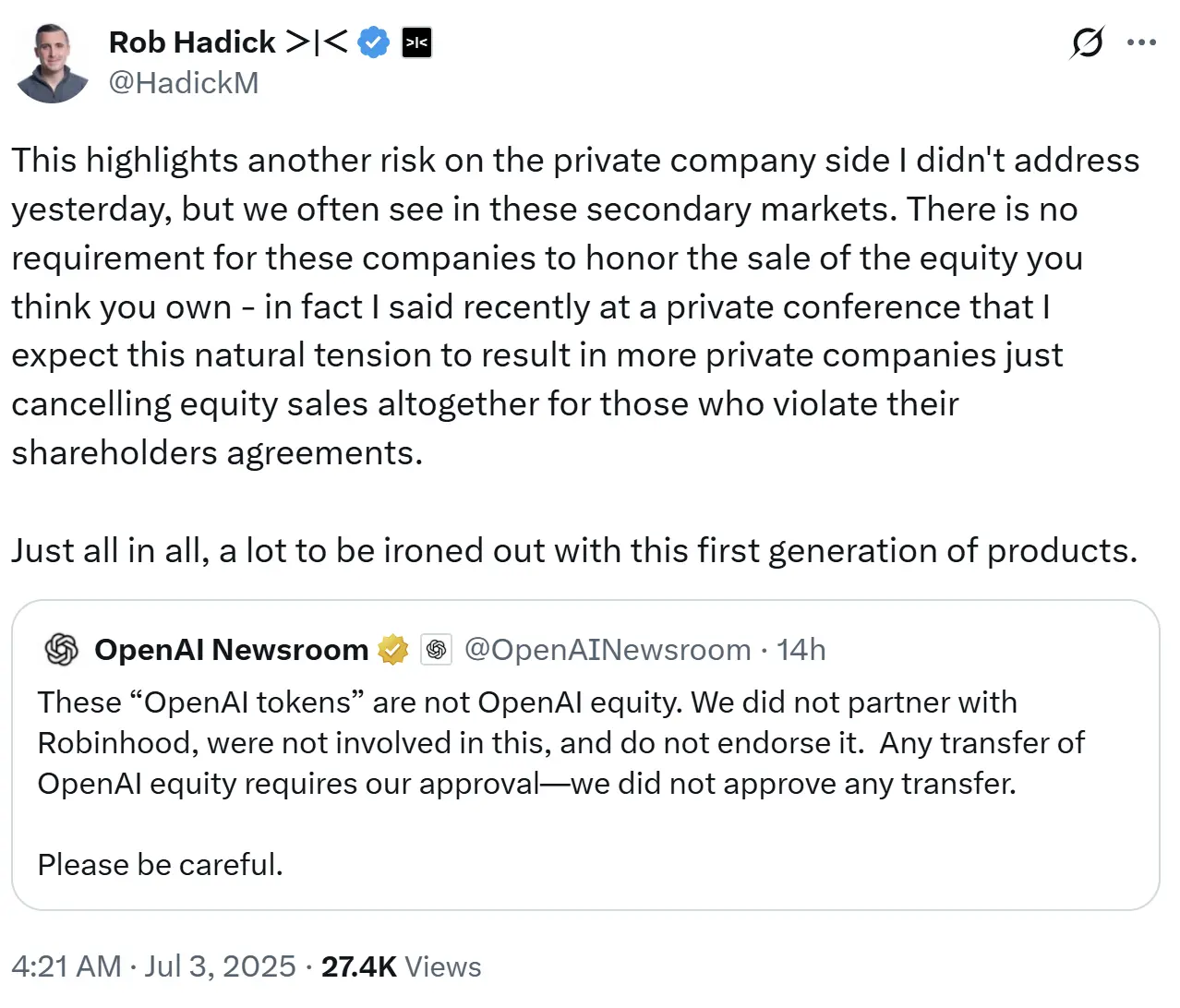
In the case of Robinhood and OpenAI, Dragonfly partner Rob Hadick pointed out that these companies are not obligated to recognize "the equity sales you think you own." He anticipates that this inherent contradiction will lead more private companies to directly cancel equity sales that violate shareholder agreements. This phenomenon is not uncommon in the secondary market.
Crypto KOL qinbafrank raised another scenario: in the secondary market for private equity, the circulating shares of unlisted companies often do not represent direct equity but correspond to LP shares of the investment funds behind the unlisted companies (usually held through SPV structures, with GP exercising rights). The transfer of these LP shares does not require official consent from the company, and the unlisted company may not even be aware of changes in the investment institutions' LP shares. However, despite the flexibility of LP share trading, it also comes with extremely high information asymmetry risks.
Additionally, companies like OpenAI may resist stock tokenization to maintain their pricing power in the secondary market, posing challenges for enterprises pushing for tokenization.
3. Incremental Benefits Are Questionable, Limited Appeal to Large Funds
Although stock tokenization has advantages such as "24/7 trading" and "global no-threshold access" at the narrative level, its incremental benefits to the overall market structure still appear limited, especially in attracting institutional-level funds.
Crypto KOL Phyrex pointed out that most stock tokens circulating on-chain are not issued by brokers, with the core issue being the inability to achieve substantial delivery. The inability to deliver means that price distortions may not be corrected in a short time, making positive arbitrage difficult. Furthermore, without legal approval from regulatory bodies like the SEC, it cannot attract institutional funds with scalable trading capabilities.
More critically, the traditional stock market does not operate 24 hours, while the 24/7 trading mechanism of on-chain stock tokens creates a "time misalignment." Under the premise of being unable to deliver, if price anchoring relies entirely on oracles, price disconnection between tokens and stocks will become the norm, and deep sharing between stock tokens will be impossible, leading to systemic disadvantages in price depth and volatility.
4. Triple Risks of Audit, Compliance, and Security
In the previous round of attempts at stock tokenization, the lack of compliance was almost a common issue for all failed projects. Although the overall regulatory environment for the crypto industry has slightly improved in recent years, the regulatory framework for stock tokenization remains highly uncertain, even blank.
Currently, Coinbase is actively seeking approval from the U.S. SEC, attempting to provide stock tokenization trading services for users within a compliant framework, but there has been no clear outcome so far.
Meanwhile, issues related to smart contracts and asset custody pose another systemic risk in this sector. Stock tokenization projects typically rely on smart contracts to perform key functions such as asset mapping, position recording, and rights settlement. However, once subjected to external attacks, on-chain assets may suffer irreversible losses. In the absence of regulatory oversight, users will find it even more challenging to seek legal remedies or recover off-chain corresponding assets.
If the platform (like xStocks) encounters operational or systemic issues, its connected exchanges and other partners may quickly be affected, leading to a "domino effect."

"Stock tokenization" has once again become a focal point in the industry, undoubtedly opening up vast imaginative space for on-chain finance, but the market risks behind it cannot be ignored, and this journey of transformation remains full of unknowns and challenges.
Recommended Reading:
Entering the stock token battlefield, Robinhood aims to be the Nasdaq of the crypto world
 Risk warning
 Risk warning



Popular articles





