








Payment Party: Will Visa and Mastercard be absent?

 If Web3 wallets become the new payment standard, those building the underlying infrastructure may also benefit.
Written by: Prathik Desai
Compiled by: Block unicorn
It took nearly a thousand years from the first paper money in ancient China's Tang Dynasty to the functional check system. Then came wire transfers, which accelerated cross-border trade in the 19th century. But what truly changed the way we pay was a forgotten wallet.
In 1949, Frank McNamara forgot his wallet while dining with clients at Major's Cabin Grill in Manhattan, New York. This embarrassing moment led to an innovation that ensured such incidents would not happen again. A year later, he returned with the world's first credit card—the Diners Club Card—which eventually evolved into a credit card network processing billions of transactions daily.
Soon after, Mastercard and Visa emerged from the chaos of bank alliances and brand reshaping, primarily out of necessity for survival.
As BankAmericard (later renamed Visa) gradually captured the market in the 1960s, other regional banks feared missing out on the credit card opportunity. To address this challenge, a group of banks established Interbank in 1966, which later became Master Charge and ultimately Mastercard, allowing them to pool resources, share infrastructure, and build a scalable competitive network.
This race to remain competitive evolved into one of the most successful collaborations in banking history. Payments became simpler, but more importantly, they became "invisible." Swiping or tapping a card was not just convenient; it laid the foundation for modern commerce.
People can now carry purchasing power with them. Merchants receive payments faster. Banks gain new revenue streams. And the intermediaries—the credit card networks—have become some of the most valuable businesses in the world.
In 2024, Mastercard and Visa generated $17 billion and $16 billion in revenue, respectively, just from payment services. The volume of digital transactions continues to grow each year.
Transaction volume increased from $645 billion in 2018 to $1.65 trillion in 2024, a 2.5-fold increase. According to Capgemini's "World Payments Report 2025," transaction volume is expected to grow by 70% from the 2024 level, reaching $2.84 trillion by 2028.
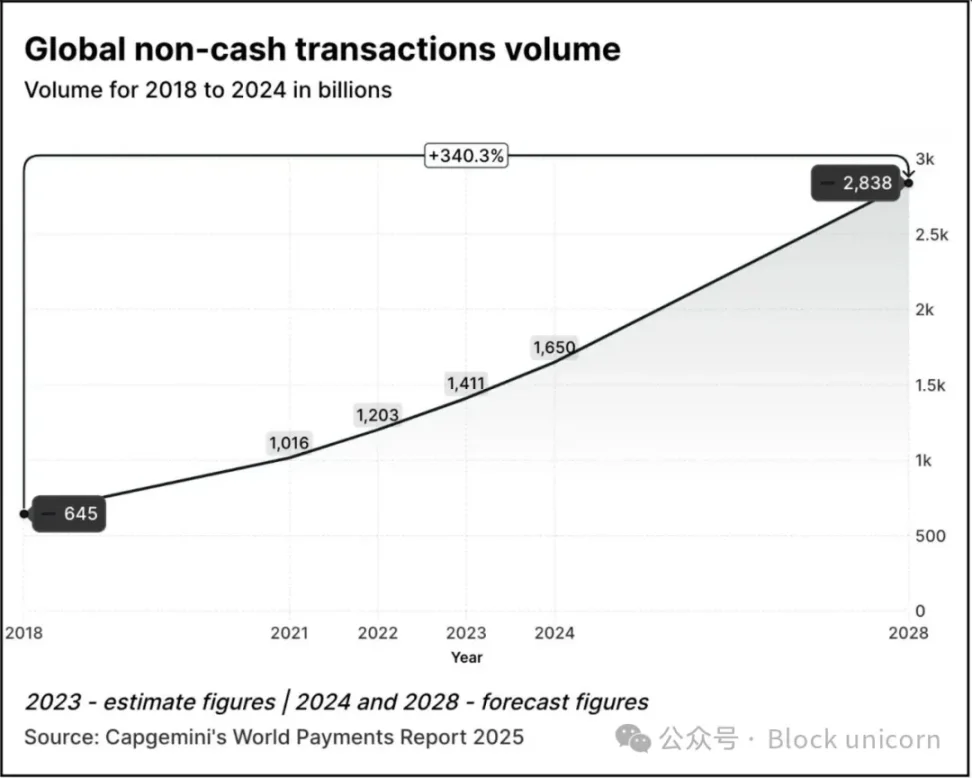
In 2023, approximately 57% of global non-cash transactions were completed using debit or credit cards, which typically take 1 to 3 days to settle. Each transaction often passes through multiple institutions before the merchant finally receives the funds. Nevertheless, this system continues to operate smoothly. You can use the same card to make payments in Tokyo, Toronto, or Thiruvananthapuram. Payments have become invisible.
Visa and Mastercard do not actually issue cards or hold your funds. What they possess is a channel built on trust between unacquainted financial institutions. When you swipe your card, their networks decide whether to allow the transaction, match the correct accounts, settle the bills, and ensure the funds are ultimately transferred.
To do this, merchants need to pay about 2-3% of the transaction value, with fees distributed among the issuing bank, acquiring bank, processing entities, and card networks. In return, everyone benefits from a fundamentally reliable system. You don't need to know who settled the payment, as long as it gets done.
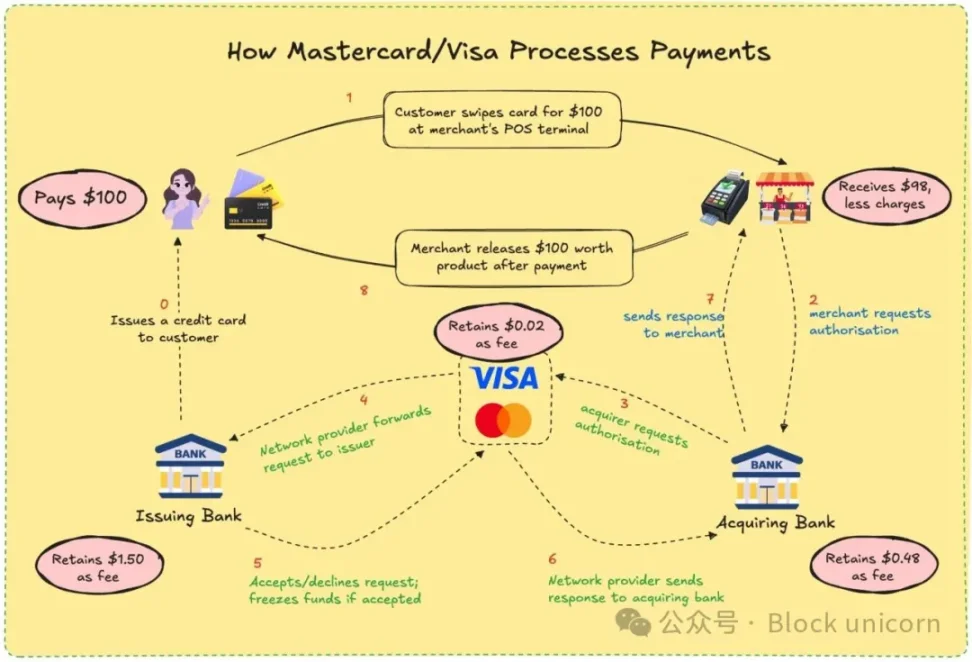
As a user, you might not think twice about this process. Do you remember the last time you asked your favorite café how they received funds after you swiped your card? You paid, they smiled back, and life went on. But for merchants, those few percentage points add up, especially for small businesses with thin margins.
Have you ever felt frustrated for being charged a few extra dollars for using a card instead of cash or other digital payment methods? Now you know why.
Imagine if they could eliminate delays, receive payments instantly, and incur very low fees. This is the promise of blockchain. Visa and Mastercard are trying to emulate this model or risk being surpassed by it.
With the introduction of stablecoins, the dynamics of payment settlement have further changed. In the past 12 months, the monthly transaction volume of stablecoins has exceeded that of Visa.
With stablecoins, transactions can settle directly from one wallet to another in seconds. No banks, no processing entities, no delays—just code. On networks like Solana or Base, fees are just a few cents, and transactions are nearly instantaneous.
This is not just theoretical. Freelancers in Argentina are already accepting USDC. Remittance platforms are integrating stablecoins to bypass traditional banking systems. Crypto-native wallets allow users to pay merchants directly without a card.
The threat facing Visa and Mastercard is existential. If the world starts transacting on-chain, their roles could disappear. Therefore, they are adapting.
Mastercard's actions over the past year are noteworthy.
It recently partnered with Chainlink to connect over 3.5 billion cardholders directly to on-chain assets, representing over 40% of the global population. This system leverages Chainlink's secure interoperability infrastructure, combined with the power of payment processors like Uniswap and Shift4, to create a bridge for converting fiat to cryptocurrency.
Additionally, it has partnered with Fiserv to launch a stablecoin called FIUSD, which Mastercard plans to integrate into over 150 million merchant touchpoints. What is their goal? To enable merchants to seamlessly convert between stablecoins and fiat currency anytime, anywhere, just like sending an email.
Through its Multi-Token Network (MTN), Mastercard is also laying the groundwork for stablecoin-linked cards, digital asset merchant settlements, and tokenized loyalty programs. Why should you forfeit loyalty rewards associated with cards just because you choose on-chain payment options?
What’s in it for Mastercard? Quite a lot. Enabling on-chain settlements can reduce internal processing costs by minimizing intermediaries.
Mastercard's $300 million investment in Corpay's cross-border payment division in April 2025 indicates that they are betting on high-volume, low-margin businesses where cost efficiency is crucial. Think about cross-border payments; this is one of the key differentiators for Mastercard compared to its competitor Visa. In 2024, Mastercard's cross-border transaction volume grew by 18% year-over-year.
They are also creating new fee structures: while traditional per-transaction fees may gradually decrease, they can now charge for API access, compliance modules, or integration with MTN.
Meanwhile, Visa is collaborating with Africa's Yellow Card to experiment with cross-border stablecoin payments—something that Africa desperately needs. It has partnered with Ledger to launch a card that allows users to spend cryptocurrency and earn cashback in USDC or BTC. Furthermore, Visa continues to develop its Visa Tokenized Assets platform, aimed at enabling banks to issue digital fiat tools on-chain.
With stablecoin settlements, Visa no longer needs to transact through multiple banks or bear as much foreign exchange slippage. The motivation behind this is to reduce costs and increase profit margins.
The philosophies of both companies are shifting. They are programming themselves as the infrastructure layer for programmable money. They realize that the future may not be dominated by card swipes but by smart contract calls.
There are also some deeper personal factors behind all this.
I once waited three days for a refund due to a canceled booking. I have witnessed international freelancers frustrated by wire transfer delays and costs. I have wondered why my cashback took weeks to arrive after a transaction. For users like us, these inefficiencies, while inconvenient, have quietly become the norm. Web3 now offers an alternative.
For payment giants, the biggest hurdle will be cost. For merchants, traditional card transactions can cost 2% or more. With on-chain stablecoins, fees can drop below 0.1%. For users, this means faster cashback, real-time settlements, and lower prices. For developers and fintech companies, this means the ability to build applications that connect directly to a global payment network without traditional banking procedures.
Web3 will still have its own trade-offs. Credit card networks provide fraud protection, refunds, and dispute resolution services. Stablecoins do not. If you send funds to the wrong wallet, that money is likely gone forever. While the efficiency of on-chain fund flows is high, it still lacks the consumer protections we value. The recently passed GENIUS Act in the Senate likely addresses some of these consumer protection concerns.
Visa and Mastercard are not waiting for the right moment. Instead, they view this gap as an opportunity. By layering traditional compliance, risk scoring, and security features on top of stablecoin transactions, they aim to make Web3 safe for the average user. The strategy is to let others build the protocols and then sell the hardware that will enable those protocols to be used at scale.
They are also betting on transaction volume. Not speculative trades, but real-world use cases: remittances, payroll, e-commerce. If these flows move on-chain, companies that help manage these flows will benefit, even if they are no longer the fee collectors of the past.
Visa and Mastercard want to be the drivers of building such ecosystems from the ground up. So when your chosen crypto wallet needs a trusted KYC layer, or your bank requires cross-border compliance, a branded API will be ready.
What does this mean for users? It could mean a future where your wallet operates like a bank. You receive payments in stablecoins, spend through Visa or Mastercard interfaces, earn tokenized rewards, and everything settles instantly. You might not even notice which chain it went through.
For someone like me, who has experienced everything from banking apps to UPI to buying coffee with cryptocurrency, the appeal is obvious: I want payments to be simple and efficient. I don’t care if it’s tokens or rupees. What I care about is that it’s fast, cheap, and error-free in transactions. If these old giants can guarantee that, perhaps they deserve to continue existing.
Ultimately, this is a race to remain indispensable. If Web3 wallets become the new payment standard, the beneficiaries may also be those building the tracks underneath. The card giants are betting that even if currency changes, the infrastructure may still belong to them.
They want to once again fade into the background. Only this time, the pipeline will be made of code.
Recommended reading:
The "Beautiful Act" thrillingly passes, a look at the power struggle behind the 869-page text
OpenAI "debunks" Robinhood: Unveiling the four major controversies behind stock tokenization
 Risk warning
 Risk warning


Popular articles





