








4E Labs | Crypto Stock Panorama: From Bitcoin Hoarders to Capital Games of Blockchain Infrastructure (II)

 This article is the next part of the "Cryptocurrency Stock Panorama" series. Following the previous discussion on BTC reserve companies and financial service platforms, this article will focus on mining companies with computing power and ETF trends, helping readers establish a more complete cryptocurrency stock allocation map.
Author: 0xYuri
Against the backdrop of the successful launch of Bitcoin ETFs, the gradual release of Ethereum ETFs, and the countdown to stablecoin legislation, a group of publicly listed companies closely related to the cryptocurrency industry is playing an increasingly important role in the capital market, with the institutionalization process accelerating the differentiation of related stocks. They cover multiple segments including trading platforms, mining, power, asset management, and stablecoin issuance, forming a bridge asset pool between traditional finance and Web3.
This article is the next installment in the "Cryptocurrency Stock Panorama" series, following the previous discussion on BTC reserve companies and financial service platforms. This article will focus on computational mining companies and ETF trends, helping readers establish a more complete cryptocurrency stock allocation map. 📎 If you have not yet read the previous content, you can click to view: 4E Labs|Cryptocurrency Stock Panorama: From Bitcoin Hoarders to Capital Games of Blockchain Infrastructure (Part One)
3. Bitcoin Computational Power: Related Capacity Forms the Foundation of the BTC Production Chain
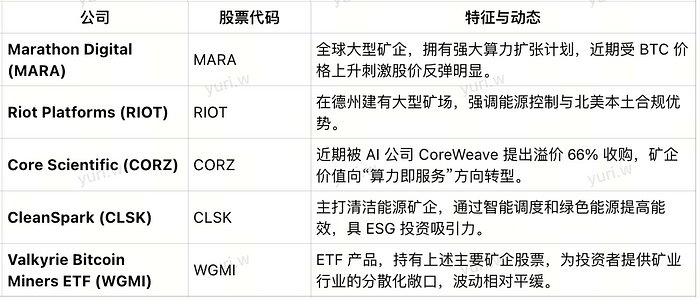
3.1 Marathon Digital (MARA): The Largest Independent Mining Company in the U.S.
Marathon Digital Holdings, Inc. (Ticker: MARA), now renamed MARA Holdings, Inc., was established in 2010 and is headquartered in Fort Lauderdale, Florida, USA. The company vertically integrates Bitcoin mining technology stacks through its own mining pool (MaraPool), custom firmware, and immersion cooling technology, making it one of the largest industrial-scale Bitcoin miners in North America. In 2024, the company significantly increased its computational power through acquisitions and equipment upgrades. MARA is one of the core holdings of the Valkyrie Bitcoin Miners ETF (WGMI).
- Main Business: Bitcoin mining (operates multiple data centers located in North Dakota, Texas, and the UAE, with a computational power of 36.9 EH/s by June 2025, producing 705 Bitcoins per month, a year-on-year increase of 5%), technology optimization and infrastructure (invests in hardware such as Auradine and develops immersion cooling systems to reduce energy consumption and improve computational efficiency).
- Bitcoin Holdings: As of June 2025, holds 49,940 Bitcoins (valued at approximately $5.4 billion), making it the second-largest publicly traded Bitcoin holder after MicroStrategy. In 2024, purchased 6,210 Bitcoins through a $300 million convertible bond issuance, demonstrating a "hold as primary" strategy, with an average mining cost of approximately $51,000 per coin.
- Financial Performance: In 2024, revenue was $697 million, a year-on-year increase of 78%; net profit was $450 million, reversing the losses of 2023; by June 2025, market capitalization was $4.8 billion, with a price-to-earnings (P/E) ratio of approximately 22.5, stock price at $12.53, and Bernstein's target price at $23 (potential upside of 153.7%).
- Risks: High-frequency expansion requires continuous financing; after the Bitcoin halving in April 2024, rewards will decrease, and mining costs (approximately $51,000 per coin) need Bitcoin prices to remain high to maintain profitability.
3.2 Riot Platforms (RIOT): Texas Power and Energy Management Expert
Riot Platforms, Inc. (Ticker: RIOT) was established in 2000 and is headquartered in Colorado, USA, focusing on Bitcoin mining and energy management. The company owns large facilities in Rockdale and Corsicana, with a total capacity of 1 GW, making it one of the major Bitcoin miners in North America. Riot enhances efficiency through its own mining pool and immersion cooling technology. The utilization rate of its mining sites reaches 95%, but a quarterly loss of $399 million exposes the industry's common issues—high-leverage expansion combined with the fatal combination of Bitcoin production halving.
RIOT is a core holding of WGMI, with strong energy cost control capabilities, receiving $5.6 million in electricity rebates through the ERCOT grid demand response program, with hydropower accounting for over 60%, and significant ESG rating advantages; stock prices are boosted by expectations of AI/HPC transformation.
- Main Business: Bitcoin mining (operates Rockdale and Corsicana facilities, with a computational power of 31.5 EH/s by September 2025, monthly Bitcoin production increased by 28% year-on-year; produced 1,364 Bitcoins in the first quarter of 2024, planning to reach 56.6 EH/s by the second quarter of 2025); energy management and cost control (leveraging Texas's low-cost electricity (average 2.8 cents/kWh in 2023, far below residential rates of 13.5 cents), profiting through demand response programs (Responsive Reserve Service), with $18 million in electricity sales revenue in 2022).
- Bitcoin Holdings: Holds 10,427 Bitcoins, primarily adopting a "hold as primary" strategy.
- Financial Performance: In 2024, revenue was $793 million, a year-on-year increase of 8%; net income was $211 million, showing significant growth; by 2025, market capitalization was $2.6 billion, with a P/E ratio of approximately 12.3, stock price at $7.78, and Bernstein's target price at $19 (potential upside of 146.9%).
- Development Direction: Plans to shift the Corsicana facility's 600 MW towards AI/HPC applications by 2025, exploring diversified revenue and seeking partnerships with Amazon, Microsoft, etc.
- Operational Risks: Reliance on a single region (Texas), instability of the power grid (such as the 2021 Uri storm), and fluctuations in electricity prices may increase costs; AI transformation requires key partners.
3.3 Core Scientific (CORZ): Pioneer in AI Infrastructure Transformation
Core Scientific, Inc. (Ticker: CORZ) was established in 2017 and is headquartered in Delaware, USA, being one of the largest industrial-scale Bitcoin miners in North America. In 2022, the company filed for Chapter 11 bankruptcy protection due to falling Bitcoin prices and rising energy costs, completing restructuring in January 2024 and relisting on NASDAQ. The company operates 8 data centers.
Main Business
- Bitcoin Mining and Hosting
- Self-mining operations use ASIC miners, producing 1,115 Bitcoins in the first quarter of 2024, a year-on-year decrease of 62% (due to halving and increased network difficulty).
- Provides hosting services, managing mining equipment for third-party clients (such as CoreWeave), with hosting revenue expected to increase by 2025.
- AI/HPC Infrastructure
- In 2025, reached a 12-year, $6.7 billion agreement with Nvidia-supported CoreWeave to provide 900 MW of computational power for AI and high-performance computing.
- Added 70 MW of capacity in 2025 (Denton and Muskogee), bringing total data center capacity to 1.3 GW.
- 45% of CoreWeave's contracted computational power is provided by CORZ, highlighting its importance in AI infrastructure.
- Bitcoin Holdings and Asset Management
- In June 2024, sold $167 million worth of Bitcoin (nearly 75% of holdings) to pay off debts and for operations, currently holding a low amount.
- Restructuring in 2024 reduced $400 million in debt, improving financial condition.
Financial Performance: In 2024, revenue was $502 million, a year-on-year increase of 49%; net loss was $120 million (due to halving and impairments); by 2025, market capitalization was approximately $2.5 billion, with a P/E ratio not reaching profitability, stock price rebounded after a 40% correction, Bernstein's target price at $17.
Future Development: Will continue to transition towards AI/HPC, with existing mining capacities at multiple large mining sites and data centers shifting towards AI computational services, expanding hosting services, and CoreWeave proposing a full acquisition at a 66% premium; however, acquisition uncertainty is high, AI transformation requires continuous investment, and mining revenue is pressured by halving, with no clear direction in industrial planning.
3.4 CleanSpark (CLSK): Leader in Green Energy Mining
CleanSpark, Inc. (Ticker: CLSK) was established in 1987 and is headquartered in Nevada, USA, as a Bitcoin miner powered by green energy. The company operates 6 data centers (in Georgia and New York), primarily using low-carbon electricity (such as wind and hydropower). By June 2025, the company’s computational power reached 50 EH/s, becoming one of the largest Bitcoin mining operators globally.
Main Business
- Green Energy Mining
- By June 2025, computational power reached 50 EH/s, a year-on-year increase of 50%, producing 685 Bitcoins per month (valued at $74.2 million).
- Operates over 196,000 mining machines, targeting a computational power of 60 EH/s by 2025, increasing capacity through the acquisition of GRIID Infrastructure.
- 90% of electricity comes from renewable sources, reducing mining costs (approximately $25,000 per coin).
- AI Optimization and Smart Scheduling
- Uses AI control systems to optimize time-of-use electricity pricing, reducing operational costs.
- Deploys immersion cooling technology to enhance mining machine efficiency and lifespan.
- Bitcoin Holdings and Financial Strategy
- Holds 8,701 Bitcoins (as of October 2024), tends to retain most mining rewards to reduce shareholder dilution.
- In the third quarter of 2023, cash was $29.2 million, Bitcoin holdings valued at $110 million, with only $15.9 million in debt, indicating strong financial health.
Financial Performance: In 2024, revenue was $738 million, a year-on-year increase of 165%; net profit was $242 million, reversing the losses of 2023; by 2025, market capitalization was $2.24 billion, with a P/E ratio of approximately 9.2, stock price at $8.01, and Bernstein's target price at $20 (potential upside of 170%).
Future Development: Targeting a computational power of 60 EH/s by 2025, continuing to invest in green energy and AI optimization, exploring AI/HPC hosting services. High industry computational power (693 EH/s) squeezes market share, necessitating cost advantages; natural disasters may disrupt operations.
3.5 Valkyrie Bitcoin Miners ETF (WGMI): An Intensive Tool for Mining Company β Returns
Valkyrie Bitcoin Miners ETF (Ticker: WGMI) was listed on NASDAQ in February 2022, managed by Valkyrie Funds, and is an actively managed ETF focusing on investing in publicly traded companies in the Bitcoin mining industry. The fund invests at least 80% of its assets in companies engaged in Bitcoin mining or providing related hardware/services, emphasizing miners that use renewable energy.
Key Holdings and Investment Strategy
- Core Holdings
- As of July 2025, major holdings include: Argo Blockchain (13.32%), CleanSpark (11.37%), Stronghold, Marathon, Riot, etc., covering 18 cryptocurrency-native companies.
- MARA, RIOT, CLSK, and CORZ are the main weights, accounting for 30%-40% of the fund's assets.
- Investment Model
- Reduces single-company risk through diversified investments, prioritizing companies with high computational power, low debt, and a focus on green energy.
- Actively managed strategy adjusts holdings based on market conditions, such as increasing weights of MARA and RIOT in 2025 (1.61% and 0.96%, respectively).
- Fees and Scale: Expense ratio of 0.75%, higher than typical ETFs, reflecting active management costs; by 2025, assets under management (AUM) were approximately $150 million, a 20% increase from 2024.
Financial Performance: In 2024, annual return rate was approximately 30%, benefiting from Bitcoin prices breaking $100,000; 2025: Due to industry computational power competition and Bitcoin price corrections, the ETF fell by 42.5%, but remains optimistic about AI/HPC transformation and Bitcoin's upward trend.
Risks: High industry volatility, miner debt, and energy costs may drag down performance; high expense ratio affects long-term returns.
- Challenges: Bitcoin price fluctuations and industry competition may impact the profitability of holding companies, requiring a balance between high fees and investment returns.
Suitability: Suitable for investors looking to invest in mining while avoiding the risks associated with individual stock computational power.
🔹 Mining companies form the foundation of the BTC production chain, focusing on performance competition in capacity, assetization, and energy utilization. MARA and RIOT are core stocks in the mining industry, CLSK focuses on green processes, CORZ is at a transformation crossroads, and WGMI provides an ETF and balanced allocation approach.
III. Market Trends: ETF Fund Flows as a Barometer for Institutional Entry
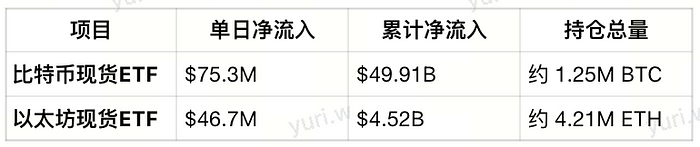 (Source: Farside Investors)
As of July 9 data:
- Bitcoin Spot ETF: Daily net inflow of $75.3 million, total $49.91 billion, holding 1.25 million BTC;
- Ethereum Spot ETF: Daily net inflow of $46.7 million, cumulative $4.52 billion, holding 4.21 million ETH.
ETF products continue to receive net inflows from mainstream funds, indicating a stable growth in institutional investors' long-term allocation demand for BTC/ETH; this trend also provides a long-term value reassessment basis for cryptocurrency stocks, particularly benefiting mining companies, stablecoin issuers, and compliant trading platforms.
Additionally, according to a Santiment report, since June 6, there has only been one day of outflows, with BTC ETF funds showing a continuous net inflow, forming a 17-day net inflow cycle, indicating stable institutional sentiment.
At the same time, several research institutions predict that in the next 6 to 12 months, as ETFs become more popular, BTC's price increase will fluctuate in the range of 20% to 45% (e.g., Global X predicts BTC will rise to $200K), and at least $120 billion is expected to flow into the BTC asset class.
IV. Investment Recommendations
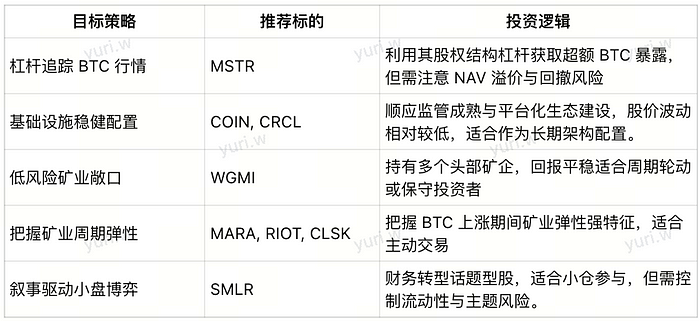
Key Variables for the Next 180 Days
- ETF Inflow Rhythm: If funds continue to flow in at high levels (e.g., maintaining a daily average of $50-$70 million), then mining and MSTR can continue to benefit; if volatility decreases, related stocks may face corrections.
- Bitcoin Price Trends: ETF formation supports demand, but if BTC breaks key technical levels (e.g., $90K support), high-leverage targets face significant correction risks.
- Regulatory Dynamics: If the GENIUS Act or new regulations are introduced, it will directly impact trading platform valuations and the popularity of stablecoin issuers (COIN/CRCL).
- Macroeconomic Policies: Federal Reserve policy easing, dollar trends, and inflation data will all affect BTC asset attractiveness and volatility.
- Mining Supply and Demand Variables: Trends in electricity prices, bottlenecks in the mining machine supply chain, and cycles of computational power changes are key barriers to mining companies' operations and profitability.
V. Conclusion: Cryptocurrency Stocks in 2025 Have Become One of the Representatives of the "New Economy"
2025 is a year when cryptocurrency stocks transition from a marginal concept to institutional boundaries. They are no longer just tools for reflecting the prices of Bitcoin or Ethereum, but key anchors connecting on-chain finance and traditional asset allocation. Whether it is Strategy with massive BTC reserves, Coinbase and Circle building compliant service stacks, or Galaxy constructing computational power and AI infrastructure, these companies are representing the prototype of the next generation of financial architecture.
In the future, as the Federal Reserve's monetary policy clarifies, ETF mechanisms strengthen further, and the cryptocurrency industry deeply integrates with the financial system, cryptocurrency stocks will become an indispensable structural force in allocation-oriented investment portfolios. Future digital asset investments will no longer be limited to on-chain tokens but will form a complete ecosystem of "on-chain assets + publicly listed companies + ETF products." For professional investors, establishing a structured cryptocurrency stock allocation framework has become a core task to seize the next phase of cyclical opportunities.
 Risk warning Risk warning


Popular articles





