








Vitalik's Blog: What values need to be clearly aligned in the Ethereum ecosystem?
 One of the most important social challenges in the Ethereum ecosystem is balance.
Compiled by: Wu Says Blockchain
The views expressed in this article do not represent ChainCatcher's opinions
One of the most significant social challenges in the Ethereum ecosystem is balance—more precisely, the integration of decentralization and collaboration. The strength of this ecosystem lies in the multitude of different individuals and organizations—client teams, researchers, Layer 2 teams, application developers, local community organizations—who are all striving for their own visions of Ethereum's future. The main challenge is to ensure that all these projects can collaboratively build what appears to be a unified Ethereum ecosystem rather than 138 incompatible small kingdoms.
To address this challenge, many in the Ethereum ecosystem have proposed the concept of "Ethereum alignment." This can include alignment of values (e.g., maintaining open source, minimizing centralization, supporting public goods), alignment of technology (e.g., adhering to standards across the ecosystem), and alignment of economics (e.g., using ETH as a token as much as possible). However, this concept has historically been vaguely defined and may pose risks of social control: if alignment merely means "being with the right people," then the concept of "alignment" has already failed.
To tackle this issue, I believe we should clarify the concept of alignment by breaking it down into specific attributes that can be represented by particular metrics. Each person's list of metrics may differ, and the metrics may change over time. However, I think we already have some solid starting points.
Open Source - This has two important values: (i) the code is auditable to ensure security; and more importantly, (ii) it reduces the risk of proprietary technology lock-in and allows permissionless third parties to improve it. Not every part of every application needs to be fully open source, but the core infrastructure components that the ecosystem relies on should absolutely be open source. The gold standard here is the FSF's definition of free software and the OSI's definition of open source.
Open Standards - Strive for interoperability within the Ethereum ecosystem and build upon existing open standards (e.g., ERC-20, ERC-1271, etc.) as well as standards currently under development (e.g., account abstraction, cross-L2 transfers, L1 and L2 light client proofs, upcoming address format standards). If you want to introduce a new feature that existing standards do not serve well, collaborate with others to write a new ERC. Applications and wallets can be evaluated based on the ERC standards they are compatible with.
Decentralization and Security - Avoid points of trust, minimize censorship vulnerabilities, and reduce reliance on centralized infrastructure. Metrics can include (i) "retreat testing": if your team and servers disappeared tomorrow, would the application still be usable? (ii) "internal attack testing": if your team attempted to attack the system, how much would it damage, and how severe would the harm be? An important formal test is the rollup phase from L2beat.
Positive Sum
Contribution to Ethereum - The success of a project should benefit the entire Ethereum community (e.g., ETH holders, Ethereum users), even if they are not part of the project's own ecosystem. Specific examples include using ETH as a token (thereby enhancing its network effects), contributing to open-source technology, and committing to donate a portion of tokens or revenue to public goods in the Ethereum ecosystem.
Contribution to the Wider World - Ethereum aims to make the world freer and more open, enabling new forms of ownership and collaboration, and making positive contributions to the significant challenges facing humanity. Is your project making a difference in this regard? Examples include applications that bring sustainable value to a broader audience (e.g., financial inclusion), donations to public goods that extend beyond Ethereum, and building technologies that can be practically applied outside the crypto space (e.g., funding mechanisms, general computer security).
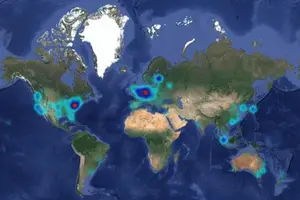
Ethereum Node Map, Source: ethernodes.org
Clearly, not all of the above applies to every project. The metrics applicable to Layer 2, wallets, decentralized social media applications, etc., will vary significantly. Different metrics may also change in priority: two years ago, having "training wheels" on Rollup was acceptable because it was still in the "early stage"; today, we need to move into at least phase 1 as quickly as possible. Currently, the clearest positive sum metric is the commitment to donate a portion of tokens, which an increasing number of projects are practicing; in the future, we can also find other aspects of positive sum metrics.
My ideal goal here is to see more entities like L2beat emerge, tracking the performance of various projects in meeting the above standards and other standards proposed by the community. Competition between projects will no longer be about being friendly with the "right friends," but rather striving to align as closely as possible under clear and understandable standards. The Ethereum Foundation should maintain a certain distance from these activities: we can fund L2beat, but we should not become L2beat. Creating the next L2beat is itself a permissionless process.
This will also provide a clearer pathway for the Ethereum Foundation and other organizations (and individuals) interested in supporting and participating in the ecosystem to decide which projects to support while maintaining neutrality. Each organization and individual can make judgments based on the standards they value most and choose projects that align with those standards. This not only allows the Ethereum Foundation but also others to become part of the incentive structure for maintaining project alignment.
Only by clearly defining "capability" can we truly become a selective system; otherwise, it is likely to turn into an exclusive and zero-sum social game. Regarding concerns about "who supervises the supervisors," the best solution is not to expect all influential people to be "angels," but rather to employ time-tested technologies, such as the separation of powers. "Dashboard-type organizations" like L2beat, blockchain explorers, and other ecosystem monitors are excellent examples of this principle at work in today's Ethereum ecosystem. If we can further clarify different aspects of alignment without concentrating all power in a single "supervisor," we can make this concept more effective and embody it in the fair and inclusive manner that the Ethereum ecosystem seeks.
 Risk warning
 Risk warning



Popular articles





