








The Rise of Stablecoins: A Catalyst for a New Era of Digital Finance

 As a product of the integration of blockchain and traditional financial systems, stablecoins have gradually moved from being a marginal tool serving cryptocurrency trading to a core position in cross-border payments, settlements, and digital financial infrastructure.
Author: Renmin University of China Institute of Financial Technology
The Technical Core and Evolution Path of Stablecoins
Stablecoins, as emerging digital financial tools, have served as a bridge connecting crypto assets and the traditional financial system since their inception. Their fundamental mission is to provide a low-volatility digital value carrier through a value anchoring mechanism, serving both decentralized finance (DeFi) and being integrated into mainstream payment, settlement, and financing scenarios in traditional finance.
According to Deloitte's report "2025: The Year of Payment Stablecoins," payment stablecoins (PSC) are defined as "digital currencies based on a 1:1 fiat reserve, with instant redemption capabilities, and legally not constituting securities." This asset form has rapidly expanded globally, becoming an indispensable trading intermediary in the crypto asset market and gradually penetrating into the real economy sectors such as cross-border payments and supply chain settlements. Roland Berger defines stablecoins as "digital value units based on blockchain distributed ledger technology, anchored to high-credit assets, characterized by low volatility and high transparency," emphasizing their decentralized and programmable attributes as potential forces for reconstructing global capital flows.
Stablecoins integrate the advantages of traditional currencies and digital technology: relying on blockchain to record transactions, their value is anchored by holding high liquidity assets such as cash and government bonds, achieving high transparency, low intermediary costs, and high capital velocity, providing new ideas for the construction of digital financial infrastructure in emerging markets.
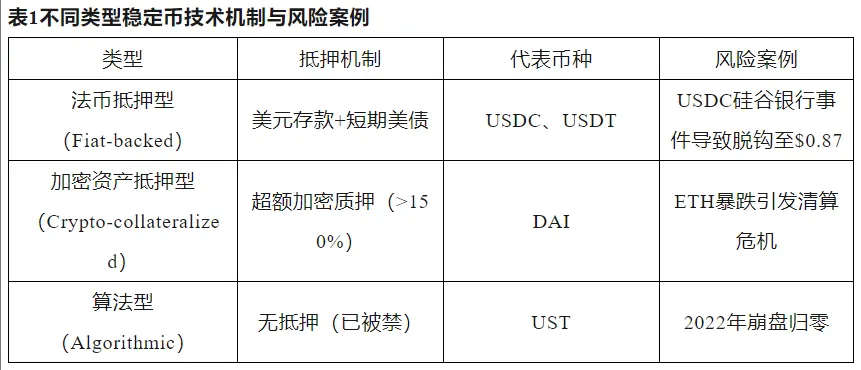
Stablecoins can be categorized into three types based on their collateral models and value maintenance methods: fiat-collateralized (supported by cash, short-term government bonds, etc., at a 1:1 ratio or over-collateralized), crypto-collateralized (maintaining the peg through over-collateralization of crypto assets), and algorithmic (not relying on real asset collateral, maintaining the peg through supply and demand algorithms). Table 1 compares the three models and their risk cases:
 Both Roland Berger and Deloitte's reports point out that the technology of stablecoins has evolved through three stages:
The first stage: Transaction medium function (2015-2020). During this stage, stablecoins were primarily used to serve crypto asset exchanges as hedging and fund settlement tools.
Both Roland Berger and Deloitte's reports point out that the technology of stablecoins has evolved through three stages:
The first stage: Transaction medium function (2015-2020). During this stage, stablecoins were primarily used to serve crypto asset exchanges as hedging and fund settlement tools.
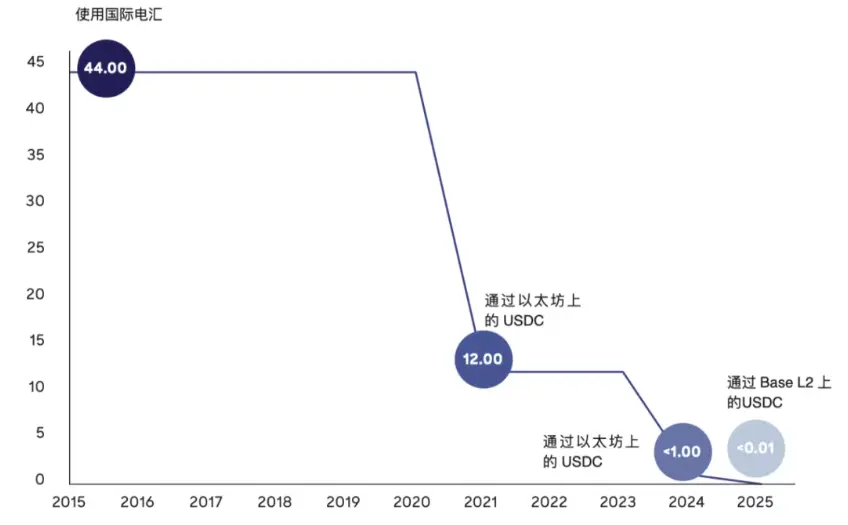
The second stage: Payment and settlement infrastructure (2021-2024). With the optimization of on-chain technology, stablecoins began to be applied in scenarios such as cross-border payments and supply chain settlements. Data from Roland Berger shows that the average cost of cross-border transfers using early versions of USDC on the Ethereum chain was $12 per transaction, with a delivery time of about 10 minutes. After optimization on the Base chain, the current cost has dropped to $0.01 per transaction, and the delivery time has shortened to 5 seconds.
 The third stage: Integration into the financial system (2025-present). Starting in 2025, stablecoins are gradually being incorporated into mainstream financial infrastructure, becoming important tools for inter-institutional fund allocation, corporate financial settlements, and cross-border trade payments.
The significant value of stablecoins lies not only in anchoring fiat currencies and reducing volatility but also in the financial innovation potential brought by programmability. Combined with smart contracts, stablecoins can support functions such as conditional payments, fund custody, and split settlements, promoting the upgrade of financial products from static contracts to dynamic capital flows.
Global Market Landscape and Impact on Traditional Banks
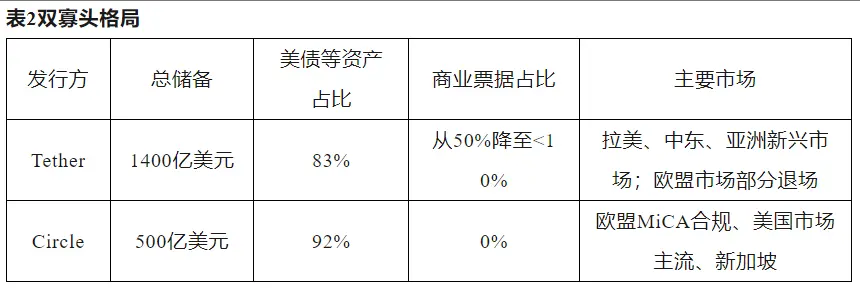
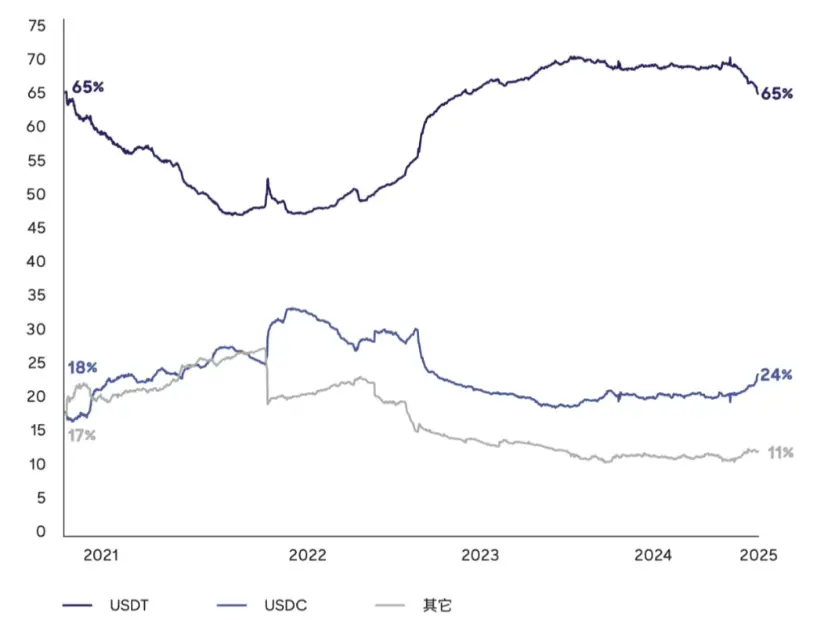
In the past five years, stablecoins have transitioned from marginal tools to mainstream financial infrastructure. According to data from Bain, Roland Berger, and Deloitte (2025), the global circulating market value of stablecoins has increased from less than $2 billion in 2019 to over $200 billion at the beginning of 2025. By 2025, USDT (Tether) and USDC (Circle) account for over 85% of the stablecoin market. Tether mainly serves emerging markets, with high liquidity assets such as U.S. Treasury bonds in its reserves reaching $116 billion, accounting for 58% of global stablecoin reserves. USDC, with its compliance and transparency advantages, is widely used in developed markets such as the EU and Singapore, with reserves exceeding $50 billion.
In terms of regional distribution, the acceptance of stablecoins is particularly prominent in emerging markets and high-inflation economies. For instance, in Turkey, due to the continuous depreciation of the local currency, residents' use of stablecoins (mainly USDT) for asset preservation and cross-border payments has been steadily increasing, with USDT holders accounting for 34% of the country's total population by 2024. Similar phenomena are observed in countries like Nigeria and Argentina, where the amount of remittances received through stablecoins has significantly increased, with Nigeria receiving a total of $20 billion in cross-border remittances through stablecoins in 2024, accounting for over 30% of the country's total remittances.
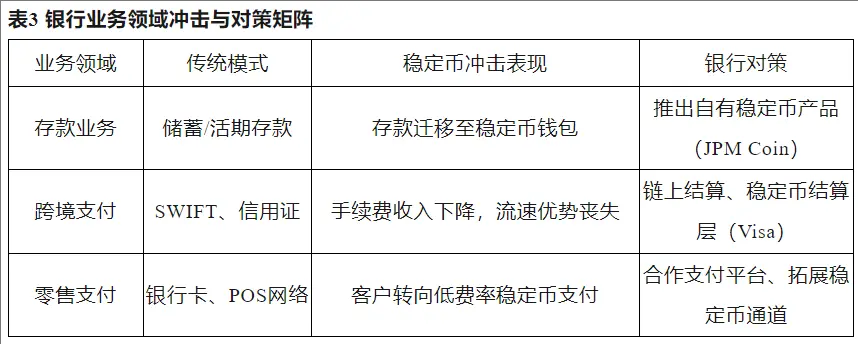
The rapid development of stablecoins poses systemic challenges to the traditional banking system, particularly in the following aspects: First, deposit diversion. Stablecoin wallets and non-custodial accounts serve as alternative value storage methods, gradually diverting demand for demand deposits and savings deposits that traditionally belonged to banks. Second, payment business income is squeezed. The low-cost and high-efficiency characteristics of stablecoins directly impact traditional payment channels such as SWIFT. It is estimated that this has eroded approximately $30 billion in annual fee income for banks. The response strategies of banks mainly include proactively launching stablecoins, building on-chain settlement networks, and collaborating with stablecoin issuers.
Ecosystem Participants and Profit Model Analysis
The core participants in the stablecoin ecosystem are the issuing institutions, whose business models and reserve management methods directly determine the credibility and market acceptance of stablecoins. By early 2025, the global stablecoin market has formed a dual oligopoly structure dominated by Tether (USDT) and Circle (USDC). Their profit models mainly derive from the following aspects: First, reserve asset income. The large-scale holdings of U.S. Treasury bonds, repurchase agreements, and deposits by issuers can generate substantial interest income. For example, Tether's investment income from U.S. Treasury bonds and equivalent assets reached billions of dollars in 2024, becoming its core profit source. Second, transaction fees and commissions. Third, cooperative ecosystem profits. Ecosystem commissions and settlement shares formed through partnerships with payment platforms, banks, and wallet service providers. Nevertheless, the sustainability of their profit models remains highly dependent on the safety of reserve assets, market trust, and changes in regulatory conditions.
In the stablecoin ecosystem, custodians and payment infrastructure play a bridging role connecting reserve assets, on-chain assets, and end users, with main functions including: custody of reserve assets to ensure asset safety and high liquidity; providing on-chain asset custody and key management services; supporting payment networks, merchant settlements, and clearing services. Traditional financial institutions are gradually deepening their participation in this segment to hedge against the impact of stablecoins on their business while sharing in the industry dividends.
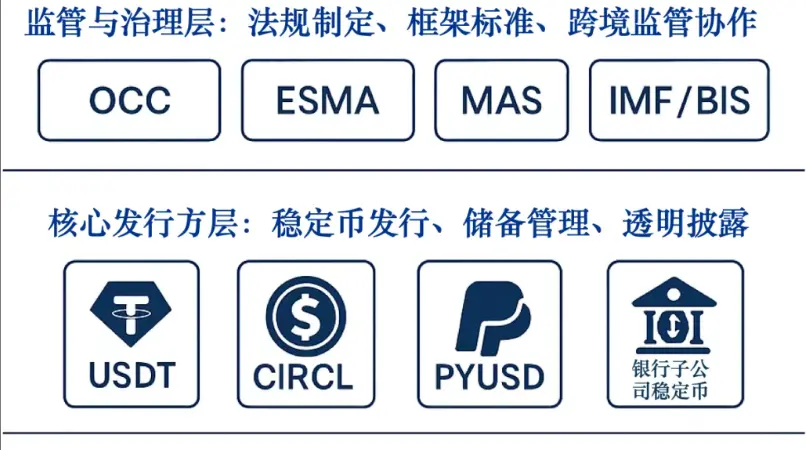
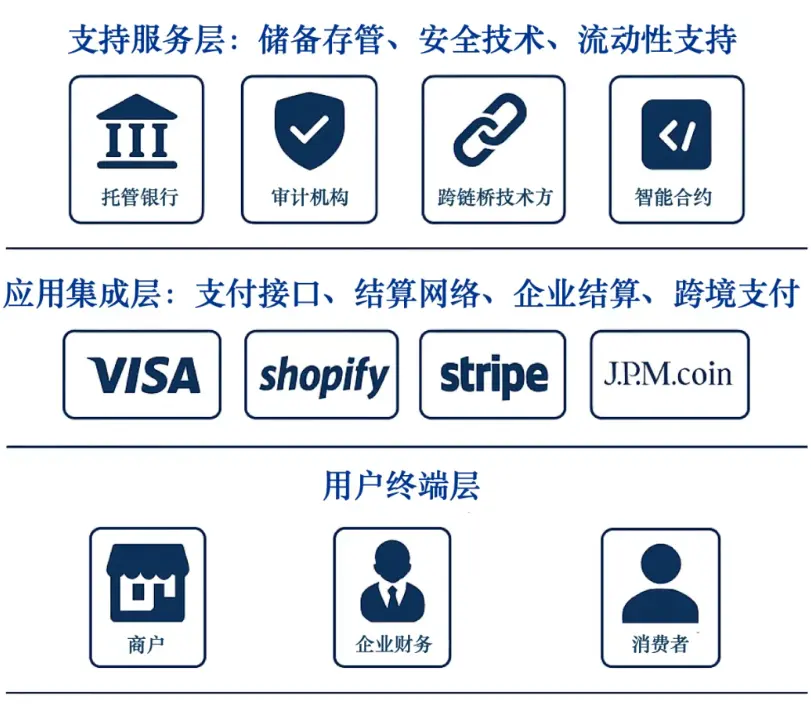 The stablecoin ecosystem is gradually presenting a profit pattern of "multi-layer collaboration + micro-profit high frequency." Although reserve asset income remains the core profit source for issuers, the future profit models of stablecoin issuers will face three major challenges due to increased regulation, rising compliance costs, and intensified market competition (such as traditional banks entering the market):
First, narrowing interest margins. Fluctuations in reserve asset income and a declining interest rate cycle will compress the profit space for stablecoins. Second, rising compliance costs. For example, the EU's Markets in Crypto-Assets Regulation (MiCA) requires monthly CPA verification and daily disclosure of reserves, increasing operational costs. Third, squeezed ecosystem shares. Banks and payment giants are launching their own stablecoins and on-chain settlement solutions to compete for market share. Deloitte's report points out that "the future profit model of stablecoins must transition from a simple reserve interest logic to a diversified model of data value addition, ecosystem collaboration, and financial innovation; otherwise, it will be difficult to maintain long-term competitiveness."
Main Risks and Governance Framework
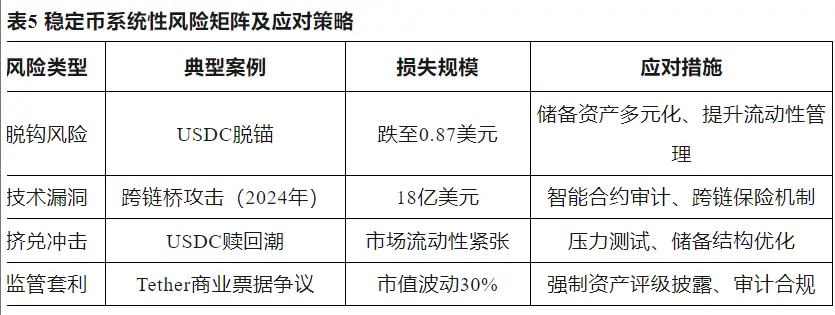
The main risks of stablecoins are reflected in the following four aspects: First, decoupling and liquidity risks. If reserve assets depreciate or liquidity tightens, it can easily trigger a decoupling and large-scale redemptions, impacting financial markets. Second, technical security risks. Stablecoins relying on blockchain and smart contracts face risks of hacking. The 2024 cross-chain bridge vulnerability incident caused losses of $1.8 billion, becoming a serious security incident. Third, runs and market shocks. When the reserve structure is opaque, panic or rumors can easily trigger a wave of redemptions. In 2023, USDC experienced a redemption of $3.8 billion in one day due to the Silicon Valley Bank incident, with its price dropping to $0.87 at one point. Fourth, regulatory arbitrage. Different countries have varying regulations, allowing issuers to evade oversight through gray areas. Tether has faced regulatory pressure from multiple countries due to a high proportion of commercial paper in its reserve assets.
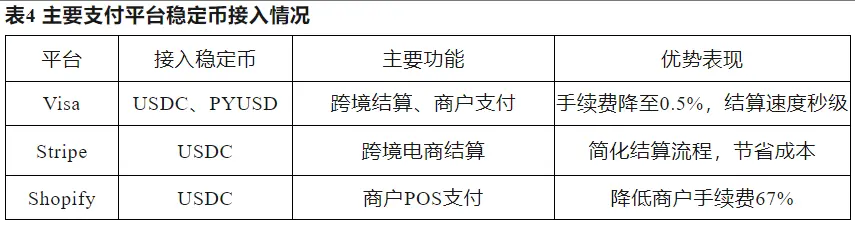
To address these "systemic risks," the report suggests that stablecoin governance should be advanced in layers, forming a multi-dimensional collaborative protection system of "regulatory layer - financial institutions - technical layer." At the regulatory level, it is necessary to promote the unification of global regulatory standards, implement reserve asset disclosure, cross-border data sharing, and stress testing (referencing the EU's MiCA and the UK's FCA regulatory sandbox experience). At the financial institution level, commercial banks can defend against deposit outflow risks by launching their own stablecoins (such as JPM Coin) while promoting on-chain settlement innovations; payment platforms (such as Visa) should also integrate stablecoin settlement layers to enhance competitiveness in cross-border business. At the technical level, it is essential to strengthen third-party audits of smart contracts, establish cross-chain bridge insurance mechanisms, and promote the development of anti-MEV (Maximum Extractable Value) protocols to prevent front-running and manipulation risks in on-chain transactions.
Global Regulatory Dynamics
The rapid development of stablecoins has attracted global regulatory attention, with countries striving to find a balance between encouraging financial innovation and controlling risks. Since 2023, the United States, the EU, Singapore, and the UAE have successively introduced regulatory frameworks to standardize key aspects such as reserve management, issuance qualifications, and information disclosure. Institutions like Deloitte believe that regulatory clarity is a necessary condition for stablecoins to transition from the margins to the mainstream financial system.
(1) The U.S. GENIUS Act
As a global financial innovation center, the U.S. regulatory path serves as a model. The pending "GENIUS Act" (General Examination of New Issuance of United Stablecoins Act) aims to unify national stablecoin regulatory standards and address the fragmentation of state and federal oversight. Key contents include: 1. Issuance qualifications: Non-bank institutions and bank subsidiaries can issue stablecoins, with federal approval required for those exceeding $10 billion in scale. 2. Reserve requirements: 100% high liquidity assets (≥80% U.S. Treasury bonds), with monthly audits. 3. Redemption and disclosure: T+1 redemption, mandatory monthly CPA reports, and pilot real-time disclosures. 4. Regulatory jurisdiction: The OCC regulates national issuers while retaining state licensing approval rights. However, challenges include conflicts over state and federal jurisdiction, disputes over reserve transparency, and interest bans on payment stablecoins, which may raise concerns in the industry about restrictions on innovation and rising compliance costs.
(2) EU MiCA Framework
The EU's Markets in Crypto-Assets Regulation (MiCA) will take effect in 2024, forming a full lifecycle regulatory system. Key requirements include: First, issuers must be licensed credit or payment institutions; second, reserve assets must be highly liquid and audited daily; third, real-time reserve disclosures are mandatory, with violations leading to delisting (Tether has already been delisted from some platforms). The MiCA model has successfully promoted industry transparency and standardization but has also significantly raised the entry barriers for the industry.
(3) Pilot Programs in Asia and the Middle East
Economies such as Singapore and the UAE have chosen to advance stablecoin management through a "regulatory sandbox + flexible regulation" approach. Singapore's MAS requires stablecoin issuers to primarily hold AAA-rated assets as reserves and accept monthly information disclosures and redemption commitments. The focus is on encouraging financial innovation alongside regulatory progress. The Central Bank of the UAE has approved commercial banks to pilot the issuance of AED stablecoins for local retail payment scenarios, constructing a model for the application of local currency stablecoins in consumer payments and microfinance.
The experiences of these countries indicate that phased and sectoral pilot programs during the initial regulatory stage can help balance innovation development and risk control. 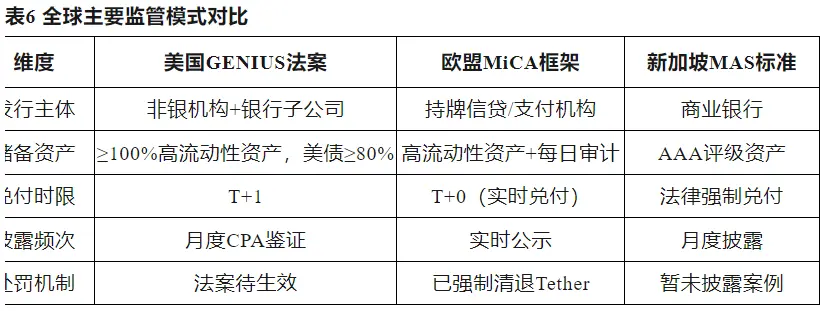
Future Development Path and Strategic Insights
Currently, stablecoins are evolving from auxiliary tools for crypto asset trading to important components of global financial infrastructure, profoundly impacting payment systems, cross-border capital flows, banking operations, and monetary policy. The report indicates that the future of stablecoins will be jointly driven by technological innovation, regulatory improvements, and the adaptability of the financial system, accelerating applications in high-value-added areas such as corporate payments, cross-border settlements, and supply chain finance, thereby promoting the upgrade of the global payment system with low costs and high efficiency.
As the regulatory system gradually improves, stablecoins that do not meet reserve and transparency requirements will be eliminated from the market, accelerating the industry's compliance process. At the same time, stablecoins are expected to achieve interoperability with central bank digital currencies (CBDCs), jointly undertaking global payment and settlement functions. The development of technological standardization and reserve transparency will promote the full integration of stablecoins into the global financial system.
However, the development of stablecoins also faces multiple challenges. On one hand, the innovation capabilities of stablecoins in payment and financial services are limited by stringent regulations, making the balance between innovation and safety a key focus for regulators in various countries. On the other hand, while their efficient payment and near-instant settlement enhance cross-border payment efficiency, they also amplify the speed of financial risk transmission. Additionally, the large-scale anchoring of dollar assets by stablecoins exacerbates "digital dollarization," putting pressure on the stability of local currencies and the independence of monetary policy in emerging markets.
For emerging economies like China, the development of stablecoins brings three insights: First, pilot programs should be initiated in closed scenarios such as cross-border e-commerce, regional trade, and offshore settlements to accumulate experience; second, a dual focus on technology and compliance should be promoted, strengthening reserve transparency and on-chain security, and facilitating interoperability and mutual recognition between the digital renminbi and controllable stablecoins; third, active participation in global governance mechanisms such as the BIS and IMF should be encouraged to jointly promote the formulation of digital financial rules, striving for the interests and voice of more developing countries.
 Risk warning
 Risk warning






Popular articles





