








51% market share, 18 billion dollars in real lending, how is the "Aave effect" sweeping through every corner of DeFi?

 In the DeFi space, network effects determine success or failure, and no one does it better than Aave.
Original Title: The Aave Effect
Original Author: Kolten
Original Compilation: Tim, PANews
In the DeFi space, network effects determine success or failure, and no one does it better than Aave. With five years of market accumulation, a user base of millions, and the deepest liquidity in the DeFi sector, projects built on Aave will gain unparalleled scale and network effects, which is a core advantage that other platforms cannot replicate.
Partners can instantly access infrastructure, user bases, and liquidity, which would typically take years to build independently. This is what we refer to as the "AAVE Effect."
Some Data
Source: DeFiLlama
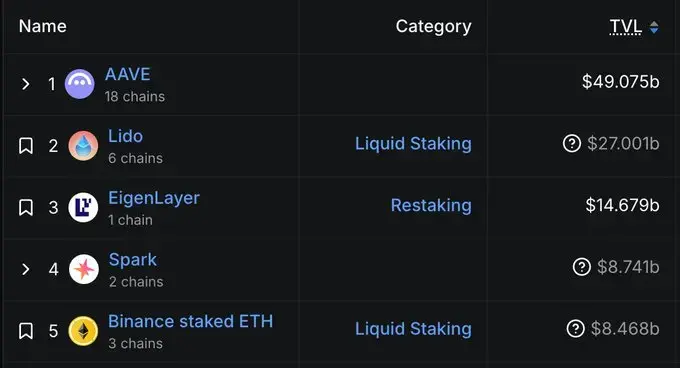
Aave is currently the largest protocol in the DeFi space, more accurately, the largest protocol in history. Its TVL accounts for 21% of the entire DeFi market, capturing 51% of the lending market share, with net deposits exceeding $49 billion. While these figures are already impressive, the real core lies in Aave's market penetration. For example:
- After Ethena's sUSDe scaled its operations on Aave, deposits surged from $2 million to $1.1 billion in just two months.
- Within just a few weeks of Pendle being added to Aave, users deposited $1 billion worth of PT tokens. This figure has now doubled to $2 billion, making Aave the largest supply market for Pendle tokens.
- KelpDAO's TVL skyrocketed from 65,000 ETH to 255,000 ETH in just four months after rsETH was incorporated into the Aave protocol, achieving a fourfold increase.
There are countless examples. Aave holds nearly 50% of the active stablecoin market and serves as the primary liquidity hub for Bitcoin in DeFi. Notably, Aave has achieved nearly $1 billion in TVL across four independent blockchain networks, a rare and profound layout.
How is the Aave Effect Formed?
Anyone can incentivize deposits through token rewards and yield farming programs to expand supply-side scale. This is why, on the surface, TVL is not always a meaningful metric. In fact, attracting funding supply is now seen as a solvable problem, but creating demand for asset usage is much more challenging unless you are a platform like Aave.
Source:https://tokenterminal.com/explorer/markets/lending/metrics/active-loans
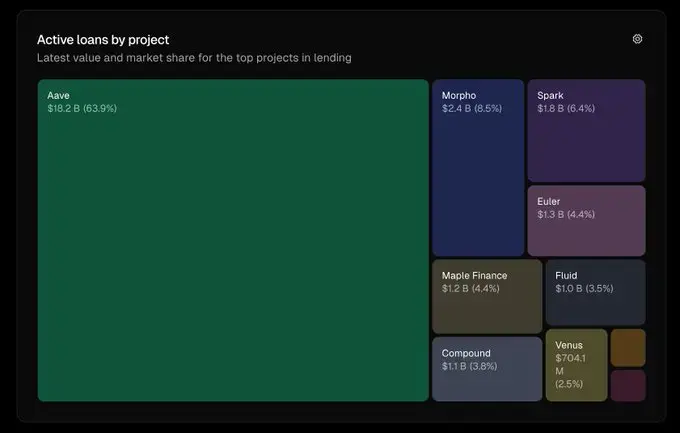
The active borrowing volume on the Aave platform exceeds $18 billion, far surpassing the total of all its competitors combined. The protocol is not merely a sophisticated staking contract; when users deposit assets into Aave, those assets are either lent out or used as collateral to borrow other assets. In other words, funds are never idle.
This creates a positive feedback loop that continuously reinforces demand. When an asset is launched on the Aave market, or a development team builds on it, they can benefit from this demand. Ultimately, everyone will benefit from the actual economic activities generated by a large active user base.
This is crucial for teams developing on Aave. The protocol has withstood five years of scrutiny, traversing multiple market cycles, consistently earning the trust of developers and users. As a primary platform for billions of dollars in funds, it far exceeds many emerging protocols today.
Source: Block Analitica
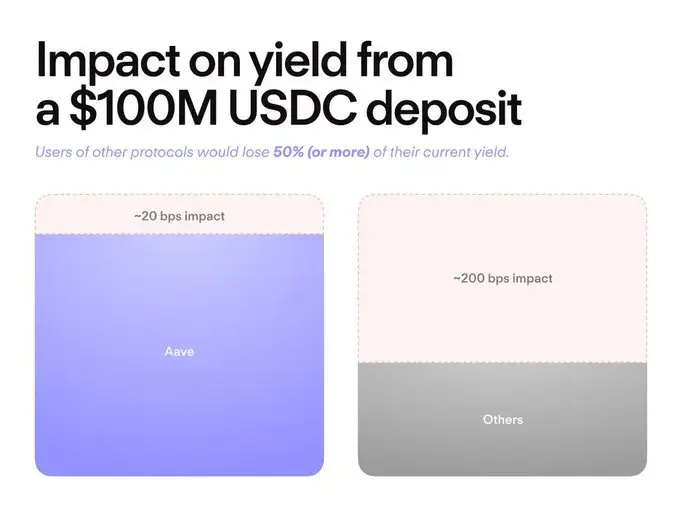
Moreover, developers on the Aave platform are not constrained by "scale." Compared to other protocols, Aave can support deposit and borrowing volumes that are tens of millions of dollars higher. This allows fintech applications of any size (retail user level, institutional level, or both) to develop robustly on this platform.
Outlook
When Aave V4 launches, the core driving engine of the Aave effect will continue to evolve. Its new architecture will provide builders and users with unprecedented asset access pathways and unique lending strategy solutions.
All the factors that make Aave valuable to DeFi today will become even more pronounced in the future.
 Risk warning
 Risk warning




Popular articles





