








From PayPal Mafia to Investment Empire: Unveiling the Rise of Peter Thiel's Founders Fund (Part 1)

 The Rise of the Founders Fund: How Thiel's Contrarian Philosophy Reshaped the Investment World from PayPal to Silicon Valley Venture Capital Giant?
Podcast Source: Mario Gabriele, The Generalist Podcast
Original Title: No Rivals - the story of Founders Fund Part 1.
Release Date: July 8, 2025
Compiled & Edited by: Lenaxin, ChainCatcher
Summary:
TL&DR
- The essence of success lies in seeking differences
- Founders Fund manages billions of dollars in assets
- He can foresee the chessboard twenty moves ahead and position key pieces precisely
- Talented and unconventional, daring to explore conclusions that most people shy away from
- Since the mid-1998 Stanford speech, the three founders of Founders Fund officially met.
- Thiel's strength lies in strategy rather than execution
- Pursuing macro investment achievements, systematizing venture capital practices, while simultaneously founding new companies
- All successful companies are different—achieving monopoly by solving unique problems; all failed companies are the same, failing to escape competition.
- "He comes from a hedge fund background and always wants to cash out." Moritz commented on Thiel.
ChainCatcher Editor's Note:
This article is compiled from the podcast No Rivals, presenting how Founders Fund transformed from a small side project into one of the most influential and controversial companies in Silicon Valley. It deeply analyzes Peter Thiel's venture capital empire, including its origin story, how Peter Thiel assembled an extraordinary team of investors, how the fund's concentrated bets on SpaceX and Facebook yielded astonishing returns, and how Peter Thiel's contrarian philosophy reshaped the venture capital industry and American politics.
This report is based on exclusive performance data and interviews with key figures obtained from The Generalist Podcast, revealing how the institution set the record for the best returns in venture capital history. This podcast consists of four parts, and this is the first part.
The Prophet
Peter Thiel is nowhere to be seen.
On January 20, to escape the harsh winter storm, the most powerful figures in America gathered under the dome of the Capitol to celebrate Donald J. Trump’s inauguration as the 47th president.
If you have even a fleeting interest in technology and venture capital, it’s hard not to think of Thiel when looking back at photos from this event. He was absent but omnipresent.
His former employees (now the Vice President of the United States); a few steps away stood his old partner from The Stanford Review (the new AI and cryptocurrency affairs director of the Trump administration); sitting a bit further away was his earliest angel investment target (the founder and CEO of Meta); and beside him was his partner, both friend and foe: Elon Musk, founder of Tesla and SpaceX, and the world’s richest person.
To say that all of this was orchestrated by Peter Thiel would be an exaggeration, but the career of this former chess prodigy has consistently displayed remarkable talent: he can foresee the chessboard twenty moves ahead and position key pieces precisely: JD to B4, Sacks to F3, Zuck to A7, Elon Musk to G2, Trump to E8.
He navigates the core centers of power, including New York's financial sector, Silicon Valley's tech scene, and Washington's military-industrial complex; his actions are always cautious and unconventional, making him hard to pin down; he often mysteriously disappears for months, then suddenly reappears, throwing out a sharp quip, a perplexing new investment, or a captivating act of revenge. At first glance, these actions seem like blunders, but over time, they gradually reveal his extraordinary foresight.
Founders Fund is the core of Thiel's power, influence, and wealth. Since its establishment in 2005, it has grown from a $50 million fund with an immature team into a Silicon Valley giant managing billions of dollars in assets, with a top-notch investment team. Its image is controversial, reminiscent of the "Bad Boy Legion" of the early 1990s.
Performance data supports Founders Fund's flamboyant style. Despite the fund's continuous expansion, its concentrated bets on SpaceX, Bitcoin, Palantir, Anduril, Stripe, Facebook, and Airbnb have consistently generated astonishing returns. The 2007, 2010, and 2011 funds created a trilogy of the best performances in venture capital history: achieving total returns of 26.5 times, 15.2 times, and 15 times on principal investments of $227 million, $250 million, and $625 million, respectively.
Contemporaries have described Talleyrand's smile as "narcotic," and even the often boastful salon hostess Madame de Staël lamented, "If his conversation could be bought, I would go bankrupt."
Peter Thiel seems to possess a similar charm. This is often evident when tracing the origins of Founders Fund. The chance encounters with Peter Thiel often leave listeners enchanted: some moved cities for him, while others gave up prestigious positions just to immerse themselves in his "strange" thoughts.
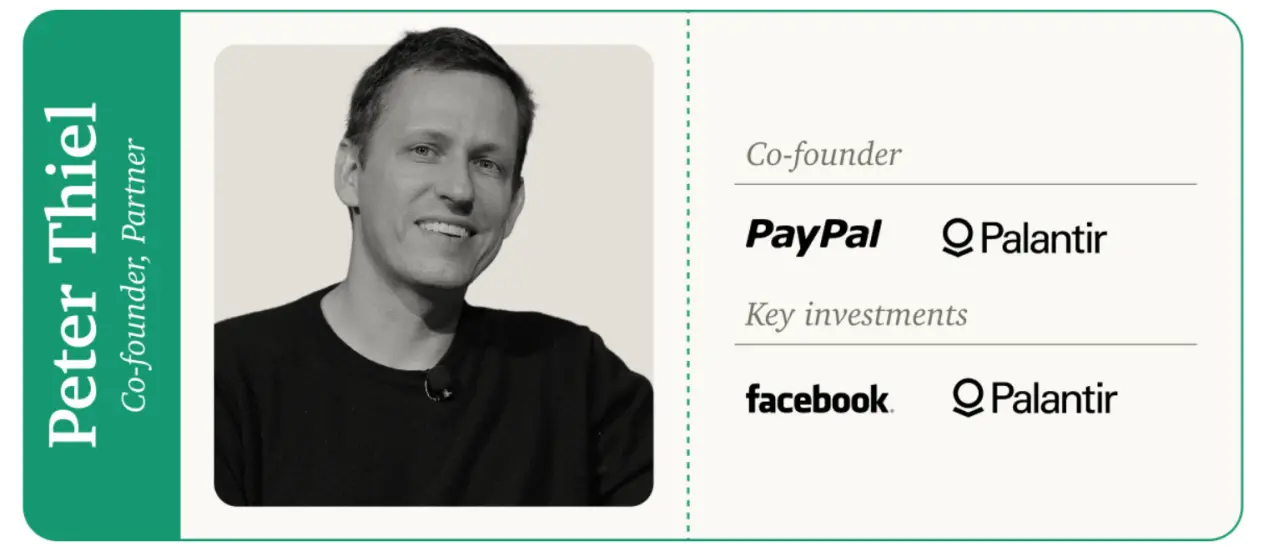
Whether on the conference stage or in rare podcasts, listening to Thiel speak, you will find that his charm does not come from a diplomat's smooth talk. Instead, his charm comes from a versatile ability to dance across different topics, narrating with the profound knowledge of a Trinity College professor.
Who else can write a classic book on startups, argue for the virtues of monopoly, and discuss the wisdom of running a business like a cult through Lucretius, Fermat's theorem, and Ted Kaczynski? How many people's thoughts contain such rigor and irreligiosity?
Ken Howery and Luke Nosek had already succumbed to this charm years before co-founding Founders Fund with Peter Thiel in 2004. Ken Howery's "conversion moment" occurred during his undergraduate studies in economics at Stanford. In Peter Thiel's 2014 business philosophy book Zero to One, he described Howery as the "only member of the PayPal founders who fits the stereotype of a privileged American childhood, the only Eagle Scout in the company." This Texan youth moved to California in 1994 and began writing for The Stanford Review, a conservative student publication co-founded by Thiel seven years earlier.
Peter Thiel's first encounter with Ken Howery stemmed from a Stanford Review alumni event. As Howery was promoted to senior editor, the two kept in touch. On the eve of Howery's graduation, Thiel extended an olive branch: would he like to be the first employee of his new hedge fund? He suggested they discuss it further at the Sundance steakhouse in Palo Alto.
Howery quickly realized this was no ordinary recruitment dinner. During a four-hour intellectual odyssey, the young Thiel displayed complete charisma. "From political philosophy to entrepreneurial ideas, his insights on every topic were more captivating than anyone I encountered during my four years at Stanford, and the breadth and depth of his knowledge were astounding," Howery recalled.
Although he made no commitment on the spot, that night back on campus, Howery confided to his girlfriend, "I might work with this person for the rest of my life."
The only obstacle was Howery's original plan to join ING Barings in New York for a high-paying position. In the following weeks, he asked friends and family whether to choose the well-paying investment bank or follow a new investor managing less than $4 million. "Everyone advised me 100% to choose the bank, but after thinking for weeks, I decided to go the other way," Howery stated.
Before graduation, while attending a campus talk by his new boss, a young man with brown curls named Luke Nosek suddenly leaned over and asked, "Are you Peter Thiel?"
"No, but I'm about to work for him," Howery replied, as the young man, claiming to be Luke Nosek, handed him a business card that simply read "Entrepreneur." "The company I founded," Nosek explained. At that time, Nosek was developing Smart Calendar, one of the many electronic scheduling applications that emerged around the same period, which Thiel had already invested in.
This interaction raised a perplexing question: how could Nosek forget his supporter, someone he had shared breakfast with a few times? Perhaps it had been a long time since they last met, or maybe this quirky, driven founder simply didn't care about the investor's appearance. Or perhaps Thiel was just briefly forgotten.
In Nosek, Thiel found the ideal talent prototype: talented and unconventional, daring to explore conclusions that most people shy away from. This powerful brain, free-thinking, and disregard for social norms perfectly aligned with Thiel's values. Thiel quickly followed Nosek's lead and signed a contract with the cryonics organization Alcor.
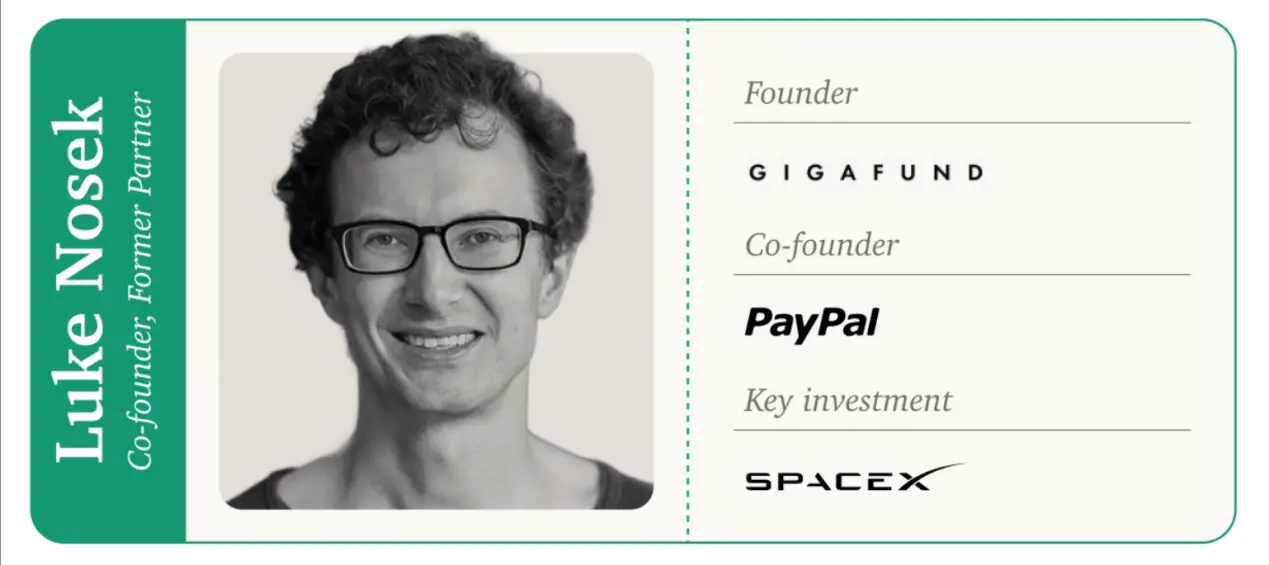
Since the mid-1998 Stanford speech, the three founders of Founders Fund officially met. Although the three spent another seven years establishing their respective venture capital funds, deeper collaboration had already begun.
Spite Store
"I’m Larry David, and I want to introduce you to the soon-to-open Latte Larry's coffee shop." In the opening line of the nineteenth episode of Curb Your Enthusiasm, the creator of Seinfeld said, "Why get involved with coffee? Because the owner next door is such a jerk, I had to do something, so I opened a spite store."
Thus, the cultural term "spite store" was born—using business to take revenge by competing for customers.
To some extent, Founders Fund is Peter Thiel's "spite store." While Mocha Joe, the acerbic character, inspired Larry David, Thiel's actions can be seen as a response to Sequoia Capital's Michael Moritz. Moritz, a journalist turned investor from Oxford, is a legendary figure in venture capital, responsible for early investments in Yahoo, Google, Zappos, LinkedIn, and Stripe.
Moritz is a literary-minded investment expert who repeatedly became a stumbling block in Thiel's early entrepreneurial history.
The story begins with PayPal: that summer, Thiel met Ukrainian-born genius entrepreneur Max Levchin. He graduated from the University of Illinois, where he developed a highly profitable encryption product for PalmPilot users. After hearing the pitch, Thiel said, "This is a good idea; I want to invest."
Thiel immediately decided to invest $240,000. This underestimated decision ultimately yielded $60 million in returns and opened the curtain on one of the most tumultuous entrepreneurial epics of the internet era. (The Founders provides a comprehensive account of this.)
Levchin quickly recruited the entrepreneur who had previously failed, Nosek. Thiel and Howery then joined full-time, with Thiel serving as CEO. The addition of talents like Reid Hoffman, Keith Raboy, and David Sachs created the most luxurious startup team in Silicon Valley history.
The company originally named Fieldlink (later renamed Confinity) soon crossed paths with X.com, founded by Elon Musk. To avoid a war of attrition, the two companies chose to merge, naming the new company "PayPal" after Confinity's most popular email address and payment connection.
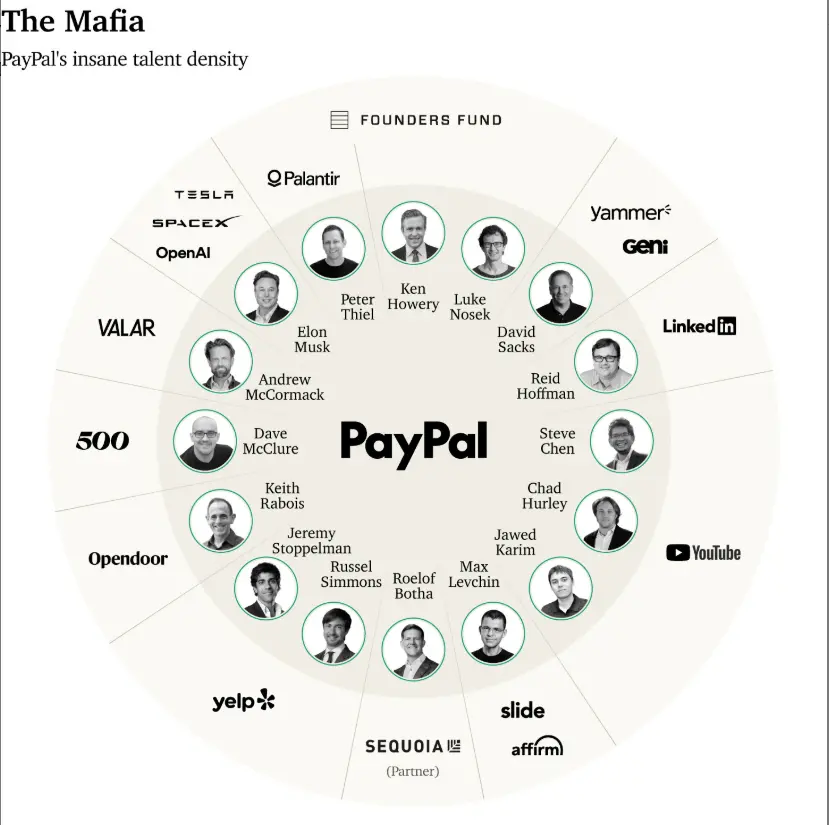
This merger required not only the integration of two stubborn management teams but also the acceptance of each other's investments and investors.
Moritz, who had invested in X.com, suddenly needed to deal with a group of quirky geniuses. On March 30, 2000, the two companies announced a $100 million Series C funding round—Thiel pushed for this round because he anticipated a macroeconomic downturn. His foresight proved correct: within days, the internet bubble burst, and many star companies collapsed.
"I want to thank Peter," one employee stated, "he made the judgment and insisted that we must complete the financing because the end was near…"
However, his keen macro interpretation was not enough to save the company. Thiel saw an opportunity for profit. At a 2000 PayPal investor meeting, Thiel suggested: if the market really fell further as he expected, why not short it? PayPal could simply transfer its new $100 million to Thiel Capital International, and he would handle the rest.
Moritz was furious, saying, "Peter, it's simple," a director recalled Moritz's warning, "if the board passes this proposal, I will resign immediately." Thiel found it hard to understand this stubborn reaction; the fundamental difference lay in Moritz's desire to do the right thing, while Thiel wanted to be the right person. Finding common ground between these two epistemological extremes was not easy.
In the end, both sides suffered: Moritz successfully blocked Thiel's plan, but Thiel's prediction was entirely correct. After the market crash, one investor admitted, "If we had shorted back then, the returns would have exceeded all of PayPal's operational income."
This boardroom conflict intensified the distrust between the two, and a power struggle months later led to a complete rupture. In September 2000, under the leadership of Levchin, Thiel, and Scott Bannister, PayPal employees staged a coup to overthrow CEO Elon Musk (who had just dismissed the parachute CEO Bill Harris). Musk refused to compromise, and Thiel's rebellious faction had to persuade Moritz to approve Thiel taking over the company. Moritz set the condition: Thiel could only serve as interim CEO.
In fact, Thiel had no intention of running PayPal long-term; his strength lay in strategy rather than execution. But Moritz's terms forced him to humbly seek a successor for himself. It wasn't until an external candidate also expressed support for Thiel's formal appointment as CEO that Moritz changed his mind.
This "devaluation followed by praise" power game deeply wounded this vengeful genius, laying the groundwork for his later establishment of Founders Fund.
Despite the internal conflicts at PayPal, the company ultimately succeeded. And Thiel had to admit that Moritz played an indispensable role in this. When eBay made a $300 million acquisition offer in 2001, Thiel advocated for acceptance, while Moritz insisted on independent development.
"He comes from a hedge fund background and always wants to cash out." Moritz later commented on Thiel. Fortunately, Moritz persuaded Levchin, and PayPal rejected the acquisition. Soon after, eBay raised its offer to $1.5 billion, five times the exit price Thiel initially suggested.
This deal made Thiel and his "gang" members very wealthy, adding another glorious chapter to Moritz's investment record. If the two had different personalities, perhaps time could have healed the animosity, but the reality was that this was just the beginning of a prolonged war.
Clarium Call
As evidenced by the rejected $100 million macro bet, Thiel never extinguished his investment enthusiasm. Even during his time at PayPal, he and Howery continued to manage Thiel Capital International. "We spent countless nights and weekends keeping the fund running," Howery revealed.
To align with Thiel's broad interests, they pieced together a mixed investment portfolio of stocks, bonds, currencies, and early-stage startups. "We completed 2-3 deals annually," Howery specifically pointed out the investment in the email security company Ironport Systems in 2002—which Cisco acquired for $830 million in 2007.
The $60 million profit from the PayPal acquisition further ignited Thiel's investment ambitions. Even during the period of scaling up management, he continued to pursue multiple lines: chasing macro investment achievements, systematizing venture capital practices, while simultaneously founding new companies. Clarium Capital became the core vehicle for these ambitions.
In the same year the PayPal acquisition was completed, Thiel set out to establish the macro hedge fund Clarium Capital. "We are striving for a systematic worldview, as proclaimed by people like Soros," he explained in a 2007 Bloomberg profile interview.
This perfectly aligned with Thiel's thinking traits—he is naturally adept at grasping civilization-level trends and instinctively resists mainstream consensus. This mindset quickly demonstrated its power in the market: Clarium's asset management scale skyrocketed from $10 million to $1.1 billion within three years. In 2003, it profited 65.6% by shorting the dollar, and after a sluggish 2004, it achieved a 57.1% return in 2005.
Meanwhile, Thiel and Howery began planning to systematize their scattered angel investments into a professional venture capital fund. The performance gave them confidence: "When we looked at the portfolio, we found internal rates of return as high as 60%-70%," Howery stated, "and that was just from part-time, casual investments. What if we operated systematically?"
After two years of brewing, in 2004, Howery launched fundraising for a fund initially sized at $50 million, originally intended to be named Clarium Ventures. They invited Luke Nosek to join as a part-time member as usual.
Compared to the billions managed in hedge funds, $50 million seemed insignificant, but even with the halo of the PayPal founding team, fundraising was still exceptionally challenging. "It was much harder than expected; everyone had a venture capital fund by then, but at that time, it was very alternative," Howery recalled.
Institutional LPs showed little interest in such a small fund. Howery had hoped Stanford University's endowment fund would serve as an anchor investor, but they withdrew due to the fund's small size. Ultimately, only $12 million in external funding was raised—mainly from personal investments by former colleagues.
Eager to launch, Thiel decided to contribute $38 million (76% of the initial fund) to fill the gap. "The basic division of labor was Peter providing the money, and I providing the effort," Howery recalled. Given Thiel's other commitments, this division was inevitable.
The 2004 Clarium Ventures (later renamed Founders Fund) inadvertently became the best-positioned fund in Silicon Valley, thanks to two personal investments Thiel completed before fundraising. The first was Palantir, co-founded in 2003—Thiel again took on dual roles as founder and investor, launching the project with PayPal engineer Nathan Gettings and Clarium Capital employees Joe Lunsdale and Stephen Cohen. The following year, he invited his Stanford Law School classmate, the eccentric curly-haired genius Alex Karp, to serve as CEO.
Palantir's mission was highly provocative: drawing on the imagery of the "seeing stone" from The Lord of the Rings, it aimed to use PayPal's anti-fraud technology to help users achieve cross-domain data insights. But unlike conventional enterprise services, Thiel targeted the U.S. government and its allies as clients. "After 9/11, I thought about how to combat terrorism while safeguarding civil liberties," he explained to Forbes in 2013. This government-oriented business model also faced financing difficulties—investors were skeptical about the slow government procurement process.
Kleiner Perkins executives directly interrupted Alex Karp's roadshow, discussing the impracticality of the business model; old rival Mike Moritz arranged a meeting but doodled throughout the entire session—this seemed to be another deliberate slight against Thiel. Although they failed to impress the Sand Hill Road venture capital firm, Palantir gained favor with the CIA's investment arm, In-Q-Tel. "What impressed me most about this team was their focus on human-machine data interaction," a former executive commented. In-Q-Tel became Palantir's first external investor with a $2 million investment, which later brought Thiel significant financial and reputational returns. Founders Fund subsequently invested a total of $165 million, and by December 2024, the stake was valued at $3.05 billion, yielding an 18.5x return.
However, substantial returns would take time, and Thiel's second key investment before founding Clarium Ventures paid off more quickly: in the summer of 2004, Reid Hoffman introduced the 19-year-old Mark Zuckerberg to his old friend Thiel. This politically divergent yet like-minded PayPal comrade (Hoffman founded the social networking site SocialNet in 1997 and later joined Confinity as COO) had already deeply discussed social networks. By the time they met Zuckerberg in Clarium Capital's luxurious San Francisco Presidio office, they had a mature understanding and investment determination.
"We did extensive research in the social networking space," Thiel candidly stated at a Wired event, "the investment decision had nothing to do with the meeting performance—we had already decided to invest." This 19-year-old, dressed in a T-shirt and Adidas sandals, exhibited the "Asperger-like social awkwardness" qualities that Thiel praises in Zero to One: neither trying to please nor ashamed to ask unfamiliar financial terms. This quality of stepping away from imitative competition was precisely the entrepreneurial advantage in Thiel's eyes.
Days after the meeting, Thiel agreed to invest $500,000 in Facebook in the form of convertible debt. The terms were straightforward: if users reached 1.5 million before December 2004, the debt would convert into equity, granting him a 10.2% stake; otherwise, he had the right to withdraw his funds. Although the target was not met, Thiel still chose to convert—this conservative decision ultimately yielded over $1 billion in personal gains. Although Founders Fund did not participate in the first round of investment, it later invested a total of $8 million, ultimately generating $365 million in returns for LPs (46.6x).
Thiel later viewed the Series B funding for Facebook as a significant mistake. The first round was valued at $5 million, and eight months later, Zuckerberg informed him that the Series B valuation had reached $85 million. "The graffiti on the office walls was still terrible, the team had only eight or nine people, and it felt like nothing changed every day," Thiel recalled. This cognitive bias led him to miss the opportunity to lead the round, doubling down only when the Series C valuation reached $525 million. This taught him the counterintuitive lesson: "When smart investors lead a valuation surge, it is often still underestimated—people always underestimate the acceleration of change."
Sean Parker's decision to blacklist Michael Moritz had its reasons. This son of a television advertising broker and oceanographer shocked the tech world at the age of 19 with his P2P music-sharing application Napster. Although Napster was ultimately shut down in 2002, it earned Parker both fame and controversy. That same year, he founded the contact management application Plaxo, whose social features and "dangerous prodigy" aura attracted Sequoia Capital's Moritz and others to invest $20 million.
Plaxo repeated the fate of Napster: it started strong but declined. Reports at the time indicated that Parker's management style was erratic—chaotic schedules, unfocused teams, and volatile emotions. By 2004, Moritz and angel investor Ram Sriram decided to oust Parker. When Parker attempted to cash out his shares and was blocked, tensions escalated: Plaxo's investors hired private investigators to track his whereabouts, discovering signs of drug use (Parker claimed it was for entertainment and did not affect his work). This farce ended with Parker's exit in the summer of 2004 but unexpectedly led to a turning point—after leaving Plaxo, he immediately began collaborating with Mark Zuckerberg. The two had met earlier that year when Facebook rapidly took over Stanford's campus, and Parker proactively reached out to the young founder to discuss development.
Parker even flew to New York to have dinner with Zuckerberg at a trendy Tribeca restaurant, even overdrawing his bank account. As Plaxo fell apart, he reunited with Zuckerberg in Palo Alto and soon became Facebook's president, initiating a brief yet legendary collaboration. His first move was to take revenge on Michael Moritz and Sequoia Capital—when Facebook surpassed one million users in November 2004, Sequoia sought to engage. Parker and Zuckerberg designed a cruel prank: they deliberately arrived late and dressed in pajamas, presenting a slideshow titled "Ten Reasons Not to Invest in Wirehog," which included slides like "We have no revenue," "We arrived late in pajamas," and "Sean Parker is involved." "Given their behavior, we could never accept Sequoia's investment," Parker stated. This missed opportunity may have become one of Sequoia's most painful losses.
As this episode illustrates, the Napster founder played a key role in early Facebook financing, guiding Zuckerberg into the world of venture capital. Therefore, when Zuckerberg met Thiel and Hoffman in Clarium's Presidio office, Parker was also present.
Although Thiel and Parker had intersected during their early days at Plaxo, the real foundation for collaboration was laid during the Facebook era. In August 2005, while renting a party villa in North Carolina, Parker was arrested due to the presence of underage assistants and a cocaine search incident (though he was not charged and denied knowledge), ultimately being forced to leave Facebook. This turned out to be a turning point for all parties: Zuckerberg was ready to take over management, investors were relieved to be rid of a talented yet elusive spokesperson, and Parker admitted that his personality of "sprinting and then disappearing" was not suitable for daily operations.
Months later, Parker joined Thiel's venture capital firm as a general partner—by this time, it had been renamed Founders Fund (ultimately dropping the definite article like Facebook). This name better aligned with its ambitions and positioning. "We had some criticisms of certain investors from the PayPal era; we believed we could operate in another way," Howery stated. Its core philosophy was simple yet disruptive: never oust the founders.
This seemed commonplace in today's "founder-friendly" market, but at the time, it was groundbreaking. "They pioneered the 'founder-friendly' concept; the norm in Silicon Valley was to find technical founders, hire professional managers, and ultimately oust both. Investors were the actual controllers," commented Ryan Peterson, CEO of Flexport.
"This was how the venture capital industry operated for the first 50 years until Founders Fund appeared," summarized Stripe co-founder John Collison in the history of venture capital. Since the 1970s, Kleiner Perkins and Sequoia Capital had achieved success through active management involvement, and this "investor-led" model had proven effective in cases like Atari and Tandem Computers. Even 30 years later, top venture capitalists retained this cognitive inertia—power belonged to the capital side rather than the entrepreneurs. Sequoia's legendary founder Don Valentine even joked that mediocre founders should be "locked in the Manson family dungeon."
Founders Fund's "founder-centric" philosophy was not only a differentiated strategy but also stemmed from Thiel's unique understanding of history, philosophy, and the essence of progress. He firmly believed in the genius value of "sovereign individuals," arguing that constraining those who break conventions is not only economically foolish but also a destruction of civilization. "These people will destroy the creations of the world's most valuable inventors," Luke Nosek articulated the team's disdain for traditional venture capital.
Sean Parker perfectly embodied this philosophy, but his joining at the age of 27 still raised concerns among investors. Reports announcing his appointment stated bluntly: "His past experiences made some LPs nervous." Parker himself admitted, "I always lack a sense of security; after meetings, I constantly ask myself if I provided value."
This concern drew fire from old rival Mike Moritz. After raising $50 million in 2004, Founders Fund aimed for $120-150 million in 2006. By this time, the team had undergone a complete transformation: Parker joined, Nosek came on board full-time, and with Thiel's halo as Facebook's first external investor, this small firm that had originally belonged to hedge fund side projects was transforming into an emerging force.
This move clearly angered Moritz. According to Howery and others, the Sequoia chief attempted to obstruct their fundraising: "During our second fundraise, a warning slide appeared at the Sequoia annual meeting—'Stay away from Founders Fund.'" Brian Singerman, who joined two years later, added details: "They threatened LPs that if they invested in us, they would permanently lose access to Sequoia."
Contemporary reports indicated that Moritz's wording was more subtle. He emphasized at LP meetings that he "appreciated founders who stayed committed to their companies long-term," naming several well-known entrepreneurs who failed to do so. This clearly alluded to Founders Fund partner Sean Parker. "We increasingly respect those founders who create great companies rather than speculators who prioritize personal interests over the team," Moritz later responded.
This "boomerang" effect instead propelled Founders Fund forward: "Investors became curious: why was Sequoia so wary? This released a positive signal," Howery stated. In 2006, the fund successfully raised $227 million, with Thiel's contribution dropping from 76% in the first fund to 10%. Howery noted, "Stanford University's endowment fund led the investment, marking our first recognition from institutional investors."
As early investments began to show results, Founders Fund's unique investment philosophy started to demonstrate its power. Thiel's aversion to institutional management left the fund in a state of "efficient chaos" during its first two years. Howery was busy scouting projects, while the team refused fixed agendas and routine meetings.
Since Thiel needed to balance Clarium Capital, his time was extremely limited. Howery stated, "I could only arrange for him to participate in key meetings." Although Parker's addition did not change the fund's operational principles, it brought more systematization: Howery explained, "When Luke and Sean joined, the three of us could evaluate projects together, or one person could initially filter before bringing it to the team for decision-making."
The core team formed complementary abilities: "Peter is a strategic thinker, focusing on macro trends and valuations; Luke combines creativity and analytical skills; I focus on team evaluation and financial modeling," Howery analyzed. Parker completed the product dimension: "He deeply understands internet product logic; his experience at Facebook made him proficient in identifying consumer internet pain points and accurately spotting niche opportunities." His personal charm also became a negotiating weapon: "He is highly persuasive, especially outstanding in closing deals."
In addition to the two flagship investments in Facebook and Palantir, Founders Fund also invested in Buddy Media, which was sold to Salesforce for $689 million, but missed out on YouTube—this should have been a project "within range," as founders Chad Hurley, Steve Chen, and Joed Kareem all came from PayPal, ultimately captured by Sequoia's Roelof Botha, who sold it to Google for $1.65 billion just a year later.
Regardless, the early years of Founders Fund's performance were already impressive, and even more glorious moments were about to come.
In 2008, Thiel reunited with old rival Elon Musk at a friend's wedding. This former PayPal associate had by then founded Tesla and SpaceX with cash-out funds. While the venture capital market chased the next consumer internet hotspot, Thiel's interest waned—stemming from his obsession with the theories of French philosopher René Girard during his Stanford days. "Girard's ideas were out of sync with the times, perfectly suited to rebellious undergraduates," Thiel recalled.
Girard proposed the theory of "mimetic desire": human desire arises from imitation rather than intrinsic value. This theory became the core framework for Thiel's analysis of the world. After Facebook's rise, witnessing the venture capital community collectively chase the mimetic frenzy of social products, Founders Fund, although investing in the local social network Gowalla (later acquired by Zuckerberg), seemed to struggle.
Thiel succinctly summarized in Zero to One: "All successful companies are different—achieving monopoly by solving unique problems; all failed companies are the same—they failed to escape competition." " Although monopolies are hard to come by in the venture capital field, Thiel still implemented this idea in his investment strategy: seeking areas that other investors are unwilling or unable to touch.
Thiel turned his attention to hard tech—companies building the atomic world rather than the bit world. This strategy came at a cost: after Facebook, Founders Fund missed all major opportunities in the social domain, including Twitter, Pinterest, WhatsApp, Instagram, and Snap. But as Howery stated, "You would gladly trade all those misses for SpaceX."
After the wedding reunion in 2008, Thiel proposed investing $5 million in SpaceX, partly motivated by "making amends for the rift during the PayPal era," showing that he was not yet fully convinced of Musk's technology. At that time, SpaceX had already experienced three launch failures and was nearly out of funds. An email mistakenly sent to Founders Fund by a former investor further exposed the industry's general pessimism towards SpaceX.
Although Parker chose to avoid the unfamiliar field, other partners pushed forward vigorously. As the project lead, Nosek advocated increasing the investment to $20 million (nearly 10% of the second fund) to enter at a pre-money valuation of $315 million—this was the largest single investment in Founders Fund's history and proved to be the wisest decision.
"This was highly controversial; many LPs thought we were crazy," Howery admitted. But the team firmly believed in Musk and the technology's potential: "We had missed multiple projects from PayPal colleagues; this time we had to go all in." Ultimately, this investment quadrupled the fund's stake in its best project.
A well-known LP that Founders Fund was negotiating with subsequently severed ties. "We parted ways because of this," Howery revealed. This anonymous LP missed out on astonishing returns—over the next 17 years, the fund cumulatively invested $671 million in SpaceX (second only to Palantir's holdings). By December 2024, when the company conducted an internal share buyback at a valuation of $350 billion, that stake was worth $18.2 billion, achieving a 27.1x return.
Disclaimer
The content of this article does not represent the views of ChainCatcher. The opinions, data, and conclusions in the text represent the personal positions of the original author or interviewees. The compiler maintains a neutral stance and does not endorse their accuracy. This does not constitute any professional advice or guidance; readers should exercise caution based on independent judgment. This compilation is for knowledge-sharing purposes only; readers must strictly comply with local laws and regulations and refrain from participating in any illegal financial activities.
 Risk warning
 Risk warning

Popular articles





