








Manipulating SharpLink, revealing the behind-the-scenes players of the cryptocurrency and stock frenzy A.G.P

 Unveiling how investment bank A.G.P. operates to transform listed companies into crypto proxy stocks, leveraging regulatory and narrative arbitrage to become the behind-the-scenes winner in designing the rules of the game.
Author: Zz, ChainCatcher
Editor: TB, ChainCatcher
On July 15, 2025, an astonishing announcement shook the market: the near-delisted gaming company SharpLink declared it would use the $413 million raised within a week to buy Ethereum. The capital market responded with fervor—according to data from Investing and Nasdaq, its stock price skyrocketed by 528% in six months, surging over 150% in a single month.
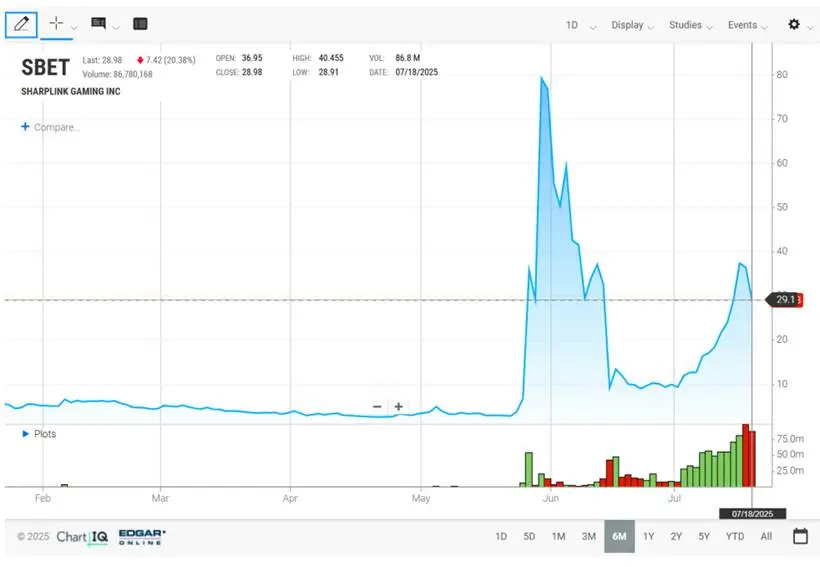
However, SharpLink's comeback story is just the tip of the iceberg. Almost simultaneously, a broader capital alchemy was quietly unfolding across various industries: a traditional consumer goods company (Upexi) seamlessly incorporated SOL tokens into its reserves through clever bond design; a crypto mining giant (Bitdeer) successfully connected with traditional Wall Street capital; and a cutting-edge Canadian tech company (BTQ) raised tens of millions from U.S. investors by exploiting regulatory loopholes.
From near-bankrupt "junk stocks" to robust consumer brands, from crypto-native enterprises to cross-border tech newcomers. When people sought to find the driving force behind this, the spotlight did not shine on Goldman Sachs or JPMorgan, but rather on a mid-sized investment bank that had previously been inconspicuous in the public eye: A.G.P. (Alliance Global Partners).
As the operator or key participant in all these transactions, A.G.P. has played this model to perfection. Just from the SharpLink project alone, based on its commission rate, it earned possibly over $8 million in commissions within a week, and this was merely the beginning of its massive $6 billion plan.
While Wall Street giants were building compliance bridges for institutional clients, A.G.P. took a more aggressive route: transforming a variety of listed companies into "cryptocurrency proxy stocks" in bulk, sitting at the table as the rule-maker.
Bulk Manipulation of SharpLink and Other U.S. Listed Companies' Crypto Vault Construction
A.G.P. showcased its manipulation techniques through four cases. Its model is not a standardized strategy but highly customized: identifying client pain points and market hotspots, flexibly using tools like ATM agreements, and designing fee structures that maximize its own interests for each transaction.
The most typical case is SharpLink. On May 27, 2025, SharpLink announced it had completed a $425 million private placement, led by Consensys, with Ethereum founder Joseph Lubin as chairman. According to the 8-K filing, A.G.P. acted as the exclusive placement agent, earning a 5-7% underwriting fee. However, the real main course was the subsequent ATM agreement.
Here, the brilliance of the ATM agreement needs to be explained. Traditional stock issuances are like dumping a large bucket of water into the market, inevitably causing the stock price to plummet. The ATM agreement is entirely different; it is akin to installing a smart faucet for the company: when the stock price is soaring, the investment bank accelerates the flow, selling millions of shares in a single day; when the stock price pulls back, it immediately turns off the faucet or slows down the issuance, waiting for a better opportunity; the company's management can decide at any time to pause or restart the entire plan.
Specifically, the core of the ATM agreement is batch-directed issuance. Unlike traditional issuances that require a one-time determination of price and quantity, the ATM allows companies to raise funds in batches under optimal market conditions. Each issuance is controlled to be within 1-2% of the daily trading volume, hardly attracting market attention. This high-sell-low-stop strategy protects the stock price while maximizing financing efficiency.
From the fee structure perspective, according to the S-3/A document dated June 14, A.G.P. charged the $6 billion ATM limit in three tiers: the first $1 billion at 2.5%, the next $1 billion at 2.0%, and subsequent amounts at 1.75%. Based on an average of 2.1%, A.G.P. could earn about $126 million from this. This mechanism creates a bundling of interests: A.G.P. has the incentive to maintain the stock price for continuous issuance, while SharpLink secures a long-term stable financing source.
In addition to SharpLink, another innovative case from A.G.P. is Upexi. On July 17, A.G.P. designed a $150 million convertible bond for the consumer goods company Upexi. Investors used SOL tokens as collateral to purchase the bonds, enjoying a 2.0% annual interest rate while obtaining the right to convert to stock at $4.25. This way, for Upexi, it was equivalent to acquiring SOL reserves at a low cost, raising funds while riding the crypto wave. Crypto funds holding SOL locked in the opportunity for traditional stock market gains. A.G.P., as the exclusive placement agent, earned underwriting fees from this transaction.
Equally noteworthy, on June 18, A.G.P. participated as a co-manager in the $330 million convertible bond issuance for the crypto mining company Bitdeer Technologies. By serving industry enterprises, A.G.P. not only earned direct underwriting income but also established its position in the crypto mining financing niche.
The case of BTQ Technologies, a post-quantum cryptography company, further demonstrates A.G.P.'s regulatory arbitrage capability. On July 11, by utilizing Canada's LIFE exemption mechanism (which allows simplified approval for small-scale financing), A.G.P. raised CAD 40 million from U.S. investors for this company. In return, A.G.P. received a 7% cash commission and warrants equivalent to 2.5% of the financing amount. This cross-border regulatory arbitrage yielded a total return rate close to 10%, far exceeding the traditional IPO business's 5-7% commission level.
A.G.P. Has a Golden Finger
A.G.P.'s business model is not a simple copy-paste but resembles an experienced hunter, selecting the most precise and effective "weapons" for different types of "prey" and their environments. Each case selection is closely coupled with its unique financial solution design.
SharpLink was on the brink of collapse. Its business revenue plummeted, and its stock price was sluggish, making it a typical company in desperate need of "strong medicine" to survive. For such targets, management and shareholders are most receptive to aggressive solutions, willing to pay high commissions for a lifeline, providing A.G.P. with the greatest operational and profit space.
SharpLink's transformation requires a continuous, self-reinforcing story. One-time traditional issuances cannot achieve this. The flexibility of the ATM (At-The-Market) agreement allows A.G.P. to turn financing actions into a series: "announce buying coins to boost stock prices, then immediately sell shares at high prices in the secondary market; after raising money, buy coins again, and push up stock prices" in a cycle of "financing - buying coins - stock price increase." Only the ATM, which can be issued at any time and in any quantity, can perfectly realize this, turning the company into a "perpetual ATM" under A.G.P.'s control.
Upexi is a traditional consumer goods company, not a distressed enterprise. Choosing it was to prove that A.G.P.'s model can empower any stable company eager for a "crypto narrative," greatly broadening its business boundaries.
Traditional companies are hesitant to directly use cash reserves to purchase high-volatility crypto assets. A.G.P.'s design of SOL token-collateralized convertible bonds: simply put, A.G.P. brought in a group of wealthy crypto funds to use $150 million in cash to buy Upexi's bonds. The clever part is that these funds must also put up their SOL tokens as additional collateral.
For Upexi, it gained $150 million in cash while being able to say, "We have SOL reserves," making the stock price story much more appealing, without spending a dime. For the crypto funds, their calculation is "guaranteed interest, waiting for a surge." They first secure a stable annual interest of 2%, with the real goal being to convert the bonds into stocks at the agreed low price of $4.25 after Upexi's stock price takes off, then sell at a high price for a big profit.
And what about A.G.P.? It is the one "setting up the game." Regardless of whether Upexi's stock price rises or falls, as the intermediary, it first securely pockets a substantial underwriting fee.
Bitdeer Technologies is itself a giant in the crypto mining industry, not lacking a crypto story. A.G.P. chose it to prove that it can not only transform "outsiders" but also serve "insiders," acting as a bridge connecting the crypto world with traditional Wall Street capital.
For crypto-native enterprises like Bitdeer, the core pain point of their financing needs is obtaining "trust endorsement" from traditional financial markets. By participating as a co-manager in its convertible bond issuance, A.G.P. effectively uses its credibility as a licensed investment bank to enhance Bitdeer's credibility, making it easier to gain recognition and funding from mainstream institutional investors. This move aims to establish A.G.P.'s authoritative position in the core track of crypto infrastructure financing.
The key feature of BTQ Technologies, a Canadian post-quantum cryptography company, lies in its "non-U.S." jurisdiction. A.G.P. chose it to demonstrate its ability to navigate complex cross-border regulations, a highly specialized skill with high barriers to entry.
Directly allowing U.S. capital to invest in a small Canadian tech company is a cumbersome process. A.G.P. precisely utilized the Canadian LIFE exemption mechanism, a regulatory shortcut that bypasses the full prospectus requirements, quickly and cost-effectively bringing U.S. capital to BTQ. This is essentially a clever "regulatory arbitrage," where A.G.P., leveraging its mastery of different countries' financial rules, creates excess returns and efficiency unmatched by traditional IPOs.
Behind the Gold Touch: Wall Street's Thirst for Money and Radical Change
In the post-pandemic macroeconomic environment, traditional small and mid-cap companies generally face growth bottlenecks. When the traditional path of improving core business becomes exceptionally difficult, they urgently need a new story that can instantly ignite market enthusiasm. Cryptocurrency, especially Ethereum and Bitcoin, provides the most attractive and easily understood "growth narrative" for the capital market.
Rather than spending years on a difficult business transformation, it is more effective to directly announce the purchase of cryptocurrency—this radical "balance sheet revolution" can reshape a mediocre company into a tech pioneer overnight, which is the fundamental driving force behind the rise of the coin-stock linkage model.
The core contradiction in the current market lies in the significant time lag between the actions of regulatory bodies (such as the U.S. SEC) and the speed of market speculation.
The SEC and other agencies have indeed expressed "serious concerns" multiple times regarding large-scale shareholder dilution, misleading marketing, and potential market manipulation. However, these warnings in the first half of 2025 largely remained at the level of risk alerts and framework discussions, not yet translating into specific, enforceable regulations that could comprehensively prohibit such operations.
There is a long process from issuing warnings to legislation and then to effective enforcement. It is precisely this regulatory vacuum that investment banks like A.G.P. have keenly captured, becoming a fleeting golden window in their eyes. Rather than "acting against the wind," it is more about "rushing to harvest the last wave of dividends before the storm arrives."
The strategies of market participants perfectly illustrate that everyone is racing to capitalize on this wave before the window closes:
As a pioneer, A.G.P. understands that this feast has a time limit. Therefore, it is rapidly expanding its ATM agreement business at an unprecedented speed, extending its clients from tech companies to a broader range of traditional industries, including retail, manufacturing, and biotechnology. Its logic is very clear: complete as many transactions as possible before the regulatory "gate" closes, securing profits.
When firms like B. Riley Securities and TD Cowen are forming dedicated teams to enter the market, it precisely indicates that the entire Wall Street has recognized that this is a special period of "what is not prohibited by law is allowed." The first-mover advantage is disappearing; while commission rates may decline due to competition, the certainty of this wave's dividends attracts everyone.
Upgrades and Risks: A "Noah's Ark" in the Storm?
When the crypto market enters a bear phase, or when regulatory crackdowns finally hit, this revelry supported by leverage and narrative will come to an end. At that time, financing channels will dry up, assets will significantly depreciate, stock prices will collapse, and collective lawsuits will form a "perfect storm."
Simply betting A.G.P.'s future on the current success or failure of the coin-stock linkage may underestimate the core capabilities of this investment bank. Reviewing its manipulation cases reveals that A.G.P.'s true "golden finger" is not a magic that turns stone into gold but a replicable, highly flexible methodology.
For A.G.P., the real "Noah's Ark" is not a specific asset or business but this methodology itself. When the wave of "coin-stock linkage" recedes, it will almost inevitably apply this approach to the next hot spot, whether it be real-world asset tokenization (RWA), carbon credits, or any other new field with "narrative potential" and "regulatory ambiguity."
Data from S3 Partners shows that SharpLink's short interest has surged by 300% in the past month, indicating that "smart money" has sensed danger, quietly withdrawing before the countdown ends and betting on the ultimate collapse of this revelry.
In Conclusion
A.G.P.'s story is a microcosm of Wall Street's search for survival space in the new era. This mid-sized investment bank has carved out a unique track amidst the giants by leveraging market positioning and a guaranteed profit model.
However, the coin-stock linkage model walks the edge between opportunity and risk, innovation and speculation. For investors, understanding who the real winners are is more important than participating in the game itself.
As the iron law of Wall Street suggests: in financial markets, the ones who truly make guaranteed profits are always the ones who design the rules of the game.
Recommended Reading:
RootData: 2025 H1 Web3 Industry Investment Research Report
Stablecoins Breaking the Circle: In-Depth Analysis of 12 Countries' Stablecoin Regulatory Policies
 Risk warning
 Risk warning






Popular articles





