








When Christie's can buy houses with cryptocurrency, a new milestone in the RWA track

 Playing real estate with Crypto is like playing "Monopoly."
Author: BUBBLE, BlockBeats
"Buy land, they're not making it anymore." This is a quote often misattributed to Mark Twain in the 20th century, frequently used as a slogan in the real estate sales sector. Gravity strongly endorses this statement; if humanity cannot achieve interstellar travel, land, like Bitcoin, is "not subject to inflation."
In 2025, the crypto wave spread from Silicon Valley to Wall Street and eventually impacted Washington. As compliance gradually progressed, it began to quietly change the fundamental structure of the real estate industry. In early July, Christie's International Real Estate officially established a dedicated department for crypto property transactions, becoming the world's first mainstream luxury real estate brokerage brand to fully support "pure cryptocurrency payment for property purchases."
And this is just the beginning. From Silicon Valley entrepreneurs to Dubai developers, from Beverly Hills mansions in Los Angeles to rental apartments in Spain, a number of property trading platforms centered around blockchain technology and digital assets are emerging, forming a new "Crypto Real Estate" track.
Why Crypto Can Drive the Next Wave of U.S. Real Estate
The value of U.S. real estate reached nearly $50 trillion in 2024, making it one of the most significant asset markets globally. This figure was about $23 trillion a decade ago in 2014, indicating that the asset scale in this field has doubled in ten years.
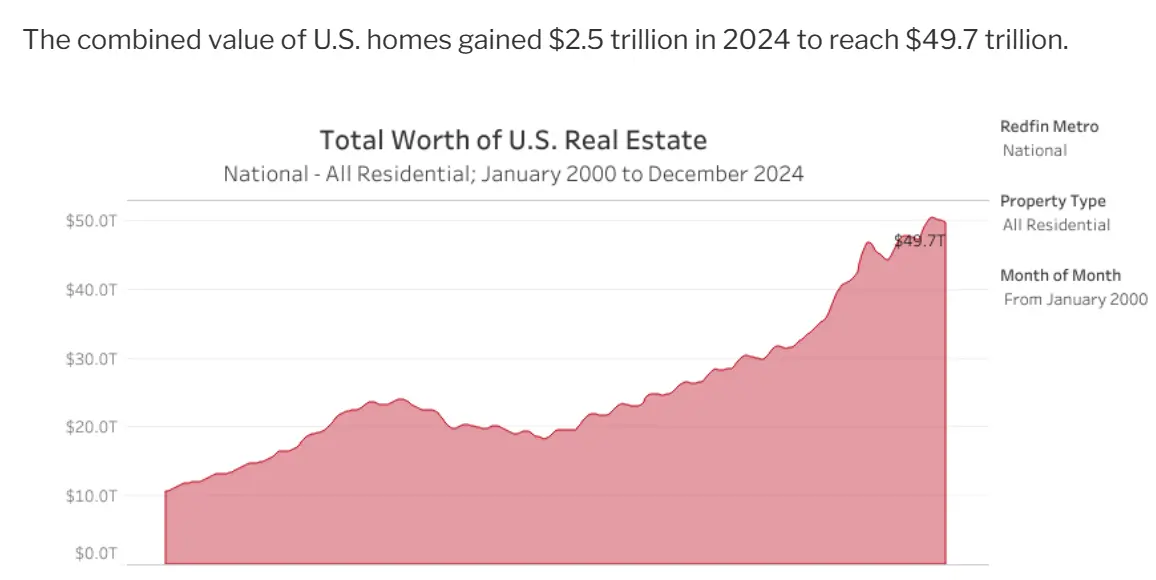
Overall U.S. real estate volume, Awealthofcommonsense analysis report
In June 2025, the NAR report showed that the median home price in the U.S. reached $435,300, up 2% from the same period last year. The housing inventory was about 1.53 million units, with a supply-demand ratio of 4.7 months. High home prices and long-term supply shortages have raised the threshold, and the persistently high mortgage rates (the average 30-year fixed rate was about 6.75% in July 2025, while Bitcoin mortgages are currently around 9%) have consistently exceeded the annual appreciation of property values, suppressing transaction volume and leading property investors to seek new sources of liquidity.
However, high rates are not just blocking the liquidity issues for real estate investors. Over the past five years, the average wealth of property owners has increased by $140,000. Yet many families are reluctant to leverage their real estate assets for liquidity because their monetization paths generally consist of two options: selling the entire asset or renting it out. Leveraging property for loans does not seem like a good choice given the current interest rates, and selling in the context of rising home prices also does not appear to be a better investment decision.
Thus, in the overall $50 trillion real estate sector, about 70% of the equity (approximately $34.98 trillion) is owned by holders, meaning only 30% is supported by borrowed funds, with the rest being the buyers' own capital. For example, if a family owns a property worth $500,000, although nominally they own this property, if they want to sell it, they need to deduct the portion of the loan to determine their actual ownership. In the case of 70% equity, they own $350,000 of the property.
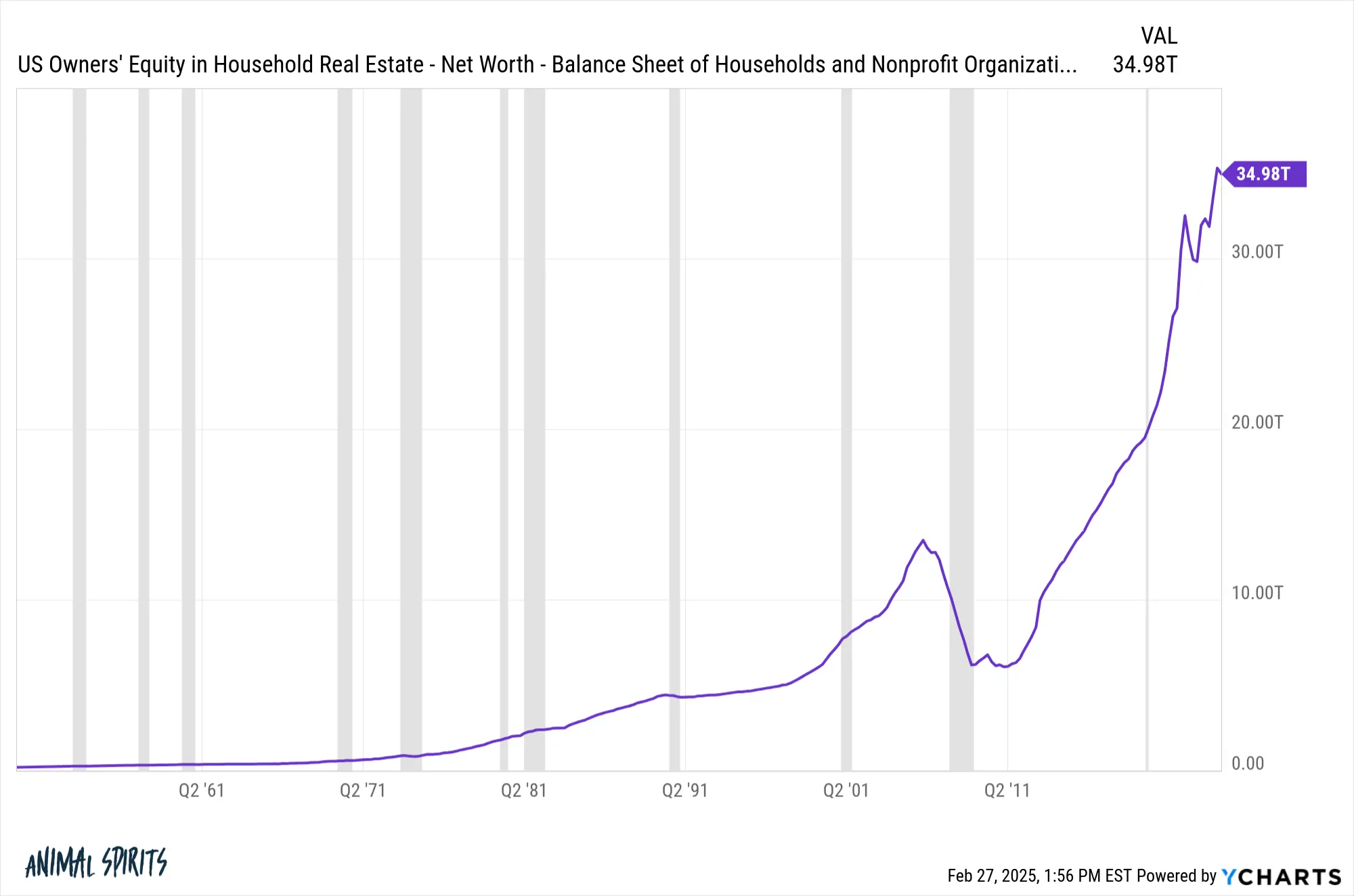
U.S. real estate equity holdings, source: Ycharts
However, merely having a supply-demand relationship is far from sufficient. The concept of RWA has developed for many years but has only truly exploded in the past two years, especially after Trump's election in 2025, which further increased the upward slope.
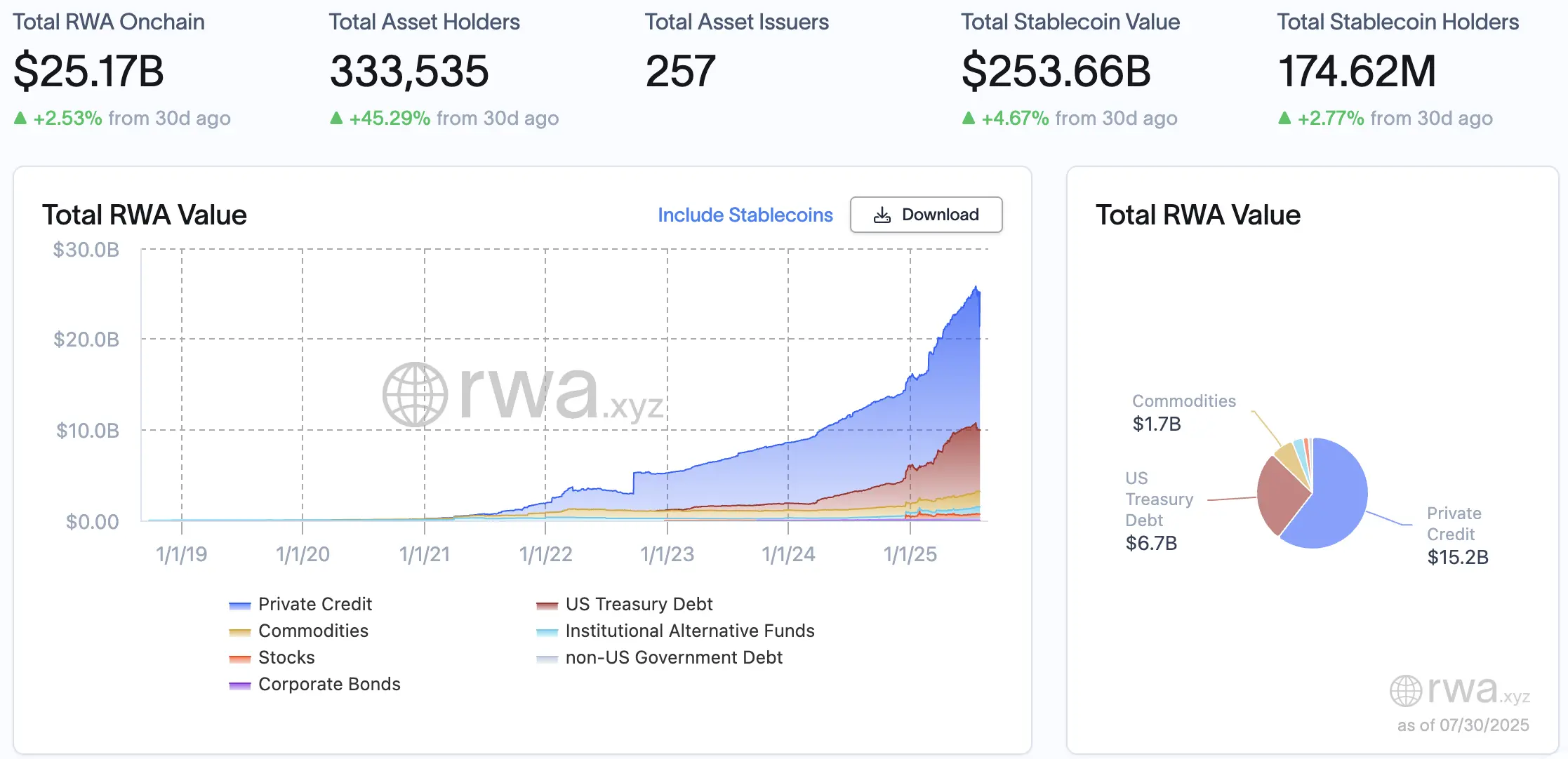
Its core is compliance, especially for investors in low-liquidity assets like real estate. In March 2025, the new FHFA director, William Pulte, ordered mortgage giants Fannie Mae and Freddie Mac to develop plans to allow crypto assets to be included as reserve assets when assessing single-family mortgage risks, without needing to convert them into dollars first. This policy encourages banks to view cryptocurrencies as countable savings assets, expanding the borrower base.
In July 2025, Trump signed the GENIUS Act and promoted the CLARITY Act. The GENIUS Act officially recognizes stablecoins as legitimate digital currencies, requiring stablecoins to be fully backed 1:1 by safe assets like dollars or short-term government bonds and mandating third-party audits. The CLARITY Act aims to clarify whether digital tokens are securities or commodities, providing a regulatory pathway for practitioners.
These combined efforts provide greater safety margins in the field, and the scarcity attributes of real estate, similar to Bitcoin's "non-inflationary" nature (land cannot increase, but properties can; building houses is like mining), make it easier for the two to combine. Digitization helps break down high barriers. One of the Big Four accounting firms, Deloitte, predicts that by 2035, approximately $4 trillion of real estate could be tokenized, far exceeding the less than $300 billion in 2024.
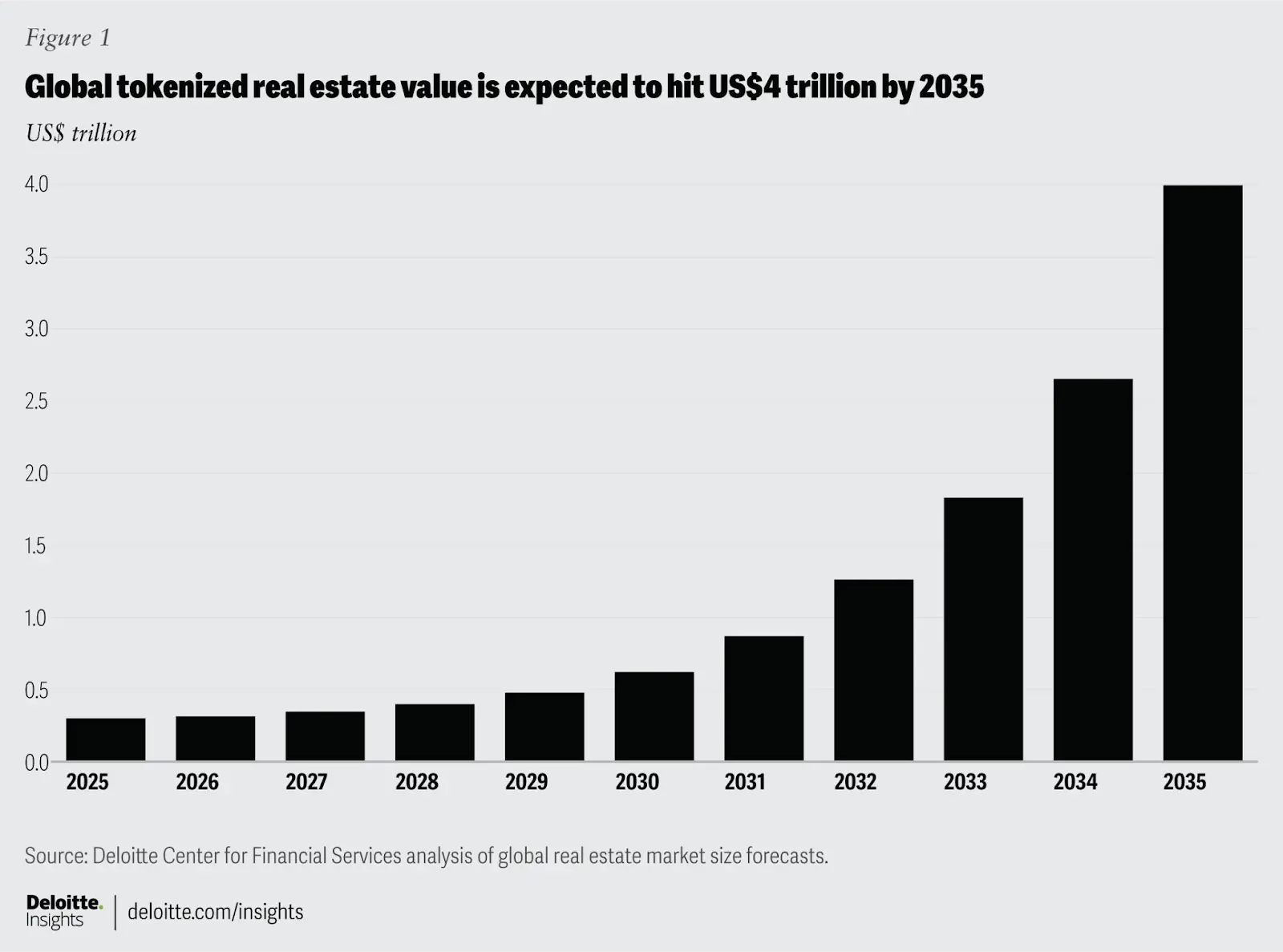
Tokenization can split large real estate into smaller shares, providing a low-threshold, high-liquidity way for global investors to participate, while also creating cash flow for sellers and buyers who originally lacked funds. That said, while the $4 trillion figure sounds appealing, it is debatable, much like institutional predictions that ETH's market cap will reach $85 trillion in the future. But how far has it actually developed? We might find some Alpha in the market.
Fragmentation? Lending? Renting? Providing liquidity? Play real estate like DeFi
Unlike low-liquidity counterparts like gold and art, real estate inherently carries financial attributes. Its connection to crypto has diversified it even further.
Although there were previous attempts, the collaboration between the Harbor platform and RealT in 2018, which launched blockchain-based real estate tokenization services, is considered one of the earlier and more substantial real estate tokenization projects.
Specifically, the RealT platform splits property rights into tradable RealTokens via blockchain. Each property is held by an independent company (Inc/LLC), and investors purchasing RealTokens effectively hold a portion of the company's shares and proportionally enjoy rental income. The platform utilizes Ethereum's authorized issuance mechanism, lowering the investment threshold (usually around $50), and both transactions and rental distributions are completed on-chain, relieving investors from the daily management tasks of traditional landlords. RealT distributes rental income weekly to holders in stablecoins (USDC or xDAI).
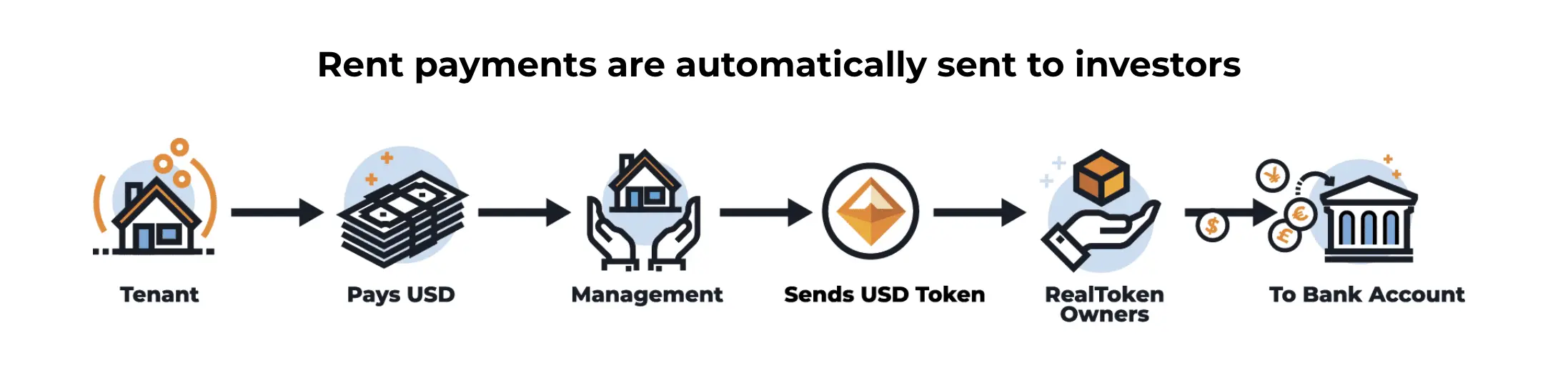
The expected returns come from the Return on Net Assets (RONA), which is the annual net rent divided by the total property investment. For example, if the expected annual rental income for a property, after deducting expenses, is $66,096, and the total investment is $880,075, then the RONA is 7.51%. This figure does not include leverage or property appreciation returns. Currently, the average return on the platform fluctuates between 6% and 16%.

After tokenization, the next step is naturally to apply it. RealT's properties have no loans, and all funds come from selling RealTokens. However, to allow holders to flexibly utilize their assets, RealT launched the RMM (Real Estate Money Market) module.
RMM is based on the Aave protocol, allowing you to do two things: first, provide liquidity, similar to LP interest in DeFi, where investors can deposit USDC or XDAI into RMM and receive corresponding ArmmTokens, which accumulate interest in real-time. Second, you can borrow by collateralizing RealTokens; holding RealTokens or stablecoins can be used as collateral to borrow assets like XDAI. There are also two borrowing rate options: a stable rate (similar to a short-term fixed rate but adjusts when utilization is too high or rates are too low) and a variable rate (fluctuating based on market supply and demand).
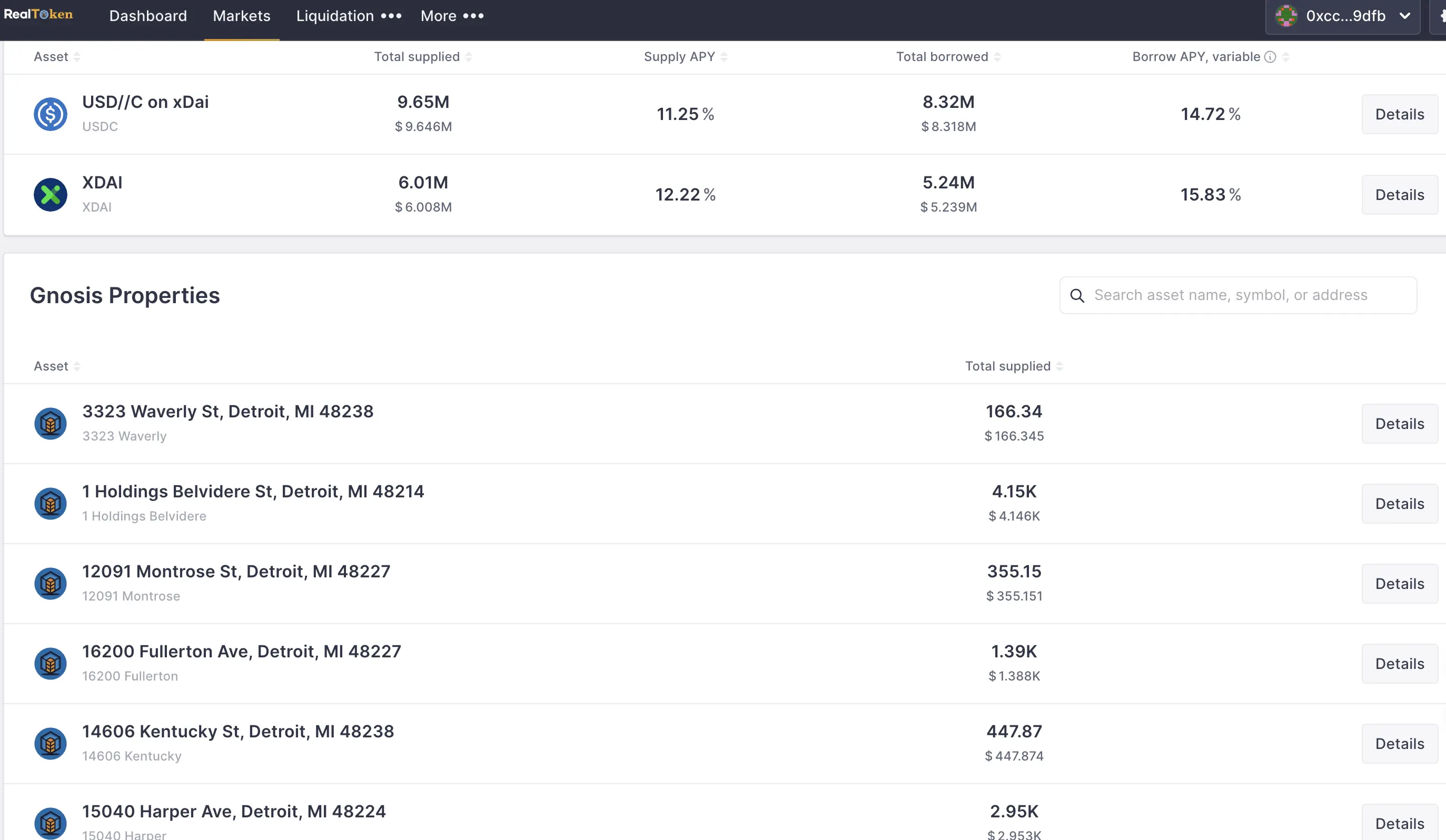
Opening up this lending pathway means leveraging, much like how property investment groups borrowed money to buy houses years ago, using mortgage loans to buy more houses. Collateralizing RealTokens to borrow stablecoins and then purchasing RealTokens again can be repeated multiple times to increase overall returns. It is important to note that with each additional layer of leverage, the health factor decreases, and the risk increases.
Note: The health factor is the inverse ratio of the collateral value to the loan value; the higher the health factor, the lower the liquidation risk. When the health factor drops to 1, it means the collateral value equals the loan value, which may trigger liquidation. Ways to avoid liquidation include repaying part of the loan or adding more collateral (similar to margin in perpetual contracts).
In addition to using real estate as "collateral" for loans, there has been more recent discussion about using crypto-native assets as collateral to buy homes. Financial technology company Milo allows borrowers to use Bitcoin as collateral to obtain up to 100% loan-to-value mortgages. By early 2025, it had completed $65 million in crypto mortgage business, with total loans exceeding $250 million. Policy-wise, this model is also being "greenlit," as the FHFA requires mortgage giants Fannie Mae and Freddie Mac to consider compliant crypto assets in risk assessments. Although the interest rates for crypto mortgages are generally close to or slightly higher than traditional mortgages, their main attraction lies in financing without having to sell crypto assets.
A survey by Redfin showed that about 12% of first-time homebuyers in the U.S. used cryptocurrency gains for down payments (through sales or collateralized loans) after the pandemic. Coupled with the shift in policy direction, this will undoubtedly attract "big enterprises" to enter the market, and "Crypto Real Estate" is also welcoming the entry of high-end real estate economic companies for the first time.

In July 2025, Christie's International Real Estate became the first to establish a luxury real estate department focused on cryptocurrency, marking a significant case of integration between traditional high-end property brokerage and digital assets. Interestingly, this move did not stem from a top-down strategic push but was a response to the genuine needs of high-net-worth clients.
Christie's executives stated, "An increasing number of wealthy buyers want to complete property transactions directly with digital assets, prompting the company to build a service framework that supports full-process crypto payments." In Southern California, Christie's has completed several luxury home transactions entirely paid for with cryptocurrency, totaling over $200 million, all at the "eight-figure" level for top-tier residences. Currently, Christie's portfolio of crypto-friendly properties is valued at over $1 billion, encompassing many luxury homes willing to accept "pure cryptocurrency offers."

One of the homes accepting pure cryptocurrency payment, valued at $118 million, "La Fin," located in Bel-Air, Los Angeles, features 12 bedrooms, 17 bathrooms, a 6,000 square foot nightclub, a private wine cellar, a sub-zero vodka tasting room, a cigar lounge, and a gym with a climbing wall. The previous listing price was as high as $139 million, source: realtor
Christie's crypto real estate department not only provides payment channels based on mainstream crypto assets like Bitcoin and Ethereum but also collaborates with custodians and legal teams to ensure transactions are completed within a compliant framework. This includes crypto payment custody, tax and compliance support, and asset matching (exclusive crypto property portfolios that meet the specific investment needs of high-net-worth clients).
Christie's property CEO Aaron Kirman predicts, "In the next five years, over one-third of residential real estate transactions in the U.S. may involve cryptocurrency." Christie's transformation indirectly confirms the penetration of crypto assets among high-net-worth individuals and signals a structural change in traditional property transaction models.
Infrastructure is Improving, but "User" Education Still Has a Long Way to Go
As of now, real estate tokenization projects have begun to take shape, but they seem to fall short of their expected standards. RealT has tokenized over 970 rental properties, generating nearly $30 million in pure rental income for users; Lofty has tokenized 148 properties across 11 states, attracting about 7,000 monthly active users who share approximately $2 million in annual rental income through token holdings. Several projects hover around tens of millions to hundreds of millions, struggling to break through for various reasons.
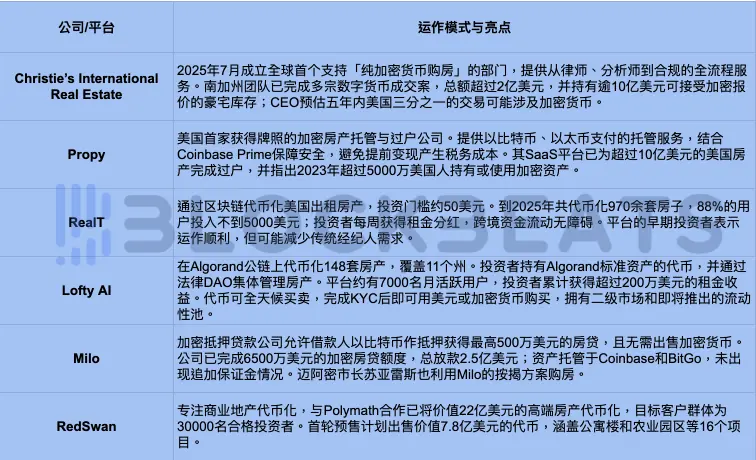
On one hand, blockchain indeed allows transactions to escape geographical limitations, achieving cross-border instant settlement, and transaction fees are lower compared to traditional property transfer costs. However, investors need to understand that this is not a "zero-cost" ecosystem: token minting fees, asset management fees, transaction commissions, network fees, and potential capital gains taxes constitute a new cost structure. Compared to the "one-stop service" of traditional real estate agents and lawyers, crypto real estate requires investors to actively learn and understand smart contracts, on-chain custody, and crypto tax rules.
On the other hand, while liquidity is a selling point, it comes with higher volatility. Tokenized real estate can be traded around the clock in the secondary market, allowing investors to receive rent and exit their positions at any time. However, when liquidity is insufficient, token prices may be far above or below the true valuation of the property itself, with market fluctuations potentially outpacing the cycles of physical real estate, increasing the speculative nature of short-term trading.
Additionally, many platforms introduce DAO (Decentralized Autonomous Organization) governance, allowing investors to vote on matters like rent and maintenance. This sense of participation is akin to "playing Monopoly," lowering barriers and enhancing interactivity, but it also places new demands on users: they must not only understand property management but also possess awareness of on-chain governance and compliance. In the absence of sufficient education, investors may misjudge risks, viewing digital real estate as a short-term arbitrage tool rather than a long-term asset allocation.
In other words, the real barrier to crypto real estate lies not in technology but in cognition. Users need to understand concepts like collateral ratios, liquidation mechanisms, on-chain governance, and tax reporting, which represents a disruptive shift for those accustomed to traditional home-buying models.
As regulations become clearer, platform experiences improve, and mainstream financial institutions get involved, the future of crypto real estate is expected to shorten this educational curve. However, in the foreseeable years, the industry still needs to invest more resources in user training, risk control education, and compliance guidance to truly transition "crypto real estate" from niche experimentation to widespread adoption.
Recommended Reading:
 Risk warning
 Risk warning


Popular articles





