








Market instability? These 7 high APY stablecoin pools may become a safe haven
 7 mainstream stablecoin pools with an APY of over 10%, make sure to see the last one.
The bull market has arrived, and all yield mechanisms are amplifying the interest rate spread under the influence of bullish sentiment, making stablecoin deposits and loans a source of "steady happiness." BlockBeats has compiled seven mainstream stablecoin-focused "high APR pools," all with an APY of over 10%. Here’s a detailed introduction:
Huma Finance
Huma Finance is a decentralized yield platform operating on Solana, with its revenue sources linked to real payment financing activities. It launched in April 2025 and recently reopened Huma 2.0 deposits.
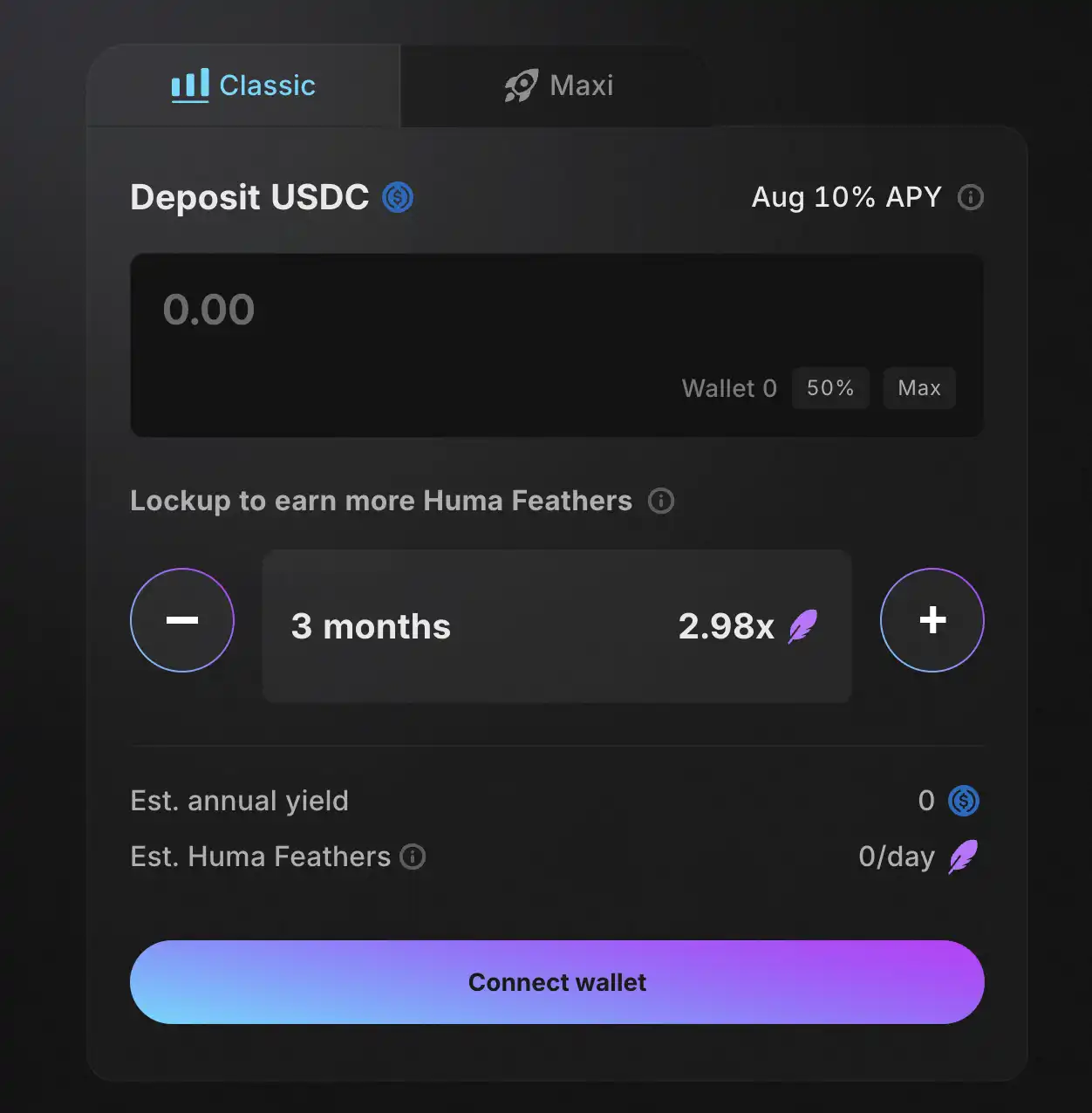
Users can deposit USDC to mint LP share tokens: in Classic mode, it's $PST, allowing for approximately 10.5% annualized yield in USDC while also receiving basic Huma Feathers; in Maxi mode, it's $mPST, which does not accrue interest but enjoys a reward multiplier of up to 19× in Feathers. Each mode serves different needs, with a maximum deposit of 500,000 USDC per wallet.
According to the official Dune dashboard, since the launch of Huma 2.0, it has facilitated approximately $5.62 billion in trading volume, bringing users about $4.592 million in total earnings and distributing 2.66 billion Feathers. Currently, the platform has about $150 million in active liquidity, with approximately $104 million directed towards PayFi (payment financing) business, and the remaining $46.015 million in a redeemable Liquid state.
Silo Finance
Silo Finance is a "risk-isolated" non-custodial lending protocol deployed across multiple chains: each asset has its own independent market (Silo), with funding supply and borrowing not interfering with each other, and risks divided by asset. Users simply need to deposit supported tokens (such as USDC, ETH, WBTC, etc.) into the corresponding Silo to automatically earn interest based on market parameters.
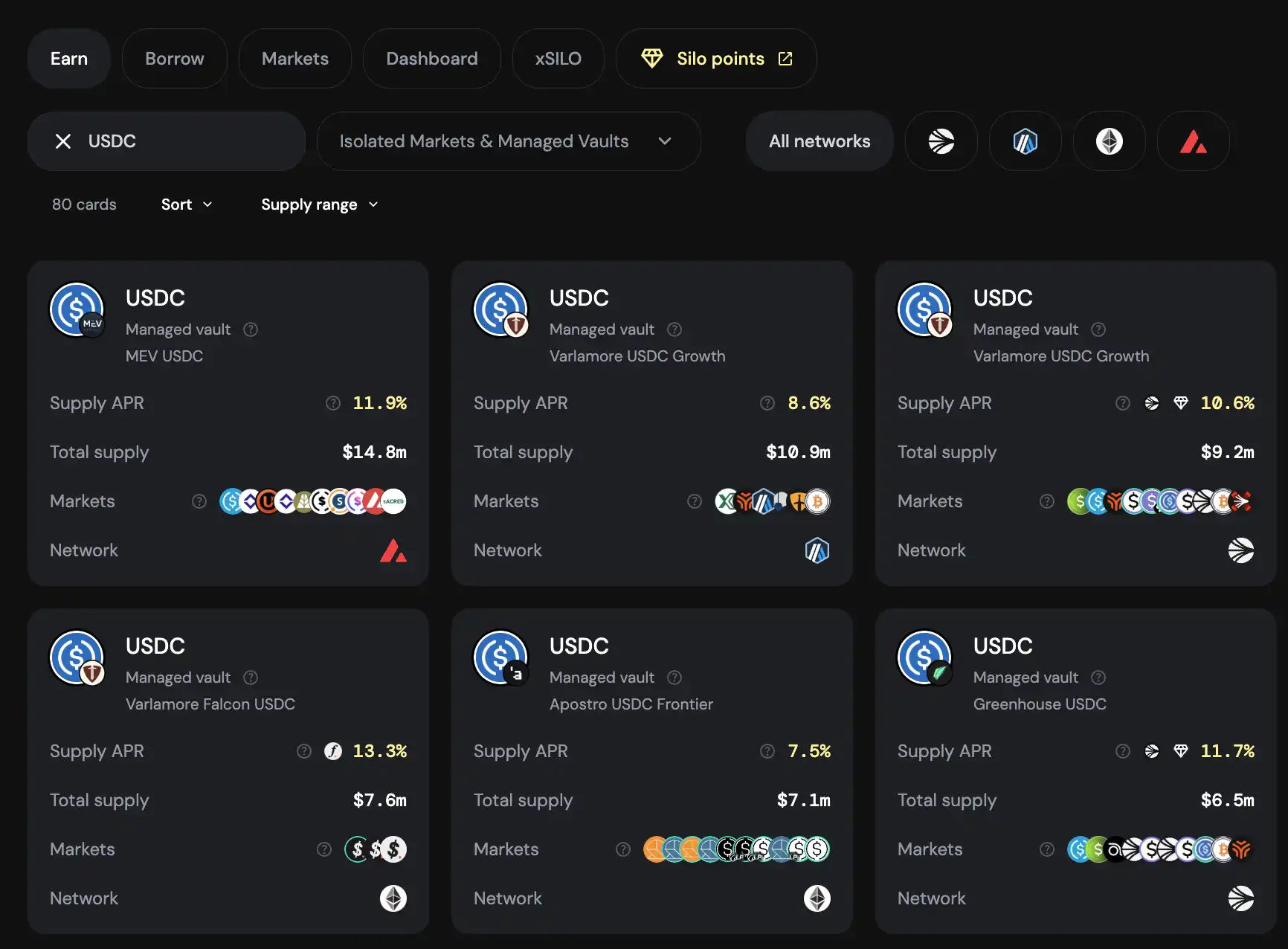
According to DeFiLlama data, as of now, Silo Finance's overall TVL is approximately $228 million, distributed across Sonic ($113 million), Avalanche ($46.2 million), Ethereum ($44.4 million), Arbitrum ($23.53 million), and other chains. Selecting the Managed Vault for USDC shows that Silo Finance currently offers an APY of 7%-13%.
BFUSD
BFUSD is a "passively earning margin asset" launched by Binance, designed specifically for futures traders. Users can exchange USDT or USDC for BFUSD at a 1:1 ratio and store it in a U-based contract account, automatically receiving stablecoin earnings daily without the need for staking or additional operations.
From the official page, the earnings of BFUSD mainly come from three parts: the base annual yield (Base APY) is 3.97%, derived from Binance's hedging trades and staking strategies; the derived annual yield (Derived APY) is 4.89%, coming from additional earnings distribution under the joint margin model, requiring holders to conduct at least one U-based contract trade to activate; the wealth management annual yield (Wealth Management APY) is 0.40%, sourced from earnings allocation of Binance's wealth management products. The combined annualized yield for holding BFUSD is approximately 9.26%.
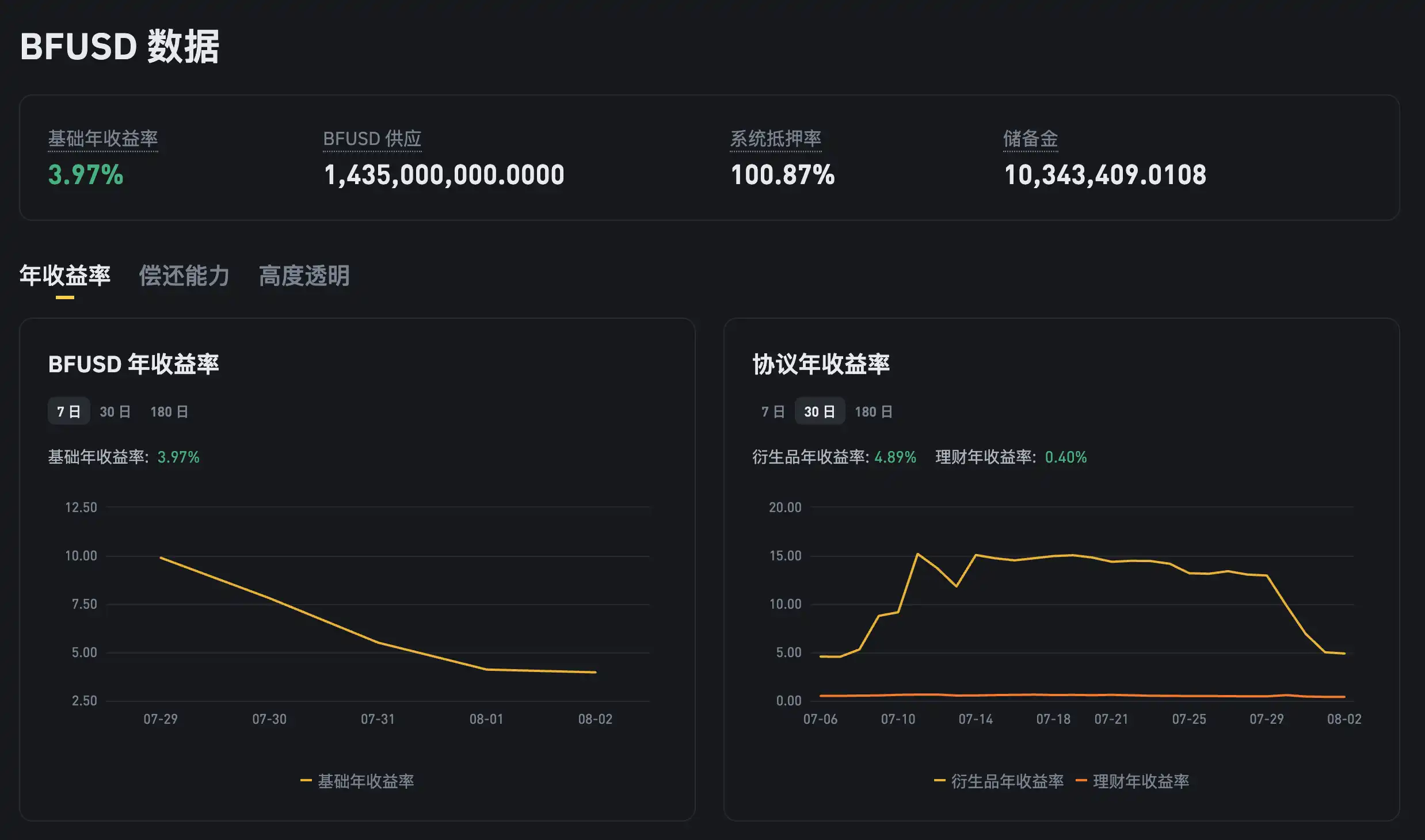
In terms of risk control, BFUSD has a system collateralization ratio of 100.87%, and Binance has allocated a special reserve of $10.34 million to ensure payment capability during extreme market fluctuations. Additionally, the total supply of BFUSD is approximately 1.435 billion tokens, with limits allocated based on users' VIP levels; higher limits can be obtained by opening sub-accounts for additional quotas.
Each time BFUSD is purchased or redeemed, the platform charges a 0.1% fee. Rewards are calculated based on the "minimum BFUSD balance in the daily snapshot" and are directly credited to the user's U-based contract account the next day, with details available in the "reward records."
Orderly
Orderly officially launched OmniVault on April 15, 2025, managed by professional market maker Kronos Research. Users only need to connect their wallets, select a network (Arbitrum, Base, Optimism, etc.), and deposit USDC into the Vault with one click to start earning a share of trading fees and market-making profits.
As of August 4, 2025, OmniVault's TVL has surpassed $7.9 million, with an annualized yield of 39.15% over the past 30 days, and no performance fees (Performance fee 0%). All earnings are automatically reinvested based on shares, with share prices settled at the end of each 3-hour Vault cycle.
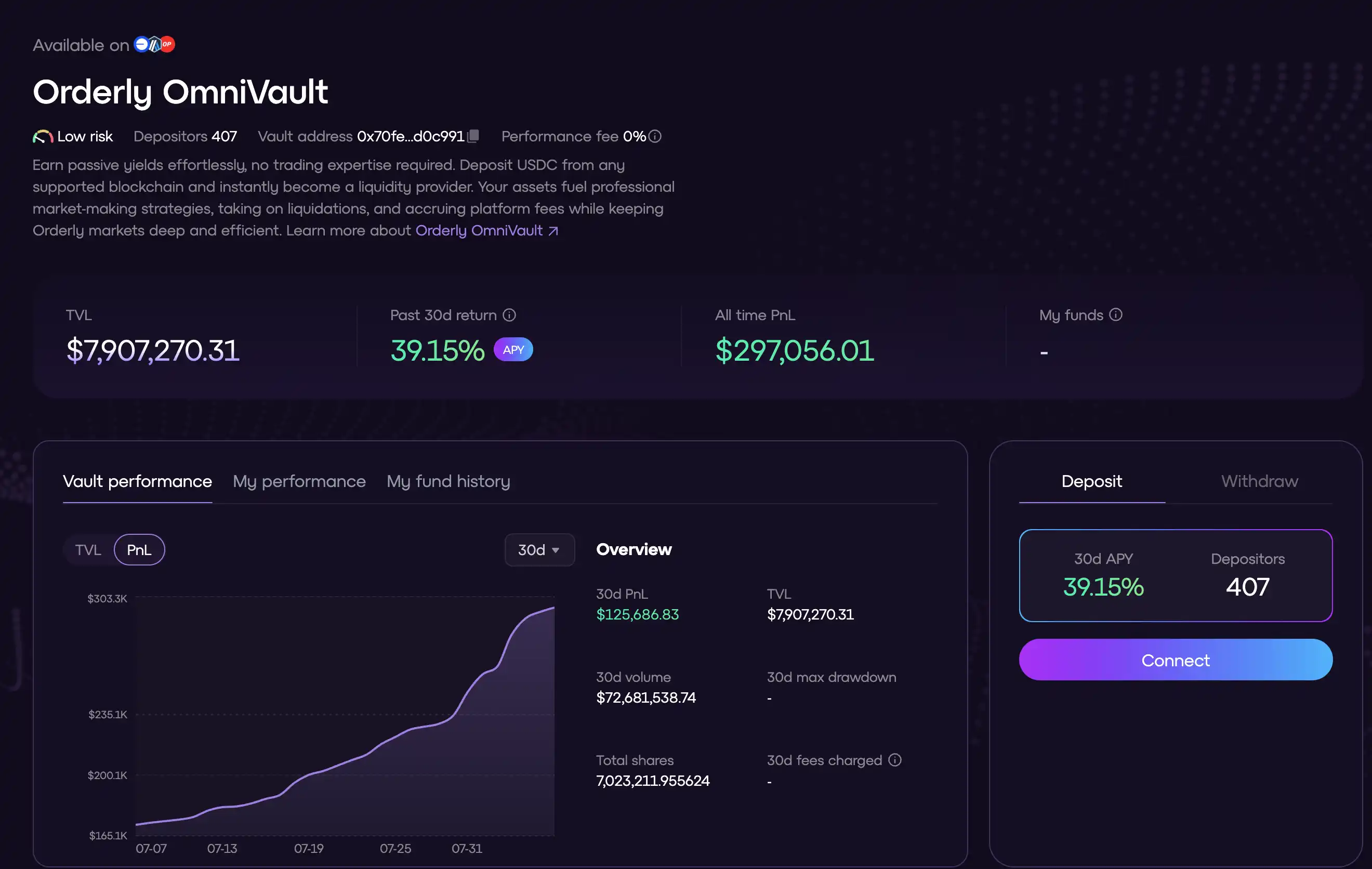
Additionally, the Orderly protocol promises to allocate up to 40% of its protocol revenue and a portion of liquidation fund fees to OmniVault to enhance overall LP returns.
StandX
StandX is a Perps DEX currently in the Alpha testing phase, co-founded by former Binance contract head Aaron Gong and colleagues from Goldman Sachs, funded by the Solana Foundation. Additionally, StandX's core product is DUSD, which users can mint 1:1 using USDT or USDC.
In the StandX "Deposit USDT to Mint DUSD" interface, users can directly select the asset to deposit (such as USDT) in the input box and fill in the amount, with the system instantly displaying how much DUSD will be obtained. The current strategy calculates an annualized yield of 10.6%. A fee of only 0.1% is charged upon redemption.

Holding DUSD allows users to enjoy two major sources of income: one is staking yields from mainstream assets like ETH and SOL, and the other is funding fee income from hedging short-term perpetual contracts. The instant annualized yield of DUSD once approached 13%, but the seven-day average displayed on the official website is about 7.5%.
Wasabi
Wasabi Protocol is a "CultureFi" leveraged trading platform established in 2022, initially focusing on leveraged long and short strategies for niche assets like NFTs and memecoins, later expanding its business to a broader DeFi leverage and market-making field. Investors include Electric Capital, Alliance DAO, and Memeland.
Wasabi Earn, launched on the Base network, allows users to open the Finance section in Coinbase's Base App and deposit USDC with one click to automatically enjoy an annual yield of up to 20%.
This yield comes from the on-chain leveraged trading strategies behind Wasabi: your USDC will be used as liquidity for up to 456 trading pairs, providing funding for market-making and leveraged lending, with interest paid by borrowers ultimately returned to depositors. So far, it has supported a total trading volume of $1.23 billion, with a cumulative TVL of $23.8 million.
Wildcat-KAI2USDC
Wildcat Labs, established in 2022 and headquartered in the UK, is a "risk-isolated" unsecured lending protocol where each market (Silo) operates independently, avoiding the contagion of liquidations or vulnerabilities across different markets. To date, Wildcat has accumulated over five different asset markets on mainnets like Ethereum, with a total TVL exceeding $70 million (with the latest USDC market also surpassing $2.1 million in lending volume).
On August 1, 2025, Bodhi Ventures—a Web3 venture capital firm led by Synthetix founder and Infinex co-founder Kain Warwick—opened the third USDC market on Wildcat, publicly seeking a quota of 10 million USDC, with a base lending APR locked at 16%, and the market being open-ended with no expiration date.
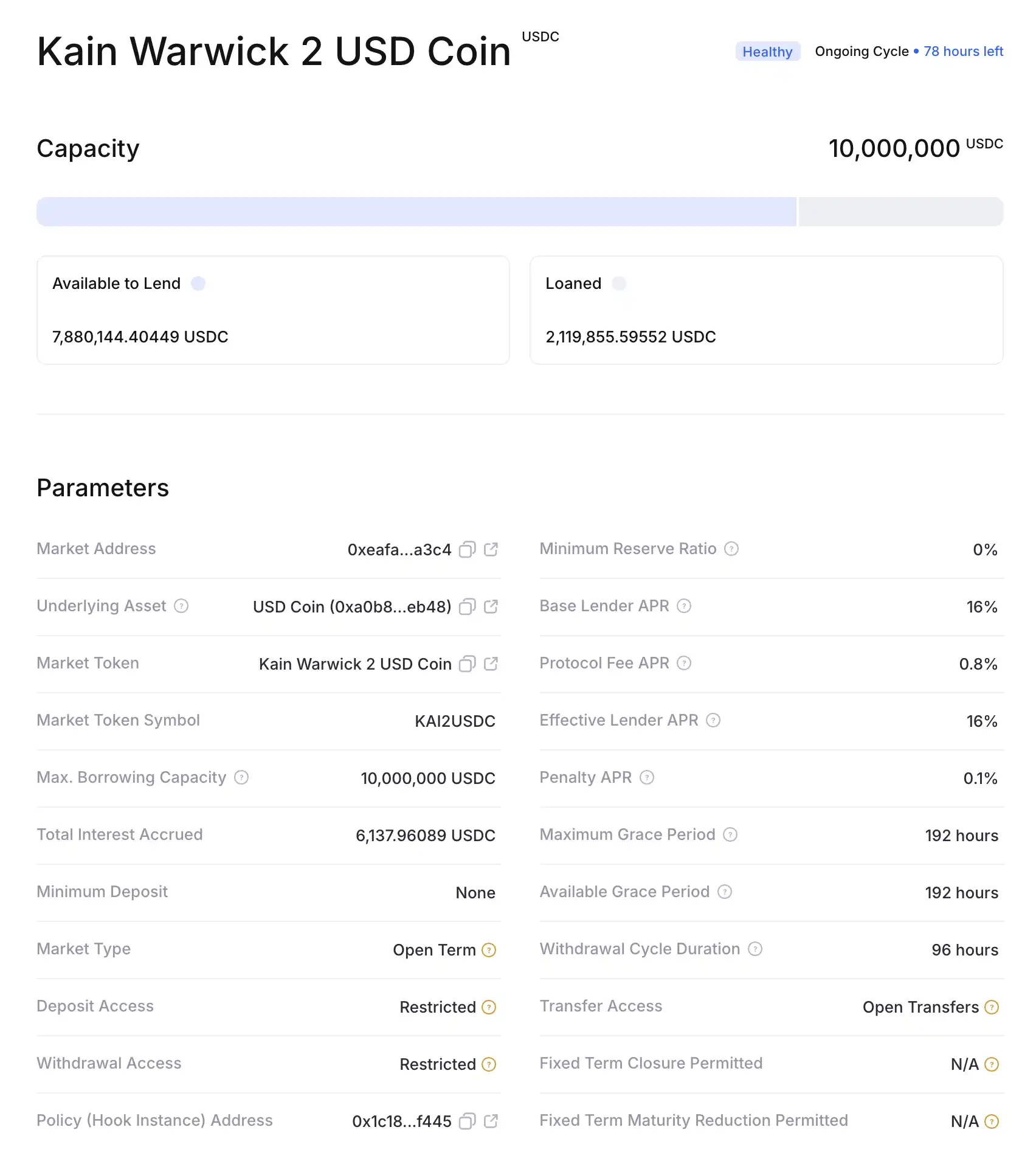
Users do not need a minimum deposit threshold; any address that completes OFAC verification can deposit USDC. After funds are deposited, a freely tradable debt certificate "KAI2USDC" will be minted. Currently, $2 million of the quota has been used, with $7.8 million remaining, and 78 hours left. Withdrawals follow a 96-hour withdrawal cycle and a maximum 192-hour grace period, with a redemption fee of only 0.1%; overdue penalties are 0.1%.
Aave
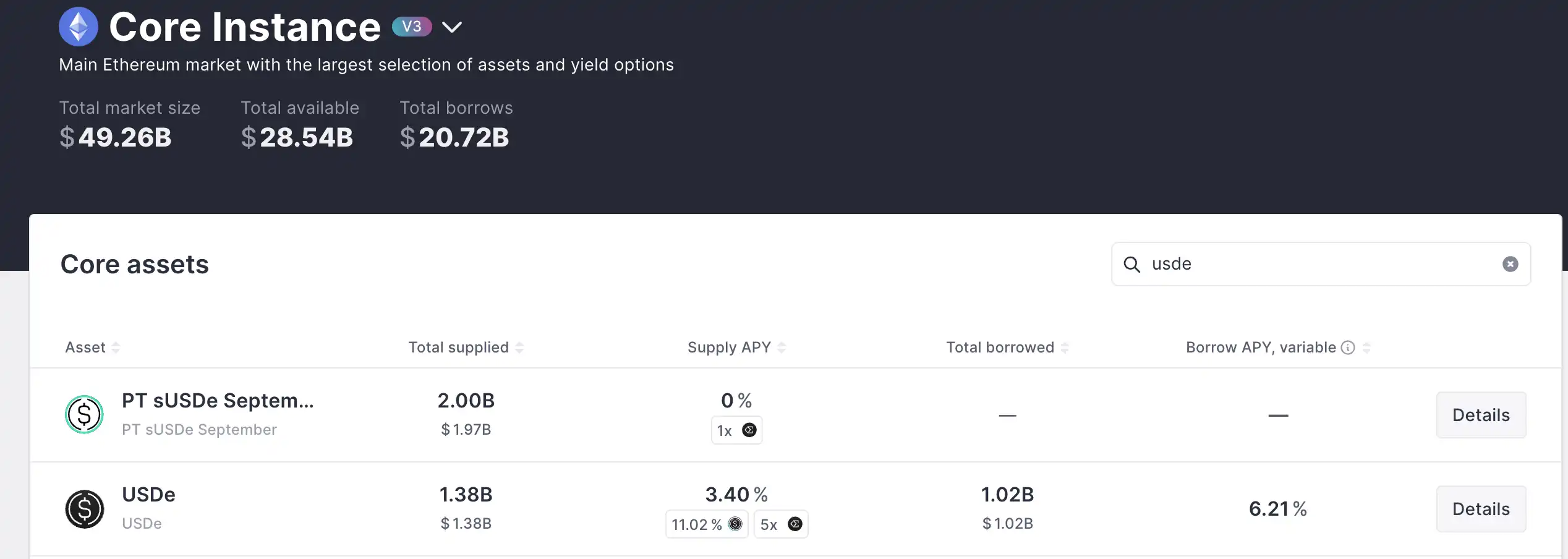
Last week, Ethena Liquid Leverage launched on Aave, and with the widening interest rate spread driven by the bull market, the short-term APY for circular lending on AAVE can reach as high as 50%.
By simultaneously depositing 50% sUSDe and 50% USDe in Aave's stablecoin E-Mode, users can borrow USDC or USDT, then exchange the borrowed stablecoins back to USDe, redepositing and borrowing again, and so forth. Each completed cycle will yield an additional native yield of sUSDe and a funding fee difference of USDe.
As of now, the common funding fee (Borrow APR) in the market is around 11%, while the base annualized yield (Supply APR) for directly depositing USDe/sUSDe is around 12%, creating a spread of about 7%. With five cycles, it is theoretically possible to achieve: 12% + 4 × (12% - 5%) for a 40% APY. Additionally, Ethena's extra rewards for Liquid Leverage (currently offered until the end of August) can push the short-term peak APY up to around 50%, but this will only last until the end of this month, with expectations of a significant drop after the subsidy ends.
 Risk warning
 Risk warning




Popular articles





