








Tokenized Equities on the Rise: How is the Crypto Industry Exploring the Future of Stock-Crypto Integration?

 MEXC leverages its own moat advantages to launch US stock token products, helping more crypto-native users participate in the US stock market investment efficiently in a familiar way.
As Bybit, Kraken, and Robinhood announce their entry into tokenized U.S. stock trading, the convergence of crypto and traditional finance has reached a new milestone. This move not only signals increasing regulatory alignment within the crypto industry but also brings the Web3 ambition and vision of "tokenizing everything" one step closer to reality.
According to data fromrwa.xyz, the market's response to tokenized stocks has been enthusiastic. As of July 18, 2025, the total market cap of tokenized U.S. equities surged to $512.94 million, marking a 46.14% increase over the past 30 days. The number of holders jumped nearly 20 times, while monthly active addresses skyrocketed by 165 times.
Despite this explosive growth, the tokenized equities market still represents only a fraction of the traditional securities market. It remains in its infancy, with vast potential for expansion in the coming years.
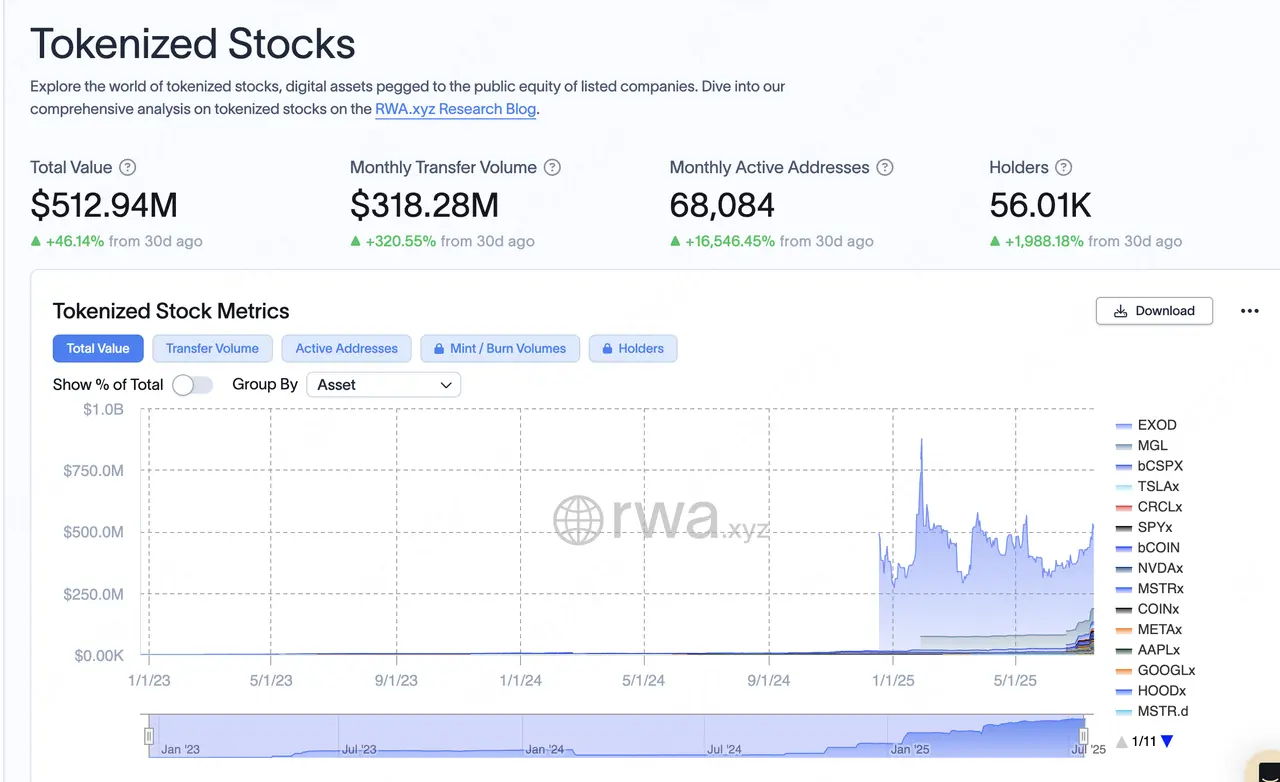
Image source:rwa.xyz
The tokenization of U.S. equities is not a brand-new concept in the crypto market. As early as 2019-2021, leading exchanges like Binance and FTX launched similar products, but these offerings were quickly delisted due to regulatory pressure. Now, with global crypto regulations gradually becoming clearer and the push for compliance accelerating, the rise of the RWA (real world asset) narrative has reignited interest in tokenized stocks. From crypto exchanges to traditional financial institutions, more players are once again exploring this frontier, but this time with a broader range of models. MEXC has leveraged its competitive advantages to launch US stock futures, enabling more crypto-native users to efficiently participate in US equity market investments through familiar mechanisms.
Purpose Behind MEXC Launching Stock Futures
MEXC Stock Futures primarily deliver value to users in the following three areas:
-
Amplified Profit Potential
Leverage trading enables users to control larger market positions with relatively small amounts of capital, significantly improving capital efficiency. For example, with $1,000 and 5x leverage, a trader can open a $5,000 position, making this approach especially appealing to retail investors with limited funds.
-
Flexible Trading Strategies
Spot trading only allows users to profit by buying low and selling high, limiting opportunities during market downturns. In contrast, MEXC's Stock Futures offers hedge mode trading, enabling users to profit from both rising and falling prices. This flexibility empowers traders to adapt to various market conditions and capitalize on volatility in the U.S. stock market, even when prices decline, short positions can generate prof
-
Risk Management and Hedging Tool
For investors already holding tokenized stocks (e.g., TSLAx spot), Stock Futures serve as an essential risk management instrument. When facing potential market pullbacks, holders can hedge their portfolios by opening equivalent short positions in perpetual futures, without needing to liquidate their spot assets. Additionally, traders can leverage these contracts for cross-market arbitrage or to build market-neutral strategies, allowing for more stable, risk-adjusted returns amid volatile market conditions.
Comparison of Active Players in the Stock Futures Market
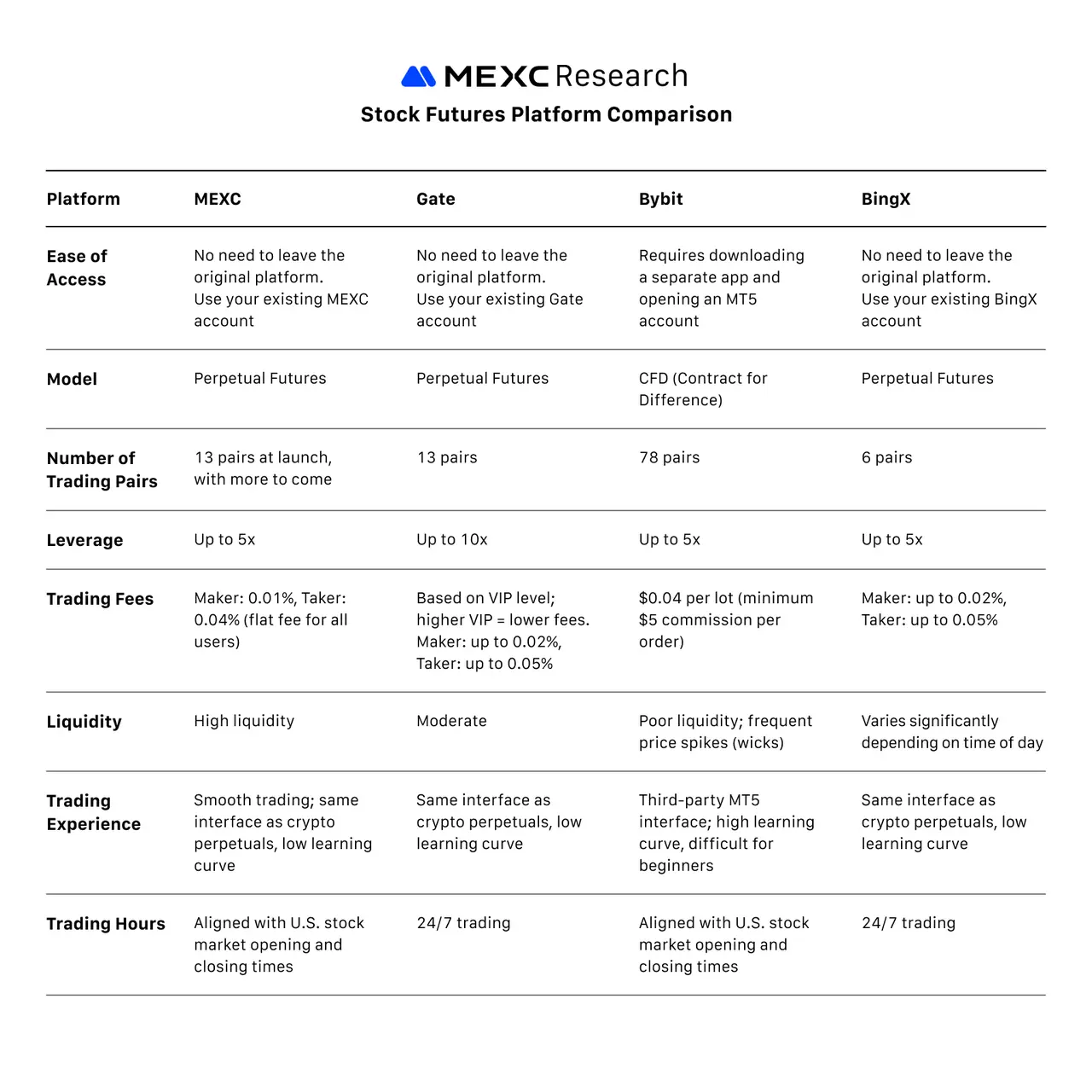
Within the crypto space, stock futures trading remains a largely untapped blue ocean. Among centralized exchanges, the most active players include MEXC, Gate, BingX, and Bybit. Overall, MEXC, Gate, and BingX have adopted the perpetual futures model, while Bybit operates under a CFD (Contract for Difference) structure. Notably, MEXC has established a differentiated competitive edge through its lowest fee, zero slippage, and industry-leading market depth.
Liquidity
In terms of liquidity performance, MEXC stands out significantly ahead of its closest competitor, backed by strong order book support and deep trading depth. Taking four pairs, TSLA, NVDA, COIN, and HOOD as examples, within a 0.2% price range on the order book during the first day of listing, MEXC recorded executable volumes of 613,839, 610,693, 602,640, and 391,799 USDT, respectively. Within a tighter 0.1% range, the corresponding volumes were 412,883, 351,630, 316,234, and 195,668 USDT, demonstrating exceptional market depth and order execution capability.
In comparison, the second-best platform only showed 0.2% depth volumes of 3,429, 23,414, 37, and 46 USDT, with a maximum depth of just 13 USDT at the 0.1% level, vastly inferior to MEXC. These figures indicate that MEXC offers significantly deeper liquidity within the same spread range, enabling trades to be executed with minimal slippage and greater price stability. This advantage translates into a more efficient and reliable trading experience for market participants.
Trading Fees
Trading fees are one of the most critical factors considered by participants in stock futures trading. In this regard, MEXC sets one of the lowest fee benchmarks in the market with a fixed Maker/Taker fee of 0.01%/0.04%. In comparison, Gate applies maker/taker fees of up to 0.02%/0.05%, while BingX follows a similar fee structure. Bybit, on the other hand, charges $0.04 per lot with a minimum commission of $5 per order, and overnight positions may also incur swap fees.
MEXC’s low and inclusive fee structure offers real savings without any extra requirements such as KYC or VIP tiers. This model not only benefits cost-sensitive high-frequency and large-volume traders but also lowers the participation barrier for all users.
Ease of Use
MEXC, Gate, and BingX all adopt the perpetual futures model, with liquidation and margin call processes identical to traditional crypto perpetuals. For existing crypto derivatives traders, there is virtually no additional learning curve. Even for beginners, the rules are intuitive and easy to grasp, allowing for quick onboarding. By contrast, Bybit's CFD model relies on the MT5 platform, which involves more complex interfaces and calculations, resulting in a steeper learning curve and higher barrier to entry.
Additionally, MEXC, Gate, and BingX users can trade stock futures seamlessly using their existing exchange accounts. In comparison, Bybit's CFD trading requires a separate MT5 download and new account registration, adding extra operational steps.
Trading Hours
Trading hours for stock futures vary across platforms. Gate and BingX offer a 24/7 trading model, which provides flexibility but raises concerns about insufficient liquidity during U.S. market closures (e.g., weekends). During these periods, market makers are unable to hedge risk, leading them to widen bid-ask spreads or withdraw liquidity altogether. This exacerbates slippage, increases trading costs, and even allows small orders to trigger sharp price swings, significantly raising liquidation risk.
In contrast, MEXC aligns its trading hours with official U.S. stock market hours. During market closures, high-risk actions such as placing new orders are restricted. Only order cancellations and margin top-ups are allowed. This mechanism helps prevent extreme price volatility in illiquid conditions and prioritizes user fund protection.
Asset Selection
In terms of product variety, Bybit leads the market by offering 78 U.S. stock futures through its MT5 platform, significantly outpacing its peers. Gate currently provides 13 stock futures, while MEXC follows with a curated initial batch of 9, with plans for rapid expansion. BingX offers the fewest, with only 6 available contracts.
Regarding leverage, Gate offers up to 10x leverage, appealing to traders with a higher risk appetite. MEXC, Bybit, and BingX adopt a more conservative 5x leverage cap, aiming to strike a balance between return potential and risk control.
Summary
MEXC has secured a first-mover advantage in attracting crypto-native traders by offering lowest trading fees and aligning its trading hours with U.S. market sessions to prioritize user safety. Its superior order book depth ensures exceptionally low slippage and high execution efficiency, maximizing both cost and performance benefits. Bybit leads in product variety but faces barriers with its complex MT5 setup and higher trading fees. Gate stands out with its 10x leverage offering, while BingX provides flexible 24/7 trading, but its liquidity risk during off-hours remains a key concern.
Within this cycle, new approaches now go beyond surface-level tokenization. For example, MEXC has leveraged its core strengths in perpetual futures, zero slippage, and deep liquidity, to offer Stock Futures trading. This model provides a new gateway to the U.S. equity markets using trading language that crypto-native users know best. By bridging traditional financial value into the crypto ecosystem without forcing users to change their trading habits, MEXC delivers a seamless, efficient solution for accessing traditional stock markets.
Risk Disclaimer: Leveraged trading carries significant risk. Please proceed with caution.
 Risk warning Risk warning




Popular articles





