How to achieve a 10% annual return on 10 million? The "stable high return" paradox in the context of Web3

 10 million can achieve a 10% annual return, but the premise is that you invest in the right structure, not just in the hot spots.
Recently, a seemingly simple question has been hotly discussed in the crypto circle: "If I have 10 million, where should I invest it? Can I still achieve a 10% annual return?"
At first glance, it sounds like a continuation of middle-class anxiety, but behind it lies a true reflection of the crypto market— the incentive dividends are gradually receding, stable returns are becoming increasingly scarce, and capital is beginning to reassess the "return structure" itself.
In traditional finance, what does a 10% annual return mean? It could either be a decline in credit quality, leverage support, or extremely poor liquidity. The high returns once offered by Web3 were more driven by incentive-induced bubble dividends rather than efficiency transformations brought about by underlying structures.

As the "yield farming economy" exits, DeFi blue-chip returns are falling, on-chain trading volumes continue to decline, and capital efficiency is gradually becoming the main theme— the real anxiety in today's market is:
"In the absence of subsidies and a bull market, can Web3 still provide a sustainable return answer for conservative capital?"
This article attempts to deconstruct possible solutions to this question through several key projects.
DeFi Dividend Recession, Capital Begins to Shift Towards "Real Use + Structural Optimization"
Currently, most users have realized that relying solely on airdrops is no longer sustainable, and the structural issues of on-chain liquidity are becoming increasingly prominent.
On one hand, incentive models are difficult to sustain; on the other hand, liquidity competition among DeFi protocols has reached an extreme, but the infrastructure itself has not undergone a qualitative leap. Most Rollups are still replicating Ethereum's old model, and on-chain matching performance is far from meeting real trading needs.
In this context, capital is beginning to seek new return structures, with the core focus shifting from "speculative assets" to "investing in structures"— investing in systems that can generate real on-chain cash flow and enhance trading efficiency.
Two directions are beginning to attract market attention:
- On-chain trading infrastructure aimed at professional traders, reconstructing matching systems
- Composable service layers providing standardized trading modules for developers
Hyperliquid: An On-chain Matching System Designed for Professional Traders
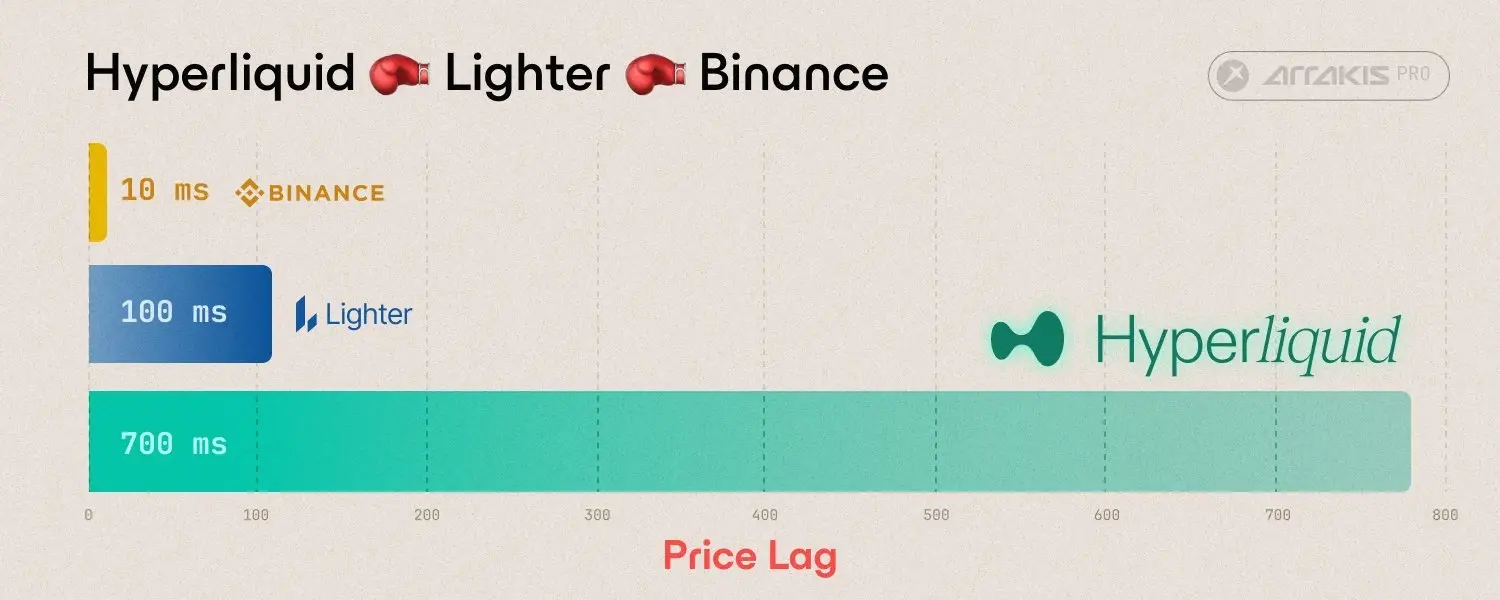
Hyperliquid is a full-chain perpetual protocol running on a self-developed L1 chain. This project currently has no token and no incentives, but its trading depth has consistently ranked among the top three across the network for several months.
This is not a coincidence. Hyperliquid redefines the performance standards for on-chain perpetuals, creating a system that is closer to the usage habits of professional traders with a design of "centralized experience + on-chain settlement." Its self-developed L1 chain supports sub-second matching while achieving low slippage and low gas costs, sufficient to support frequent trading of large amounts of capital.
More importantly, Hyperliquid does not position itself as an "airdrop platform" or "retail entry," but rather as a structural product aimed at high-frequency traders. In this system, returns come from real trading depth rather than incentive stacking.
For capital like "10 million," this represents a new on-chain capital strategy: not pursuing one-off short-term returns, but seeking trading infrastructures that gather real users, have high capital efficiency, and possess long-term depth.
Orderly: From On-chain Matching to Standardized Trading Modules
In contrast to Hyperliquid's vertical integration, Orderly Network offers a "modular trading infrastructure." It does not engage in front-end operations or guide users but provides developers with a set of composable and pluggable trading systems.
In simple terms, Orderly aims to become the "Amazon Web Services" of the Web3 trading space, not participating in retail but focusing on development tools and foundational components.
Orderly's structure consists of four core modules:
1. Matching Engine
The performance bottleneck of on-chain matching has always been a barrier for high-frequency strategies. Orderly adopts an off-chain matching and on-chain settlement approach, balancing efficiency and transparency, supporting more complex trading instructions and higher capital utilization.
2. Liquidity Pool System
Unlike AMMs, Orderly introduces a liquidity pool model closer to traditional exchanges, allowing market makers to inject liquidity on demand while ensuring stable depth in the order book. This also lays the foundation for subsequent multi-strategy market making.
3. Clearing and Settlement System
Capital settlement is based on Layer 1, with user assets managed in isolation, preventing systemic risks from front-end projects or intermediate layers, thus enhancing capital security.
4. Risk Control System
Orderly modularizes off-chain risk control, making it easier for developers to integrate quickly and lowering the barriers to project setup.
The greatest significance of this modular solution is that developers can quickly build their own trading products like assembling Lego, without needing to construct complex systems for matching, clearing, and risk control from scratch.
Real-world Implementation on High-Performance Chains
Orderly's recent application on Solana provides a very typical case.
Although Solana far exceeds Ethereum in infrastructure performance, it wasn't until recently that a set of "Order Book Infra" capable of matching its performance emerged. Orderly's integration on Solana has achieved:
- Off-chain matching engine operation, balancing speed and user control
- Processing thousands of order requests per second, meeting the needs of bots and professional traders
- Settlement back to the chain, ensuring transaction verifiability
This not only significantly reduces the real trading costs for users but, more importantly, it truly converts Solana's high performance into user capital efficiency.
As a result, Orderly has become one of the few matching protocols that simultaneously supports both Ethereum and Solana, possessing strong cross-chain compatibility.
Opening Real Return Capabilities to Ordinary Users
For most users who cannot engage in high-frequency trading or develop strategies on their own, structural matching returns are no longer out of reach. OmniVault is a typical representative of this trend.
As a one-stop yield platform created by Kronos, OmniVault allows users to simply deposit USDC, and their funds can automatically participate in market-making activities on the Orderly network, running Kronos strategies across multiple chain markets to obtain real, verifiable LP returns. Unlike returns from "simulated matching" or "internal loop trading," the returns captured by OmniVault come from the real trading activities of on-chain matching orders, offering stronger sustainability and anti-cyclical properties.
Recently, Binance Wallet officially supported the integration of OmniVault. This globally largest Web3 wallet by trading volume (accounting for over 95% of market trading volume in 2025) not only opens up access to hundreds of millions of users but also releases the potential for billions of dollars in liquidity. OmniVault's current TVL has approached 7 million USD, with the annualized return rate steadily increasing to 30%, becoming one of the few universal gateways that convert "real market-making returns" into "user passive income."
From Incentive Dividends to Structural Dividends, A New Paradigm of On-chain Returns is Taking Shape
Whether it is Hyperliquid designed for professional traders, Orderly providing modular infrastructure for developers, or OmniVault opening real return capabilities for users, they collectively showcase a trend:
The new paradigm of "stable high returns" on-chain no longer relies on subsidies and speculation but on real trading demand and capital efficiency structures.
In the past few years, Web3 capital has rotated through narratives like airdrops, market-making, and restaking, but truly resilient systems must be built on real use cases and structural optimization capabilities.
Achieving a 10% annual return on 10 million is still possible— but the premise is that you invest in the right structure, not just in the latest trends.
 Risk warning Risk warning