Can DeSci solve the "broken window effect" in research funding?

 Can this new trend in cryptocurrency break open the rigid old system and allow real money to flow into meaningful research?
Original Title: Science Funding Is Broken. Can Crypto Fix It?
Original Author: Thejaswini M A
Original Translation: Saoirse, Foresight News
I have a friend who spent a full seven months writing a research funding application.
Seven months! That's longer than many people spend planning their weddings, and the pressure must have been immense. She is a talented cancer treatment researcher, yet she spends more energy on fundraising than on actual research work.
The entire system is completely upside down. Research requires funding, but to get funding, one must first prove that the research will succeed—yet how can one prove it will succeed without doing the research?

In contrast, some things are simply absurd: a YouTube blogger launched a crowdfunding campaign called "Counting Grains of Rice" and raised $100,000 in just one weekend. The irony is striking.
Now, in the crypto space, a movement called DeSci (Decentralized Science) is emerging, attempting to revolutionize the research funding model using cryptocurrency and blockchain technology.
Don't dismiss it too quickly; you might change your mind after hearing more—this approach might actually work.
How Bad Is the Current System?
The traditional research funding process works like this: researchers write detailed research proposals, submit them to government agencies or companies, and then wait 6 to 18 months for a response. Most applications are rejected, and even if approved, they come with a host of restrictions, leading researchers to spend more time on paperwork than on actual research.
The core of this process is "risk reduction," which sounds reasonable, but the problem is that groundbreaking discoveries are inherently risky. From antibiotics to the internet, the most significant scientific breakthroughs were often in "unpopular directions" that review committees would not fund initially.
There’s also the issue of publishing papers: researchers must publish their results in expensive academic journals, which charge exorbitant fees and put research behind paywalls. The result is that research funded by taxpayers is inaccessible to the taxpayers themselves.
Ultimately, excellent researchers waste years navigating bureaucratic processes instead of solving real problems. Important research is delayed or even stillborn, while the public, which funds most basic research through taxes, is cut off from the very research results they paid for.
Enter DeSci
DeSci (Decentralized Science) essentially applies the principles of cryptocurrency to the research field: researchers no longer have to "beg" for funding from review committees but can directly crowdfund from those interested in their research; research results are no longer locked behind paywalls but stored on public blockchains, accessible to anyone.
When Ethereum co-founder Vitalik Buterin and former Binance CEO Changpeng Zhao began discussing this concept publicly, DeSci gained widespread attention. It’s worth noting that when big names in the crypto space focus on something, it often means the necessary infrastructure is ready for implementation.
The specific operational model is as follows: researchers issue tokens representing their projects, and people fund the research by purchasing these tokens. If the research succeeds and generates profitable results, token holders can share in the profits.
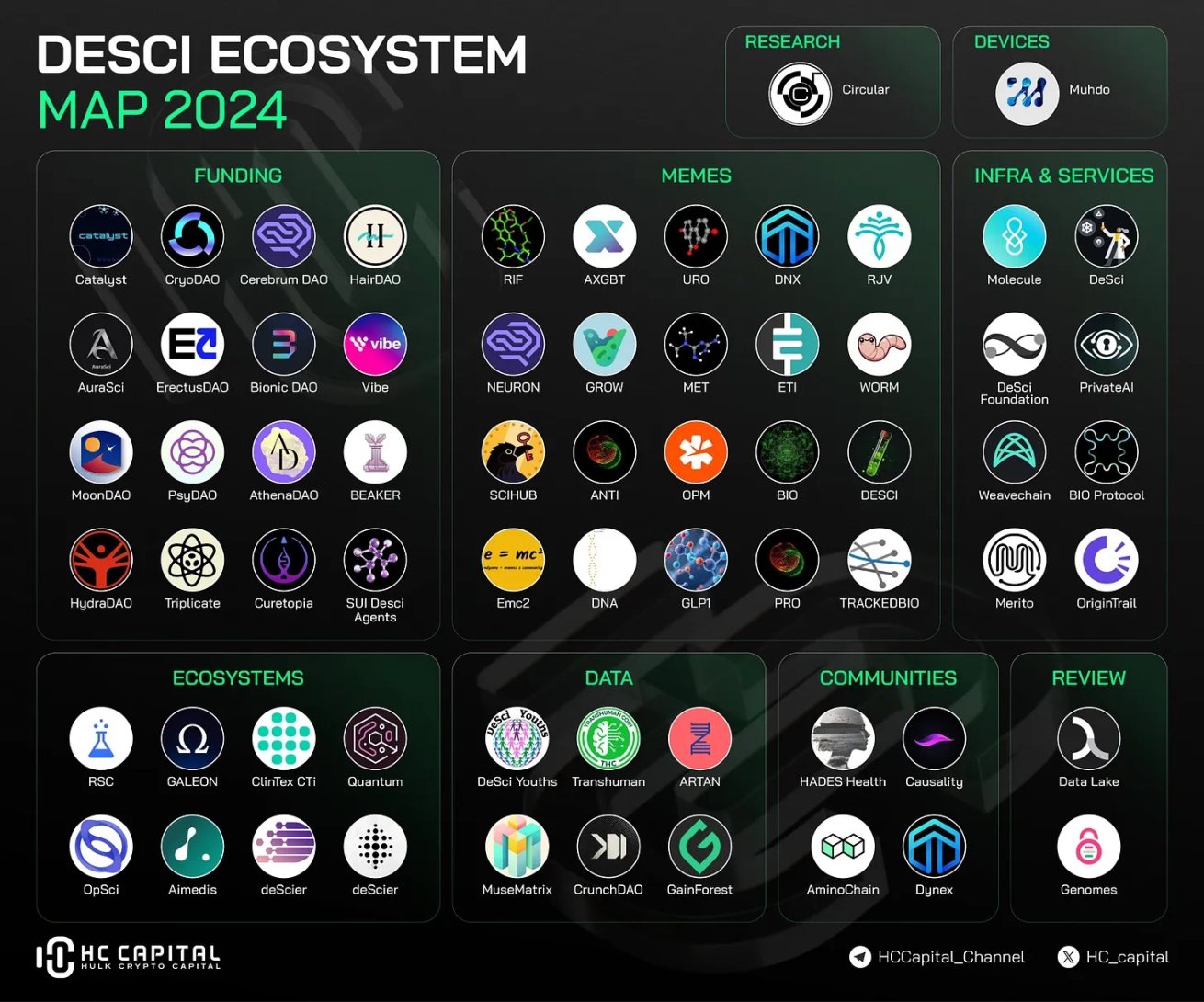
This is no longer a theoretical fantasy; many companies are building tangible infrastructure for decentralized science.
Take BIO Protocol, a key player in this field, for example. It has received support from Binance Labs and has substantial financial backing. BIO has created what it calls "BioDAOs," essentially investment communities that crowdfund biotechnology research. It’s no longer a few wealthy individuals deciding which cancer therapies are worth developing; instead, thousands of people can pool their resources and vote on research directions.
There are also Molecule and VitaDAO, which focus on longevity research and tokenize intellectual property: when researchers achieve certain results, ownership is distributed among all funders. Current projects they support include aging research at Newcastle University and longevity research at the University of Copenhagen.
The scale of funding is also continually growing. These platforms have processed millions of dollars in research funding, with some individual projects raising hundreds of thousands of dollars through token sales. While still small compared to traditional funding, the growth rate is astonishing.
The more I think about DeSci, the more I feel it is profoundly significant. Scientific research is inherently a collaborative process; researchers build on the work of others, share data, and peer review, and blockchain technology is designed precisely for this kind of transparent collaboration.
The traditional funding system has created distorted incentive mechanisms: researchers, in order to secure funding, must exaggerate the certainty of their research, which in turn hinders exploration in "uncertain but potentially groundbreaking" directions. DeSci reverses this. It rewards researchers for sharing all data, including failed experiments, as these may help others avoid pitfalls.
Another benefit is that it allows researchers from around the world to participate. A researcher in Nigeria with a great idea can raise funds globally without having to rely on Western universities or funding agencies. This has significant implications for the democratization of scientific progress.
Moreover, transparency is inherent: when research is funded through blockchain tokens, everyone can clearly see where the funds are going, eliminating the guesswork about whether the funding is being used for actual research or administrative expenses.
Risks and Challenges
Of course, risks cannot be ignored. The biggest issue is quality control. Traditional peer review, despite its flaws, does filter out some subpar research. In a decentralized system, how can we prevent people from funding obviously unreliable research projects?
Volatility is also a real challenge. If a five-year cancer research project is funded through crypto tokens, what happens if the token price plummets by 90%? Long-term research requires stable funding support.
Regulatory uncertainty also exists. Most countries have complex regulations regarding medical research, drug development, and intellectual property, and it remains unclear how tokenized research will fit into existing legal frameworks.
To be honest, most scientists are not "natives" of the crypto space; expecting them to suddenly become experts in token economics and DAO governance is quite a stretch.
Conclusion
Despite the many issues, the momentum behind DeSci is undeniable. The relevant infrastructure is becoming increasingly robust, funding is on the rise, while the traditional research funding system is deteriorating. When funding agencies take 18 months to approve funding for urgent research, while crypto crowdfunding can complete in just a few days, the efficiency gap is evident.
Early projects are largely concentrated in the biotechnology and longevity research fields, which makes sense given their clear commercial potential: if the funded research leads to a new drug, token holders can share in the profits. However, this model is applicable to any research that can ultimately create value.
I believe we are at the early stages of a significant endeavor. It’s not that cryptocurrency will overnight replace traditional research funding, but it offers a faster, more transparent path for global researchers to access funding.
The true test of DeSci will be whether it can produce actual scientific breakthroughs, not just raise money. But given the current state of traditional research funding, trying new methods is certainly worthwhile.
This is just the beginning. The DeSci field is evolving rapidly, with new projects emerging and real money flowing into actual research. The intersection of cryptocurrency and research funding is giving rise to opportunities that did not exist a year ago.
Click to learn about job openings at ChainCatcher
Recommended Reading:
 Risk warning
 Risk warning