350 million is just the starting point: What wealth secrets are hidden in Arbitrum's RWA ecosystem?

 In the struggle between traditional finance and the on-chain world, Arbitrum has raised the RWA TVL to 350 million in just one year. Its key actions, the deeper logic behind institutional involvement, and the real breakthrough points are yet to be revealed.
Author: Castle Labs
Compiled by: Saoirse, Foresight News
Abstract
For many, the ability to enter the realm of Real World Assets (RWA) has become a benchmark for measuring whether cryptocurrencies have achieved mainstream adoption: only when we can connect the on-chain world with traditional finance can cryptocurrencies truly establish themselves as an attractive mainstream asset.
What was once a vision is gradually becoming a reality, with U.S. Treasury bonds, bonds, and even real estate being tokenized and brought on-chain.
Driven by clearer regulations and technological maturity, RWA is gaining significant momentum.
This article focuses on the Arbitrum ecosystem, a Layer 2 solution that has successfully launched multiple RWA-focused projects, with the total value locked (TVL) in RWA assets exceeding $350 million.
This article will outline the RWA landscape on Arbitrum, the projects and initiatives driving its development, key assets and providers (including case studies), as well as related risk considerations and future outlook.
Overview of RWA on Arbitrum
The RWA market is thriving. Many early cryptocurrency adopters once envisioned a scenario where Wall Street elites used cryptocurrencies. Today, this vision has been realized, as real-world assets have successfully been brought on-chain and are beginning to be widely adopted.
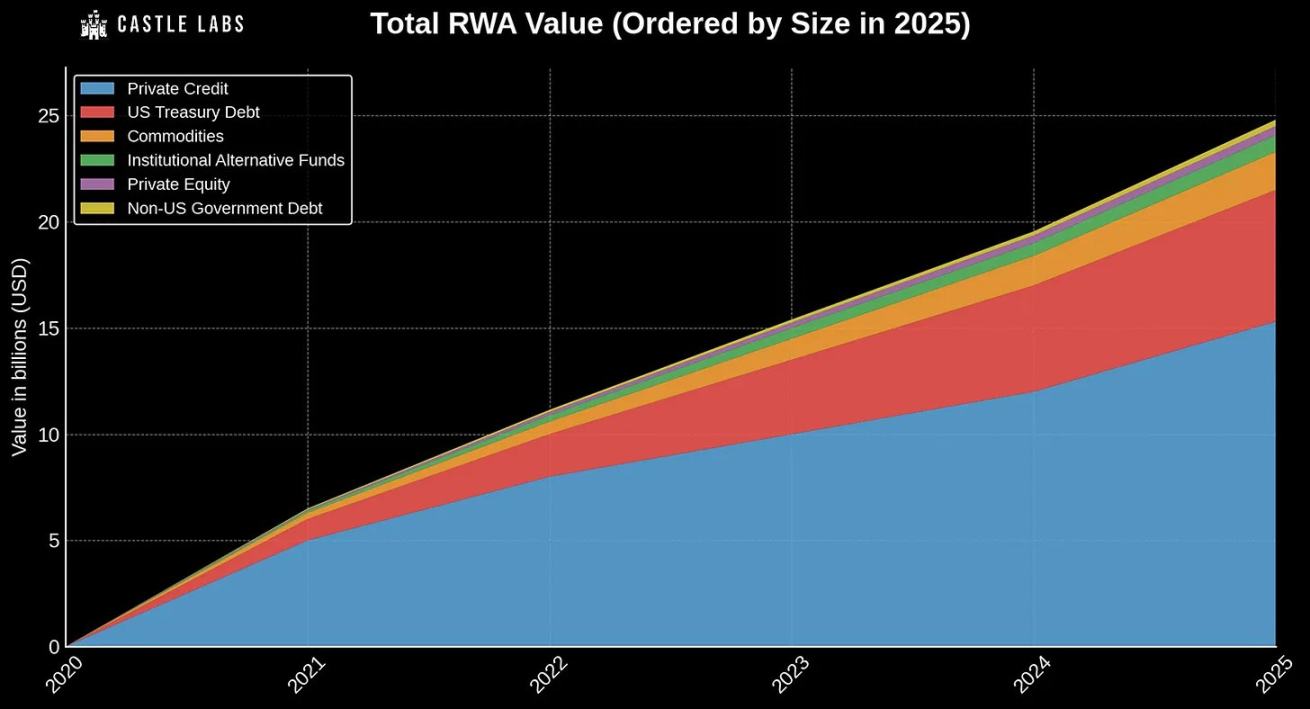
Source: rwa.xyz
Currently, the total value of RWA exceeds $25 billion, distributed as follows:
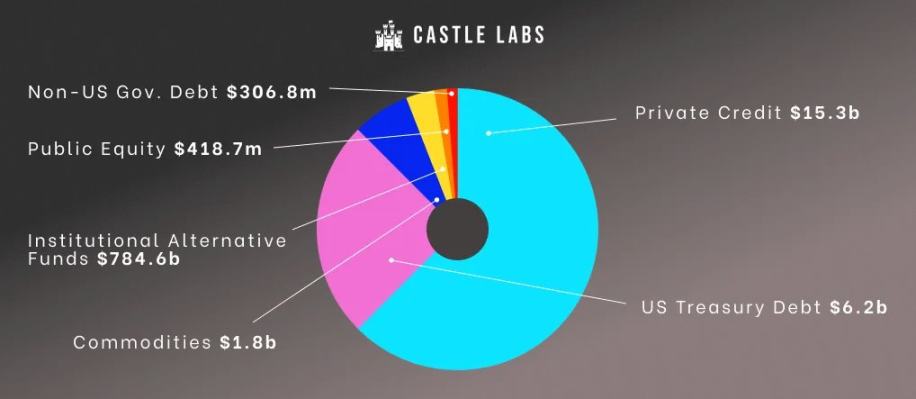
Source: rwa.xyz
- Private Credit: $15.3 billion (60%)
- U.S. Treasury Bonds: $6.2 billion (26.9%)
- Commodities: $1.8 billion (7.2%)
- Institutional Alternative Funds: $784 million (3.26%)
- Private Equity: $418.7 million (1.71%)
- Non-U.S. Government Bonds: $306 million (approximately 1.2%)
The on-chain growth of RWA is attributed to several factors:
- The regulatory framework for digital assets is maturing.
- The technological infrastructure has reached production-level reliability.
- Institutional interest is rapidly increasing.
Cryptocurrencies are gradually being accepted and integrated into regulatory frameworks, such as Europe's MiCA and the recently passed GENIUS Act in the U.S., indicating that these assets are gradually moving towards legitimacy in a broader financial context.
At the same time, networks like Bitcoin and Ethereum have been operating stably for over a decade, demonstrating their security, activity, and decentralization characteristics.
However, due to their inherent nature, RWA requires higher assurances before being brought on-chain. Therefore, the emergence of Layer 2 solutions is highly attractive to institutional investors, as they can significantly reduce on-chain operational costs compared to the Ethereum mainnet.
Among various Layer 2 networks, Arbitrum is one of the fastest-growing Layer 2 solutions in the RWA space.
Why Choose Arbitrum?
- Mature and reliable tech stack
- Trustworthy blockchain space neutrality
- One of the largest capital pools in the cryptocurrency space
Arbitrum has a solid tech stack: it focuses on technology-driven development, with the introduction of technologies like Stylus and Timeboost, making it an effective alternative to the Ethereum mainnet.
Additionally, Arbitrum's backend technology is used by projects like Hyperliquidx as a cross-chain bridge for USDC, extending beyond the functionality of its ecosystem. This fully demonstrates Arbitrum's trustworthy neutrality as a blockchain space. Trustworthy neutrality refers to the principle that blockchain networks operate fairly, treating all participants equally without favoring any user, application, or outcome.
The Importance of Trustworthy Neutrality:
- Trust: Users and institutions are more willing to rely on a platform that does not arbitrarily change rules or favor one side.
- Security: Neutral systems are better able to withstand manipulation or centralization risks.
- Composability: DeFi can thrive when developers are confident that no protocol will receive special treatment.
- Institutional Confidence: For RWA, neutrality ensures that tokenized assets do not face hidden risks (such as censorship or biased governance).
Lastly, it is worth mentioning that Arbitrum has the sixth-largest capital pool in the space, with assets exceeding $1.17 billion, and also boasts one of the most mature stablecoin ecosystems.
RWA can represent tangible assets and income-generating instruments while also providing the programmability and transparency of blockchain systems, offering institutional investors and decentralized autonomous organizations (DAOs) new opportunities for diversified investment, stable returns, and improved capital efficiency.
What Proposals Have Driven This Development?
This section briefly reviews the development history of RWA within Arbitrum. The initial development of RWA in Arbitrum was jointly driven by the foundation and Arbitrum DAO.
The first major initiative by Arbitrum DAO in the RWA space began with the "Stable Treasury Endowment Proposal" (STEP), followed by the RWA Innovation Grant Program, treasury management proposals, and finally STEP 2.
STEP (April 2024)
This proposal aims to invest over $85 million (35 million ARB) into tokenized U.S. Treasury bonds and other real-world assets through institutional issuers.
Although the plan was initially just a pilot project, several providers were successfully selected after in-depth analysis of applicants:
- Securitize's BUIDL
- Ondo Finance's USDY
- Superstate's USTB
- Mountain Protocol's USDM
- OpenEden's TBill
- Backed's bIB01
The criteria for selecting applicants were as follows:
- No investment restrictions
- Clear organizational structure with no departmental silos
- Significant asset management scale, exposure to multiple International Securities Identification Numbers (ISINs), and experienced teams
- Use of public or decentralized tools and networks (rather than relying solely on proprietary tools and networks)
- Avoiding companies with additional layers of decentralized governance
- Comprehensive and detailed documentation
Furthermore, to ensure coverage is not limited to the above list, STEP also plans to invest 1% of the DAO treasury in tokenized real-world assets each year for the next five years. This plan also provides practical opportunities to gain deeper insights into the RWA space and balance ecosystem development with principal protection. Future iterations are expected to focus on one of these goals.
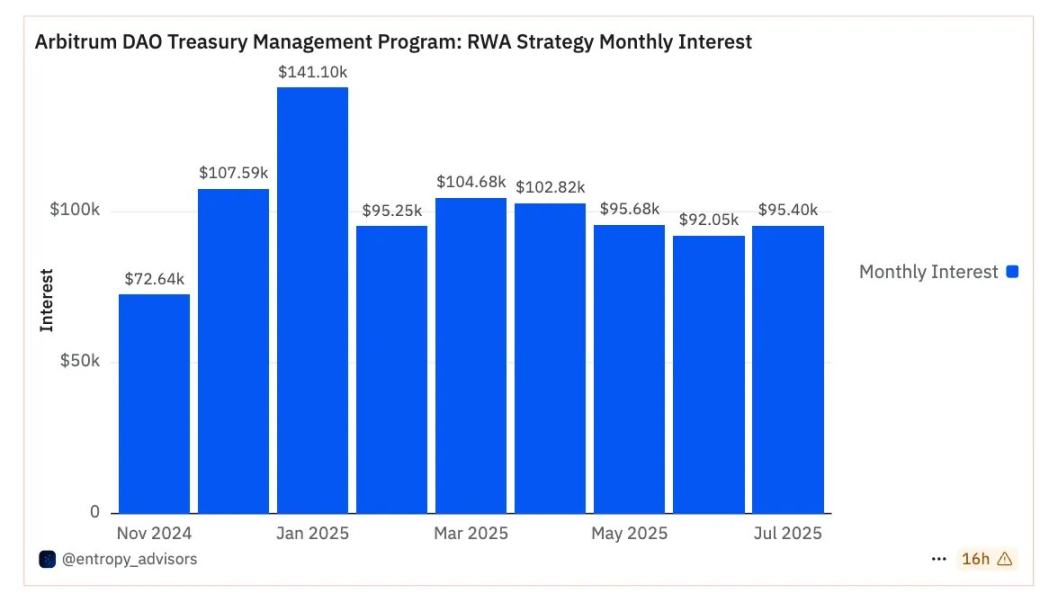
The STEP plan has achieved great success, generating $600,000 in interest income for Arbitrum DAO in less than a year.
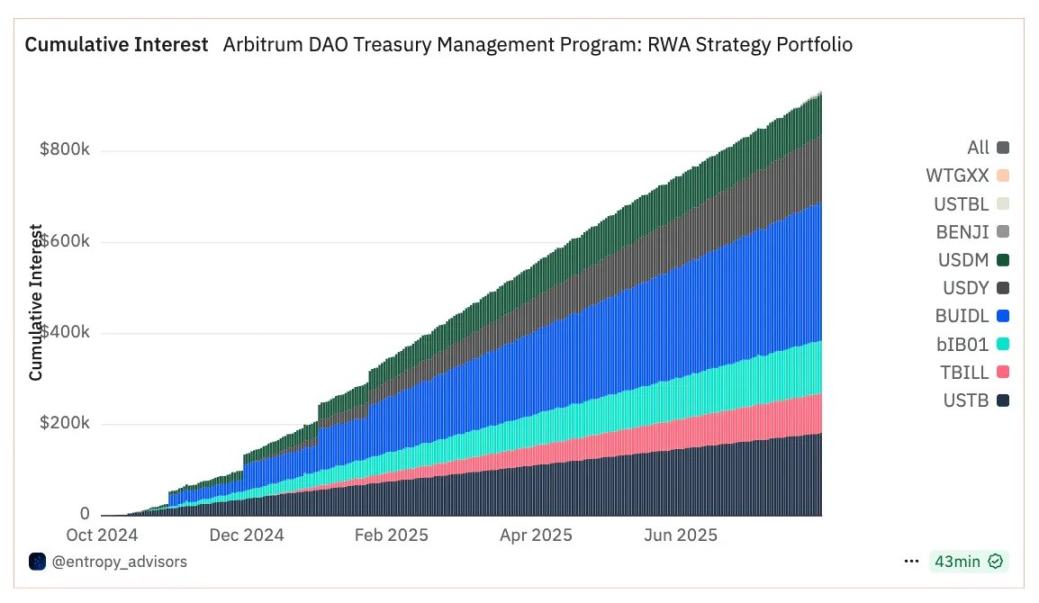
Here is the cumulative amount by month:
What makes STEP special is its adherence to clear principles when collaborating with institutional service providers:
- Direct assessment and selection of income-stable assets without intermediary involvement
- Using a Request for Proposal (RFP) model, where protocol parties can submit product applications for review
- Institutional participants apply directly in decentralized forums, aiming to create sustainable income for the DAO
RWAIG Grant Program (June 2024)
The Arbitrum Foundation funded a series of innovative grant projects (RWAIG), a two-month pilot program conducted from June to August 2024, aimed at supporting RWA integration, analysis, and research within Arbitrum, with a budget of 300,000 ARB.
The main goals of these grant projects are:
- Significantly enhance the activity of RWA within Arbitrum, gaining a competitive edge and ensuring "future growth assurance for the platform."
- Explore how to invest DAO treasury funds in RWA and how to initiate on-chain tokenization on Arbitrum.
- More broadly integrate RWA assets and tools into existing ecosystem applications like GMX, Aave, and Pendle.
The program ultimately funded eight different projects:
- RWA Research: Educating users about the field.
- PYOR: RWA analytics dashboard.
- Mystic Finance: A lending market allowing users to borrow stablecoins against RWA assets.
- Jia: Tokenizing accounts receivable from small and medium-sized enterprises.
- Truflation: Providing real-time inflation data.
- Backed Finance: Creating structured products tracking securities.
- Infinfty: Developing ERC-6651 RWA tokens to track the entire lifecycle of product procurement, performance, ownership, and environmental impact.
Treasury Management (December 2024)
At the end of 2024, a treasury management proposal emerged to complement the preliminary work of STEP. This proposal focuses on generating passive income by utilizing on-chain strategies for ARB tokens rather than leaving the tokens idle in the treasury.
Its goals include:
- Asset Management: Managing 25 million ARB tokens to generate on-chain returns.
- Stablecoin Exchange: Simplifying the process of exchanging ARB assets for stablecoins, minimizing slippage and market impact.
- Stablecoin Liquidity Deployment: Converting 15 million ARB into stablecoins and investing in low-risk income strategies to cover DAO expenses or service provider fees.
- Diversification and Stability: Focusing on risk-adjusted returns while ensuring capital safety.
The strategy is divided into two directions:
- Treasury: Allocating 10 million ARB for pure ARB strategies, converting 15 million ARB into stablecoins as the DAO's "current account."
- Growth: Allocating 7,500 ETH to the decentralized finance (DeFi) space.
STEP 2 (January 2025)
Inspired by the initial success of STEP, the STEP 2 proposal was approved, adding an additional 35 million ARB (approximately $15.7 million).
After carefully reviewing over 50 applications, the STEP committee decided to allocate assets as follows:
- WisdomTree WTGXX: 30%
- Spiko USTBL: 35%
- Franklin Templeton FOBXX (BENJI): 35%
The importance of this plan is also reflected in the DAO's recognition of it.
STEP 2 was approved by an absolute majority, with nearly 89% of participants expressing support, 11% abstaining, and only 0.01% opposing.
These projects and initiatives have collectively driven the development of on-chain real-world assets on Arbitrum, increasing its total value locked (TVL) from nearly zero to over $70 million in less than a year.
So what is the current situation?
What does the RWA landscape on Arbitrum look like?
The next section will delve into on-chain data to explore RWA assets, asset providers, and the growth of RWA on Arbitrum.
Growth of RWA on Arbitrum
With its low-cost, high-throughput architecture and trustworthy neutrality, Arbitrum is rapidly building an ecosystem composed of issuers, infrastructure providers, and incentive programs to drive RWA on-chain at scale.
Although Arbitrum initially focused on DeFi building blocks, DEXs, lending protocols, and yield aggregators, the concept of bringing off-chain assets on-chain began to gain attention after early experiments with tokenized U.S. Treasury bonds on Ethereum in 2022.
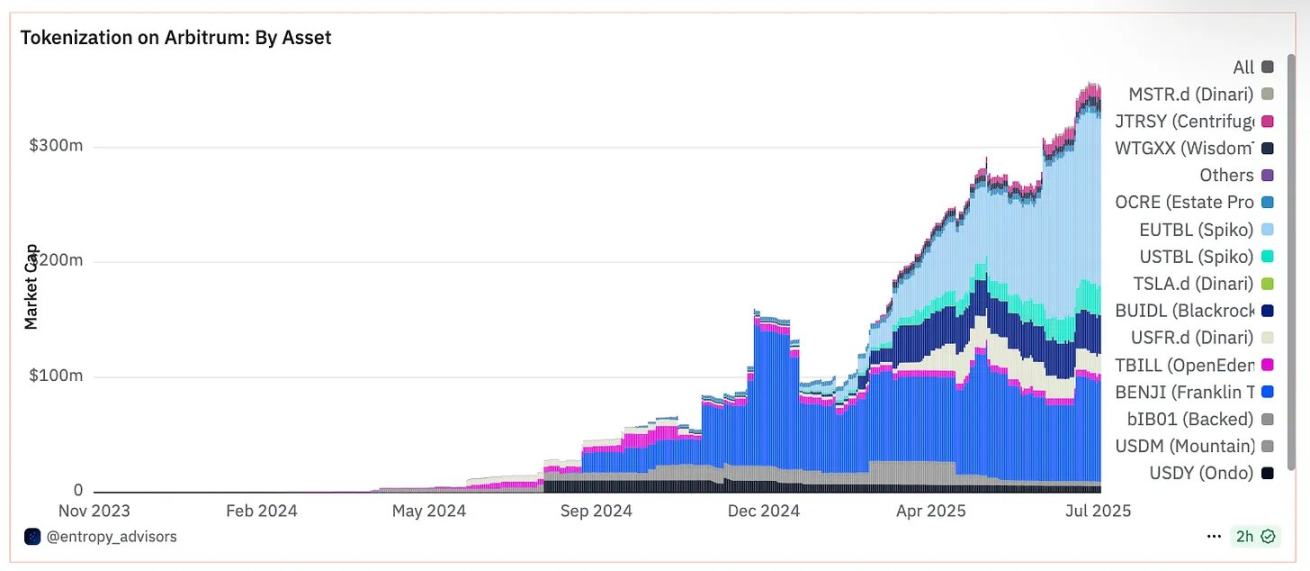
Currently, the market capitalization of RWA on Arbitrum is close to $350 million, with over 129 assets tokenized. While this figure is impressive, it only represents about 1.39% of the total market capitalization of RWA assets, indicating strong growth potential for the future.
Despite varying predictions, several forecasts estimate the growth of the on-chain RWA space as follows:
- Reaching $16 trillion by 2030 (10% of global GDP)
- Reaching $30 trillion by 2034
In the first scenario, the sector is expected to grow 40 times over the next five years.
As one of the most mature on-chain RWA networks, Arbitrum will gain a significant competitive advantage.
Growth Journey of RWA on Arbitrum
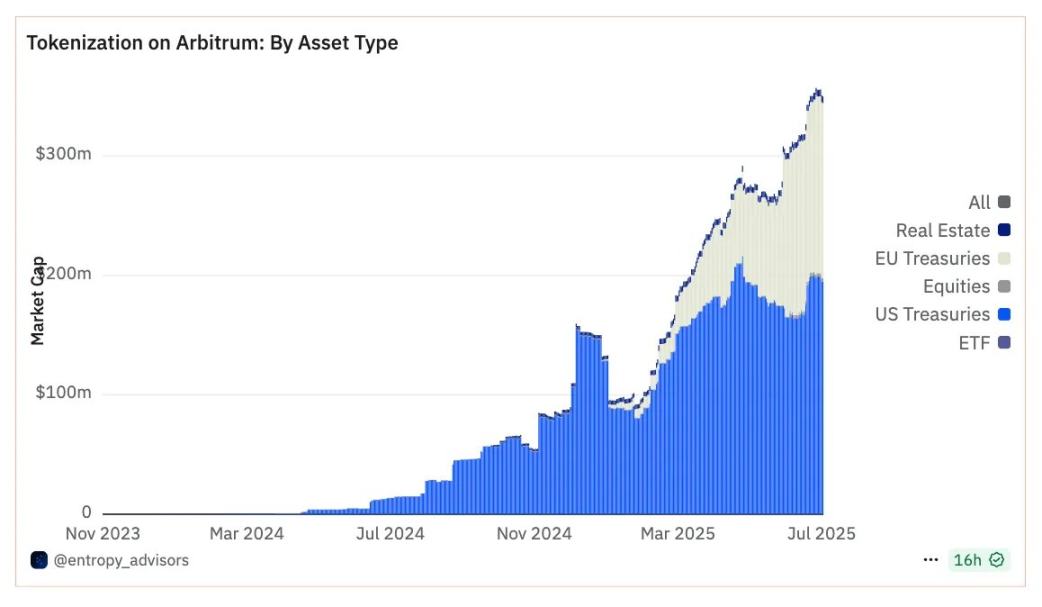
In just one year, the total value locked (TVL) in Arbitrum grew from nearly zero to nearly $85 million by the end of 2024.
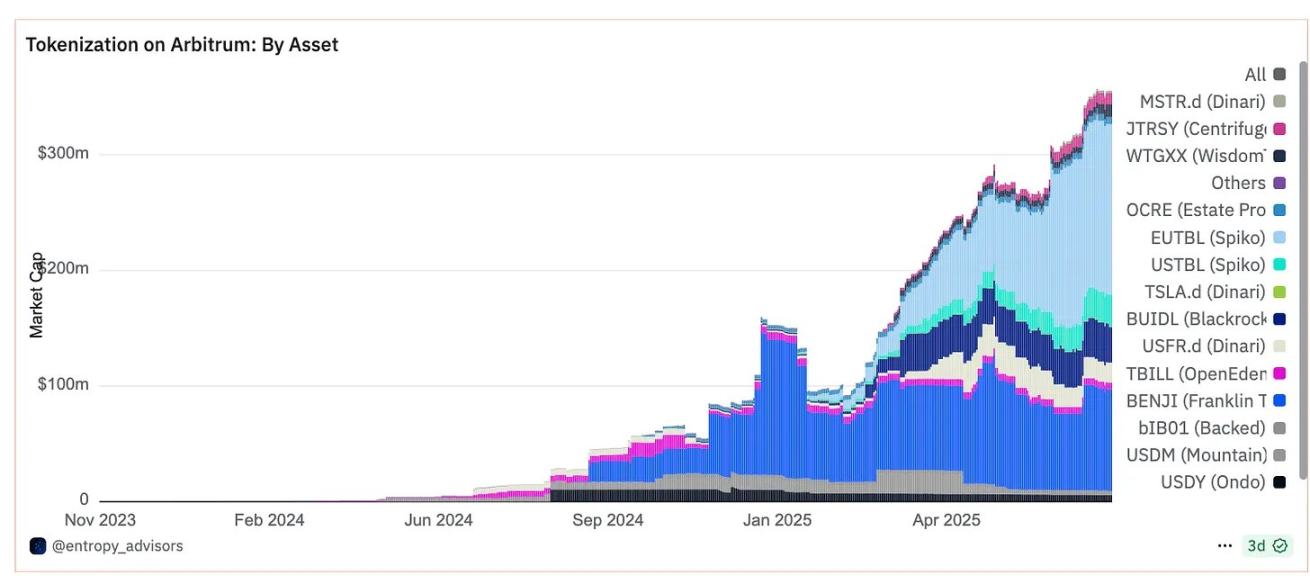
This growth journey can be divided into three phases, closely related to the key initiatives mentioned above:
- Early Growth Phase (Q1 2024): The total value locked in RWA on Arbitrum surged from nearly zero to over $5 million, showing initial development momentum.
- Significant Growth Phase (Q2 2024): In the first half of 2024, the total value locked grew from about $20 million to around $70 million, coinciding with the funding allocation timing of STEP 1.
- Continuous Expansion Phase: With increased DAO treasury allocations (STEP 2) and the addition of new RWA issuers (such as Spiko, WisdomTree, and BlackRock), growth is expected to continue into 2025.
This development is also reflected in the types of assets supported on-chain. In 2024, most RWA were still U.S. Treasury bonds. Over time, the diversity of asset types has increased, incorporating new varieties.
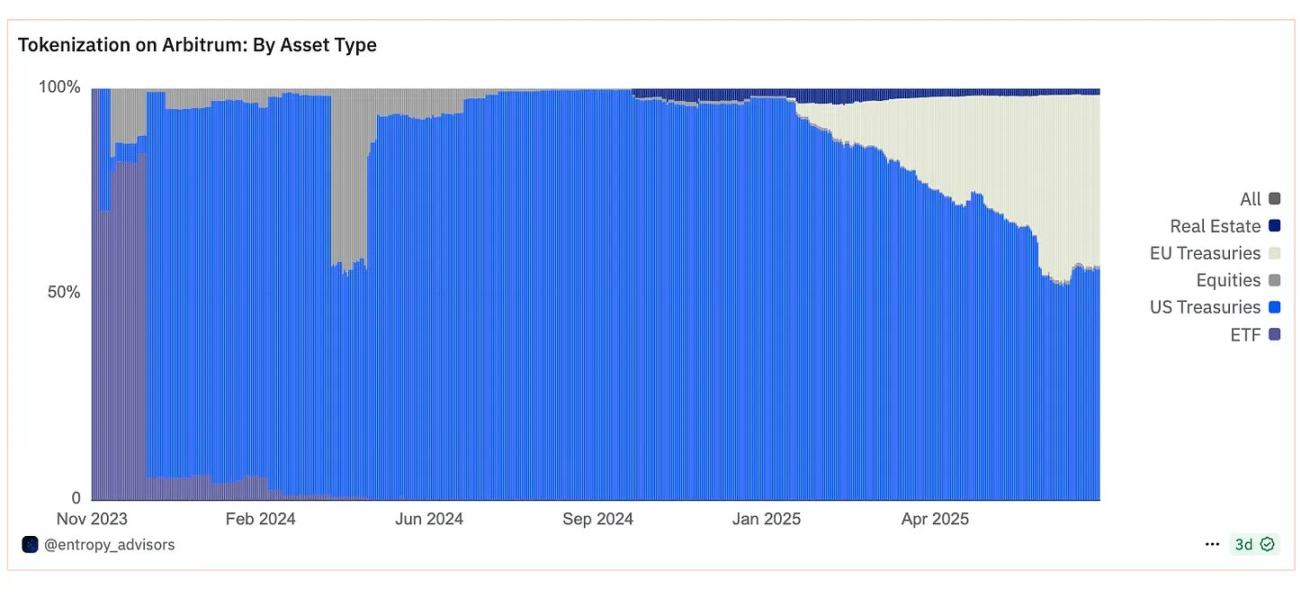
While U.S. Treasury bonds still account for the majority of asset types ($197 million), EU government bonds are closely following ($150 million). Alternative assets such as real estate, stocks, and ETFs are also gradually gaining attention.
RWA Assets and Providers
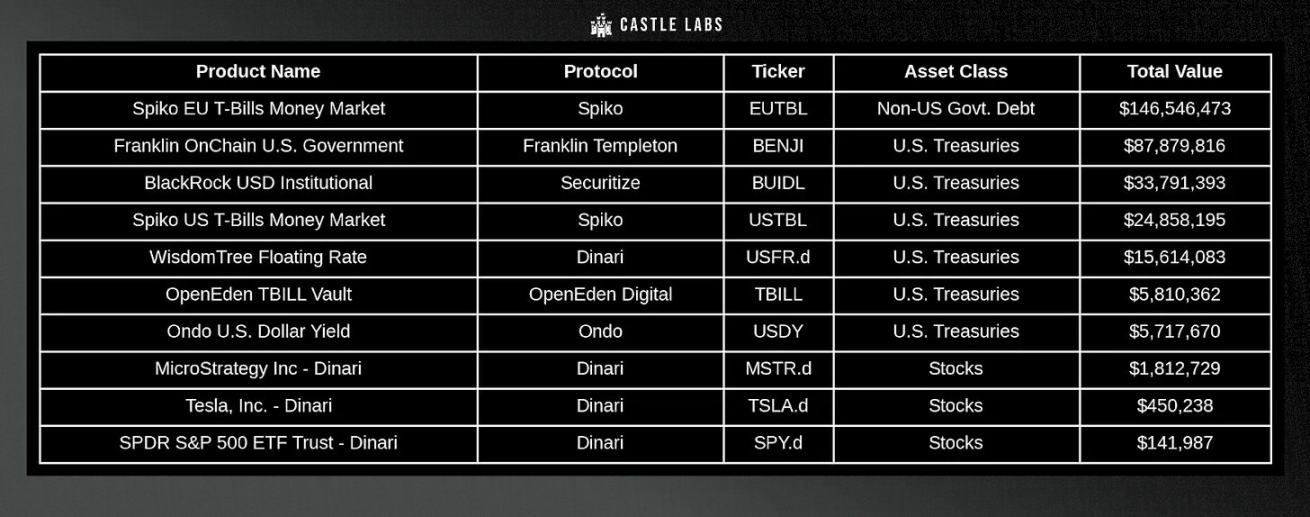
This section will delve into these asset categories, highlighting the top ten RWA products ranked by total value and categorizing them by issuer.
Spiko
Spiko has created an on-chain securities token issuance and distribution platform.
The platform is licensed by the French Financial Markets Authority (AMF) and has launched two money market funds:
- Spiko Euro (EUTBL)
- Spiko Dollar (USTBL)
These funds are backed by a portfolio of short-term government bonds, with yields close to the central bank's risk-free interest rate. Currently, they are among the most widely used products, with EUTBL leading at $146 million in total value and USTBL ranking fourth at $24.8 million, further proving that short-term government bonds are the most widely used assets in on-chain applications.
Franklin Templeton
Franklin Templeton is a well-known investment management company listed on the New York Stock Exchange (BEN).
To bring tokenized mutual funds on-chain, the company launched the BENJI mobile app, which supports tokenized securities and cryptocurrencies through its proprietary record-keeping system.
Each BENJI token represents a share of its Franklin on-chain U.S. Government Money Market Fund (FOBXX). Currently, BENJI is the second-largest RWA product on Arbitrum, valued at over $87 million.
Securitize
Securitize is a platform that provides access to tokenized securities for institutional investors.
On Arbitrum, the platform offers BlackRock's U.S. Dollar Institutional Digital Liquidity Fund BUIDL.
This is a tokenized product focused on providing dollar yields on-chain, with a total value exceeding $33 million.
Dinari
Dinari allows for the creation of tokenized stocks, ETFs, indices, etc., known as "dShares," which maintain a 1:1 backing relationship with the underlying assets.
Dinari has launched several products on Arbitrum:
- WisdomTree Floating Rate Treasury Fund (USFR.d): Provides a low-cost investment channel for U.S. government floating rate bonds, with a total value exceeding $15 million.
- Tokenized MicroStrategy stock (MSTR.d): Valued at $1.8 million.
- Tokenized Tesla stock (TSLA.d): Total value of $450,000.
- Tokenized S&P 500 Index ETF Trust (SPY.d): An index composed of S&P 500 constituent companies, approximately $141,000 in size.
These assets highlight the potential of stocks and indices, but their share in Arbitrum remains relatively low.
OpenEden
OpenEden provides access to products such as tokenized U.S. securities. The platform is licensed by the Bermuda Monetary Authority and holds a digital asset operating license, receiving a "investment grade" rating from Moody's.
Currently, the platform is one of the most significant issuers of tokenized U.S. Treasury bonds in Europe and Asia. OpenEden has specifically launched the TBILL fund pool, where users can invest in short-term U.S. Treasury bonds.
Currently, deposits in this fund pool have exceeded $5.8 million.
Ondo
Ondo provides investors with opportunities to access institutional financial products.
On Arbitrum, its USDY product has initially received a positive response, currently valued at $5.7 million.
USDY is an income-generating stablecoin backed by U.S. Treasury bonds, with an annual yield of approximately 4.29%.
Although Arbitrum has a rich product and asset portfolio, the RWA ecosystem is still in its early stages.
Its future development will depend on:
- On-chain asset expansion to meet broader demand
- Strategically focusing on RWA as a key area for Arbitrum
- Collaboration among Arbitrum Alliance Entities (AAE)
- Institutional push at the business development level
Future Outlook
The initial providers established by STEP 1 have been supplemented by a new batch of providers during STEP 2, enriching the types of assets and products available on Arbitrum.
Based on the current growth rate of RWA's total value on Arbitrum, we can make the following predictions:
- Forming a RWA ecosystem worth billions of dollars
- Incorporating more asset classes (private credit, real estate, income-generating stablecoins, etc.)
- Achieving deeper interoperability of these assets across networks
While some progress has been made, Arbitrum still has significant growth potential to solidify its position in this niche. In fact, in the network ranking of total value of RWA assets, Arbitrum currently ranks seventh; based on current data, its $350 million total value locked (TVL) in RWA represents only 1.39% of the total market capitalization of on-chain RWA assets, a minuscule share.
To compete with these networks, Arbitrum needs to explore more opportunities, expanding into private credit issuance products, bonds, precious metals like gold and silver, and stocks.
Given Entropy's deep involvement in treasury management and RWA-related matters on Arbitrum, we consulted Matt for his views on the future development of RWA on Arbitrum. Here are his insights:
"Today, many RWA issuers are primarily focused on reducing operational costs associated with issuance and transfer, and there is still a long way to go to validate this on a scalable level. Nevertheless, the next significant breakthrough for RWA on Arbitrum will be further enhancing composability. This is not just about adding more asset classes or introducing new issuers; that is just the first step. The real breakthrough lies in ensuring that these assets can integrate with the more efficient on-chain building blocks developed over the past decade: exchanges, lending protocols, index tools, liquidity pool optimization tools, and various innovations that may emerge in the future. The ultimate goal is to achieve open, permissionless transferability, allowing RWA to be composable like native crypto assets. We have not yet reached this stage (considering the current regulatory realities, this is a lofty goal), but it is our North Star. Encouragingly, industry giants like Franklin and WisdomTree have begun to issue tokens themselves. This is true institutional participation, and it is a trend I hope to see continue. If we can truly conduct RWA-related user activities (such as trading and lending) on-chain— even if these activities are abstracted through permissioned channels based on Arbitrum— it will open up new horizons."
We fully agree with Matt's perspective, especially regarding the composability and accessibility of these assets. Currently, the on-chain application potential of these assets is just beginning to emerge. We look forward to a future where Treasury bills, bonds, stocks, and commodities can not only be tokenized on-chain but also integrated into various application scenarios of current DeFi building blocks.
From a research methodology perspective, it is important to note that in this report focusing on RWA, we have not included stablecoins in the analysis, as the core purpose of the report is to highlight the various assets available on the current Arbitrum platform.
Lastly, it is equally important to mention the associated risks and considerations.
Risks and Forward-Looking Considerations
- Disconnection between tokens and ecosystems: The growth of real RWA will not directly translate into value appreciation of ARB tokens.
- Asset concentration risk: Short-term government bonds still account for a very high proportion of the total value locked (TVL) in RWA, highlighting the need for diversified allocation into private credit, corporate bonds, real estate, and other asset classes.
- Regulatory dynamic risk: Although the regulatory environment for cryptocurrencies is continuously improving and gradually moving towards legitimacy, the compliance framework for tokenized securities is still in development, and institutional issuance has higher demands for regulatory clarity and cross-jurisdictional coordination.
The expansion of asset issuers and the on-chain expansion of RWA categories such as private credit and real estate are expected to drive the total value locked (TVL) in the Arbitrum ecosystem close to $1 billion by the end of the year.
With the comprehensive advancement of treasury management plans and STEP 2, we expect to gain more information and insights that will not only further reveal the implementation results of the aforementioned plans but also provide references for future decisions and initiatives.
Conclusion
The total value locked (TVL) in RWA on Arbitrum has grown from nearly zero to $350 million in just over a year.
The STEP plan and a series of initiatives led by the DAO have played a key role in driving early growth. In this process, a diverse range of institutional-grade products has been launched on Arbitrum, such as short-term government bonds, money market funds, and tokenized stocks.
The entry of institutions like Franklin Templeton and WisdomTree further solidifies Arbitrum's core position as a "reliable, neutral, and low-cost network" in the institutional DeFi space.
However, this process is just beginning.
In addition to the risks and issues mentioned above, Arbitrum will face several strategic opportunities in the coming months.
These include expanding into RWA categories such as private credit, real estate, and commodities that have not yet been fully covered, and more importantly, enhancing the composability of these new products to achieve deep integration with Arbitrum's core building blocks (decentralized exchanges, lending protocols, liquidity pools, etc.).
As the ongoing STEP 2 and treasury management plans continue to inject momentum and provide practical experience, the collaboration between the DAO, alliance entities, and institutional participants will be key to maintaining Arbitrum's long-term leadership in the RWA space.
 Risk warning Risk warning