








The 500% surge of OKB is driven by emotional frenzy or value reassessment?

 The OKB token burn and OKX's upcoming listing in the U.S. next year are still in the works.
Author: 1912212.eth, Foresight News
On August 22, OKX continued to set new historical highs, with its value once reaching $258.6, a 24-hour increase of over 30%, achieving three consecutive daily gains. From a low of $50, it surged more than five times in just 10 days, even briefly surpassing BTC and ETH in 24-hour spot trading volume. As of now, OKB's market capitalization is $5.094 billion, ranking 27th.
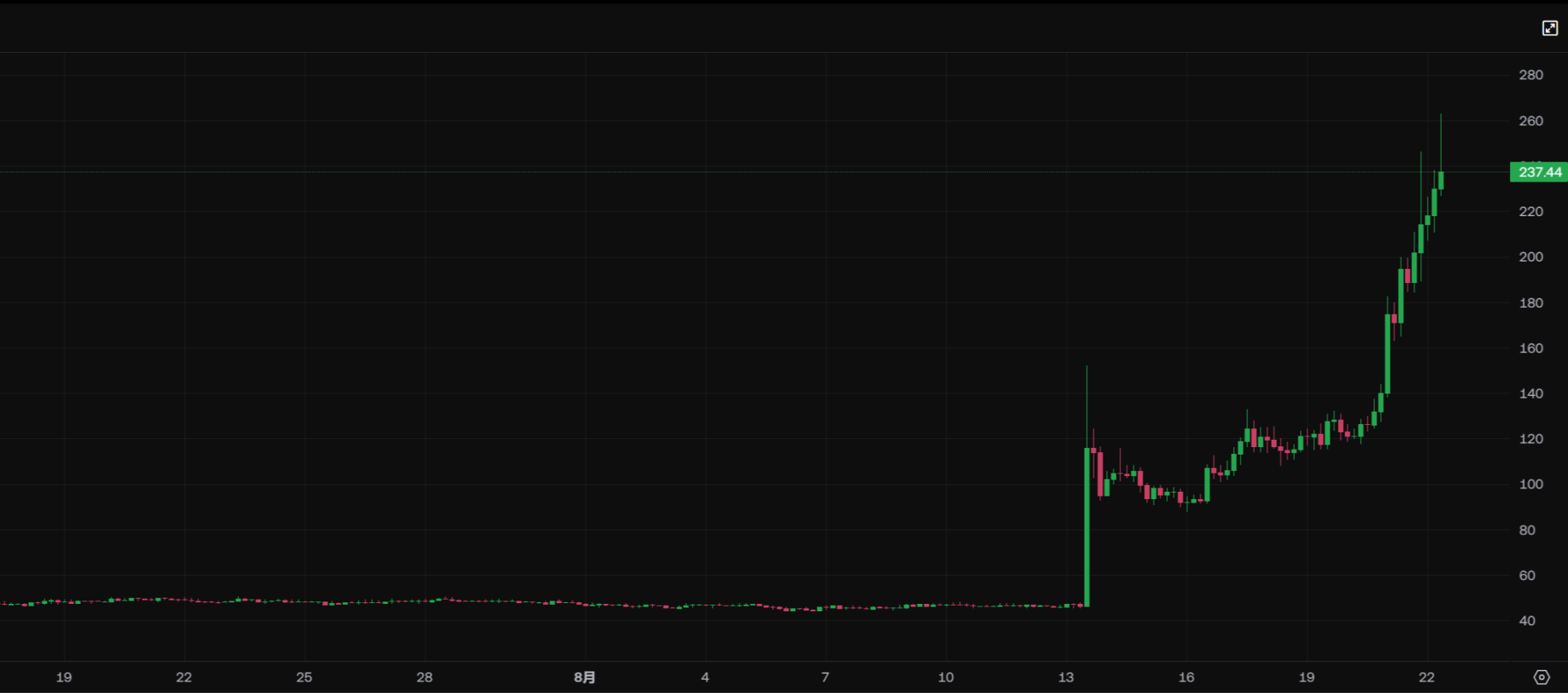
It is worth mentioning that after the price surge yesterday, the price of OKB on the Ethereum chain had a positive premium of up to 42% compared to the OKX platform.
52% of Circulating Supply Burned, Fixed Cap at 21 Million
The announcement on August 13 completely changed the trajectory of OKB. OKX announced the largest token burn in history: burning 65.2567 million OKB, equivalent to 52% of the circulating supply, and permanently fixing the total supply at 21 million. This move directly pushed OKB's scarcity to the extreme, similar to Bitcoin's design of a 21 million cap.
Users holding the Ethereum version of OKB need to recharge their assets to OKX and complete the chain swap through "Withdraw to X Layer." Meanwhile, OKTChain will be phased out, with trading on OKX stopping from August 13, 2025, at 14:10 (UTC+8), and OKT will be periodically exchanged for an equivalent amount of OKB based on the average closing price from July 13 to August 12, 2025. On-chain OKT exchanges will be supported until January 1, 2026.
After the burn, the price of OKB skyrocketed by 183% within 24 hours, rising from about $50 to over $140. On August 21, OKB broke through the $200 mark, reaching a historical peak of $239.91; the next day (August 22), it continued to rise, with its market capitalization approaching $4 billion. This series of new highs not only refreshed OKB's own records but also drove a short-term rebound in other exchange tokens like BNB.
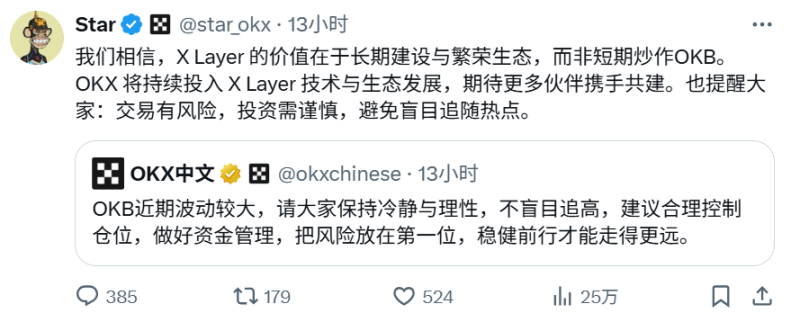
In the face of the crazy price surge, OKX CEO Star even personally took to social media to remind everyone: trading involves risks, and investment requires caution to avoid blindly following trends.
The cryptocurrency exchange OKX was founded by Star Xu. Currently, OKX's ecosystem includes a Web3 wallet, Layer 2 network X Layer, and a series of DeFi and GameFi applications, all of which provide solid value support for its token OKB.
OKB was initially issued as OKX's platform token in 2018, with an initial total supply of 300 million. It serves not only as a trading fee discount tool but also for ecosystem governance, staking rewards, and cross-chain bridging. After OKX launched its L2 network in collaboration with Polygon in 2023, OKB became the native currency on-chain.
According to historical data from OKX, OKB was limited by early market volatility and regulatory uncertainty, with a lowest price of only $0.57 in 2019. With the arrival of the crypto bull market, OKB once climbed to $44 in 2021, but the bear market of 2022 pulled it down to below $10. Entering 2025, OKB fluctuated around $50 until the announcement of the burn triggered its upward journey.
Upcoming IPO in the U.S.
In June of this year, it was reported that OKX plans to conduct an IPO in the U.S. next year.
From a financial perspective, the IPO will provide OKX with substantial capital for technology upgrades, marketing, and global expansion. After a successful listing, OKX can optimize its balance sheet through equity financing and enhance the valuation of its parent company, which is crucial for attracting institutional investors. Additionally, the listing will bring legitimacy to its platform token OKB, potentially driving its price further up.
However, viewing the IPO merely as a financial maneuver may underestimate its strategic intent. OKX's return to the U.S. market and consideration of an IPO is more about its long-term plan to enter the U.S. market. The U.S. is the largest cryptocurrency market globally, with a vast user base and institutional capital. By going public, OKX can not only enhance brand awareness but also compete directly with rivals like Coinbase and Kraken.
The latter two are also intensifying their layouts on their L2s. The L2 launched by Coinbase has become one of the most active Layer 2 networks, while Kraken is also rapidly launching its superchain ink.
The underlying reason is the shift in thinking from centralized to decentralized.
First is the diversification of revenue and profit models. Traditional CEXs rely on trading fees, but L2s provide new sources of income. As the sole sequencer of Base, Coinbase can capture trading fees significantly boosting revenue. L2s help exchanges shift from custody fees and stablecoin interest to on-chain fees and NFT minting (such as the $500 million assets generated by Coinbase's Onchain Summer event), addressing bear market volatility. Coinbase's latest financial report shows that due to a sharp drop in DA costs and a surge in user numbers, after excluding $6.34 million in DA costs, the gross profit of the Base network in March reached twice that of Arbitrum's entire first-quarter gross profit.
Second is strengthening ecosystem building, guiding users from centralized platforms to self-custody and DeFi, expanding market reach, and attracting developers to build dApps, forming a closed-loop ecosystem. By lowering the threshold through L2 (such as zero gas fee experiences), it accelerates crypto adoption, especially under the U.S. regulatory environment, providing a compliant path to avoid SEC crackdowns.
In August of this year, OKX made significant upgrades to its Layer 2 network X Layer, integrating Polygon's Chain Development Kit (CDK), increasing transaction speed to 5000 TPS (transactions per second), and achieving near-zero gas fees. This upgrade has made X Layer an efficient Web3 infrastructure, attracting more DeFi projects and developers. OKB, as the fuel token of the network, directly benefits from the ecosystem expansion.
As of now, according to official data from X Layer, the total number of its addresses has exceeded 2.18 million, with 47,000 new addresses added in 24 hours. The number of addresses holding OKB exceeds 786,000, with 3,387 new addresses added in 24 hours. Its ecosystem includes launchpad DYORSWAP, and its on-chain meme coin XDOG once had a market cap exceeding $10 million.
Overall, the surge in OKB reflects the optimism of crypto market investors regarding the future of X Layer and OKX's upcoming IPO in the U.S. In this rapidly evolving market, the story of OKB may just be the prelude to a larger wave.
 Risk warning
 Risk warning

Popular articles




