








Curve Conspiracy sequel, Yield Basis stablecoin yield new paradigm

 Yield Basis represents a renaissance, where in one project you can see liquidity mining, pre-mining, Curve War, staking, veToken, LP Token, and circular lending, which can be said to encompass the great achievements of DeFi development.
Author: Zuo Ye, Crooked Neck Mountain
The Expansion Path of Stablecoin Trading Beyond Ethena
Welcome to follow @YBSBarker, a guide to profits in the era of stablecoin credit expansion.
After the collapse of Luna-UST, stablecoins completely bid farewell to the era of stability. The CDP mechanism (DAI, GHO, crvUSD) once became the hope of the entire village, but ultimately, it was Ethena and its representative yield anchoring paradigm that broke through the siege under the encirclement of USDT/USDC. This paradigm not only avoids the inefficiency of over-collateralization but also opens up the DeFi market with its native yield characteristics.
In contrast, the Curve ecosystem, after relying on stablecoin trading to open up the DEX market, gradually ventured into the lending market with Llama Lend and the stablecoin market with crvUSD. However, under the brilliance of the Aave ecosystem, the issuance of crvUSD has long hovered around 100 million dollars, essentially serving as a backdrop.
However, after the flywheel of Ethena/Aave/Pendle was set in motion, Curve's new project Yield Basis also aimed to take a share of the stablecoin market, starting with cyclical leveraged lending, but this time focusing on trading, hoping to eliminate the chronic disease of AMM DEX—impermanent loss (IL).
Unilateralism to Eliminate Impermanent Loss
Curve's latest masterpiece, now your BTC is mine, hold your YB to stand guard.
Yield Basis represents a renaissance; in one project, you can see liquidity mining, pre-mining, Curve War, staking, veToken, LP Token, and cyclical lending, making it a culmination of DeFi development.
Curve's founder, Michael Egorov, was an early beneficiary of DEX development, improving on Uniswap's classic AMM algorithm x*y=k, and successively launching stableswap and cryptoswap algorithms to support more "stablecoin trading" and a more efficient universal algorithm.
The large-scale trading of stablecoins laid the foundation for Curve's early on-chain "borrowing" market for USDC/USDT/DAI, making Curve the most important on-chain infrastructure for stablecoins before the Pendle era. The collapse of UST was also directly linked to the moment of liquidity withdrawal from Curve.
In terms of token economics, the veToken model and the subsequent "bribery" mechanism Convex made veCRV a truly functional asset. However, after a four-year lock-up period, most $CRV holders have their own grievances, which are not for outsiders to know.
With the rise of Pendle and Ethena, the market position of the Curve ecosystem is no longer secure. The core issue for USDe is that hedging comes from CEX contracts, diverting the use of sUSDe to capture yields, making the importance of stablecoin trading itself less significant.
The Curve ecosystem's counterattack first came from Resupply, which will launch in 2024 in collaboration with the two old giants Convex and Yearn Fi, but unexpectedly faced a blow, marking the first failed attempt of the Curve ecosystem.
Although Resupply is not an official Curve project, it broke the bones and connected the tendons. If Curve does not counterattack again, it will be difficult to buy a ticket to the future in the new era of stablecoins.
When an expert makes a move, it is indeed different. Yield Basis does not target stablecoins or the lending market but rather the issue of impermanent loss in AMM DEX. However, it should be stated: The true purpose of Yield Basis has never been to eliminate impermanent loss, but to promote a surge in the issuance of crvUSD.
But it still starts from the mechanism of impermanent loss. LPs (liquidity providers) replace traditional market makers, providing "bilateral liquidity" for AMM DEX trading pairs under the incentive of fee sharing. For example, in the BTC/crvUSD trading pair, LP needs to provide 1 BTC and 1 crvUSD (assuming 1 BTC = 1 USD), making the total value of LP 2 USD.
Correspondingly, the price p of 1 BTC can also be expressed as y/x. We agree that p=y/x. At this point, if the price of BTC changes, for example, rises 100% to 2 USD, an arbitrage situation will occur:
A Pool: The arbitrageur will use 1 USD to buy 1 BTC, at which point LP needs to sell BTC to obtain 2 USD.
B Pool: Sell in the B pool where the value reaches 2 USD, and the arbitrageur nets 2-1=1 USD.
The profit of the arbitrageur essentially comes from the loss of A Pool LP. To quantify this loss, we can first calculate the value of LP after the arbitrage occurs: LP(p) = 2√p (where x and y are both expressed as p). However, if LP simply holds 1 BTC and 1 crvUSD, it considers that it has no loss, which can be expressed as LP~hold~(p) = p + 1.
According to the inequality, under the condition that p>0 and not equal to 1, we can always get 2√p < p + 1. Since the income of the arbitrageur essentially comes from the loss of LP, under the stimulation of economic interests, LP tends to withdraw liquidity and hold cryptocurrencies, while AMM protocols must retain LP through higher fee sharing and token incentives. This is also the fundamental reason why CEX can maintain its advantage over DEX in the spot field.
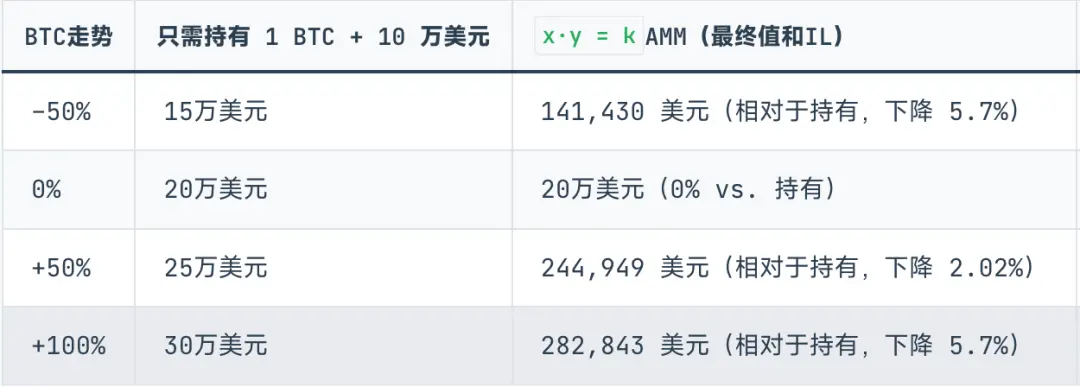
Image caption: Impermanent Loss
Image source: @yieldbasis
From the perspective of the entire on-chain economic system, impermanent loss can be seen as a kind of "expectation." Once LP chooses to provide liquidity, it cannot demand the returns of its holdings. Therefore, impermanent loss is essentially more of an "accounting" loss rather than a real economic loss. Compared to holding BTC, LP can also earn fees.
Yield Basis does not see it this way. They do not eliminate LP's expected losses by increasing liquidity or raising fee ratios but rather focus on "market-making efficiency." As mentioned earlier, compared to the holding of p+1, LP's 2√p can never outperform. However, from the output ratio of the initial investment of 2 USD, the current price is 2√p USD, and the "yield" for each dollar is 2√p/2 = √p. Do you remember that p is the price of 1 BTC? So if you simply hold, then p is your asset yield.
Assuming an initial investment of 2 USD, after a 100% increase, the LP yield changes as follows:
- • Absolute increase: 2 USD = 1 BTC (1 USD) + 1 crvUSD -> 2√2 USD (the arbitrageur will take the difference)
- • Relative yield: 2 USD = 1 BTC (1 USD) + 1 crvUSD -> √2 USD
Yield Basis approaches from the perspective of asset yield, allowing √p to become p, ensuring LP fees while retaining holding yield. This is simple: √p². From a financial perspective, it requires a fixed 2x leverage. If it is too high or too low, it will cause the economic system to collapse.
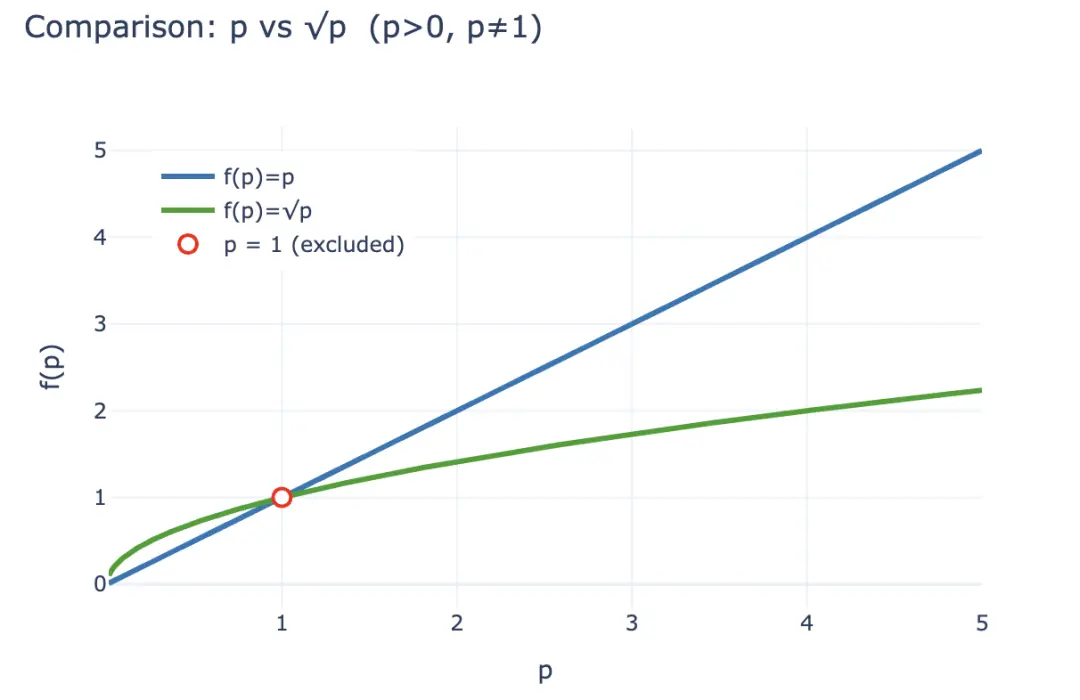
Image caption: Comparison of LP Value Scaling between p and √p
Image source: @zuoyeweb3
This means allowing 1 BTC to exert its own market-making efficiency twice, with no corresponding crvUSD participating in fee sharing. BTC only retains its own yield comparison, transforming from √p to p itself.
Whether you believe it or not, Yield Basis announced a financing of 5 million USD in February, indicating that some VCs believed in it.
However! LP must add liquidity corresponding to the BTC/crvUSD trading pair; if the pool is filled with BTC, it cannot operate. Llama Lend and crvUSD take advantage of this opportunity to launch a dual lending mechanism:
- 1. Users deposit (cbBTC/tBTC/wBTC) 500 BTC, YB (Yield Basis) borrows an equivalent of 500 crvUSD using 500 BTC. Note that this is equivalent, utilizing a flash loan mechanism, not a complete CDP (originally about 200% collateralization).
- 2. YB deposits 500 BTC/500 crvUSD into the corresponding Curve BTC/crvUSD trading pool and mints it as $ybBTC representing shares.
- 3. YB uses the LP shares worth 1000U as collateral to borrow 500 crvUSD from Llama Lend using the CDP mechanism and repays the initial equivalent loan.
- 4. Users receive ybBTC representing 1000U, Llama Lend obtains 1000U of collateral and eliminates the first equivalent loan, and the Curve pool receives 500 BTC/500 crvUSD liquidity.
 Image caption: YB operation process Image source: @yieldbasis
Ultimately, 500 BTC "eliminates" its own loan and obtains 1000 U of LP shares, achieving a 2x leverage effect. But note that the equivalent loan is borrowed by YB, acting as the crucial intermediary. Essentially, YB bears the remaining 500U loan share to Llama Lend, so YB also needs to share in the Curve fees.
If users believe that 500U of BTC can generate 1000U of fee profits, they are correct. However, if they think it all goes to themselves, that would be a bit impolite. Simply put, it is not just a 50-50 split; YB's intention is a pixel-level tribute to Curve.
Let's calculate the original yield:

Here, 2x Fee means that users investing 500U equivalent BTC can generate 1000 U of fee profits. BorrowAPR represents the rate of LlamaLend, and Rebalance_Fee represents the cost for arbitrageurs to maintain the 2x leverage, which essentially still needs to come from LP.
Now there is good news and bad news:
- • Good news: All lending income from Llama Lend returns to the Curve pool, effectively passively increasing LP yields.
- • Bad news: The Curve pool's fees are fixed at 50% for the pool itself, meaning both LP and YB must share in the remaining 50% of the fees.
However, the fees allocated to veYB are dynamic and are actually to be dynamically divided among ybBTC and veYB holders, with veYB having a fixed minimum of 10% guaranteed share. This means that even if everyone does not stake ybBTC, they can only receive 45% of the original total income, while veYB, which is YB itself, can only receive 5% of the total income.
A miraculous result appears: even if users do not stake ybBTC to YB, they can only get 45% of the fees. If they choose to stake ybBTC, they can receive YB Tokens but must give up the fees. If they want both, they can continue to stake YB to exchange for veYB, thus obtaining the fees.
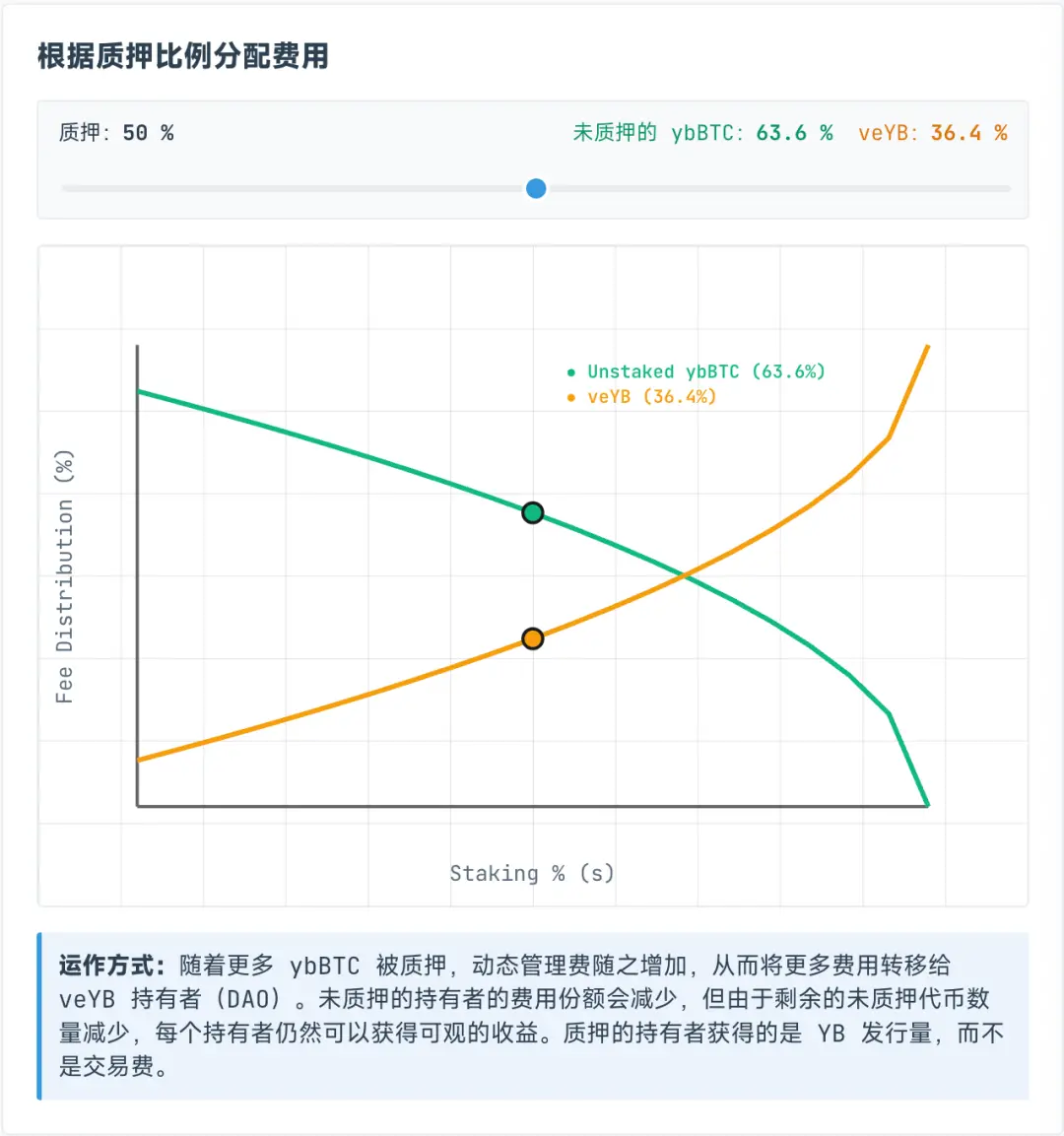
Image caption: Income sharing between ybBTC and veYB
Image source: @yieldbasis
Impermanent loss will never disappear; it will only shift.
You think you can leverage 1000U of market-making effect with 500U equivalent BTC, but YB did not say that all market-making profits go to you. Moreover, after you stake into veYB, you must unstake twice, veYB->YB, ybBTC->wBTC to get back the original funds and profits.
However, to obtain complete voting rights for veYB, which is the bribery mechanism, congratulations, you have obtained a four-year lock-up period. Otherwise, voting rights and profits will gradually decrease with the staking period. Whether the four-year lock-up yield and sacrificing BTC liquidity for YB is worth it depends on personal consideration.
As mentioned earlier, impermanent loss is an accounting loss. As long as liquidity is not withdrawn, it is a floating loss. Now YB's elimination plan is essentially also "accounting income," giving you a sense of anchored holding yield as a floating profit, while cultivating its own economic system.
You want to leverage 1000U of fee income with 500U, while YB wants to "lock" your BTC and sell you its YB.
Multi-Party Negotiation Embracing the Growth Flywheel
In the era of great yields, if you have a dream, come join us.
Based on Curve, using crvUSD, although it will empower $CRV, it also opens up the Yield Basis protocol and token $YB. So, can YB maintain its value and appreciate after four years? I'm afraid…
Beyond the complex economic mechanisms of Yield Basis, the key is the market expansion path of crvUSD.
Llama Lend is essentially part of Curve, but the founder of Curve actually proposed to issue 60 million USD of crvUSD to supply YB's initial liquidity, which is quite bold.
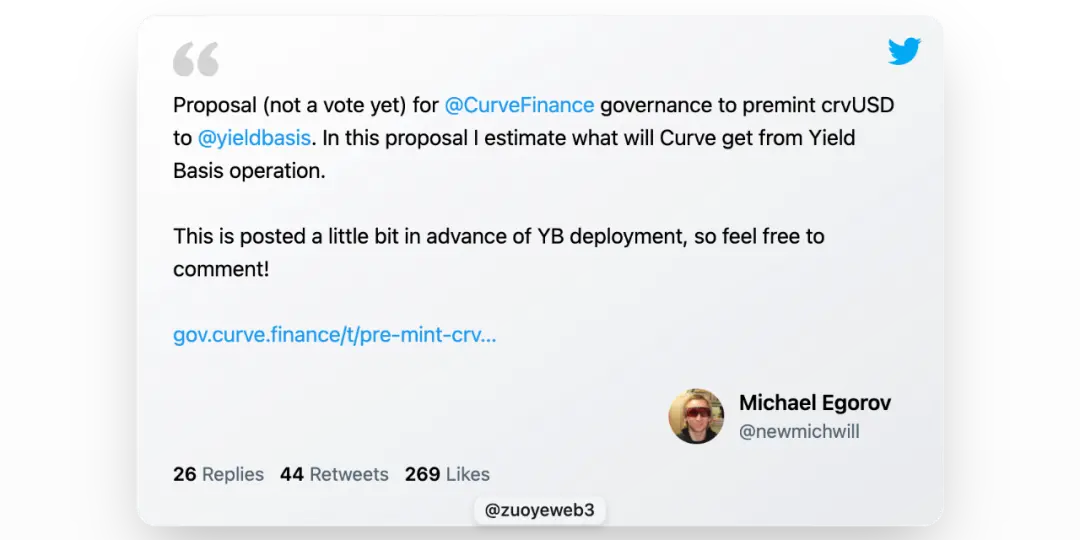 Image caption: YB remains unchanged, crvUSD is issued first Image source: @newmichwill
YB will provide benefits to Curve and $veCRV holders as planned, but the core issue is the pricing and appreciation of the YB Token. Ultimately, crvUSD is just U; is YB really an appreciating asset?
Not to mention the possibility of another ReSupply event, which would impact the Curve entity itself.
Therefore, this article does not analyze the token linkage and profit-sharing plans between YB and Curve. The lessons from $CRV are not far away, and $YB is destined to be worthless; wasting bytes is meaningless.
However, in the defense of its own issuance, we can glimpse Michael's whimsical ideas. The BTC deposited by users will "issue" an equivalent amount of crvUSD, which benefits by increasing the supply of crvUSD. Each crvUSD will be put into the pool to earn fees, which is a real trading scenario.
But essentially, this part of the crvUSD reserve is equivalent rather than excessive. If the reserve ratio cannot be increased, then increasing the profit effect of crvUSD is also a way. Do you remember the relative yield of funds?
According to Michael's vision, the borrowed crvUSD will efficiently collaborate with the existing trading pool. For example, wBTC/crvUSD will link with crvUSD/USDC, promoting the trading volume of the former and also increasing the trading volume of the latter.
The fees from the crvUSD/USDC trading pair will be split 50% to $veCRV holders, with the remaining 50% going to LP.
This can be said to be a very dangerous assumption. The crvUSD borrowed by Llama Lend for YB is for exclusive use in a single pool, but pools like crvUSD/USDC are open access. At this point, the crvUSD is essentially under-reserved. Once the currency value fluctuates, it is very easy for arbitrageurs to exploit it, leading to the familiar death spiral. If crvUSD encounters problems, it will also affect YB and Llama Lend, ultimately impacting the entire Curve ecosystem.
It is crucial to note that crvUSD and YB are tightly bound. 50% of the newly issued liquidity must enter the YB ecosystem, while the crvUSD used by YB is issued in isolation, but its usage is not isolated. This is the biggest potential point of failure.
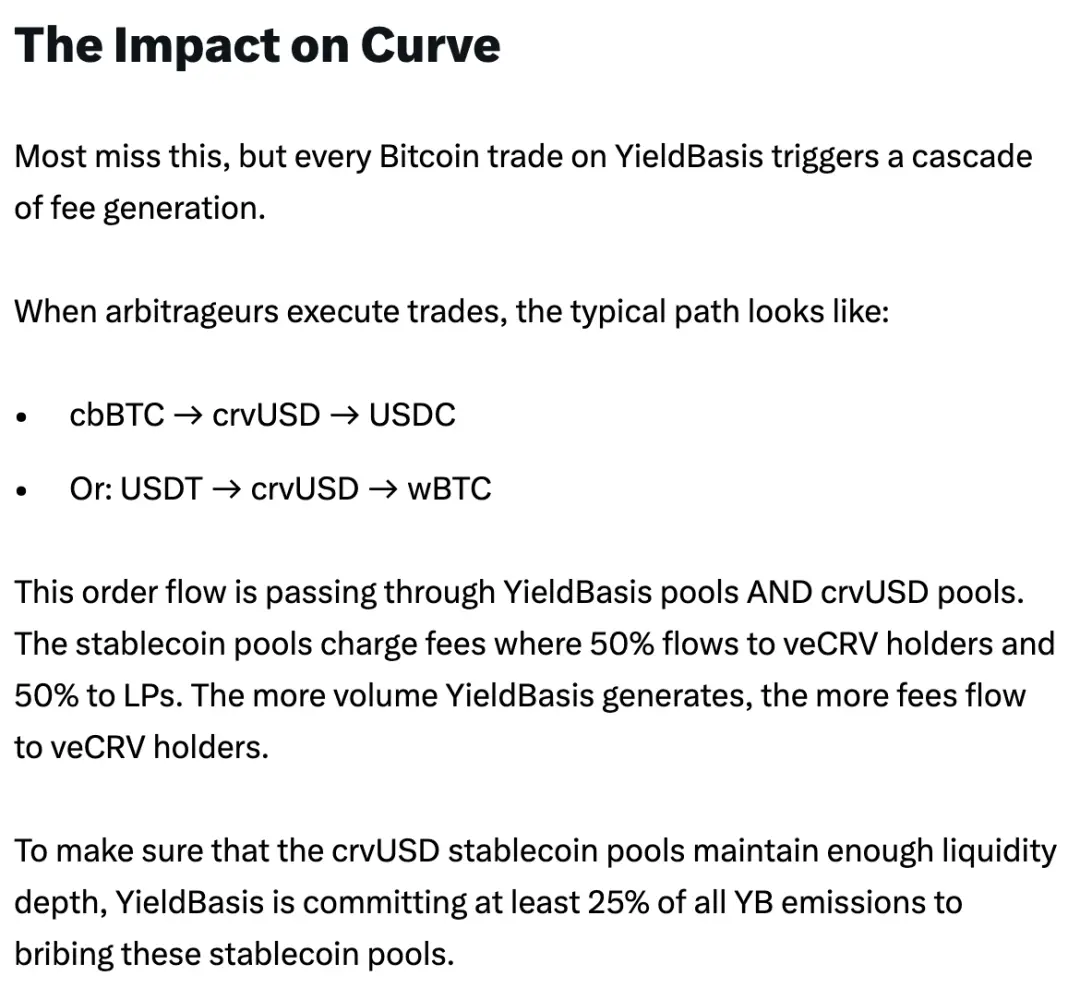
Image caption: Curve profit-sharing plan
Image source: @newmichwill
Michael's plan is to use 25% of the issuance of YB Token to bribe the stablecoin pool to maintain depth. This is already close to a joke. Asset security: BTC > crvUSD > CRV > YB. When a crisis strikes, YB cannot even protect itself; how can it protect anything else?
YB's own issuance is a product of the fee-sharing from the crvUSD/BTC trading pair. Remember, Luna-UST was also like this. UST was an equivalent minted product of the amount of Luna destroyed; the two relied on each other. YB Token <-> crvUSD is the same.
It can be even more similar. According to Michael's calculations, based on the BTC/USD trading volume and price performance over the past six years, he calculated that a 20% APR could be guaranteed and that a 10% yield could be achieved even in a bear market. In the bull market peak of 2021, it could reach 60%. If a little empowerment is given to crvUSD and scrvUSD, surpassing USDe and sUSDe is not a dream.
Because the data volume is too large, I do not have backtesting data to verify his calculation ability. But don't forget, UST also guaranteed a 20% yield. The model of Anchor + Abracadabra also ran for a considerable time. Wouldn't the combination of YB + Curve + crvUSD be different?
At least, UST frantically purchased BTC as reserves before its collapse. YB is directly based on BTC for leveraged reserves, which is also a significant improvement.
Forgetting is equivalent to betrayal.
Since Ethena, on-chain projects have begun to seek real yields rather than just looking at market dreams.
Ethena captures yields by hedging ETH through CEX, distributes yields through sUSDe, and maintains trust from large holders and institutions through the $ENA treasury strategy, stabilizing the issuance of USDe at tens of billions of dollars.
YB wants to seek real trading yields, which is not a problem in itself. However, arbitrage and lending are not the same; trading is more instantaneous. Each crvUSD is a shared liability of YB and Curve, and the collateral itself is also borrowed from users, with its own funds being close to zero.
Currently, the issuance of crvUSD is very low. Maintaining the growth flywheel and a 20% return rate in the early stages is not difficult. However, once the scale expands, the price growth of YB, price fluctuations of BTC, and the declining value capture ability of crvUSD will all cause significant selling pressure.
The dollar is an unpegged currency, and crvUSD is about to become one as well.
However, the nested risks of DeFi have already been priced into the overall systemic risk of the on-chain system. Therefore, risks that apply to everyone are not risks; instead, those who do not participate will passively share the losses of a collapse.
Conclusion
The world will give a person the opportunity to shine; being able to seize it is what makes a hero.
The traditional financial Yield Basis is the yield on US Treasuries. Will the on-chain Yield Basis be BTC/crvUSD?
The logic of YB can hold if on-chain trading is large enough, especially since Curve itself has a massive trading volume. In this case, eliminating impermanent loss makes sense. We can draw an analogy:
- • Power generation equals power consumption; there is no static "electricity," it is generated and used immediately.
- • Trading volume equals market capitalization; every token is in motion, bought and sold immediately.
Only through continuous and sufficient trading can the price of BTC be discovered, and the value logic of crvUSD can close the loop, issuing from BTC lending and profiting from BTC trading. I have confidence in the long-term rise of BTC.
BTC is the Cosmic Microwave Background (CMB) of the crypto small universe. Since the financial explosion in 2008, as long as humanity does not wish to restart the world order through revolution or nuclear war, the overall trend of BTC will rise—not because of a greater consensus on BTC's value, but due to confidence in the inflation of the dollar and all fiat currencies.
However, I have moderate trust in the technical strength of the Curve team and deep skepticism about their moral standards after ReSupply. Yet, it is also difficult for other teams to dare to try in this direction. Money flows away helplessly; impermanent loss finds its destined people.
UST frantically bought BTC before its demise, and during the fluctuations of USDe reserves, it was converted to USDC. Sky even crazily embraced government bonds. This time, I wish Yield Basis good luck.
Click to learn about job openings at ChainCatcher
Recommended reading:
Backroom: Information tokenization, a solution to data redundancy in the AI era? | CryptoSeed
 Risk warning
 Risk warning




Popular articles





