








Will Ethereum EVM be the new Microsoft Excel for Wall Street by not following the usual path?
 Once you dive deep into the "Ethereum rabbit hole," you'll realize that all paths ultimately lead back to the value capture of ETH.
Declaration: This article is for informational sharing only and does not constitute any investment advice, nor does it represent the views and positions of Wu Shuo.
The full text is as follows:
This week's theme is the announcement of "Enterprise L1" (corpo-L1s) by Circle and Stripe.
Circle's new L1 blockchain, Arc, is an EVM-compatible public chain composed of 20 permissioned validators from a regulated and trusted institutional alliance.
Stripe is developing a new L1 chain, expected to use Paradigm's RETH client—a high-performance Ethereum client developed in Rust. Notably, Paradigm founder Matt Huang currently serves on Stripe's board and likely provides significant development support for the Stripe Chain, referred to as Tempo.
Discussions on crypto Twitter this week can almost be summed up in one question: Is this good or bad for cryptocurrency? And what does it mean for "your position"? Personally, I find "permissioned L1" extremely dull. In my view, the value of cryptocurrency and its "core narrative" lies in open-source software, with Ethereum at the center of this story. Building a "permissioned L1" strays far from the main narrative of crypto and even seems irrelevant.
In the cases of Circle and Stripe, blockchain technology is merely utilized as a database structure, and nothing more.
Will Arc and Tempo issue L1 assets?
If they do, it at least means they are willing to promote the decentralization of the network, making these chains appear closer to what I find interesting. But for now, in the absence of further data, a reasonable judgment is that neither of these chains will issue any L1 assets, but will merely serve as private intranets for stablecoin settlements behind front-end applications.
There is also an "iron law" in the crypto world: If a project has the ability to issue tokens, it will eventually issue tokens (yes, I'm talking about you, Base). So completely ruling out this possibility is actually naive and childish. If these "enterprise-grade L1s" ultimately choose to issue tokens, it would bring them closer to an open-source, decentralized developer platform, which, in my view, is much closer to the core narrative of crypto.
Will Stripe and Circle try to attract developers to build on their chains?
If developers do not receive rewards and are not part owners of this "foreign land," will they really be willing to build? Stripe indeed has a large developer community… but that is a Web2 developer community, primarily building Web2 front-ends and e-commerce sites.
So, can this smoothly translate into driving Web3 developers to build on Tempo? Is the value of building on Tempo really higher than that of building on Ethereum or any of its L2s? Perhaps these chains will remain at the "lazy" level of permissioned consortium chains, without L1 assets, merely serving as backend logic to replace Visa, Mastercard, and SWIFT, constructing their own settlement networks.
All these questions currently have no answers and cannot be determined. Therefore, it is too early to argue about whether "this is good or bad for BTC, ETH, SOL, or the entire crypto industry." The only indisputable fact is that these "enterprise-grade L1" chains are beneficial for the Ethereum Virtual Machine (EVM).
Here is a slide I presented during my talk at Ethereum NYC this week:
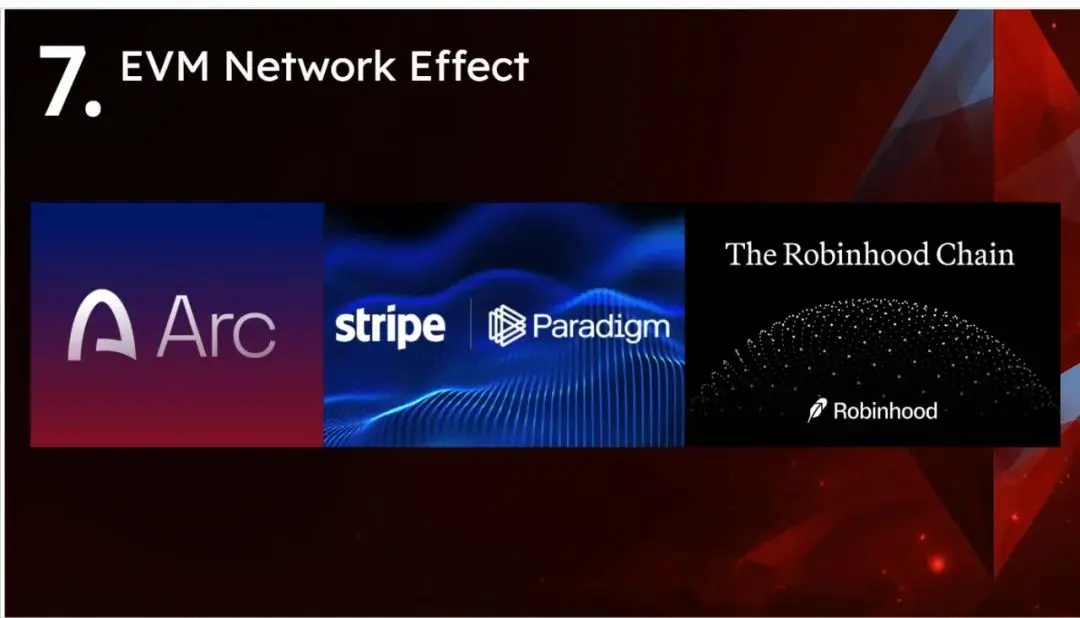
It all started with Robinhood Chain—this is the first case of a traditional finance (TradFi) company building and owning an EVM instance. Robinhood has already hired EVM developers, and understanding EVM has become a core capability of Robinhood's business. Now, we can add Circle and Stripe to this list, as they are also introducing and managing EVM technical talent within their corporate structures.
The key point here is: Any traditional finance company entering the crypto space must hire EVM developers. For a TradFi company, understanding EVM is becoming the "entry threshold" to upgrade its backend logic to the blockchain future.
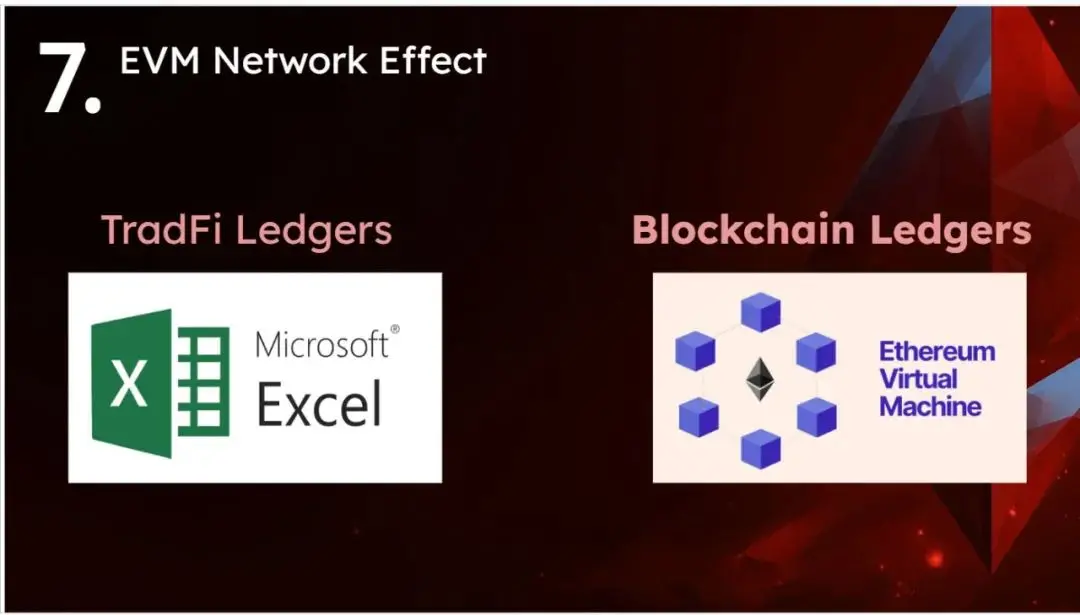
Just as Microsoft Excel once supported the operations of traditional finance, today, the Ethereum Virtual Machine (EVM) is becoming the talent and infrastructure that Wall Street must equip itself with—otherwise, they will face disruption from new things based on Ethereum and even lose market share.
Once you delve into the "Ethereum rabbit hole," you will realize that all paths ultimately lead back to the value capture of ETH, and this is one of them. Although this approach is very indirect and gentle, the expansion of the EVM empire will ultimately bring value gains to the asset at its core—ETH.
Appendix: What is the Ethereum EVM?
EVM (Ethereum Virtual Machine) is a virtual computing environment that runs on the Ethereum blockchain. You can think of it as a "decentralized computer" running on tens of thousands of nodes worldwide. Its purpose is to allow anyone to deploy and execute smart contracts on Ethereum without needing to trust any central server.
In simple terms, the EVM enables Ethereum not only to transfer funds but also to execute code and run logic, achieving a "globally shared blockchain operating system." The EVM is the runtime environment for all Ethereum smart contracts. Whenever someone calls a contract, the EVM "executes" the code line by line, ensuring the logic is correct and recording it on the chain. Ethereum accounts, balances, and the results of contract executions are all "state changes" completed within the EVM. The EVM ensures that each change is verifiable and consistent. No matter which Ethereum node you execute a smart contract on, the EVM will produce exactly the same execution result. This is also the basis for blockchain consensus. To prevent resource abuse, the EVM employs a Gas mechanism; the more complex the code execution and the more resources it consumes, the higher the required Gas, which users need to pay with ETH.
At the end of 2013: Vitalik Buterin proposed the Ethereum white paper, aiming to create a universal platform that could not only transfer funds but also allow programming. In July 2015: The Ethereum mainnet officially launched, and the EVM was born. The design inspiration for the EVM comes from the "Turing machine"—meaning it is set to be Turing complete and can run any complex program, just like a computer in the real world. The earliest version of the EVM used Solidity to write contracts, executed using EVM bytecode. Later, various programming languages (Vyper, Yul) and various EVM-compatible chains (known as "EVM-compatible chains") emerged.
Smart contracts written in Solidity by developers are compiled into an intermediate language (EVM bytecode), and the EVM executes these bytecode instructions like a virtual CPU. The EVM uses a "stack-based virtual machine" structure, which is more suitable for running on resource-constrained blockchain nodes than traditional memory-calling CPUs. The EVM runs in a sandboxed environment, isolating contracts from each other, which increases security.
The widespread adoption of the EVM has led many new public chains (such as BNB Chain, Polygon, Avalanche C-Chain, Fantom) to choose "EVM compatibility," as developers can directly use tools on Ethereum (such as MetaMask, Remix, Hardhat), allowing users to easily use the same wallet and application interface across chains. The structure of the EVM has also driven the development of Layer 2 (such as Arbitrum, Optimism), Rollup, and other scaling technologies.
Although the EVM is powerful, it also has some limitations: performance is not high (limited transactions per second); the development language Solidity has security vulnerabilities; bytecode is difficult to debug and optimize. Therefore, many alternatives or extensions have emerged: eWASM: After future Ethereum upgrades, WebAssembly may replace the EVM to enhance performance; Move, SVM (Solana), CosmWasm (Cosmos), etc., are virtual machine designs from other chains that are not EVM-compatible.
Click to learn about job openings at ChainCatcher
Recommended reading:
Backroom: Information tokenization, a solution to data redundancy in the AI era? | CryptoSeed
 Risk warning
 Risk warning



Popular articles





