








Token valuation is ambiguous, and Artemis suggests a smart cyclical supply based on stock market experience

 Introduce dual standards of "circulating supply" and "intelligent circulating supply" to enhance the transparency of cryptocurrency asset valuation.
Original Author: Artemis
Compiled by: Odaily Planet Daily
 Editor's Note: The crypto world has long suffered from a chaotic valuation system— the same token shows vastly different supply data on different platforms, leading to distorted market cap calculations and inaccurate investment judgments. While traditional stock markets have long adopted standardized metrics like circulating shares, on-chain valuations are still in a rough exploratory phase. Recently, Artemis and Pantera Capital proposed a framework called "Circulating Supply," introducing the mature concept of circulating shares from the stock market into the crypto space, providing the industry with a value benchmark that can be compared to traditional finance by excluding non-circulating tokens such as protocol holdings. This transformation could become a key infrastructure for institutional capital entry and may reshape the entire valuation paradigm of crypto assets.
The following is the full content, compiled by Odaily Planet Daily:
Abstract
Currently, there are significant discrepancies in the supply metrics displayed by crypto data providers for the same token, which can severely impact the calculation of market cap or valuation multiples (such as market cap/revenue ratio). Artemis and Pantera Capital jointly proposed a simple framework called "Circulating Supply," calculated as total supply minus total protocol holdings. This model is similar to the concept of "circulating shares" in the stock market (i.e., total issued shares minus treasury shares). Our goal is to enable investors to make clearer comparisons between tokens and stocks when conducting valuation comparisons.
Introduction
When purchasing stocks, investors typically focus on several key data points to understand the number of shares:
- Authorized Shares------ The maximum number of shares a company is legally allowed to issue;
- Issued Shares------ The total number of shares actually issued by the company;
- Outstanding Shares------ The total number of shares held by all investors (excluding treasury shares held by the company);
- Float Shares------ The actual number of shares available for public trading.
Why are these data points crucial?
Because these metrics help investors clarify:
- Ownership------ The size of the economic rights corresponding to the shares purchased by investors;
- Supply Risk------ The potential number of additional shares that may flood the market in the future;
- Liquidity------ The degree to which stocks can be traded smoothly without significantly affecting the price.
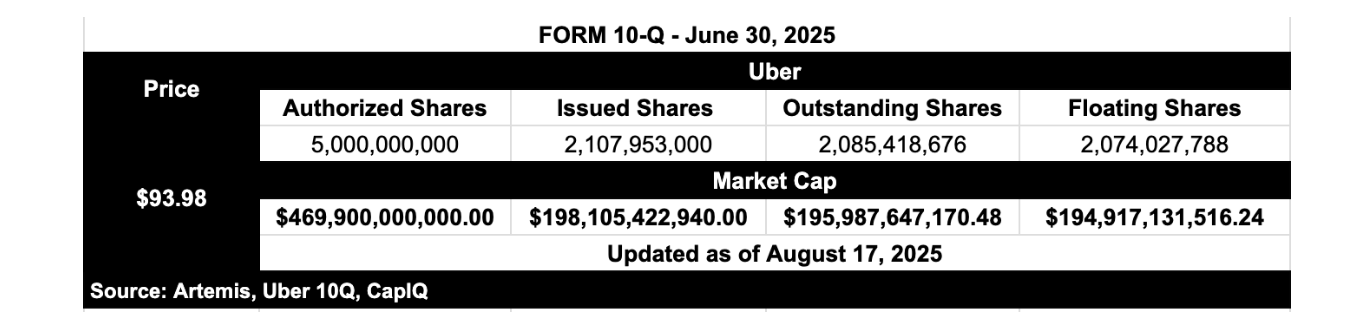
Source: Artemis
We take Uber as an example for in-depth analysis:
- Authorized Shares: 5 billion shares → The maximum share limit that Uber is legally allowed to issue. Public market investors almost never refer to authorized shares;
- Issued Shares: Approximately 2.1 billion shares → The total number of shares actually issued by Uber;
- Outstanding Shares: Approximately 2.09 billion shares → The number of shares currently held by Uber investors. This is the number of shares that public market investors truly care about;
- Float Shares: Approximately 2.07 billion shares → The actual number of shares available for trading in the market.
Imagine: If we valued Uber based on authorized shares, its market cap would soar to $469 billion, with an expected price-to-earnings ratio skyrocketing to 70 times—this is clearly absurd. Authorized shares have never been used by investors as a basis for corporate valuation because "authorized shares × stock price" does not reflect real economic value.
In reality, investors value Uber based on outstanding shares (approximately 2.09 billion shares). As of August 17, 2025, its market cap is approximately $195.9 billion, with an expected price-to-earnings ratio of 30 times. Outstanding shares accurately reflect the distribution of economic ownership of the company's value.
Current Issues with Token Supply Metrics
Currently, investors in the crypto space primarily refer to "Circulating Supply," which is the number of tokens available for trading in the public market. However, this metric has serious flaws:
- Some statistics include locked tokens, while others exclude them;
- Some include treasury wallet holdings, while others exclude them;
- Standards for whether to deduct burned tokens vary;
- Projects quietly release tokens without clear disclosure.
Meanwhile, the FDV (Fully Diluted Valuation) that investors often encounter also has issues: FDV = token price × total supply. This is akin to calculating Uber's market cap using authorized shares—assuming all shares are immediately tradable, resulting in a fictitious market cap of $469 billion, which clearly does not align with economic reality.
Thus, investors find themselves in a dilemma: either choose a distorted FDV (which includes all potential supply) or adopt a "Circulating Supply" definition that is confusing and lacks uniform standards (a key flaw is that it often excludes issued but unlocked tokens).
Why is "Circulating Supply" the best compromise?
"Circulating Supply" (Outstanding Supply) counts all generated tokens while excluding the protocol's own holdings (such as those held by foundations, treasuries, or labs), making it the "circulating shares" of the crypto space.
- Compared to FDV: More accurately reflects economic reality;
- Compared to traditional circulating supply: Clearer definitions and more unified standards;
- This metric is rooted in economic substance, providing investors with a reliable intermediate benchmark.
Real Token Example - Hyperliquid
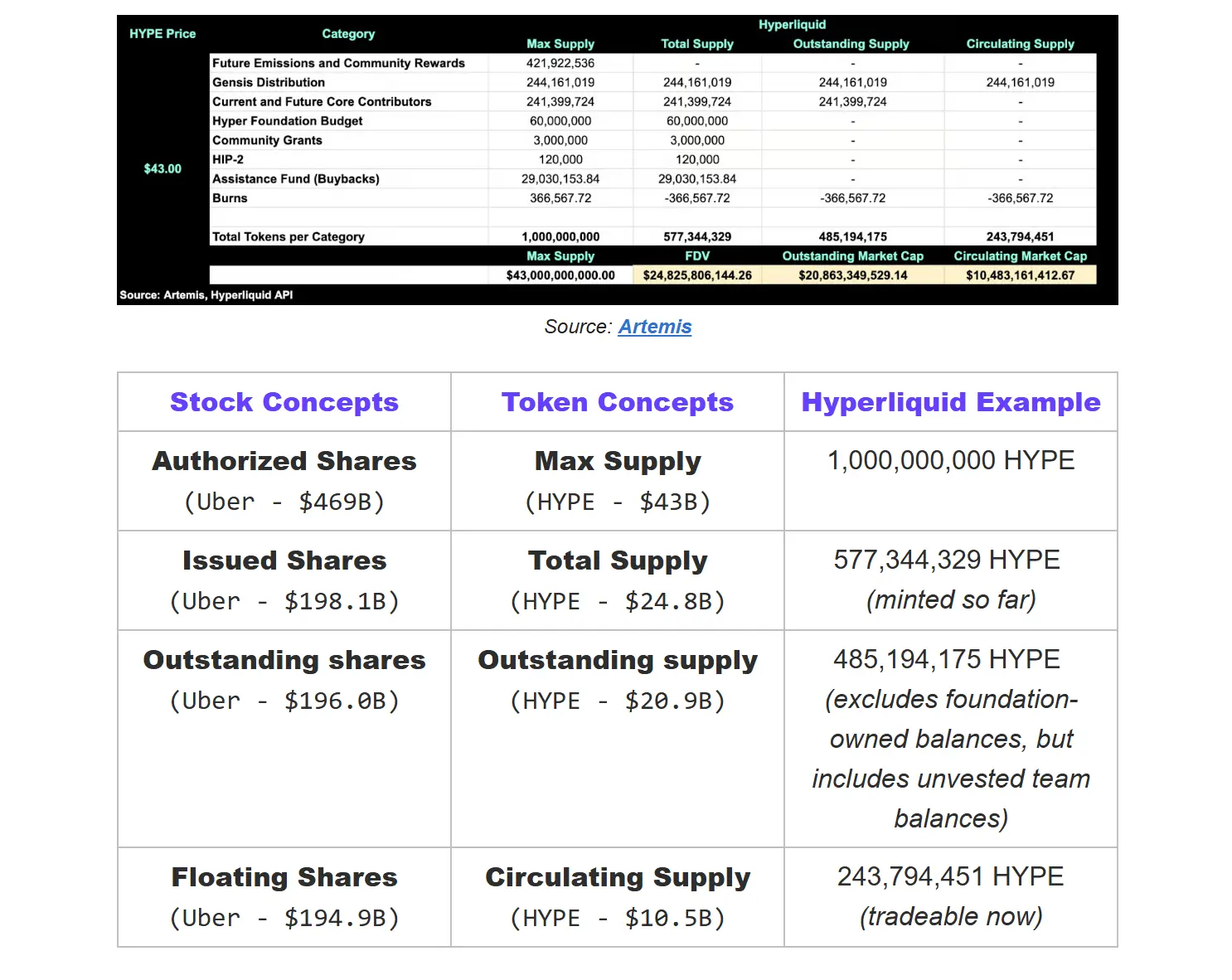
Why is the Circulating Supply metric crucial?
For a long time, the crypto space has defaulted to using FDV (Fully Diluted Valuation) = maximum supply × price for valuation. This is akin to calculating Uber's market cap based on 5 billion authorized shares, which would inflate its valuation to about $469 billion, rather than the approximately $196 billion market cap typically shown on Google Finance.
Subsequently, the industry shifted to using total supply for valuation, but this still overestimates actual value—because total supply includes all tokens held by the protocol. For example, Hyperliquid has 1 billion HYPE tokens, of which 6% (60 million) are held by the Hyper Foundation. These are assets controlled by the protocol, which can be used for operational input, ecosystem funding, or team incentives, and their economic attributes differ fundamentally from the tokens held by investors.
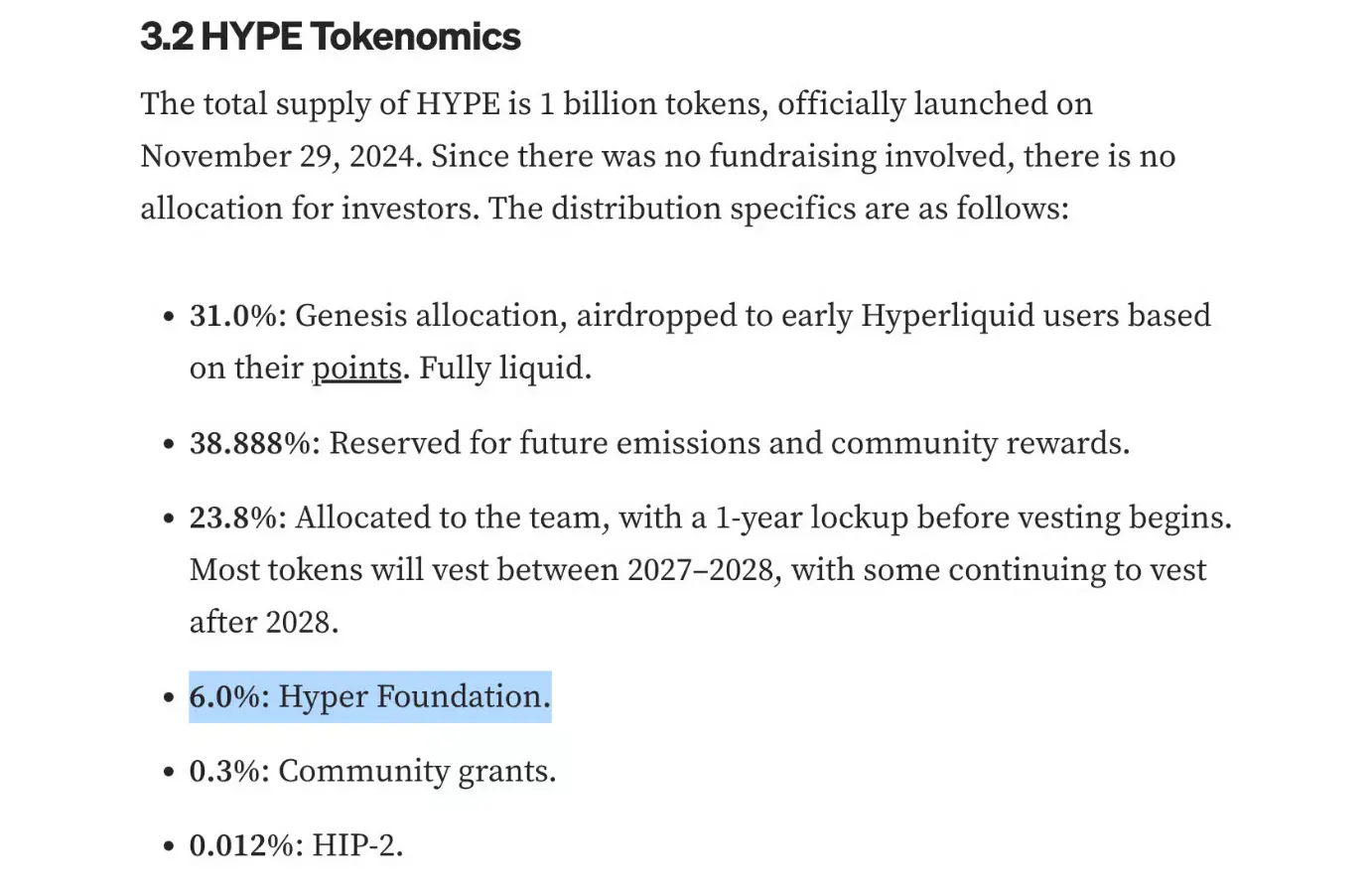
Source: Mint Ventures
Therefore, Hyperliquid's Circulating Supply valuation (approximately $20.8 billion) is closest to its real market value. This is similar to the concept of circulating shares in the stock market—excluding treasury shares to reflect the total number of tokens actually held by investors.
In contrast, its circulating supply valuation (approximately $10.5 billion) is closer to the actual number of tokens available for trading, akin to the float shares in stocks.
These supply metrics are crucial because valuation multiples such as price-to-earnings or price-to-sales ratios calculated based on FDV will be artificially inflated—this effectively penalizes projects like Hyperliquid that hold a large number of unreleased tokens, putting them at a disadvantage in peer comparisons.
Note: Our definition of total supply differs from CoinGecko. CoinGecko counts all tokens (regardless of ownership), while we exclude permanently burned and ungenerated tokens to ensure that total supply accurately reflects the number of existing tokens that impact valuation.
Why are there contradictions in existing data?
Currently, when investors look at the HYPE token, they find that different data platforms present vastly different values:
DefiLlama shows a circulating FDV of $27.8 billion. Based on a token price of $43, it assumes a circulating supply of approximately 647 million tokens—this even exceeds the current actual generation of 577 million tokens.
CoinGecko's circulating supply valuation is $14.5 billion, implying it estimates the circulating supply to be around 337 million tokens.
However, this number is likely overstated because CoinGecko does not exclude all protocol-held wallets (such as those held by the Hyper Foundation, community funding funds, and aid funds). In reality, a large number of these tokens have not yet entered the market, and the true circulating supply should be lower.
The problem is that these discrepancies can lead to valuation differences of billions of dollars. Without a unified standard, different investors can have significant divergences in their understanding of the scale of the same token.
This is precisely why we need to promote "Circulating Supply" and "smarter circulating supply." The token circulating supply standard not only enhances transparency but also achieves horizontal comparability with stock valuation systems.
Artemis Solution: Introducing New Standards for Circulating Supply and Smart Circulating Supply
Total Supply
Definition: The total amount of all generated (minted) tokens (excluding burned portions). Comparable to "Issued Shares" in the stock market.
Calculation Formula: Total Supply = Maximum Supply - Unminted Tokens - Burned Tokens
Circulating Supply (New Metric)
Definition: The portion of all existing tokens excluding those held by the protocol itself (including foundations, DAOs, labs, or locked distribution contracts). The reason for excluding protocol-held tokens is similar to how the stock market excludes treasury shares—these tokens exist but do not belong to external investors. Only tokens held externally reflect true ownership, liquidity, and market value. Comparable to "Outstanding Shares" in the stock market.
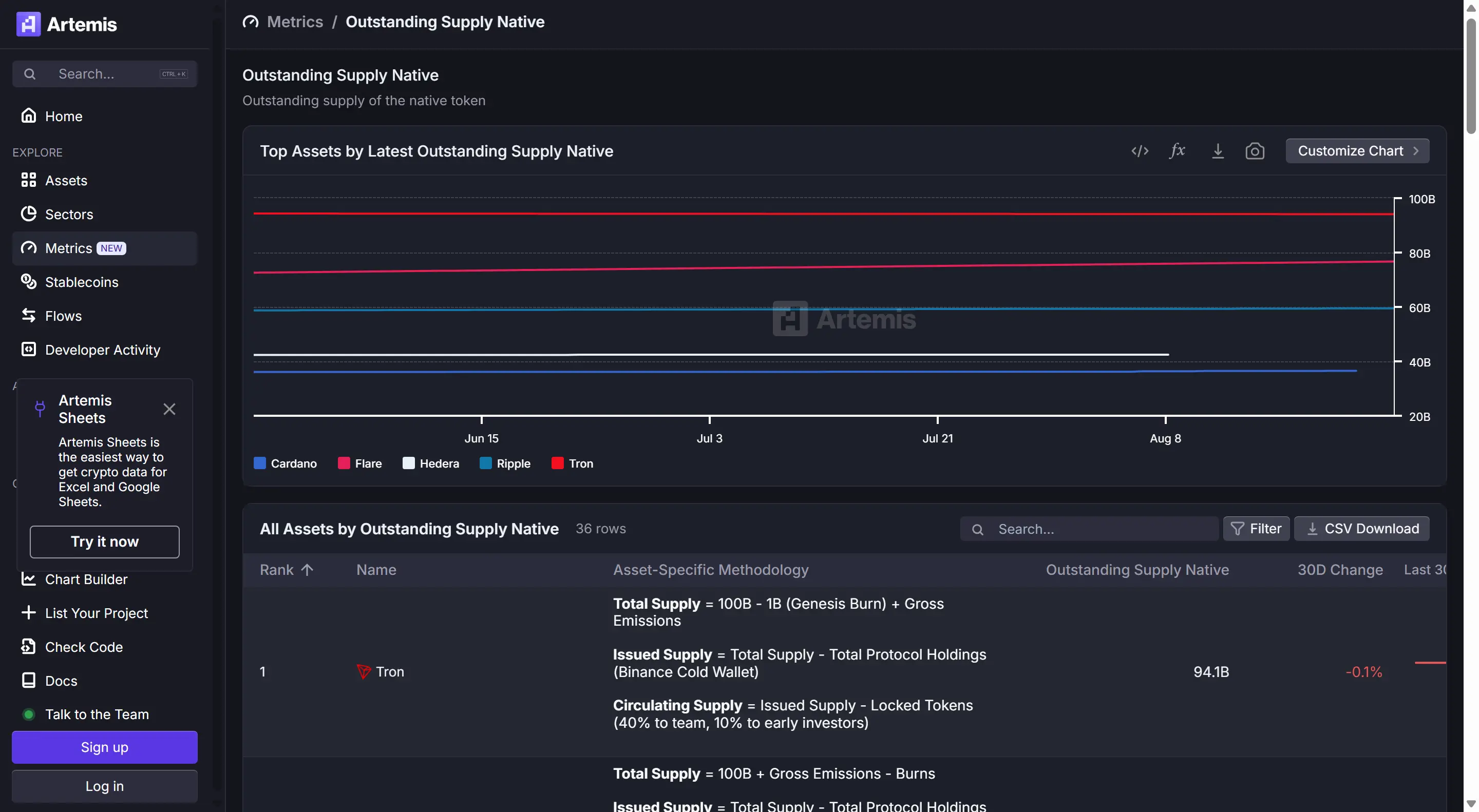
Source: Artemis
Calculation Formula: Circulating Supply = Total Supply - Total Protocol Holdings
Where total protocol holdings include:
- DAO/Foundation Holdings------ Tokens held by entities responsible for governance or ecological development;
- Lab Holdings------ Tokens held by lab entities that actually perform protocol management functions in the absence of an independent foundation (such as ecological funds, distribution managers);
- Programmatic Distribution Contracts------ Smart contracts that automatically release tokens to the ecosystem according to preset rules;
- Idle Funds------ Tokens in on-chain funds managed by validators that have not yet been deployed (must be released through decentralized voting);
- Buyback Reserves (not burned)------ Tokens repurchased by the protocol but not yet burned.
Smart Circulating Supply (Optimized Metric)
Definition: The number of tokens currently available for immediate trading. Excludes locked tokens, unblocked internal/team holdings, and non-liquid treasury wallets. Comparable to "Float Shares" in the stock market.
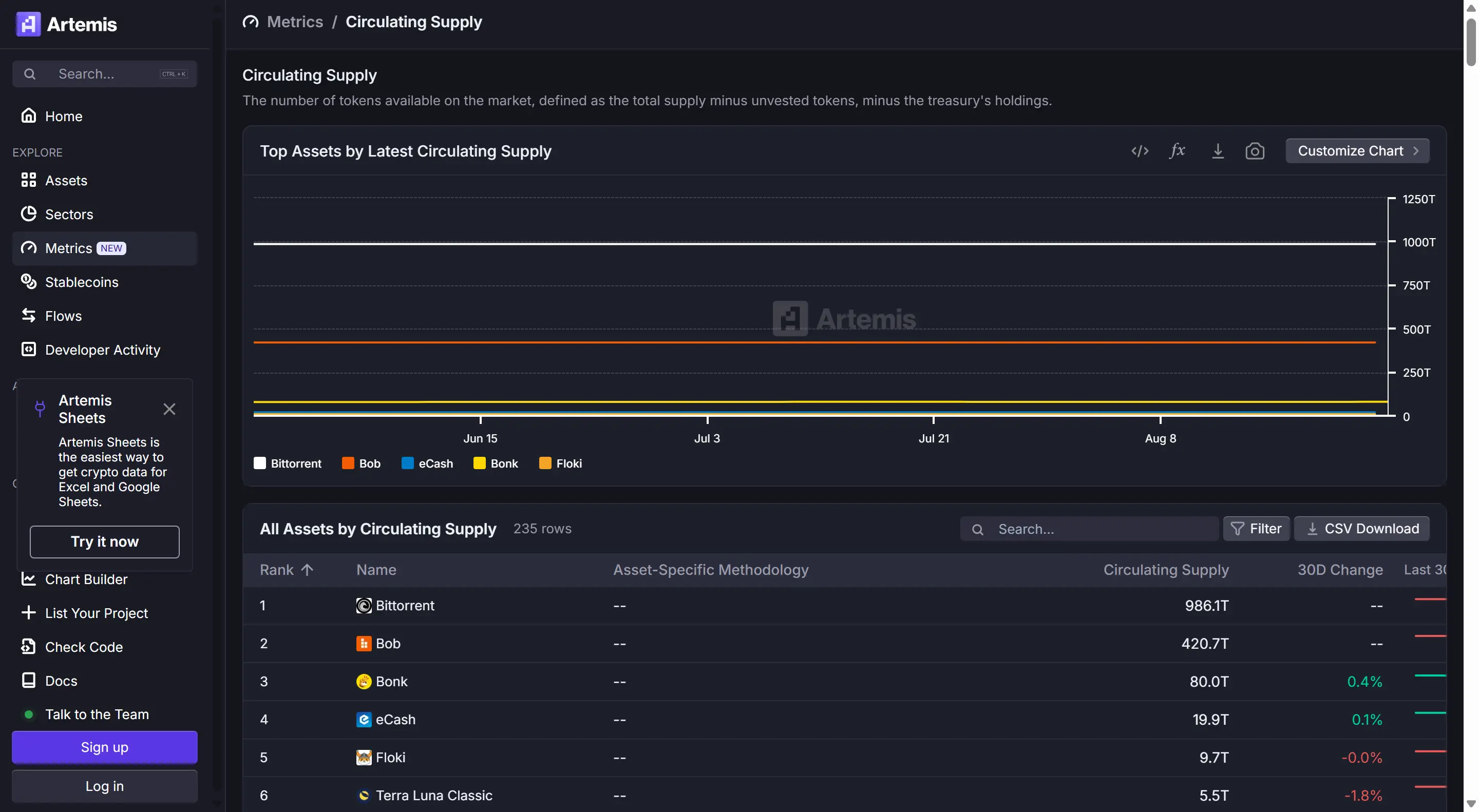
Source: Artemis
Calculation Formula: Circulating Supply = Circulating Supply - Locked Tokens
Why do we need dual metrics?
- Transparency------ Clearly distinguishes between generated tokens and those actually available for trading;
- Risk Assessment------ Anticipates potential supply that may enter circulation in the future;
- Standardization------ Eliminates statistical ambiguities between different projects;
- Real Market Value------ Accurate circulating supply means more precise valuations;
- Comparability------ Achieves standardized horizontal comparisons across projects.
Conclusion and Insights:
The stock market does not require guessing the number of shares or potential supply, and this clarity builds market trust.
The crypto space should be the same. If the industry wants to gain institutional trust, it must provide institutional-level transparency. Through the standards of Circulating Supply and Smart Circulating Supply, investors will ultimately gain a transparency experience comparable to that of traditional financial markets.
 Risk warning
 Risk warning

Popular articles





