








WLFI Token Launch: In-Depth Analysis of Arbitrage Opportunities

 Trading may be noisy, but arbitrage is stable.
Original Title: WLFI Gaming Too Intense, How to Find Arbitrage Opportunities to Make Money?
Original Author: Jaleel Jia Liu, BlockBeats
The core project of the Trump family, WLFI, is set to launch tonight at 8 PM, attracting worldwide attention. Some are betting on price fluctuations, while others are speculating on trending coins. Besides the real trading of "betting on the up or down direction," can we find a more certain way to profit from this wave of hype? The answer is arbitrage. In this article, Rhythm BlockBeats has compiled some practical arbitrage opportunities for WLFI:
Price Difference Arbitrage
1. Arbitrage Between CEXs
Due to the differing matching rules, opening hours, buying density, transaction fees, and deposit/withdrawal arrangements of various trading platforms, there will be price differences for WLFI in a short period, creating arbitrage opportunities.
For example, WLFI will open for spot trading on Binance at 9 PM tonight, but withdrawals will not be available until 9 PM tomorrow. This means that before withdrawals are enabled, funds can only "flow into Binance and be sold to on-site buyers," but cannot "flow out," leading to a situation where the on-site pricing can become relatively expensive due to one-way flow.
The practical approach is quite simple. First, select two to three controllable scenarios as a "price difference triangle," usually involving one leading CEX (most likely Binance today, due to its high buying volume and public attention), one secondary CEX that supports withdrawals (preferably with lower fees to better preserve profits), and an on-chain observation point (such as the WLFI pool on Uniswap, used to gauge the strength of on-chain marginal buying).
At the same time, open the order books and recent transactions of both exchanges and monitor the price difference of WLFI. Once you see that the price on Binance is significantly higher than on the other exchange, and after accounting for transaction fees, spreads, and potential slippage, if the net difference is still positive, you can buy in and then sell on Binance.
The difficulty of the whole process lies not in the "logic," but in the "timing." Cross-exchange arbitrage is essentially a race against delays: the opening of deposits and withdrawals, risk control pop-ups, on-chain confirmations, and even your own speed in confirming will determine whether this 0.x% to 1.x% gross profit can be realized. Therefore, it is best to first run through the entire process with a very small amount to measure the time and costs of each step before scaling up.
2. Triangular Arbitrage
Triangular arbitrage can be simply understood as an upgraded version of the previous "arbitrage between CEXs," involving more on-chain paths and sometimes requiring currency exchanges between stablecoins. Thus, there are more opportunities, but also more friction.
The most common "sandwich price difference" in the early stages of a project is: the price on the BNB chain is approximately equal to the price on the Solana chain, which is greater than the price on the Ethereum mainnet, which in turn is greater than the price on the CEX. Since the pools on the BNB and Solana chains are generally smaller and have more bots, prices can be easily pushed up by a few orders; Ethereum has higher fees and fewer bots, resulting in relatively conservative transactions and thus lower prices; while centralized exchanges are controlled by market makers, often not opening deposits or withdrawals or imposing limits, causing price differences that cannot be immediately arbitraged, making the spot price the lowest. Since WLFI is deployed across multiple chains, there is also room for such operations.
Additionally, new stablecoins like USD 1 and USDT/USDC may have slight decoupling or fee differences, which can amplify loop profits.
However, it is important to note that triangular arbitrage is more complex than CEX arbitrage, and beginners should avoid attempting it without first familiarizing themselves with cross-chain mechanisms, paths, slippage, and fees.
3. Spot-Permanent Basis/Funding Fee Arbitrage
This "spot-permanent basis/funding fee" arbitrage is a common technique used by market makers, market-neutral funds, quant traders, and arbitrageurs. Retail investors can also participate, but their smaller size, higher rates, and borrowing costs make the advantages less obvious.
The "benefit" it captures has only two essential sources: the first is the funding rate. When the perpetual price is higher than the spot price and the funding is positive, longs must pay "interest" to shorts periodically—you can do "long spot + short perpetual" to collect this interest; conversely, when the funding is negative, you can "sell spot + long perpetual," with shorts paying longs. This way, your net exposure approaches zero, and the funding fee acts like interest on a demand deposit, rolling over within a certain time frame, capturing cash flow from "emotional premiums/pessimistic discounts."
The second source is basis convergence. During the launch or emotional fluctuations, there may be a one-time premium or discount of the perpetual relative to the spot; as emotions cool and market makers restore balance, the perpetual will converge towards the spot/index price, allowing you to pocket the one-time profit from "narrowing this price difference" within the hedging structure. Together, these form a combination of "interest + convergence," and after deducting borrowing costs, fees, and slippage, you arrive at the net profit.
However, it is crucial to understand the clearing mechanisms, slippage, fees, funding rate settlement times, and trading depths of different trading platforms to prevent XPL squeeze events. Related reading: “Lighter's ETH and HL's XPL both spiked, how to avoid being liquidated by large players?”
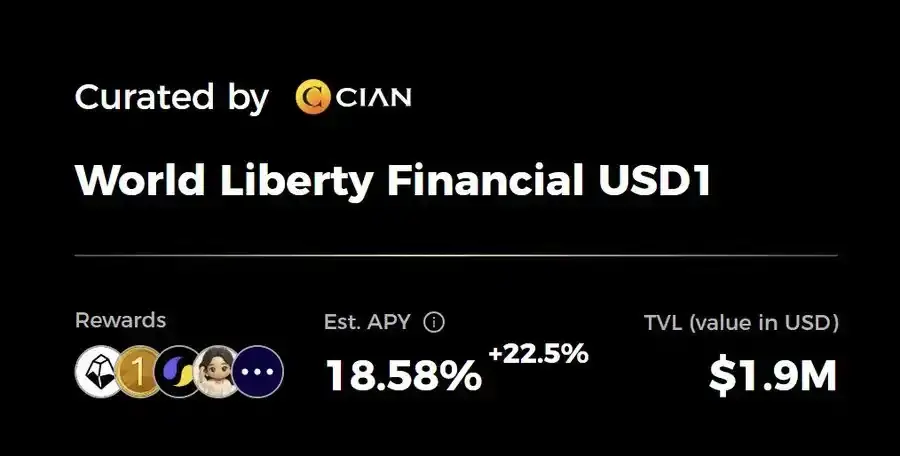
Additionally, in the most common "long spot + short perpetual" strategy, you can also find some vaults with relatively high annualized returns, such as StakeStone and Lista DAO's vaults, which have over 40% APY after subsidies.
4. LP + Short Hedge Arbitrage
Simply forming an LP is not arbitrage; it is more like "exchanging directional risk for transaction fees." However, if you layer on a short hedge, leaving only the net profit curve of "transaction fees - funding fees/borrowing interest - rebalancing costs," it is also a good hedging idea.
The most common structure is to provide concentrated liquidity on-chain (such as WLFI/USDC or WLFI/ETH pools) while shorting an equivalent nominal value of WLFI perpetuals on an exchange; if there are no perpetuals, you can borrow coins in a margin account to sell spot, but this incurs more friction. The goal is simply to avoid betting on price direction and focus entirely on "the more transactions, the thicker the fees."
When executing, treat the LP as a "fee-generating market-making range." First, choose a fee rate and price range that you can monitor, such as using a 0.3% or 1% fee tier for new coins, setting the range close to the current price with "medium width." After deployment, part of the LP position will become WLFI spot, and part will be stablecoins; you use the "equivalent nominal" of this WLFI to short the perpetuals, initially aligning the dollar values of both legs. As the price fluctuates within the range, the on-chain leg earns fees through turnover and captures a bit of price difference through passive rebalancing; the direction is borne by the short leg, creating a net neutral position. If the funding fee is positive at this time, your short leg can also earn additional interest; if the funding fee is negative, you need to rely on a wider range, lower leverage, and less frequent re-hedging to support net profits.
The difference from basis arbitrage is that basis arbitrage captures the price difference convergence between "perpetual ↔ spot" and funding fees, while this captures "transaction fees generated by on-chain turnover." The difference from pure LP is that pure LP's profit and loss largely depend on direction and impermanent loss.
WLFI Coin Stock ALTS and WLFI Hedge
ALT 5 Sigma (NASDAQ: ALTS) raised about $1.5 billion through stock issuance and private placements, part of which was directly exchanged for WLFI tokens, while another part was used to allocate WLFI in the secondary market, thus positioning itself as a "vault/agent exposure" holding WLFI.
At the same time, observe the price movements of ALTS and WLFI; logically, short the stronger side and long the weaker side, and hedge when it returns to normal. For example, WLFI may surge first due to its listing and narrative momentum, while ALTS may be "lagging" due to constraints from US stock trading hours or borrowing costs, widening the price difference; when US stocks open and funds fill ALTS's "agent exposure," this gap will revert.
If you use WLFI perpetuals to hedge, you may also earn funding fees, but the main profit still comes from the price difference itself, rather than a one-sided direction.
This differs from the previous "basis/funding fee arbitrage" in that there is no definitive anchor of "spot---perpetual" here; instead, stocks are treated as a "shadow" holding WLFI, with logic resembling the old idea of "BTC ↔ MSTR," but the execution difficulty lies in friction and timing. The crypto side trades 24/7, WLFI unlocks at 8 PM, but Nasdaq opens at 9:30 AM; if trades are made before this, they are pre-market trades, which can be placed and matched, but the matching rules differ from regular trading, and one must also be aware of the possibility of halts or circuit breakers.
WLFI Market Cap Bets on Polymarket
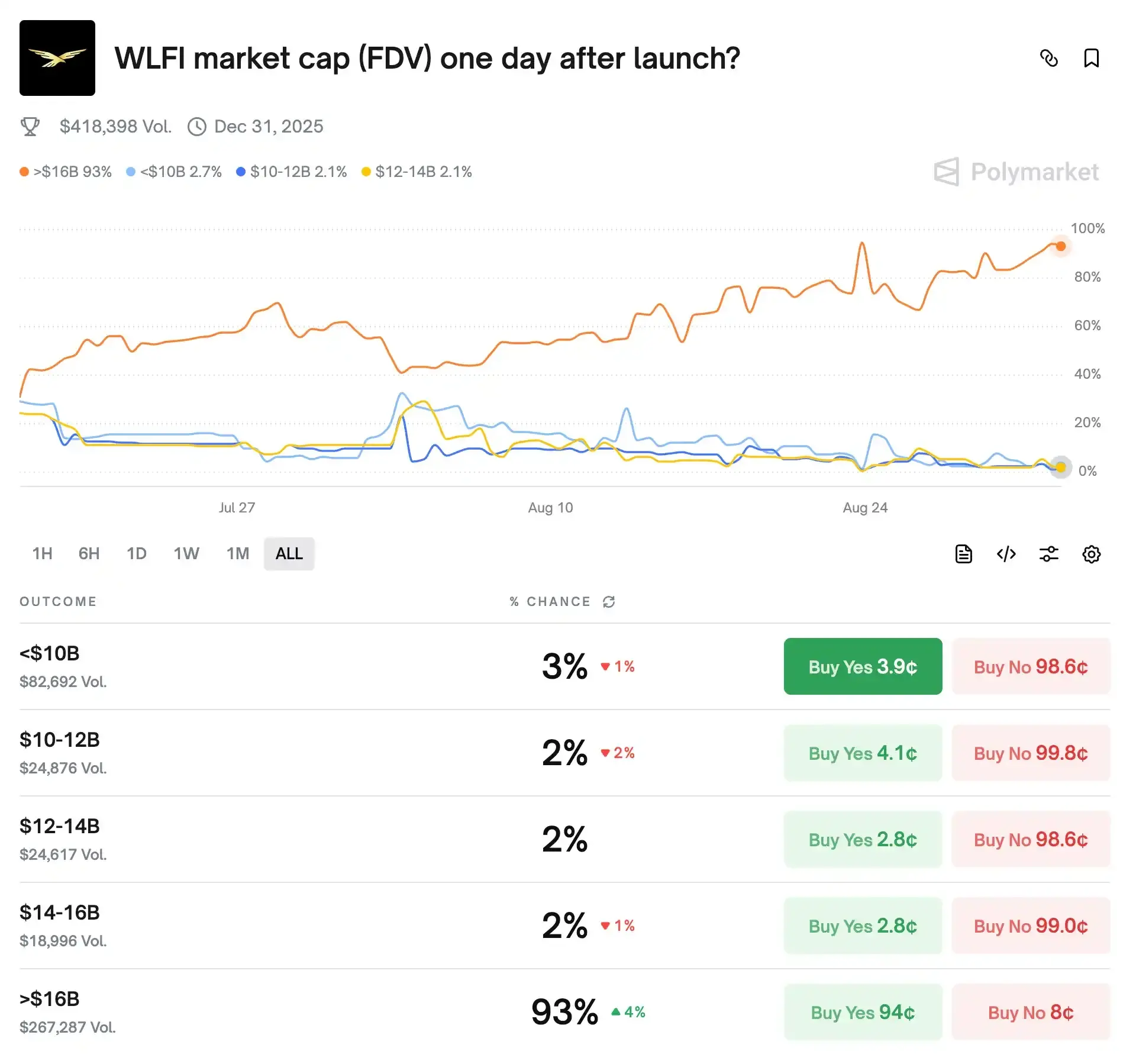
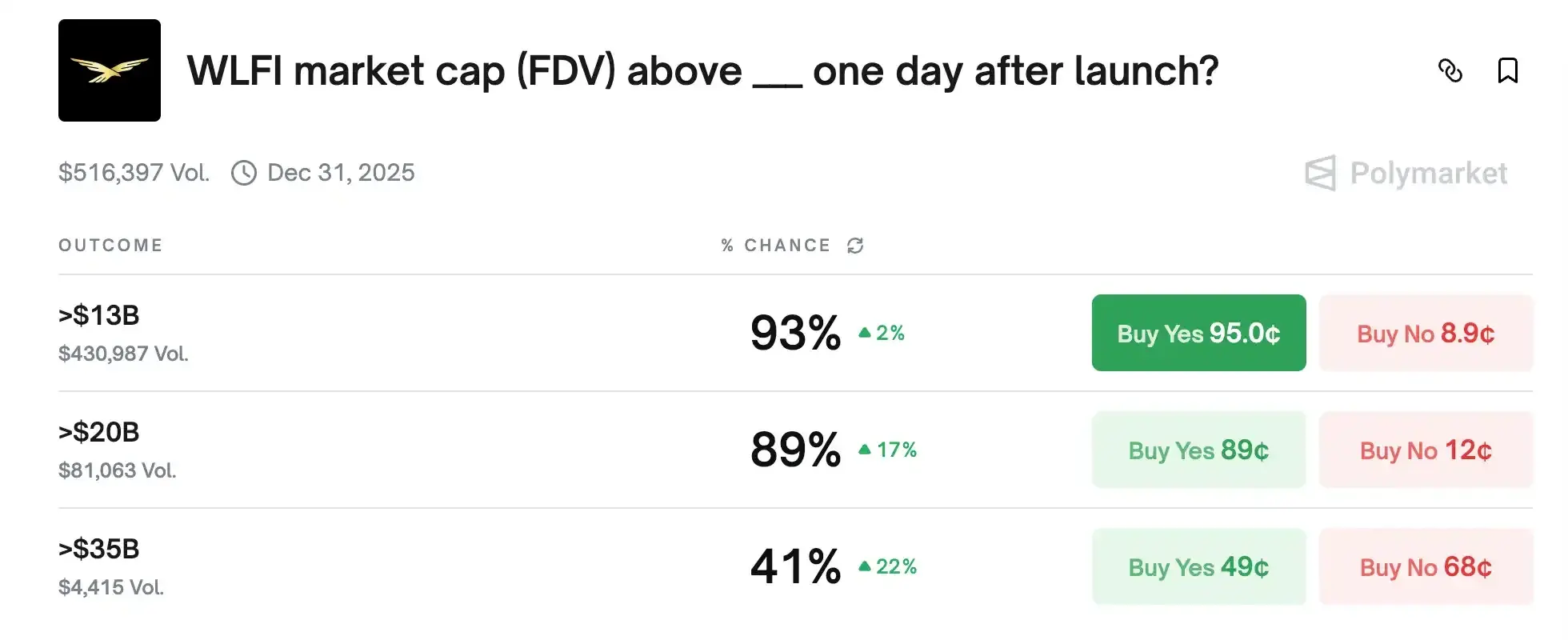
Currently, there are two bets on WLFI on Polymarket, both concerning the market cap on the day of WLFI's launch, one being a tiered market (under $10 B, $10–12 B…, over $16 B five options), and the second being a threshold market (over $13 B, over $20 B, over $35 B three binary judgments).
Since both are asking about "WLFI's FDV one day after launch," their prices must be consistent with each other: the sum of probabilities in the tiered market should equal 100%. Therefore, the price for the "over $16 B" tier must match the probability P(>16 B) in the threshold market.
At the same time, the sum of prices in its complement (under $10 B, $10–12 B, $12–14 B, $14–16 B four tiers) must equal 1 − P(>16 B) in the threshold market. If you find that the two sides are unequal, for example, if the "over $16 B" tier is priced very high, but the total of the four tiers is also not low, leading to "over $16 B + the other four tiers" clearly exceeding 1, then sell on the expensive side or hedge with No, while buying up the cheaper side to create a "guaranteed $1 basket with cost <1"; if the total is less than 1, then directly buy both sides to lock in the difference.
Click to learn about ChainCatcher's job openings
Recommended Reading:
Pantera Capital Deep Dive: The Value Creation Logic of Digital Asset Treasury DATs
 Risk warning
 Risk warning





Popular articles





