








NBER | Revealing How the Expansion of the Digital Economy Reshapes the Global Financial Landscape Through Models

 Research results indicate that, in the long run, the reserve demand effect dominates the substitution effect, leading to a decrease in U.S. interest rates and an increase in U.S. foreign borrowing.
Authors: Marina Azzimonti and Vincenzo Quadrini
Source: NBER
Compiled by: Li Yujia
1. Introduction
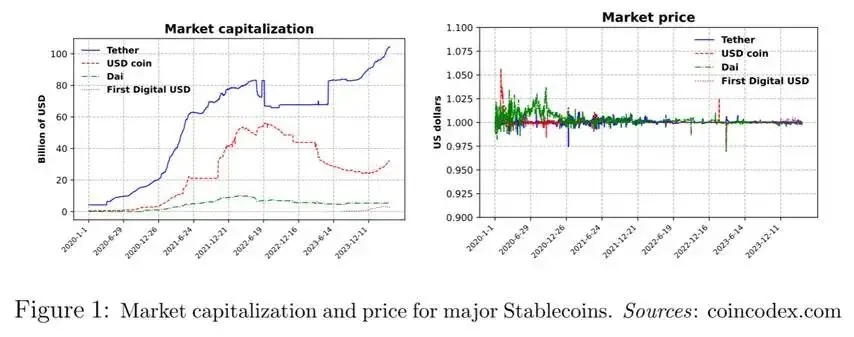
This paper focuses on the impact of the development of the digital economy on the core position of U.S. debt in global financial markets and the role of stablecoins. U.S. government debt maintains low interest rates on dollar-denominated assets due to its liquidity, convenience of service, and value storage functions. Stablecoins, as a special type of cryptocurrency, are pegged to the dollar or reserve currencies and have relatively stable value. Although their current market size is smaller than that of U.S. Treasury securities, they are expected to grow significantly in the future, potentially changing the holding situation of dollar-denominated assets and U.S. government debt. To explore the impacts of stablecoins and others, this paper constructs a multi-country model that includes the U.S., other regions of the world, and the digital economy. The growth of the digital economy is driven by factors such as familiarity among agents and operates through two channels: "financial demand" (agents include digital assets in their savings portfolios, increasing the demand for digital assets) and "real demand" (agents purchase services produced by the digital economy, increasing the demand for digital production). The long-term dominance of the "financial demand" channel will lead to a decrease in U.S. interest rates and an increase in global imbalances, and the growth of the digital economy is associated with increased volatility in U.S. consumption and decreased volatility in other regions of the world. Meanwhile, the types of collateral assets for stablecoins will affect the demand for reserve assets such as the dollar. Their development has a complex impact on international financial markets, necessitating attention to factors such as collateral instruments.
2. Literature Review
There has been considerable research on cryptocurrencies, stablecoins, and related fields. The value of cryptocurrencies often stems from their use as a medium of exchange, while stablecoins highlight their value storage function as safe assets. Related studies cover comparisons with traditional instruments, arbitrage dynamics, speculative risks, and also involve the impact of central bank digital currencies (CBDCs) and models related to the digital economy, including multi-country models used to analyze the effects of stablecoins on monetary policy. This paper focuses on the transitional and long-term impacts of the digital economy as a provider of digital services and new savings tools, viewing its expansion as a potential mechanism to alleviate the global shortage of safe assets, thereby contributing to the relevant literature.
3. Overview of the Digital Economy
3.1 Blockchain and Digital Production
The foundation of the digital economy is blockchain technology: blockchain is a decentralized public ledger where nodes compete to verify transaction blocks and receive rewards. Common protocols include PoW and PoS. Bitcoin and Ethereum are well-known blockchains, and Figure 2 presents Ethereum user transaction fees and the supply of Ether, reflecting its digital production and cryptocurrency market capitalization.
The production and scale of the digital economy: The digital economy is a productive "ecosystem," similar to the traditional economy that uses production inputs to produce services, such as matching apartment rentals through dApps, where transaction fees quantify service value. The Ethereum network is part of the digital economy, and Figure 2 further illustrates its transaction fees and cryptocurrency market capitalization.
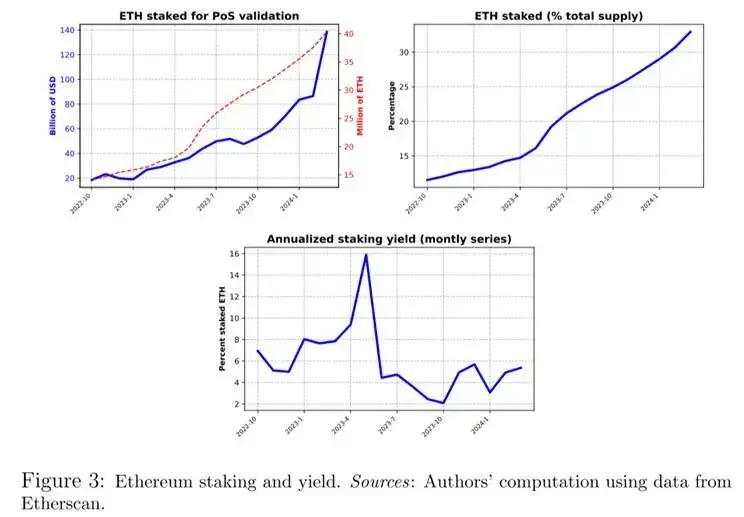
The role of cryptocurrency (Ether) as a production input: In 2022, Ethereum's verification protocol transitioned from PoW to PoS, making Ether a production input for verification services. Validators stake Ether to earn fees, and the amount staked and yield are of interest. Figure 3 shows the amount of staked ETH, its proportion of total supply, and staking yields.
3.2 Creation of Stablecoins
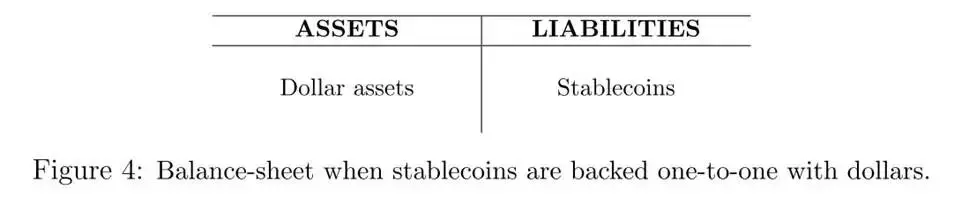
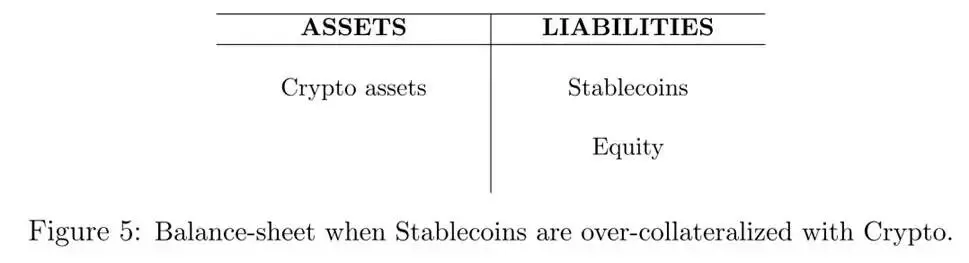
Stablecoins are liabilities issued by certain entities, with their value pegged to an underlying asset. This paper focuses on stablecoins pegged to the dollar and considers two common mechanisms. In the first mechanism, the pegged value is maintained by holding dollar reserves equal to the number of stablecoins issued. In the second mechanism, stablecoins are over-collateralized by crypto assets.
Collateralized by dollar reserves: In this case, stablecoins are created by depositing an equivalent or similar amount of dollars into a locked account. The issuer's balance sheet is shown in Figure 4.
Collateralized by crypto assets: In this case, the issuer faces a balance sheet mismatch because the currency in which assets are valued differs from that of liabilities. Due to the significant volatility of cryptocurrency market values over time, stablecoins must be over-collateralized. Therefore, for each stablecoin, the value of the cryptocurrency held by the issuer exceeds $1. The issuer's balance sheet is shown in Figure 5.
4. Model
The model includes three countries/regions: the United States (US), the rest of the world (RoW), and the digital economy (DiEco). This paper views the digital economy as a unique economic entity with its own currency. However, what defines the digital economy is not geographical boundaries but the technological platform on which it operates, namely blockchain.
4.1 Digital Economy
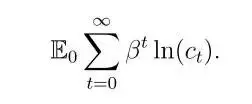
In the digital economy, there are continuous agents who maximize expected lifetime consumption utility:
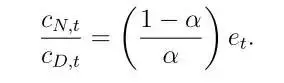
The consumption basket includes D goods (produced in both digital and non-digital economies) and N goods (produced only in the non-digital economy), with the consumption ratio determined by first-order conditions:
Digital economy agents need to import N goods and can export D goods, which are related to cryptocurrency prices and service prices. Cryptocurrency pledges are used for digital transaction verification, affected by unique shocks, but the total shocks offset each other. Residents of the digital economy can issue stablecoins (digital liabilities) whose value is stable and can also hold U.S. bonds. Through arbitrage analysis, in equilibrium, the yield on stablecoins is no less than the yield on U.S. bonds, leading to the derivation of the budget constraint and end-of-period wealth for digital economy agents, resulting in optimal policies, including the allocation of consumption, cryptocurrencies, and fixed-income assets (including U.S. bonds and stablecoins), with different yield scenarios affecting asset choices. In terms of N goods, the budget constraint for digital economy agents is:

Lemma 1: Given end-of-period wealth and price sequences, the optimal policy chosen by digital economy agents is:
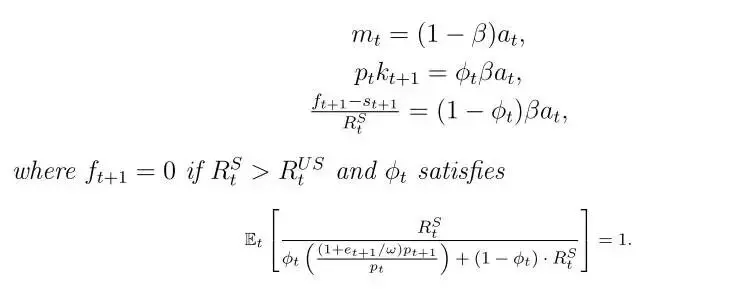
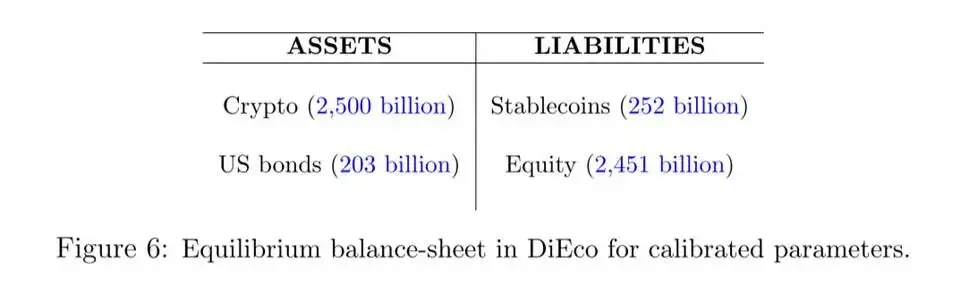
To understand the investment portfolio choices of digital economy agents, this paper provides a numerical overview, illustrating how these choices are influenced by key variables and parameters. Figure 6 shows the consolidated balance sheet of digital economy agents in steady-state equilibrium from the calibrated model.
Starting from the baseline calibration, this study explores how the investment portfolio choices of digital economy agents change with three variables: (i) the relative price of D goods produced in the digital economy (i.e., the exchange rate of the digital economy); (ii) the volatility of unique shocks to the digital economy; (iii) the interest rate on stablecoins. Figure 7 shows the sensitivity of the portfolio to each variable.
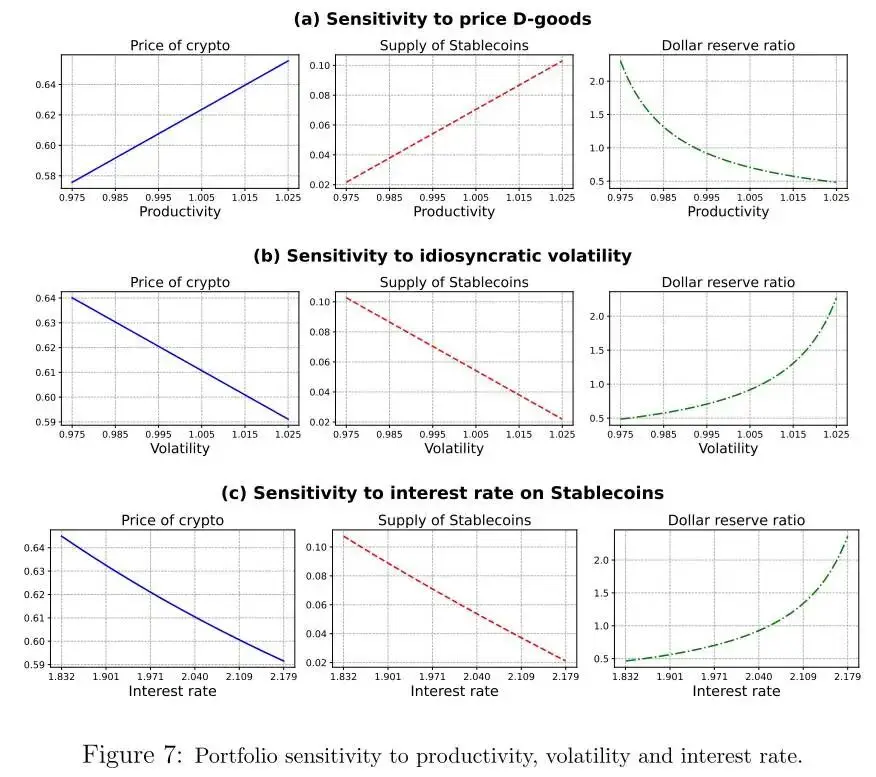
As the price of D goods rises, the market capitalization of cryptocurrencies and the supply of stablecoins increase, adjusting the investment portfolio due to increased agent wealth; as unique volatility increases, cryptocurrency prices and stablecoin supply decrease, with more stablecoins supported by U.S. debt; as the interest rate on stablecoins rises, agents reduce the issuance of stablecoins, causing cryptocurrency prices to decline due to reduced leverage, and the high price of D goods leads to an increase in stablecoin supply, while uncertainty and high interest rates have a counteracting effect.
4.2 Non-Digital Economy
Non-Digital Economy Agents and Production
Agents in the U.S. and the rest of the world (RoW) have the same preferences as digital economy agents, pursuing the maximization of expected lifetime utility:
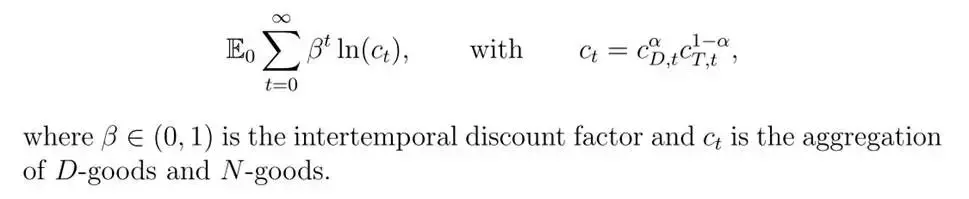
Production uses a constant supply of non-renewable land, and agents rely on unique productivity shocks to produce D or N goods. Due to the same technology, the relative price of the two is 1, but the price of D goods in the digital economy may be lower. The difference between the U.S. and RoW lies in their volatility, with RoW agents facing higher volatility, resulting in a lower net foreign asset position for the U.S., consistent with the data, and a higher distributional shape in RoW (assuming 3.1).
Agent Types and Financial Markets
Agents are divided into habitual (familiar with the digital economy, considering buying its D goods and stablecoins) and non-habitual (unfamiliar, not holding), with states evolving over time with probabilities and transitions, affecting the demand for D goods and stablecoins.
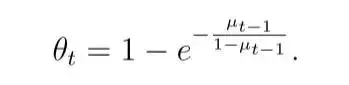
In the financial market, both the U.S. and RoW governments issue debt, and agents can hold domestic and foreign bonds as well as stablecoins. Holding foreign bonds incurs costs (assuming 3.2), while stablecoins, due to the characteristics of the digital economy, do not incur such costs. The budget constraints of agents vary by type, with habitual agents corresponding to the constraint formula:

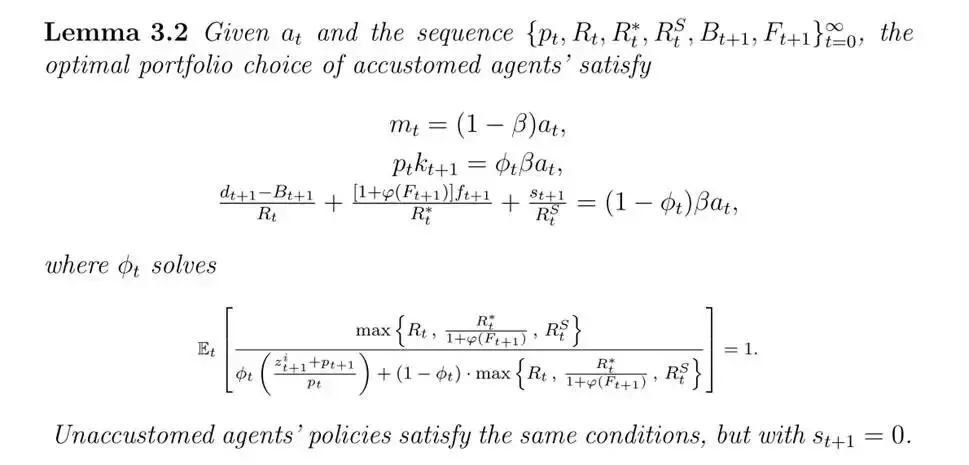
Non-habitual agents do not hold stablecoins, and the optimal policy is determined by Lemma 3.2, involving the allocation of savings between land and bonds and the comparison of returns on different assets.
Equilibrium Properties Without the Digital Economy
In the absence of the digital economy, since the only difference between the U.S. and the rest of the world lies in the volatility of unique shocks, the steady state of the integrated economy has the following properties:
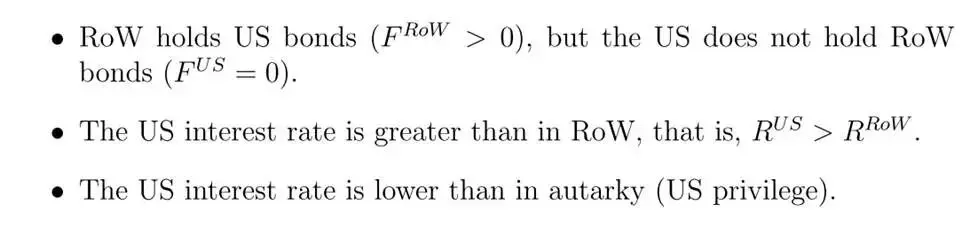
These are derived from the aggregation of agent decisions and market clearing, reflecting the balance of risk and savings, bond returns, and the impact of financial integration on U.S. interest rates. For instance, higher volatility prompts RoW to save more and lend to the U.S., requiring higher U.S. bond yields to balance costs, while financial integration allows for lower borrowing rates in the U.S.
4.3 A Fully Integrated World Economy
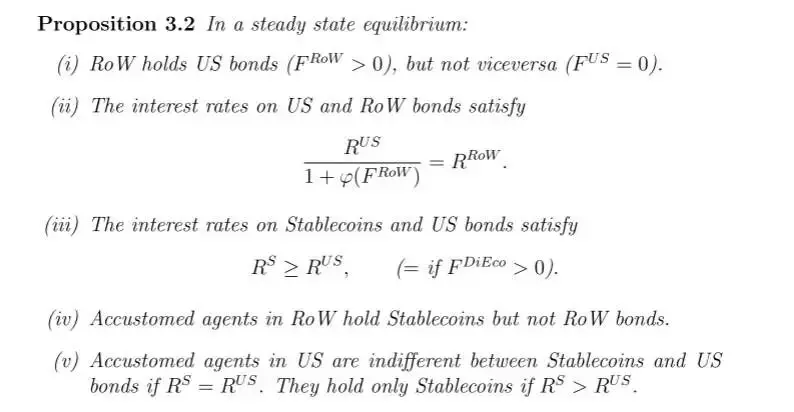
Now consider a fully integrated economic situation where habitual agents in the U.S. and RoW can hold stablecoins issued by the digital economy (DiEco), and agents in the digital economy can hold bonds issued by the U.S. and RoW. The following propositions describe some steady-state properties.
5. Quantitative Analysis
This section focuses on quantifying the impact of digital economy growth on financial markets, driven by the familiarity of traditional economic agents with digital activities (the share of habitual agents). The increase affects the economy through two channels: "financial demand" and "real demand," with subsequent counterfactual simulations distinguishing the analysis.
5.1 Calibration
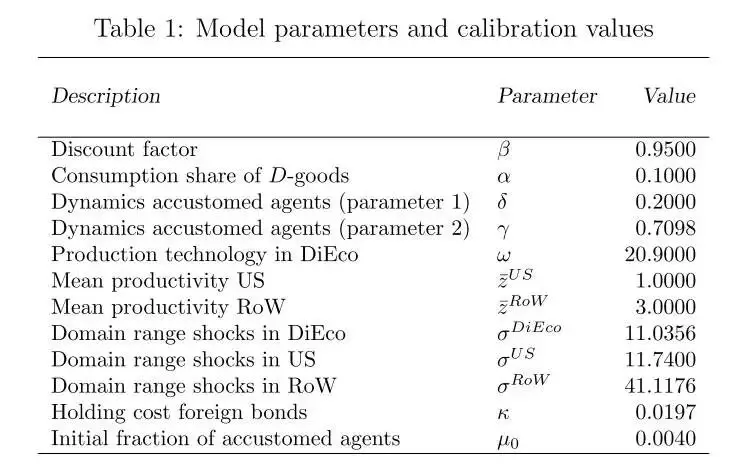
This paper combines the market capitalization of cryptocurrencies in 2023 to calibrate initial values and steady-state targets. It then continues to calibrate parameters related to productivity and cryptocurrency value to match six moments, including U.S. bond yields and net foreign asset positions. The parameters work together to achieve model calibration, with Table 1 presenting the complete calibration parameters.
5.2 Transition Dynamics Equilibrium
Figure 8 presents the transition dynamics of four key variables, with the share of habitual agents evolving from an initial 0.4% to a long-term 10%, driving the model's transition dynamics. The price of D goods in the digital economy initially is much lower than in the non-digital economy due to limited early demand, but as the share of habitual agents increases, demand and prices rise. The value added of the digital economy as a proportion of total world output increases from 0.2% to about 1.1%. The price-to-earnings ratio of cryptocurrencies initially exceeds 100, driven by future growth expectations, but later declines to about 20 as the industry matures, similar to valuation changes in emerging industries.
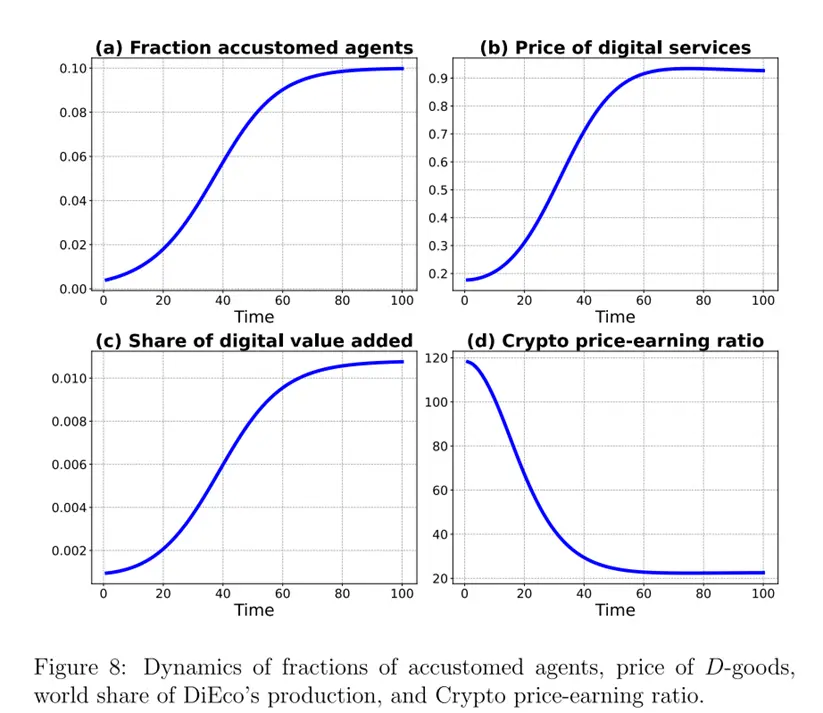
Figure 9 shows the transition dynamics of other variables. U.S. interest rates exhibit a non-monotonic trajectory influenced by two opposing forces, initially rising and then falling. As the share of habitual agents increases, agents in the rest of the world shift to holding stablecoins, exerting downward pressure on U.S. interest rates; simultaneously, this pushes up the prices of D goods and the value of cryptocurrencies, increasing the wealth of digital economy agents and leading to more stablecoin issuance, which again puts upward pressure on interest rates. The issuance of stablecoins increases due to both forces, with early supply-side effects dominating, and the ratio of dollar reserves low, while the later increase in this ratio strengthens demand for U.S. debt.
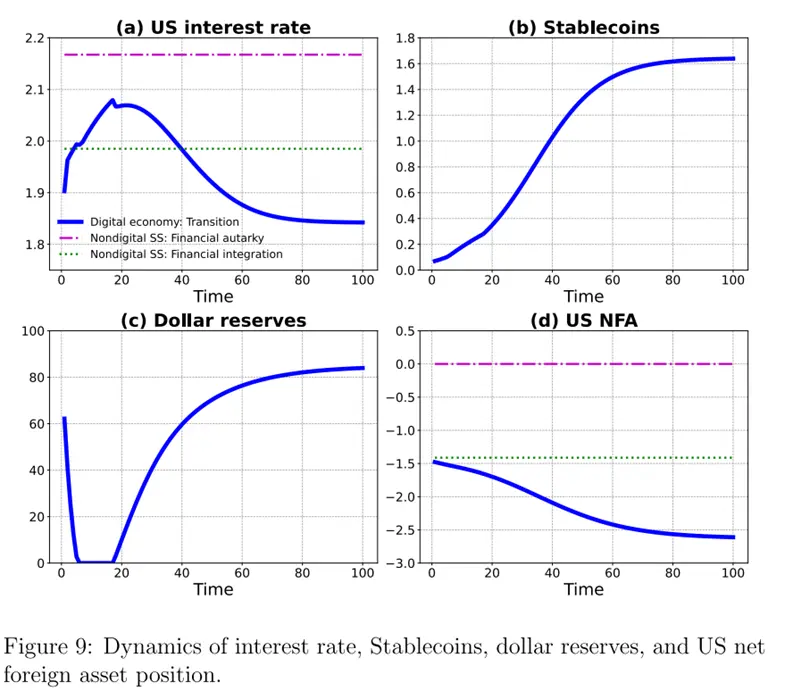
In the absence of the digital economy, the steady-state U.S. interest rate is higher than when integrated, reflecting that financial integration allows the U.S. to enjoy "excessive privilege" (borrowing at lower rates); whereas with the digital economy, interest rates are lower, indicating that its expansion reinforces this privilege. The digital economy also affects cross-border ownership of assets, with the initial negative net foreign asset position of the U.S. worsening further with its expansion, exacerbating external imbalances.
5.3 Consumption Insurance
The growth of the digital economy influences global financial markets through the issuance of stablecoins, altering the composition of agents' investment portfolios, which in turn affects individual consumption and wealth volatility. This paper derives an analytical formula for the standard deviation of individual consumption growth:
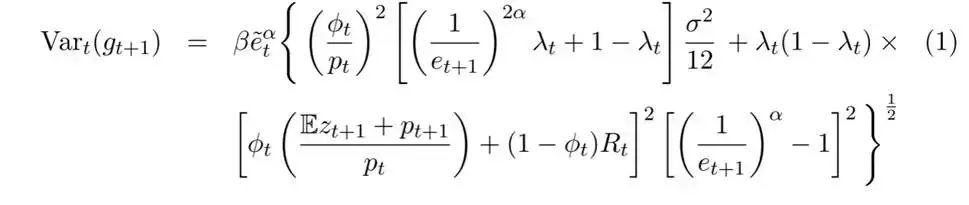
Figure 10 presents the standard deviation of consumption growth for different types of agents in various countries during the transition period. The consumption volatility of habitual agents in the U.S. rises over time due to a decline in net foreign assets and increased leverage, leading to greater net worth and consumption volatility; non-habitual agents initially experience high volatility due to potential type transitions causing significant price fluctuations in D goods, but this effect diminishes as price differences narrow. Habitual agents in the rest of the world experience lower consumption volatility due to access to high-return stablecoins from the digital economy, allowing them to adjust their portfolios and reduce net worth volatility. Consumption volatility among digital economy agents significantly increases, stemming from a decline in price-to-earnings ratios, with the share of current income (subject to unique risks) rising in wealth, leading to greater fluctuations in end-of-period wealth and consumption.
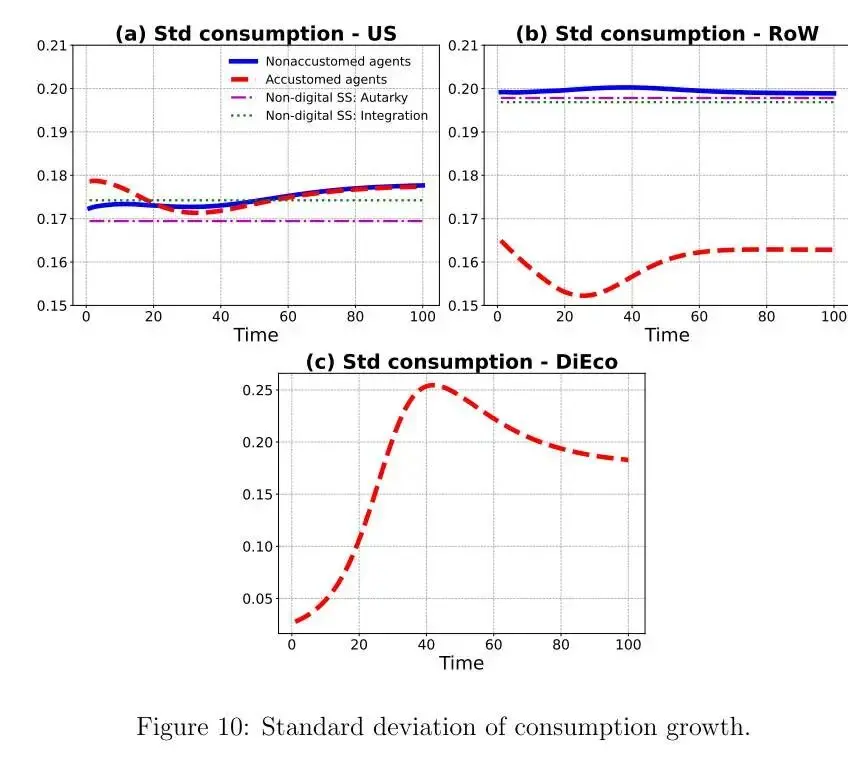
The growth of the digital economy has a significant impact on global risk-sharing, and in the long term, the U.S. expands insurance supply to other regions, partly provided by virtual residents of the digital economy. Since individual consumption volatility is related to wealth volatility, the concentration of wealth in the U.S. is expected to rise, while the concentration of wealth in the rest of the world (excluding digital economy residents) may decline, reflecting the complex role of the digital economy in global consumption insurance and wealth distribution.
6. Conclusion and Recommendations
The U.S. dollar, due to its stability, occupies a core position in international finance. This paper finds that the growth of the digital economy (especially stablecoins) impacts global finance through two channels. The first channel increases the demand for stablecoins. Since stablecoins are partially backed by dollar-denominated assets, this leads to a decrease in U.S. interest rates and exacerbates global imbalances. The second channel increases the supply of stablecoins backed by non-dollar assets, which raises U.S. interest rates and reduces global imbalances. Model simulations indicate that in the long term, the first channel dominates the second, leading to a decrease in U.S. interest rates. This also implies that the U.S.'s net external borrowing will continue to increase. Additionally, the paper finds that the expansion of the digital economy will increase the supply of stablecoins, benefiting some agents by smoothing consumption, with habitual agents in the rest of the world more likely to benefit, albeit at the cost of increased consumption volatility for the U.S. and digital economy agents. On a global scale, the digital economy enhances welfare by providing cheap services and insurance, but welfare distribution is asymmetric across countries and agents, making the exploration of its welfare impacts a direction for future research.
 Risk warning
 Risk warning




Popular articles





