








Five Soul Questions: What is Good DeFi? ARK's Answer and the Path of On-Chain Governance

 How DeFAI Builds a New Civilization on the Chain.
Author: momo, ChainCatcher
What constitutes a truly "good" DeFi protocol? Is it extremely high yields? An innovative token model? Or a massive TVL? These may have once been seen as answers, but with the collapse of several star projects, the industry has begun to realize that true "goodness" should stem from the sustainability, trustworthiness, and evolvability of the protocol, all of which must be built on a logic that frees itself from complete human governance.
For a long time, the construction of on-chain order has faced a fundamental contradiction: an over-reliance on human consensus. Whether it’s the inefficiency of governance voting, the lag in manual adjustments of economic model parameters, or the system's stability being swayed by emotions and liquidity games, all of this points to the uncertainty and systemic fragility brought about by human factors.
It is in this reflection and exploration that the DeFAI protocol ARK attempts to fundamentally construct a new on-chain civil order—using algorithmic consensus to dilute human consensus, allowing parameter models to respond autonomously, thereby reducing the interference of emotions, beliefs, and short-term games on the long-term development of the protocol.
Notably, ARK has been very active recently, having officially launched its mainnet and announced the completion of a strategic financing round led by Morgan Crest Web3 Foundation. This institution is also an early supporter of well-known projects like Lido Finance and FRAX Finance. Morgan Crest Web3 Foundation's bet further sparked market attention on the progress of "DeFAI."
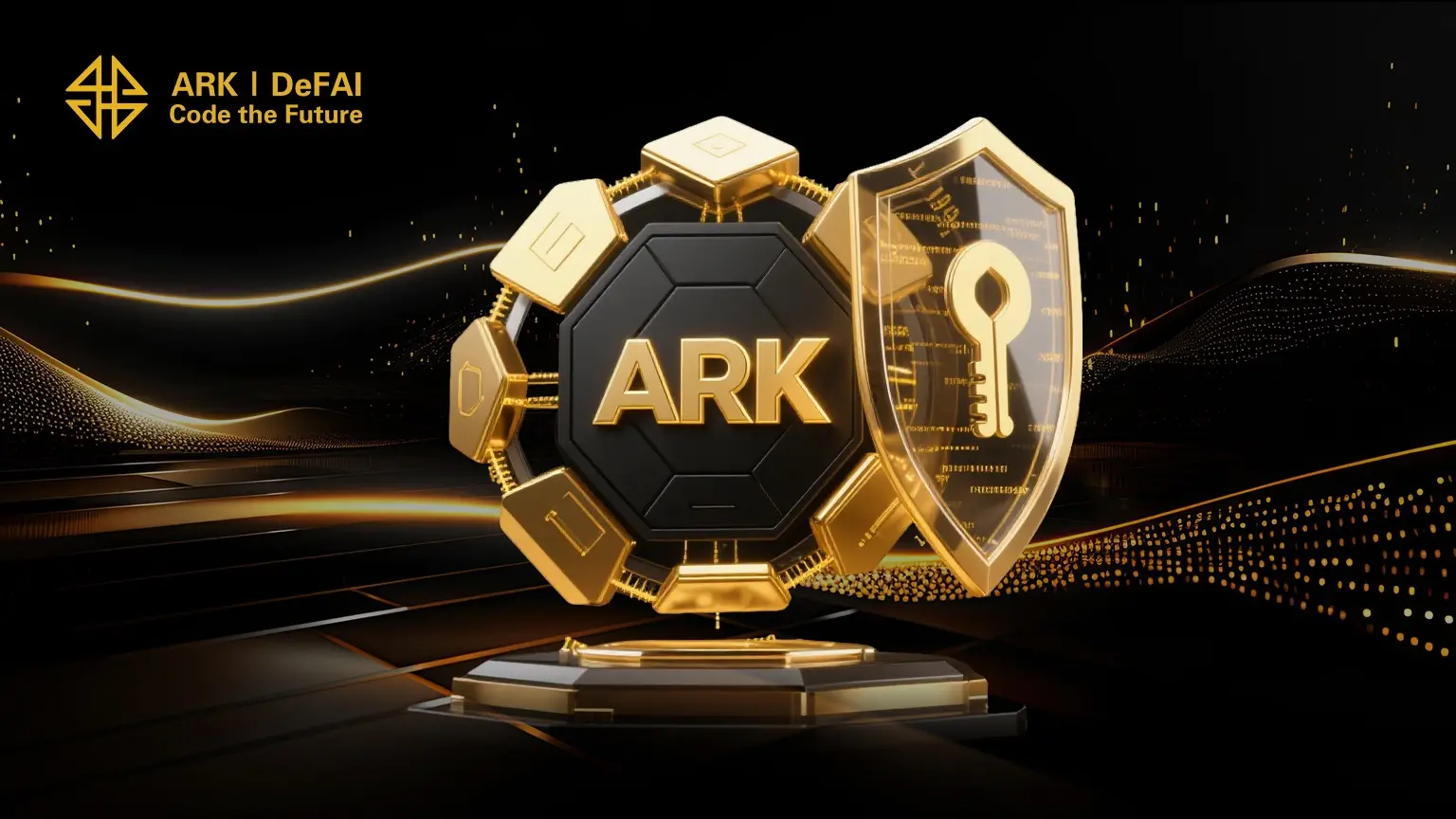
From Human Governance to Algorithmic Autonomy: How Does ARK Redefine DeFi?
ARK's vision of building a "new civilization on-chain" may seem grand, but returning to the fundamental question of "what constitutes a good DeFi protocol," the pain points ARK aims to address become clear.
In ARK's view, a good DeFi project should fundamentally solve two core issues: whether user assets are secure and whether the yield mechanism can be sustained.
So how can these core issues be addressed, relying on systems and autonomy rather than human decision-making? ARK provides a preliminary answer with its V3 protocol system, which centers around AI as the coordinating core and a modular architecture as its backbone.
In terms of security, ARK proposes three soul questions and corresponding solutions:
First, is the LP (liquidity pool) locked? If the LP is not locked, the project team can withdraw funds from the pool at any time and "run away" (Rug Pull), which is the most direct security threat. ARK completely discards LP control permissions, permanently locking liquidity within smart contracts, fundamentally eliminating the possibility of withdrawing liquidity.
Second, is the minting contract open-source? An unverified black-box contract means that the project team may have backdoors, allowing them to arbitrarily mint tokens and instantly dilute the asset value of all holders. ARK's minting contract is fully open-source, with all logic transparent and verifiable on-chain, ensuring fairness and certainty in token distribution, with no one able to mint tokens privately.
Third, is the treasury multi-sig transparent? If the treasury is controlled by a single signature, assets can be easily transferred by one person. ARK adopts a "governance + multi-sig" mechanism (like Gnosis Safe), requiring community voting proposals for any use of treasury assets, which are then executed by multiple multi-signers, achieving true decentralized governance (DAO) and asset transparency, ensuring the safety and compliant use of treasury funds.
These designs are not only to prevent external attacks but also to establish a trust foundation different from traditional finance, relying not on institutional credit but on verifiable mathematics and code.
In terms of sustainability, ARK deconstructs from two aspects.
On one hand, ARK believes that to understand the core structure of DeFi, a good DeFi protocol should embody "strong products, weak individuals, weak narratives." This means that the core value of the project should come from its protocol mechanisms and automation capabilities, rather than relying on the influence of founders or market narratives.
On the other hand, ARK introduces the concept of "algorithmic non-stablecoins," emphasizing that DeFi should no longer rely on traditional anchors but instead achieve system balance through algorithmic regulation. This leads to two key questions that a good DeFi project must face: First, has an EM (intelligent minting module) been deployed? Second, does it have an RBS (market value stabilization module)?
ARK's key breakthrough lies in encoding governance mechanisms, economic policies, and risk control into automatically executable algorithmic modules. For example, the EM (intelligent minting module) dynamically adjusts the token issuance rhythm based on market premiums to prevent malignant inflation; the RBS (market value stabilization module) automatically initiates treasury and LP pool linkage operations when the token price deviates from a reasonable range, achieving "high-price selling, low-price repurchasing" to maintain price stability corridors; and through the Yield Revenue Feedback (YRF) module, a portion of the protocol's revenue is automatically used to repurchase and burn tokens, forming a deflationary closed loop and value feedback.
The foundation of all this automation is the five smart architectures constructed by ARK V3:
Smart contract minting (EM module) ensures that token issuance is free from human intervention;
Smart contract market-making (RBS module) achieves automatic market value management;
Smart contract treasury management (transparent multi-sig treasury) ensures that assets are traceable on-chain and co-governed by the community;
Smart contract iteration (modular design) allows the protocol to be upgraded and evolved;
Smart contract perpetuity (DAO governance) returns the final decision-making power to token holders.
Together, they redefine DeFi through AI-driven collaboration, constructing an on-chain financial organism that can self-regulate, continuously evolve, and reject single points of failure, ultimately aiming for a fundamental shift from "requiring human belief" to "guaranteed by code."
ARK's Application Direction: How Far Are We from True Algorithmic Autonomy?
While the concept is grand, true persuasiveness comes from practice. ARK has recently officially launched its mainnet, marking its transition from conceptual narrative to implementation phase.
The future application direction of ARK is also unfolding through the ARKLand model society. ARKLand, as the core application layer of ARK, is designed as a digital social ecosystem driven by DeFi and AI, covering areas such as finance, education, healthcare, and social interaction. ARKLand will provide over 50 AI models for users through a "use-train-list-govern" closed-loop mechanism, offering services like financial advising, lending analysis, and governance assistance.
For example, users can access AI-driven services such as wealth management, health consulting, or educational guidance by staking ARK tokens. The AI models continuously train and optimize based on user data and community feedback, simulating market behavior or predicting risks. Developers can list new AI models or applications to expand ARKLand's functionality. The community participates in proposals and decisions through governance NFTs (LPN, Liquidity Provider NFT), with AI assisting in assessing the impact of proposals to ensure the scientific and transparent nature of governance.
As of now, ARK has made several key advancements: the mainnet launch, the completion of the genesis liquidity injection and LP token burn, and the full operation of the five modules along with the POL and ATS systems. The DAO governance mechanism is also about to be launched, allowing the community to participate in proposals and voting through LPN and to multi-sign key treasury proposals.
These achievements lay the foundation for the initial realization of ARK's decentralized civilization. Early data reflects market confidence: ARK liquidity pool assets exceed $30 million, the treasury held by the protocol is valued at over $43 million, and the total staking amount has surpassed 1.27 million ARK tokens.
However, complete autonomy remains a long journey. Currently, what ARK has achieved is "highly assisted autonomy," meaning that AI simulation and execution are introduced in key decisions, but the human community still retains the final veto and upgrade authority through governance tokens and NFTs (LPN). The ideal state of its design is that as the model continues to learn and accumulate environmental data, the proportion of human intervention will gradually decrease, and the system will possess stronger predictive, responsive, and creative capabilities.
What ARK brings is not just a set of composable DeFi protocols, but a fundamental inquiry into the nature of existence in the on-chain world: Can we establish a financial system that no longer relies on human weaknesses? Can we truly achieve a transition from "human governance" to "algorithmic governance"? In today's accelerating fusion of AI and blockchain, ARK at least provides a complete, operational, and worthy answer to examine.
 Risk warning Risk warning




Popular articles





