Revealing the ETH Holdings List: Who Will Own the Most ETH in 2025?

 This article explores the ETH rich list of 2025, from the Beacon staking contract and Coinbase's hot wallet, to BlackRock's ETHA trust, and Vitalik's holdings.
Author: Bradley Peak
Compiled by: Felix, PANews
Key Points:
- About 61% of ETH is held by just 10 addresses, most of which belong to staking contracts, exchanges, or funds, rather than individual whales.
- Nearly half of the ETH is stored in a smart contract: the Beacon deposit contract, which powers Ethereum's proof-of-stake system.
- Large institutions like BlackRock and Fidelity, as well as publicly traded companies, now hold millions of ETH, making ETH an important reserve asset.
- The ownership of ETH has shifted from early adopters. Today, it all depends on the platforms and services built on it.
As of August 2025, on-chain data shows that the top 10 ETH holders control about 61% of the total circulating supply.
This raises the question: who holds most of the ETH? The answer points to protocol-level smart contracts, large exchanges, exchange-traded fund (ETF) trusts, and even publicly traded companies.
This article explores the ETH billionaire list of 2025, from the Beacon staking contract and Coinbase's hot wallet to BlackRock's ETHA trust and Vitalik's holdings.
ETH Addresses Ranked by Balance
As of mid-2025, the circulating supply of ETH is approximately 120.71 million. After the Pectra upgrade in May, the issuance has stabilized at nearly zero levels.
As briefly discussed above, as of September 2, 2025, the top ten ETH addresses hold 71.8 million ETH (about 60% of the total supply).
From a broader perspective, the top 200 wallets account for over 52% of the share, holding more than 62.76 million ETH (most of which is related to staking contracts, exchange liquidity, token bridging, or custodial funds). Unlike inactive BTC whale addresses, these ETH whale addresses are very active on the Ethereum network, reflecting ETH's ability to fully support staking, DeFi, and institutional operations.
Who Owns the Most ETH in 2025?
As of September 2, 2025, the Beacon deposit contract holds about 68 million ETH, accounting for approximately 56% of the total circulating supply of 120.71 million ETH.
This data is roughly consistent with a report from March 2025, which estimated this share at about 55.6% (see the chart below).
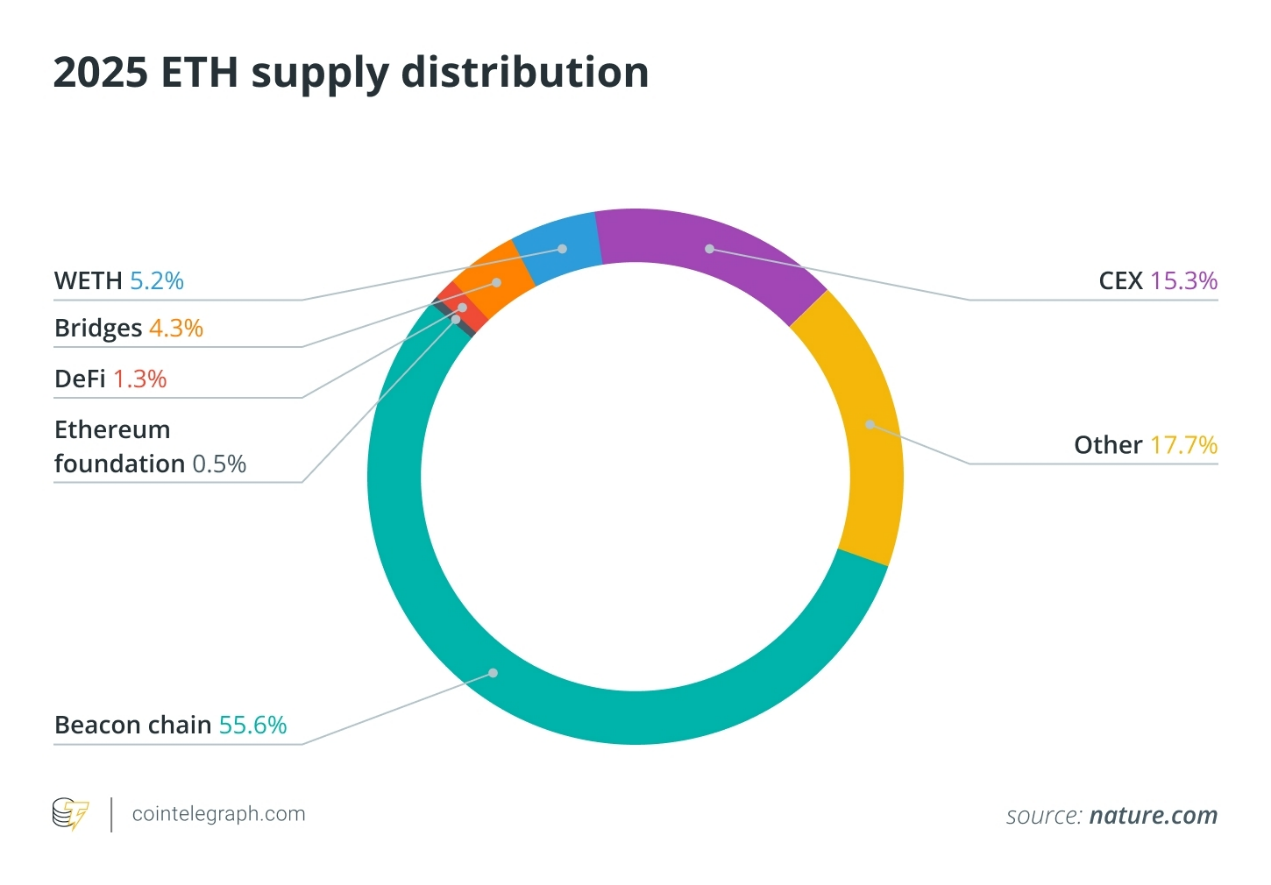
This smart contract serves as the entry point for Ethereum validators, each of whom must deposit at least 32 ETH to participate in securing the network.
Even after the withdrawal feature was enabled in 2023, funds do not immediately become liquid. Validators must exit the active set, wait for about a 27-hour unbonding period, and then rely on protocol-controlled liquidation operations to release ETH.
This makes the Beacon contract the largest holder of ETH—not individuals, but the network itself.
Through strict penalties and an organized exit mechanism, it ensures the accountability of validators. Nevertheless, some critics argue that concentrating half of the supply in one contract could pose systemic risks if a coordinated exit or protocol-level error occurs.
The Wrapped Ether (WETH) smart contract is also one of the largest holders of ETH, currently holding over 2.26 million ETH (about 1.87% of the circulating supply).
Second Largest ETH Wallet
As of September 2, the following exchanges and custodians are the second largest holders of ETH:
- Coinbase: 5.16 million ETH (about 4.2% of total supply)
- Binance: 4.06 million ETH (about 3.3%)
- Robinhood: 1.37 million ETH (about 1.1%)
- Upbit: 1.35 million ETH (about 1.1%).
These addresses represent an active infrastructure layer, where ETH is used to support exchange liquidity, staking cbETH derivatives, and cross-chain asset bridging.
The Largest ETH Wallets in 2025
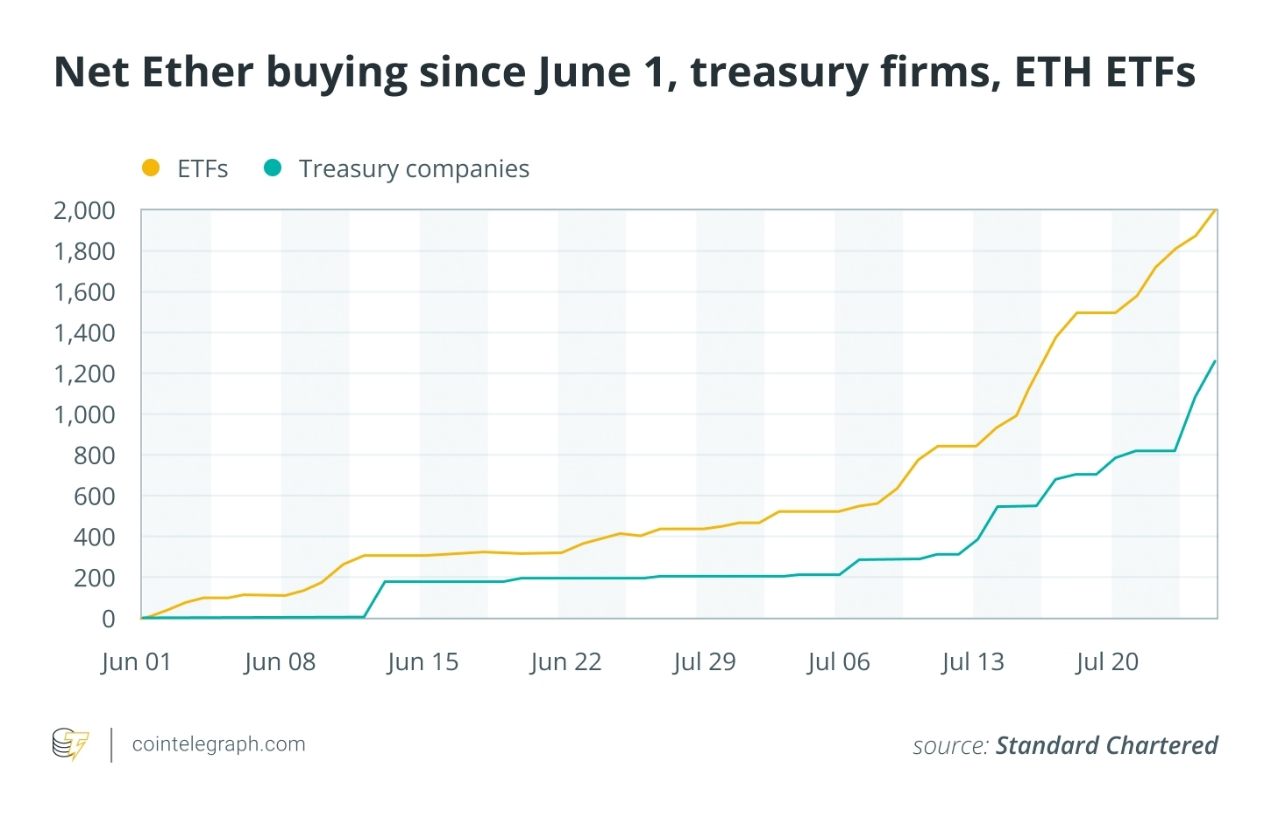
As of late July 2025, BlackRock's iShares Ethereum Trust (ETHA) has driven a significant shift in institutional ETH ownership. The net inflow to ETHA reached $9.74 billion, and it currently holds over 3 million ETH (about 2.5% of total supply), making it one of the largest ETH wallets in 2025.
Grayscale's ETHE remains an important market player, managing 1.13 million ETH. Fidelity's Ethereum fund (FETH), launched in 2024, has seen inflows of $1.4 billion, while Bitwise is transitioning from solely investing in BTC to ETH-based delegated investments, offering staking features.
These institutions currently control over 5 million ETH (4.4% of total supply), changing the landscape of ETH ownership. They represent a new class of DeFi millionaires who are regulated, hold ETF assets, and focus on staking.
Corporate Ethereum Whale Addresses
An increasing number of publicly traded companies are following the Strategy Bitcoin treasury plan (but with staking), viewing ETH as an asset. For example (but not limited to):
- Bitmine Immersion Technologies (NYSE: BMNR) holds over 1.8 million ETH (approximately $7.8 billion).
- SharpLink Gaming (NASDAQ: SBET) has purchased about 797,700 ETH (approximately $3.5 billion) since June.
- Bit Digital (NASDAQ: BTBT) holds about 120,300 ETH, having shifted from BTC to ETH after equity financing.
- BTCS (NASDAQ: BTCS) reports holding about 70,028 ETH (approximately $307 million), funded by convertible bonds.
Most of these ETH are actively staked, with annual yields of about 3% to 5%. These companies believe that Ethereum's programmability, stablecoin ecosystem, and regulatory clarity (such as the GENIUS Act) form the basis of their ETH treasury strategy.
This new ETH billionaire list includes not only individuals but also corporate personnel betting on ETH's long-term value.
ETH Billionaire List
While smart contracts and institutions dominate the Ethereum billionaire list in 2025, there are still a few individuals who are major holders of ETH.
Ethereum co-founder Vitalik Buterin is reported to hold about 250,000 to 280,000 ETH (approximately $950 million), primarily stored in a few non-custodial wallets, including the well-known VB3 address.
Rain Lõhmus, co-founder of LHV Bank, purchased 250,000 ETH during the 2014 initial coin offering (ICO) but later lost the private key. His tokens remain untouched, currently valued at nearly $900 million.
Cameron Winklevoss and Tyler Winklevoss, early investors and founders of Gemini, control between 150,000 and 200,000 ETH, not including over 360,000 ETH held in Gemini's exchange reserves.
Joseph Lubin, co-founder of Ethereum and head of ConsenSys, is said to hold about 500,000 ETH (approximately $1.2 billion), although this figure has never been officially confirmed.
Another Ethereum co-founder, Anthony Di Iorio, is reported to hold between 50,000 and 100,000 ETH.
As of early 2025, Etherscan data shows that there are over 130 million unique addresses on Ethereum, but the number of addresses holding at least 1 ETH is less than 1.3 million, accounting for less than 1% of the total.
How to Track ETH Ownership Distribution
Identifying the largest ETH holders in 2025 relies on tools like Nansen's Token God Mode, Dune Analytics, and Etherscan. These platforms categorize wallets based on behavior and associate them with exchanges, funds, smart contracts, or individuals.
- Token God Mode maps wallet clusters to known entities, tracking fund inflows/outflows and ranking the largest ETH wallets of 2025.
- Dune Analytics uses patterns like "labels.addresses" to distinguish externally owned accounts (EOAs) from smart contracts and exchanges, generating insights about public Ethereum addresses and ETH holding patterns.
- Etherscan tags wallets based on transaction history, attribution, or user-submitted evidence, enhancing the transparency of crypto wallets. These sources collectively outline the distribution of ETH ownership.
However, limitations still exist. Reused deposit addresses may inflate numbers, cold wallets may evade cluster management, and privacy technologies may obscure true control. Even the top 200 ranked Ethereum addresses may contain fragmented or mislabelled entities. The ranking of ETH addresses reflects a combination of determinism and statistical inference rather than complete visibility.
 Risk warning
 Risk warning