








Can babies be tokenized? A crypto experiment to solve the population crisis

 The subject of the transaction is never the baby itself, but rather the value prediction of its growth trajectory.
Written by: Lauris
Compiled by: Saoirse, Foresight News
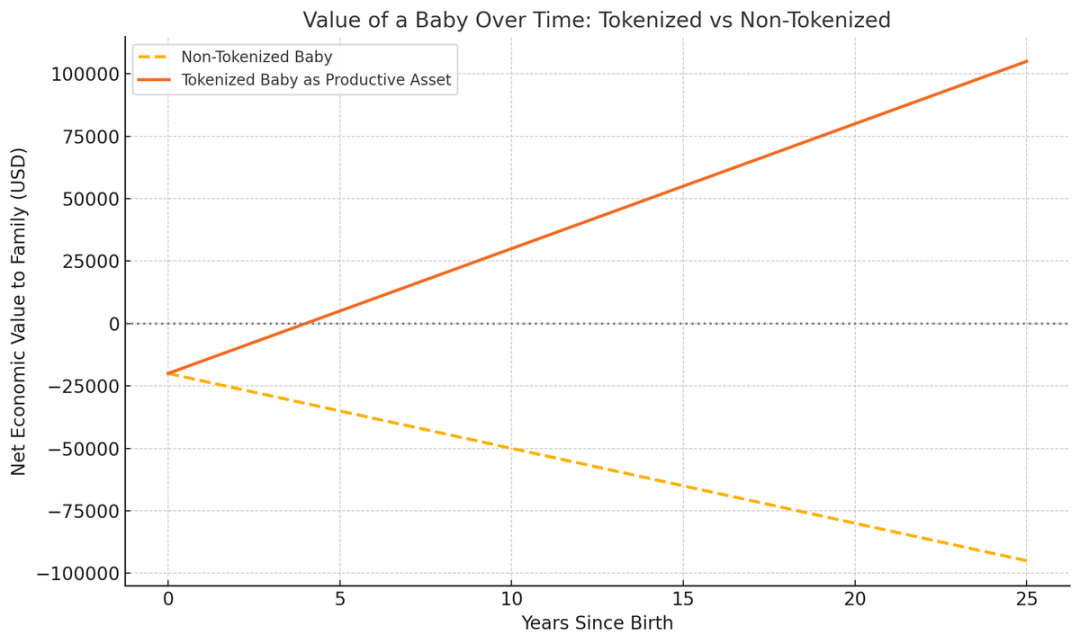
For most of human history, infants have been economic assets with productive value. Children are not just dependents needing care; they are laborers—herding sheep at five, participating in farming or apprenticing at ten. The more children there are, the higher the output, the stronger the risk resilience, and the greater the family wealth. This model was effective, with birth rates trending positively, and childbirth serving as an upstream driver of Gross Domestic Product (GDP).
Then, everything changed.
At some point in the 20th century, children ceased to participate in productive labor and became consumers instead. School education replaced labor practice, laws restricted child labor, and the focus of social education shifted from fostering initiative to emphasizing obedience. Parents still had children, but now each child became a "net liability" for the family for up to 18 years, with the marginal utility of having more children dropping below zero.
This has led to the situation we face today: a significant decline in birth rates, an inverted population structure, and an aging economy.
The model of relying on child labor on farms has become a thing of the past, but incorporating infants into a "bonding curve" mechanism (a mathematical model used for the issuance and pricing of crypto assets) can achieve the following goals:
a) Develop a brand new financial foundational tool to help families accelerate their path to financial freedom; and
b) Reintroduce children as economically productive assets, thereby releasing beneficial effects for society in terms of increasing birth rates.
Opportunity: Infants as On-Chain Financial Primitives
Cryptographic technology provides us with the tools to address this issue. With composable smart contracts, identity metadata, and financial instruments, we can now reintegrate infants into the economic system.
When a baby is born, a "baby bond" is minted. This is a hybrid ERC-404 token: part NFT (for identity identification), part fungible token (for providing liquidity). This token represents the potential economic value of the infant as it develops over time, encompassing multiple dimensions such as cultural memes, social aspects, and intelligence. The second derivative of value, or growth acceleration, is also reintroduced into considerations related to birth rates.
Contract Standard: ERC-404 and INFNT Tokens
Traditional NFTs are not suitable for this scenario due to their lack of liquidity. Therefore, baby bonds adopt the ERC-404 standard. This is a hybrid standard that allows each infant's corresponding token to achieve:
- Fragmented trading through INFNT tokens
- Individual identity recognition through parent NFTs
- Dynamic valuation through badges and bonding curves
This design allows us to balance two major advantages: the permanence of identity and the composability of liquidity.
From a mathematical perspective: Let B(t) be the baby bond at time t, then its value change formula is: dB/dt = ∂INFNT/∂milestone + ∂INFNT/∂meme velocity where both variables exhibit convexity concerning public interest and institutional validation.
Features, AI, and Badges
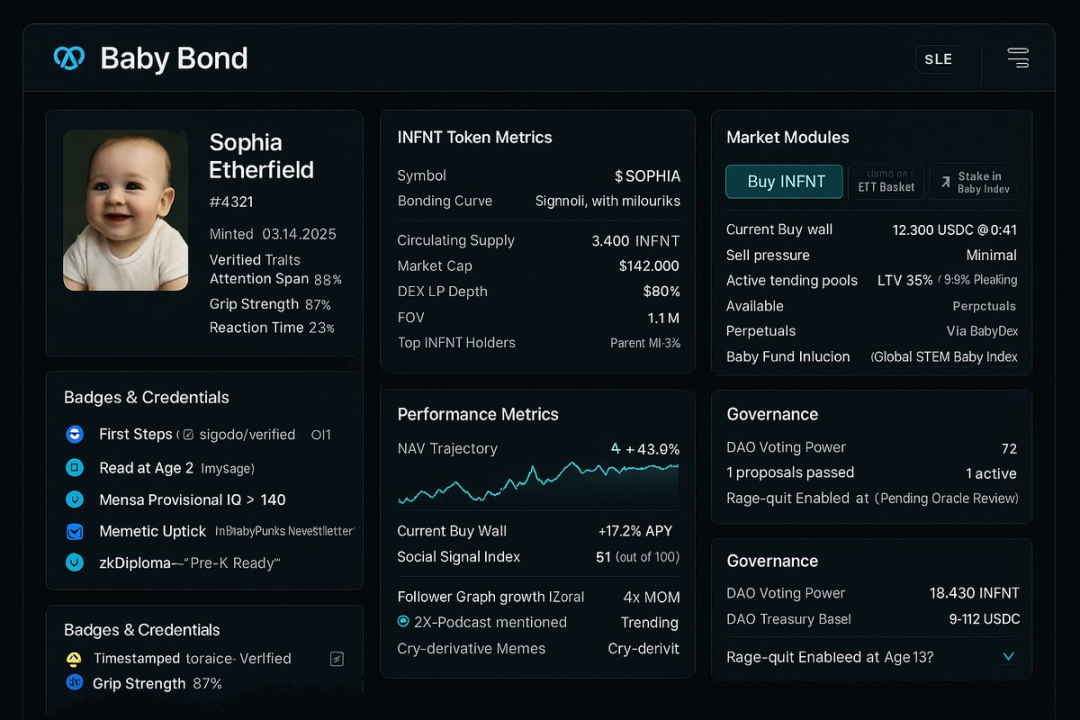
Baby bonds are not just tokens; they are living, modular carriers of value accumulation and reputation transmission.
- AI intelligent experience verification feature metadata: From the moment the token is minted, AI agents will monitor and record the infant's early developmental characteristics, such as motor speed, social behavior, and audio signal complexity. These features are attached to the NFT through semi-immutable metadata (modifiable only through trusted update oracles), ultimately forming a vertical, verifiable, and privacy-protected "baby feature profile."
- Educational certification badges: Schools, universities, digital academies, and other institutions can issue cryptographic badges directly attached to the NFT. These badges identify the infant's milestone achievements (e.g., "Literacy at 3 years old," "Admitted to MIT," "Top 1% in spatial IQ"), serving as both public resources and exclusive advantages for token holders.
- Dynamic feature accumulation and modular governance: Before the age of 18, baby bonds are managed by parents, smart contracts, or decentralized autonomous organization (DAO) trustees; after turning 18, governance rights are transferred to the infant. Additionally, "exit rights" can be granted starting at age 13. The weight of early voting decisions can be quadratic to avoid manipulation by radical large investors.
- Fully on-chain auditable: All data and operations are recorded on-chain and can be audited at any time.
Example: Feature scoring formula: TraitScore (t) = ∑ (Badgeᵢ * wᵢ) where Badgeᵢ represents verified achievement signals, and wᵢ represents market-determined weight coefficients.
Convexity and Mechanism Design
The value of baby tokenization does not stem from linear cash flows but from "unlocking convexity"—based on the infant's developmental achievements, meme propagation popularity, and external validation, significant non-linear returns can be generated.
- Bonding curve-based issuance: INFNT tokens (the native tokens of non-fungible baby bonds) are issued through bonding curves to reward early supporters. As the infant achieves more milestones or increases social influence, the token value will grow exponentially, making "baby investment" a new form of "seed round investment."
- Third-party feature injection: Verification badges issued by authoritative institutions will drive token value along a non-linear trajectory. For example, after adding an "Olympic Gold Medal" badge, the NFT may experience a discontinuous value increase due to a "supply shock" at the meme level.
- Protocolized fertility incentives: Decentralized autonomous organizations (DAOs), Layer 2 networks, and even nations can implement composable incentive mechanisms. For instance: providing gas fee subsidies for families having children, quadratic matching for baby bonds held by low-income parents, or launching "fertility farming" programs for rural users, with the design space fully open.
Downstream Application Scenarios
Once infants are tokenized, they will become programmable financial foundational carriers. Here are some potential downstream application directions:
1. Baby Mortgage Loans
Families holding high-potential baby bonds can use the infant's expected income or meme rights as collateral to obtain long-term low-interest mortgage loans. Loan approval will no longer depend on parental income but on the child's expected economic utility. For example: "We pay a 30% down payment, of which 10% is in ETH and 20% is in baby bond shares."
2. Baby Index ETF
Construct a curated portfolio of baby bonds based on geographic regions, talent areas, or characteristic profiles. For example: "Top 50 STEM Potential Babies in Nigeria," "Genius Portfolio—Top IQ Score Tier," "Elite Violin DAO Organization." These portfolios can be issued as ERC-4626 standard vaults or tradable basket tokens.
3. Baby Perpetual Futures
Build a comprehensive derivatives market where users can "go long" or "go short" on the future socioeconomic returns of specific groups. Contracts can be settled based on the infant's on-chain comprehensive key performance indicators (KPIs) at age 21, with oracle disputes resolved through multi-signature arbitration or meme resolution mechanisms.
4. Baby Impact DAO
Achieve "tokenized charity" from the moment of the infant's birth. Donors can contribute to baby bonds in impoverished areas, receiving "impact returns," and gaining governance tokens in the "Baby Advancement DAO." The "impact proof" mechanism will replace traditional charity models, forming a regenerative reproductive finance system.
5. Narrative Derivatives
Bet on speculative developmental trajectories for infants, such as: "Will Child X become a billionaire?" "Will Child Y get embroiled in public controversy before age 12?" On-chain prediction markets will become "narrative carriers," with token value increasing as trajectory outcomes materialize.
Ethical Considerations
Some may view this proposal as "dystopian," believing it commodifies life. However, in reality, life already possesses financial attributes in today's society; children are cost centers for families. We have merely been using a model with low transparency and poorly designed incentives. Tokenization is not exploitation but a reconfiguration of the existing system, allowing "the meaning of life" and "capital" to coexist.
The object of trade is never the infant itself, but the value prediction of its growth trajectory.
Conclusion
We cannot return to an era reliant on child farming; that model is long outdated. The infant labor model on farms has become history, but by tokenizing infants (combining real-world assets (RWA) and decentralized physical infrastructure (DePIN) attributes), we can leverage token incentives and cryptographic technology to address one of modern society's most pressing issues.
Childbirth becomes a source of income.
Parenthood becomes a protocol adherence.
Human society will also regain "liquidity."
 Risk warning Risk warning



Popular articles





