Almanak Research Report: The Inclusive Path of On-Chain Quantitative Finance

 This article analyzes the Almanak project, which aims to democratize quantitative trading capabilities through AgentFi (on-chain agents) technology. The report details its product architecture, technical features, token economic model, and future development roadmap.
Written by: 0xjacobzhao and ChatGPT 5
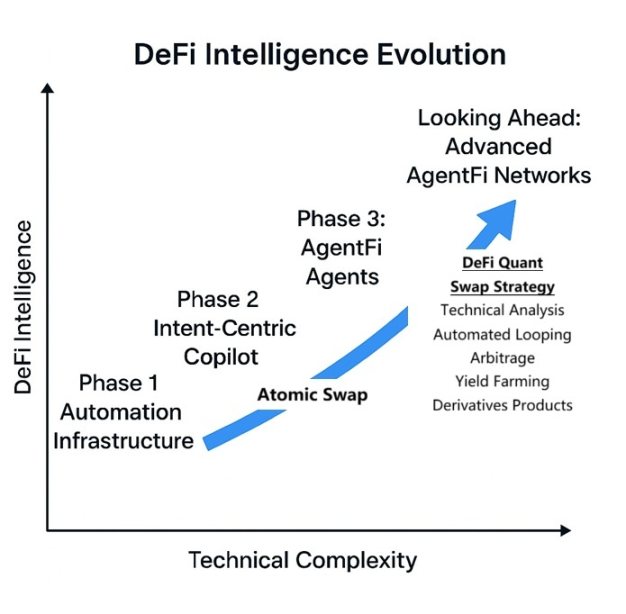
In the research report titled "The Intelligent Evolution of DeFi: The Evolution Path from Automation to AgentFi", we systematically sorted and compared the three stages of intelligent development in DeFi: Automation Tools, Intent-Centric Copilot, and AgentFi (On-chain Agents). We pointed out that a significant portion of current DeFAI projects still focuses on the core capability of "intent-driven + single atomic interaction" in Swap transactions. These interactions do not involve ongoing yield strategies, lack state management, and do not require complex execution frameworks, making them more suitable for the lightweight execution model of intent assistants, and cannot be strictly regarded as AgentFi.
In our high-level vision for the future of AgentFi, in addition to lending and yield farming, which are currently the most valuable and easily implementable scenarios, Swap combination strategies are also a potential direction. When multiple Swaps are combined in sequence or conditionally, they form a "strategy link," such as arbitrage or yield farming. This model requires state machine management for positions, condition triggers, and multi-step automated execution, embodying the complete closed-loop characteristics of AgentFi—perception → decision-making → execution → rebalancing.
1. DeFi Quantitative Strategy Map and Feasibility Analysis
Traditional quantitative finance relies on mathematical models, statistical methods, and algorithms, using historical prices, trading volumes, macro indicators, and other data for data-driven decision-making, and achieving low-latency, high-frequency, automated trading through programmatic execution, supplemented by strict risk control (stop-loss, position management, VaR, etc.). Its main applications include high-frequency trading (HFT), trend following and mean reversion (CTA), cross-market/cross-asset arbitrage, and derivatives pricing and hedging, forming a mature infrastructure, exchange system, and data ecosystem in traditional markets.
On-chain quantitative finance continues the logic of traditional quant but shifts the operating environment to the programmable market structure of blockchain. Its data comes from on-chain transaction records, DEX quotes, and DeFi protocol states, executed in smart contracts (AMM, lending, derivatives protocols), with transaction costs including Gas, slippage, and MEV risks, and can build automated strategy links through the composability of DeFi protocols.
Currently, on-chain quantitative finance is still in its early stages, constrained by multiple factors that hinder the implementation of complex quantitative strategies: first, in terms of market structure, insufficient liquidity depth and the lack of ultra-fast matching mechanisms in AMMs limit the feasibility of high-frequency and large-volume trading; second, in terms of execution and costs, on-chain block delays and high Gas fees make frequent trading unprofitable; third, in terms of data and tools, the development and backtesting environment is incomplete, and the data dimensions are singular, lacking multi-source information such as corporate finance and macroeconomics. Among the practically implementable DeFi quantitative strategies, the current mainstream directions focus on:
- Mean reversion / trend following ------ Making buy/sell decisions based on technical indicator signals (e.g., RSI, moving averages, Bollinger Bands);
- Inter-period arbitrage ------ Represented by protocols like Pendle, profiting from the difference between fixed and floating yields;
- Market making + dynamic rebalancing ------ Actively managing AMM liquidity ranges to earn transaction fees;
- Leveraged cyclical yield ------ Enhancing capital utilization through lending protocols.
Future potential growth areas include:
- Maturation of the on-chain derivatives market, especially the widespread application of options and perpetual contracts;
- More efficient off-chain data access, enriching model input dimensions through decentralized oracles;
- Multi-Agent collaboration, achieving automated execution and risk balancing of multi-strategy combinations.


2. Almank Positioning and Vision: Exploring AgentFi in On-Chain Quantitative Finance
In previous Crypto AI research reports, we introduced many excellent AgentFi projects, but most still focus on intent-driven DeFi execution, lending, or liquidity management for fully automated operations, with few teams deeply engaged in quantitative trading strategies. Currently, the only project clearly centered on quantitative trading is Almanak. This project enters the no-code quantitative strategy development space, providing a complete toolchain covering strategy writing (Python), deployment, execution, permission management, and vaulting, positioning itself uniquely in the AgentFi field and can be seen as a core representative case of on-chain quantitative finance.
In traditional finance, Inclusive Finance aims to lower participation thresholds and cover more long-tail users. Almanak extends this concept to on-chain, aiming to democratize quantitative trading capabilities. The platform uses AI-driven agents to execute strategies, significantly reducing capital, technical, and time costs, providing full-chain support from strategy conception to on-chain execution for active traders, financial developers, and institutional investors in the DeFi ecosystem, allowing ordinary users without a professional technical background to participate in crypto asset trading and yield optimization using fully automated, on-chain transparent, and customizable quantitative strategies.
The Almanak platform introduces AI multi-agent collaboration (Agentic Swarm), allowing users to quickly create, test, and deploy Python-based automated financial strategies in a no-code environment during strategy development, execution, and optimization phases, while ensuring a non-custodial, verifiable, and scalable execution environment. With modules such as State Machine strategy framework, Safe+Zodiac permission management, multi-chain protocol access, and Vault asset custody, Almanak retains institutional-level security and scalability while significantly lowering the barriers to strategy development and deployment. This report will systematically analyze its product architecture, technical features, incentive mechanisms, competitive positioning, and future development paths, and explore its potential value in inclusive finance and on-chain quantitative fields.
3. Almank's Product Architecture and Technical Features
Almanak's product architecture is centered around "strategy logic → execution engine → security assurance → assetization and expansion," constructing a full-stack system for on-chain quantitative finance aimed at AI Agent scenarios. In this system, the Strategies module provides a strategy development and management framework from conception to execution, currently supporting Python SDK and will support natural language generation in the future; the Deployments module serves as the execution engine, automating the execution of strategy logic within the authorized scope and achieving adaptive optimization through AI decision-making capabilities; the Wallets module ensures the security of funds and permissions through a non-custodial architecture of Safe + Zodiac, achieving institutional-level key management and fine-grained permission control; the Vaults module transforms strategies into tokenized financial products, relying on standardized vault contracts (ERC-7540), enabling capital raising, profit distribution, and strategy sharing—allowing strategies to possess complete composability and seamlessly integrate into a broader DeFi ecosystem.
1. Strategy Infrastructure (Strategies)
Almanak's strategy infrastructure covers the complete link from conception to execution, including strategy ideation, creation, evaluation, optimization, deployment, and monitoring. Compared to traditional quantitative trading stacks, it has three core differences in design: first, it focuses on AI Agent-led strategy development rather than relying on manual workflows; second, it introduces a Trusted Execution Environment (TEE) to protect the privacy of strategy Alpha; finally, it adopts a non-custodial execution model with Safe Wallet + Zodiac permission management, ensuring the security and controllability of funds and execution from the ground up.
Core Features
- Based on Python: Written in Python, offering highly flexible and powerful programming capabilities.
- State machine architecture: Capable of implementing complex decision trees and branching logic based on market conditions.
- High reliability: Operates on Almanak's dedicated infrastructure, equipped with comprehensive monitoring and failover mechanisms.
- Default privatization: All strategy codes are encrypted and stored, protecting users' proprietary trading logic.
- Abstraction of trading logic: No need to directly handle underlying blockchain interactions, wallet management, or transaction signing.
In this architecture, the strategy framework is designed based on a persistent state machine, fully encapsulating on-chain interactions and execution layers. Users only need to write business logic in the Strategy component. Developers can engage in highly customized Python development through the SDK or, in the future, use a natural language strategy generator to describe goals directly in English—subsequently, the multi-agent system will generate code for user review. Users have complete autonomy, able to approve, reject, or adjust strategies before deployment, and choose to publish them as independent strategies or Vaults. Vaults can also manage permissions through whitelisting, providing controlled access for entities such as institutions or liquidity funds. Strategy codes are stored encrypted by default, protecting users' proprietary logic; underlying transaction construction, signing, and broadcasting are maintained by the official team, ensuring high reliability and consistency of execution.
In the currently whitelisted Almanak strategy library AI KITCHEN, we can glimpse its strategy landscape: currently launched strategies include Tutorial Strategies and Technical Analysis, while internally developed strategies cover Liquidity Provisioning, Automated Looping, and Custom Strategy. The future roadmap plans to introduce advanced strategies such as Arbitrage, Advanced Yield Farming, and Derivatives & Structured Products, reflecting a complete product evolution path from basic entry to professional quant, from single strategies to complex cross-protocol combinations.


2. Deployment System (Deployments)
Deployments is the core execution layer connecting strategy logic and on-chain execution, responsible for automating transactions and operations within the user's authorized scope. The current main form is StrategyDeployment, which runs on a scheduled or triggered basis according to preset logic, suitable for executing clearly defined and reproducible trading strategies, emphasizing stability and controllability. The upcoming LLMDeployment will introduce one or more large language models (LLM) as decision engines, enabling strategies to adapt to market changes and continuously learn and optimize, exploring new trading opportunities within a strict permission control framework.
The Deployment workflow encompasses the entire process from authentication and authorization, strategy execution, transaction construction, permission verification, to signature submission and execution monitoring. The underlying execution is completed by core classes maintained by the official team: TransactionManager converts strategy actions into compliant on-chain transactions and simulates verification; AccountManager generates transaction signatures; ExecutionManager broadcasts transactions, tracks status, and retries when necessary, forming a highly reliable closed loop from strategy to on-chain execution. In the future, Almanak will expand to multi-Deployment collaboration, cross-chain execution, and enhanced analytical capabilities, supporting more complex multi-agent strategy operations.
3. Wallet System and Security Mechanisms (Wallets)
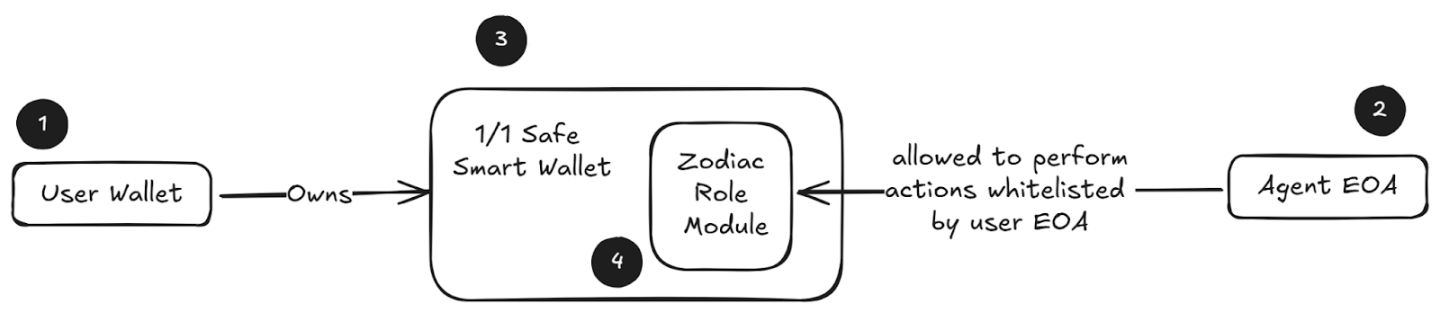
The wallet system is the core to ensuring the security of funds and the controllability of strategy execution. Almanak adopts a non-custodial solution of Safe + Zodiac, ensuring users have complete ownership of their funds and precisely and controllably delegating the permissions required for strategy execution to automated execution accounts (Deployment EOA). Users directly control the Safe Wallet through User Wallet (EOA or ERC-4337 smart account). The Safe Wallet embeds the Zodiac Roles Modifier module, allowing strict function whitelisting and parameter restrictions for Deployment EOA, ensuring "only allowed actions can be performed," with permissions revocable at any time.
The Deployment EOA is hosted by the platform, with its private keys stored securely using enterprise-level encryption and managed by Google’s security infrastructure, with no human access at any time. In extreme cases, the platform will immediately notify users to revoke permissions and generate a new EOA to ensure uninterrupted strategy operation. To ensure continuous execution of strategies, users need to purchase the Autonomous Execution Fees service package, covering on-chain operating costs (including Gas). This architecture achieves institutional-level security standards through the complete isolation of funds and execution permissions, fine-grained permission management, institutional-level key security, and rapid response to anomalies, laying a trust foundation for the large-scale adoption of automated DeFi strategies.

4. On-Chain Quantitative Strategy Vaults (Vaults)
Almanak Vaults are user-deployable, fully on-chain, permissionless vault contracts that transform trading strategies into tokenized, composable financial products. Unlike static "closed containers," these vaults are built on the asynchronous expansion standard ERC-7540 based on ERC-4626, designed as programmable capital allocators that can natively integrate into the DeFi ecosystem.
By tokenizing AI-generated strategies, vaults introduce a new DeFi primitive: the strategy itself becomes an ERC-20 asset, usable for LP, collateral, trading, transferring, or combining into structured products. This composability unlocks "DeFi Legos" at the strategy level, enabling seamless integration with protocols, funds, and structured products.
Vaults can be curated by individual curators or communities. Almanak Vaults are implemented based on Lagoon Finance's open-source contracts (MIT license), inheriting Lagoon's audit and security guarantees, and comply with the ERC-7540 standard. Its permission management mechanism aligns with Almanak Wallets, relying on Zodiac Roles Modifier to execute function whitelisting and parameter restrictions, ensuring all operations are completed strictly within authorized scopes.
The operational process includes:
- Strategy binding -- Binding existing Python strategies or AI-generated strategies to the vault;
- Capital raising -- Investors purchase vault tokens to gain proportional ownership;
- On-chain execution and rebalancing -- The vault trades according to strategy logic and dynamically adjusts positions;
- Profit distribution -- Distributing profits according to token holding ratios, with management fees and performance fees automatically deducted.
Core Advantages:
- Each vault position exists in the form of ERC-20 tokens, ensuring portability and interoperability;
- Strategies possess determinism and auditability, executed on-chain;
- Capital is both secure and liquid—safety and composability are no longer in opposition;
- Developers can permissionlessly integrate vault tokens into their own protocols, while capital allocators can flexibly allocate capital within the ecosystem.
In summary, Almanak Vaults evolve DeFi capital management from isolated packaging containers into intelligent, composable systems. By transforming AI-generated strategies into tokenized financial primitives, it pushes DeFi beyond passive yield containers towards a responsive, modular capital network, realizing the long-standing vision of programmable, interoperable finance.
5. DeFi Agentic Swarm
The Almanak AI Swarm architecture serves as a one-stop platform covering the complete strategy development cycle, capable of autonomously completing the research, testing, creation, and deployment of complex DeFi strategies while ensuring users maintain full control and assets remain non-custodial, aiming to simulate and replace the full operational workflow of traditional quantitative trading teams. Notably, the AI Swarm "team" consists of AI agents rather than real people.
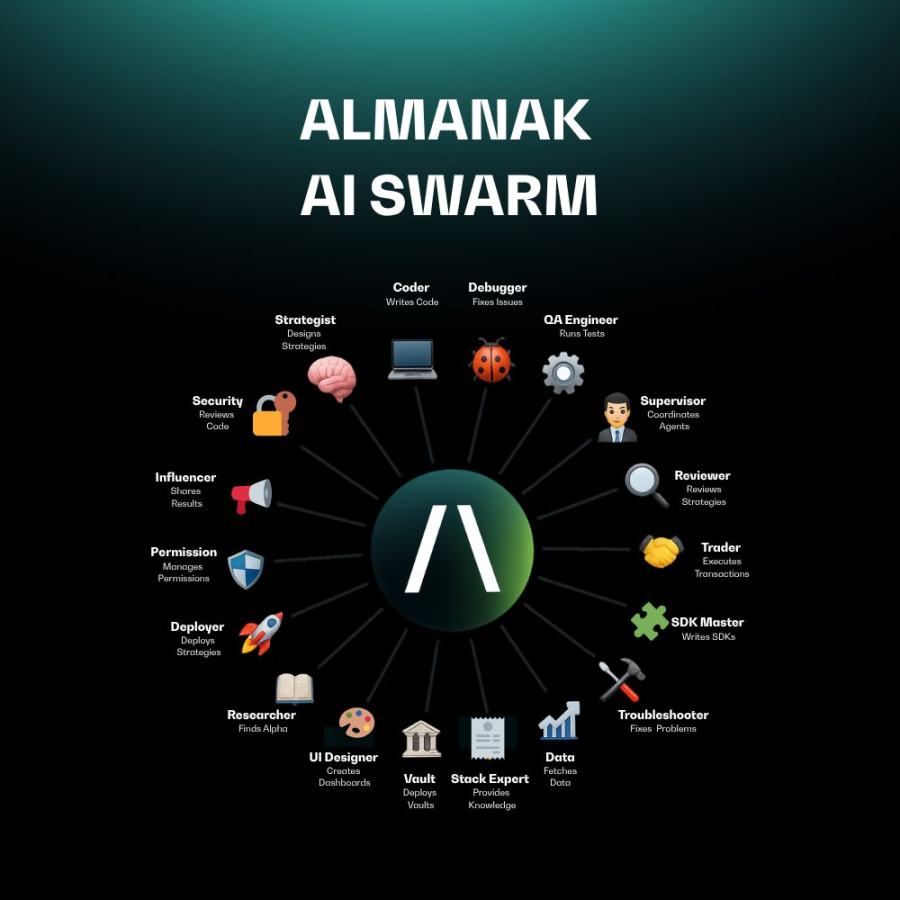
Strategy Team: Converts users' natural language instructions into deployable on-chain strategies, covering strategists (designing logic), programmers (writing smart contract code), auditors (verifying correctness), debuggers (fixing errors), quality engineers (running simulation tests), permission administrators (configuring execution permissions), UI designers (building visual panels), and deployers (executing mainnet deployments), ensuring a complete link from conception to execution.
The strategy team achieves deterministic process orchestration, persistent state sharing (TeamState), human-in-the-loop verification (HITL), parallel processing, and interruption recovery mechanisms through LangGraph. It can automatically execute the entire process but defaults to enabling human confirmation to ensure reliability.
Alpha Seeking Team: Continuously scans the entire DeFi market, identifying market inefficiencies, exploring new ideas and Alpha opportunities, and proposing new logic and strategy concepts to the strategy team.
Optimization Team: Conducts large-scale simulations of historical and predictive market data to rigorously evaluate strategy performance, performing hypothetical stress tests and periodic performance analyses before deployment, identifying potential drawdowns and weaknesses, ensuring stability and robustness of strategies in different market environments.
Additionally, auxiliary AI tools include Stack Expert AI and Troubleshooting AI: the former focuses on answering users' questions about the Almanak tech stack and platform operations, providing instant technical support; the latter focuses on real-time monitoring and problem identification during strategy execution, ensuring stability and continuity of strategy execution.
Almanak's core principle is that all AI operations are recorded, reviewed, and structured, with no AI operating independently, and all strategy logic must undergo complete human-in-the-loop verification before going live, with users retaining ultimate control and custody.
4. Almank Product Progress and Development Roadmap
Autonomous Liquidity USD Vault
Currently, Almanak has officially launched the Autonomous Liquidity USD (alUSDC Vault) stablecoin yield optimization vault deployed on the Ethereum mainnet through the community. Like other lending yield AgentFi products such as Giza and Axal, its core is the Stable Rotator Agent, which continuously scans the DeFi ecosystem, identifies and captures the highest yield opportunities, and automatically rebalances the investment portfolio based on customizable risk parameters. The strategy conducts intelligent trading cost analysis before execution, adjusting positions only when the yield increase sufficiently covers all costs, and combines advanced routing optimization with automatic compounding features to maximize capital efficiency. Currently, this vault connects to various USDC derivative assets from protocols like Aave v3, Compound v3, Fluid, Euler v2, Morpho Blue, and Yearn v3.
Almanak Liquidity Strategies and Swap Trading Strategies
The strategies launched by Almanak can be divided into two main categories: LP series (Dynamic LP Blue Chip, Dynamic LP Degen) and indicator spot strategies (MyAmazingStrat, PENDLERSI_Momentum, VIRTUALBollingerBandsMeanReversion), with detailed strategy content as follows:


Through AI tools analyzing the above strategy codes, we can draw the following conclusions:
- LP dynamic market making (Blue Chip / Degen) is suitable for pools with sustained trading volume and can accept impermanent loss; Blue Chip seeks stable fee income, while Degen aims for higher frequency yield capture.
- Indicator spot (EMA/RSI/BB) achieves light, multi-parameter grid experiments for tradable assets; however, strict cooling/slippage/minimum transaction volume control is required, with attention to pool depth and MEV.
- Capital and scale: Long-tail assets (Degen/ANIME/VIRTUAL) are more suitable for small/multiple instance strategies to diversify risk; blue-chip LP is more suitable for medium to long-term/higher TVL.
- Minimum viable combination for live trading: Dynamic LP Blue Chip (stable fee income) + RSI/BB type spot strategies (capturing volatility) + small deployments of Degen LP or EMA crossover for "high volatility testing ground."
Almanak Development Roadmap
Almanak's platform evolution is divided into three phases, gradually achieving expansion from technical foundation to full-chain popularization.
- Phase 1 focuses on infrastructure and early community building, launching a public beta version covering the complete quantitative trading stack, and forming a core user group through the Legion platform while distributing private testing qualifications. At the same time, it begins to accept funds into community vault strategies designed by AI, achieving on-chain automated management of the first batch of assets.
- Phase 2 Almanak plans to fully open AI Swarm functionality to the public by the end of this year. Before this, access permissions will gradually be relaxed as the system expands to large-scale use; this phase will be the formal landing period for the platform's token economy and incentive system.
- Phase 3 will shift focus to attracting global retail users, launching user-friendly products aimed at savings and retirement accounts, and integrating with centralized exchanges (such as Binance, Bybit) to achieve seamless connections between CeFi and DeFi. At the same time, it will expand asset classes using low-risk, high-capacity RWA strategies and launch mobile applications to further lower user participation thresholds.
Additionally, Almanak will continue to expand multi-chain support (including Solana, Hyperliquid, Avalanche, Optimism, etc.), integrate more DeFi protocols, and introduce multi-agent collaboration systems and Trusted Execution Environments (TEE), using AI to automatically discover Alpha and build the world's most comprehensive AI DeFi intelligent execution network.
5. Almank's Token Economics and Points Incentive
Almanak's token economic system aims to build an efficient and sustainable value exchange network for AI-driven financial strategies, enabling high-quality strategies and liquidity capital to be efficiently matched on-chain. The platform constructs an ecological closed loop through dual core roles of strategy & vault curators and liquidity providers: the former utilizes AI agent clusters (Agentic AI-Swarm) to design, optimize, and manage verifiable deterministic strategies in a no-code environment, introducing external capital through deploying permissionless vaults (Vault) and collecting management fees and performance shares; the latter deposits funds into these Vaults to gain tokenized strategy exposure and participate in profit distribution.
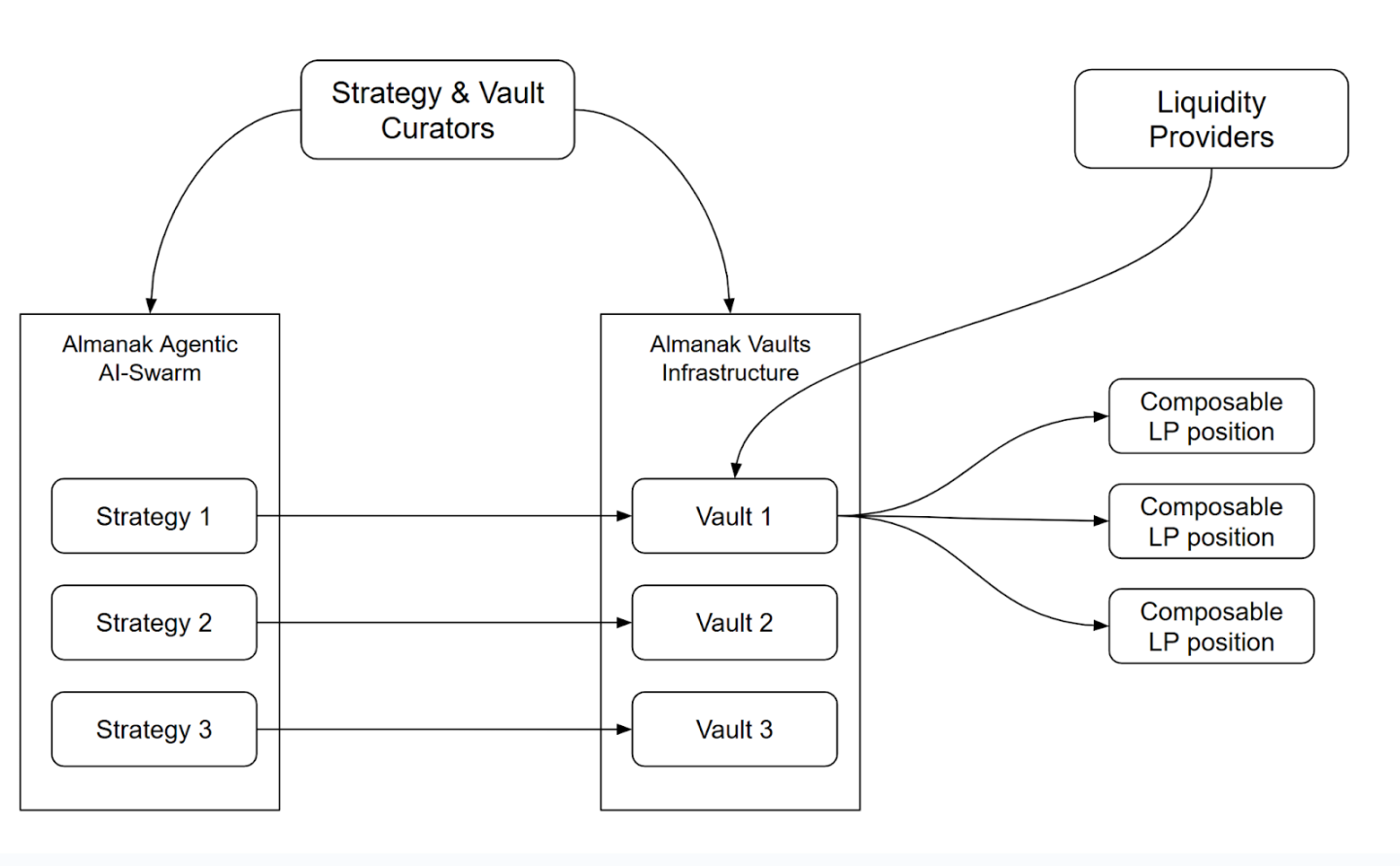
In terms of strategy privacy, strategy curators can choose between private mode (closed-source, not listed in the strategy library, accessible only to themselves) or public mode (open-source and listed in the strategy library, available for community and third-party protocol use), thus achieving a balance between IP protection and knowledge sharing.
The token economic model draws on the dynamic capital allocation logic of traditional hedge funds and integrates Bittensor's demand-driven emission distribution mechanism and Curve Finance's governance incentive model: the former allocates emissions weighted by TVL and strategy yield, encouraging capital concentration towards high-performance strategies; the latter introduces the "veToken + Bribe" model, allowing protocol parties to enhance the emission multiplier of specific Vaults through voting, guiding agentic traffic towards designated protocols.
Emission distribution adopts a weighted formula based on AUM and ROI, ensuring the contributions of Vaults in attracting capital and generating yields are directly translated into token rewards; while the governance bonus mechanism (Almanak Wars) can add up to 3 times the weight for target Vaults, forming an incentive market for project parties, curators, and liquidity providers. To maintain long-term sustainability, protocol fees (Vault fee sharing, computation resource markup, etc.) will partially flow back to the emission pool, gradually offsetting new emission pressures as the ecosystem matures.
Token functions include staking and governance: token holders can obtain discounts on platform computation resources through staking, increase voting weight, direct emissions towards specific Vaults, and participate in DAO governance, deciding key parameters such as computation resource markup rates, Vault fee ratios, and emission curves. The governance structure is expected to include an ecological parameters committee and an innovation development committee, responsible for protocol parameters, revenue distribution and fund management, ecological funding, and other affairs.
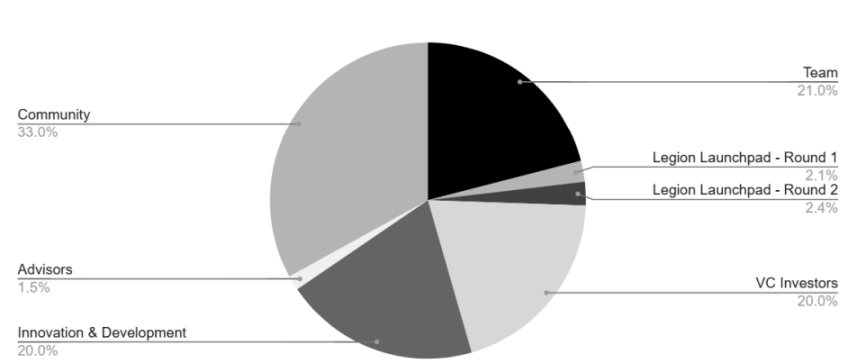
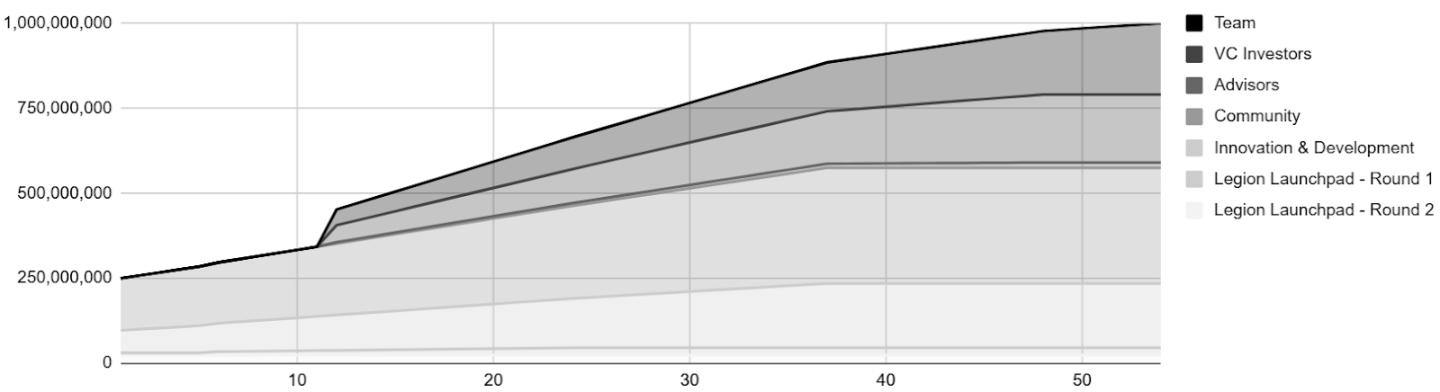
In terms of token distribution, Almanak has set up a team (54 months linear release, 12 months lock-up), institutional investors (48 months linear release, 12 months lock-up), advisors (48 months linear release, 12 months lock-up), innovation and ecological development (35% released at TGE, remaining 36 months linear release), community and early participants (45% released at TGE), and Legion community rounds (two rounds, first round 30% TGE + 24 months linear release, second round 100% TGE). The emission pool is used to reward network participants and early incentives, distributed according to an annual halving inflation model to maintain long-term incentives and governance activity.
Almanak Points: Quantitative Incentive Mechanism for Platform Participation
Almanak Points is the core mechanism for measuring user participation and contribution on the platform, aiming to drive asset retention, strategy usage, and community growth through a points system. Points are distributed in phases according to seasons, with the emission volume, participatory activities, and calculation methods adjusted for each season.
Users can earn Points through various means: ① Depositing funds into community vaults listed on the Almanak platform, with points calculated based on deposit size and holding time (current Vault deposits enjoy a 2× points multiplier); ② Holding assets in the Almanak Wallet, accumulating points based on balance and holding duration; ③ Activating and actively managing Deployments, earning additional points based on managed asset size, duration, and strategy complexity; ④ Referring new users to participate in platform activities, with the referrer receiving an additional reward of 20% of the referred user's points. Points are non-transferable and non-tradable but will convert to tokens at a 1:1 ratio upon token issuance. Additionally, points will serve as the basis for governance rights, functional usage permissions, and ecosystem benefits.
Project Financing and Token Issuance Strategy
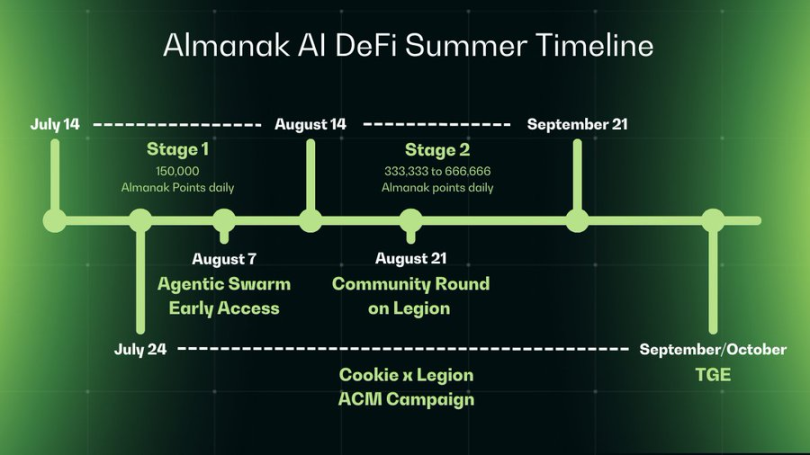
Almanak has deep collaborations with Cookie.fun and Legion.cc, introducing the Snaps/cSnaps mechanism to analyze on-chain traceable contribution points through Attention Capital Formation, directly linking user activity in community dissemination, content interaction, and financial support to token distribution, achieving a transparent and structured distribution logic of "contribution equals ownership."
In terms of capital background, Almanak received early incubation support from Delphi Digital and NEAR Foundation, and subsequently attracted well-known institutional investors such as Hashkey Capital, Bankless Ventures, Matrix Partners, RockawayX, AppWorks, Artemis Capital, and SParkle Ventures, with a total financing amount reaching $8.45M.
- January 8, 2025: Completed a $1M IDO through Legion, with a valuation of $43M, TGE unlocking 30%, with the remaining 70% set for a 6-month lock-up period and linear release over 24 months.
- August 21, 2025: The Legion community round financing is about to launch, with a valuation of $90 million FDV, targeting $2 million in financing, with a maximum cap of $2.5 million. This round is open to all verified accounts, and tokens will be 100% unlocked at TGE. TGE is expected to occur between late September and early October.
- Cookie DAO priority rights: The top 25 Snappers and the top 50 cSnappers will enjoy priority for investment at a $75 million FDV, also unlocking 100% at TGE.
- Activity incentives -- 0.55% of the total supply will be used for incentive distribution: of which 0.4% is allocated to the top 500 cSnappers (accounting for 80% of the reward pool), 0.1% to the top 250 Snappers, and 0.05% to $COOKIE stakers.
This issuance mechanism not only optimizes the fairness and participation threshold of token distribution but also deeply binds capital raising, community building, and long-term governance, forming a sustainable community of interest, laying the foundation for Almanak's long-term expansion in the AI × DeFi track.
6. Investment Logic and Potential Risk Analysis
Investment Logic
Almanak currently aligns more with the positioning of "the easiest-to-use retail DeFi strategy sandbox," possessing significant advantages in user experience, security architecture, and low barriers to entry, especially suitable for retail users who have never written code or lack on-chain strategy experience to quickly get started. Almanak's core competitiveness lies in the deep integration of AI multi-agent architecture and non-custodial execution systems, providing institutional-level security and strategy privacy protection while ensuring performance. Its tech stack consists of TEE (Trusted Execution Environment) + Safe Wallet + Zodiac Roles Modifier, enabling fully automated on-chain execution under permission management precise to contract function parameters, significantly outperforming most AgentFi models that rely solely on EOA for signing.
The technical architecture has formed a complete closed loop: from data acquisition (Sensors), strategy logic execution (persistent state machine architecture, Prepare / Validate / Sadflow), transaction execution (TransactionManager / AccountManager / ExecutionManager), to monitoring and metrics systems, and then to productization (ERC-7540 Vault) and external fundraising fees, with a smooth link and commercial scalability. Particularly, the Vault productization capability allows strategies to upgrade from self-use tools to externally issued financial products, bringing scalable management fees and performance share income to the platform.
On the operational side, the Points incentive system has been launched, with transparent rules oriented towards AUAM (Assets under Agentic Management), effectively driving locked amounts and activity levels; through the Attention Capital Formation model analyzing on-chain traceable contribution points, it deeply binds capital raising, community building, and long-term governance, forming a sustainable community of interest, laying the foundation for Almanak's long-term expansion in the AgentFi track.
Potential Risks
Although Almanak has a high level of completeness in its technical and functional systems, it still faces several key challenges:
First, protocol testing has not been fully opened. Currently, it only supports lending protocols on the Ethereum mainnet, as well as LP and Swap strategies based on Uniswap V3. The underlying Kitchen has already supported Ethereum, Base, and Arbitrum, with the capability to expand to 8+ EVM chains and 200+ protocols. The pace of broader open expansion (such as Base, Solana, Hyperliquid), multi-protocol access, and CEX integration will directly impact the diversity of strategies, yield opportunities, and market competitiveness.
Second, the strategy levels remain relatively basic. Existing strategies primarily focus on entry-level technical analysis (TA), still falling short of institutional or professional quantitative standards. In the future, it will be necessary to introduce a richer library of advanced strategies (covering on-chain liquidity management, funding rate arbitrage, cross-pool price differences, and multi-signal fusion, etc.), and improve backtesting and simulation trading tools, built-in cost optimization engines, and multi-strategy combination management functions to grow into the preferred entry point for retail users entering DeFi quant.
Additionally, the ecosystem and user base are still in the early stages. Although the points program and Vault mechanism have been launched and entered the first tier of AgentFi, the growth of TVL managed by AI-driven Vaults still requires time for validation, and user activity and retention rates will be key indicators in the medium to long term.
Overall, Almanak possesses maturity in technical architecture, clarity in commercialization paths, and drive in incentive mechanisms, making it rare in the AI-driven on-chain quantitative and asset management track. However, the speed of ecosystem expansion, the evolution of competitive landscapes, and the stability of technological implementation will be the three core variables determining its ability to maintain a leading position in the long term.
 Risk warning Risk warning