








Data Insights: The Status of Local Stablecoins in Southeast Asia Q2 2025

 This article explores the development of non-dollar stablecoins in the Southeast Asia region, analyzing their driving factors, market landscape, and future potential.
Original Title: Q2 2025: The State of Local Stablecoins (Non-USD) in Southeast Asia
Original Author: rafi, Crypto Researcher
Original Compilation: Deep Tide TechFlow
Key Points
· Dominance of Stablecoins Pegged to the Singapore Dollar: XSGD is the only stablecoin issuer pegged to the Singapore Dollar, and with partnerships with Grab and Alibaba, XSGD holds a dominant position in the Southeast Asian local stablecoin market.
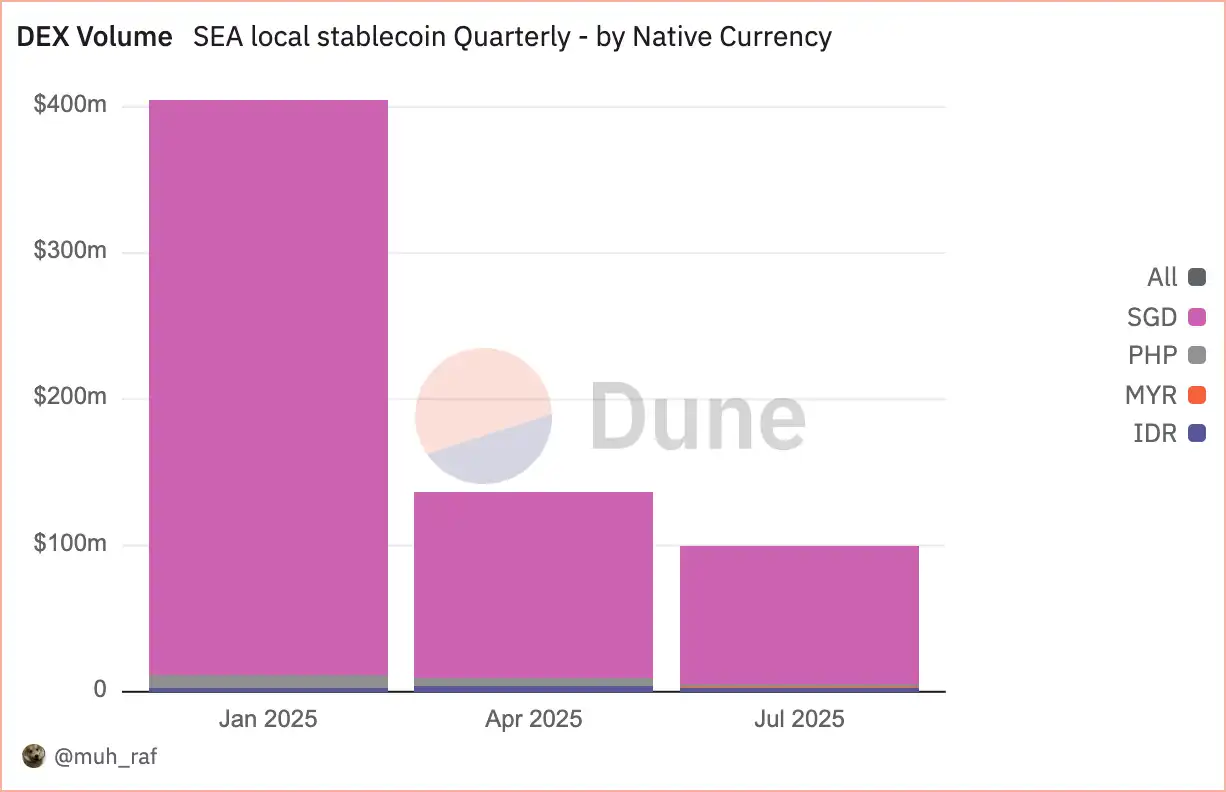
· Market Indicators: Operating on over 8 EVM chains, with 8 issuers and support for 5 local currencies. In Q2 2025, the trading volume on decentralized exchanges (DEX) reached $136 million (dominated by the Avalanche chain and Singapore Dollar), down 66% from $404 million in Q1.
· Regulatory Progress: The Monetary Authority of Singapore is advancing a stablecoin framework for the Singapore Dollar and SCS pegged to G10 currencies; Indonesia and Malaysia have launched regulatory sandbox trials.
· Cross-Border Trade: In 2023, only 22% of Southeast Asia's trade occurred within the region, with over-reliance on the US dollar leading to costly delays and fees. Local stablecoins can streamline settlement processes by providing instant, low-cost transfers and further accelerate through the ASEAN Business Advisory Council's regional QR payment initiative.
· Financial Inclusion: Over 260 million people in Southeast Asia lack bank accounts or access to banking services. Non-USD stablecoins can expand affordable financial service channels when integrated into super app wallets like GoPay or MoMo, supporting remittances, microtransactions, and everyday digital payments.
Southeast Asia (SEA) has a combined GDP of $3.8 trillion and a population of 671 million, making it the fifth-largest economy globally, competing with other economies and boasting 440 million internet users, driving digital transformation.
Against this backdrop of economic vitality, non-USD stablecoins and digital currencies pegged to regional currencies or a basket of currencies provide transformative tools for Southeast Asia's financial ecosystem. By reducing reliance on the US dollar, these stablecoins can enhance cross-border trade efficiency, stabilize transactions within the region, and promote financial inclusivity among different economies.
This article explores why non-USD stablecoins are crucial for financial institutions in Southeast Asia and policymakers aiming to shape a resilient and integrated economic future.
Transactions
Source: https://dune.com/queries/5728202/9297229
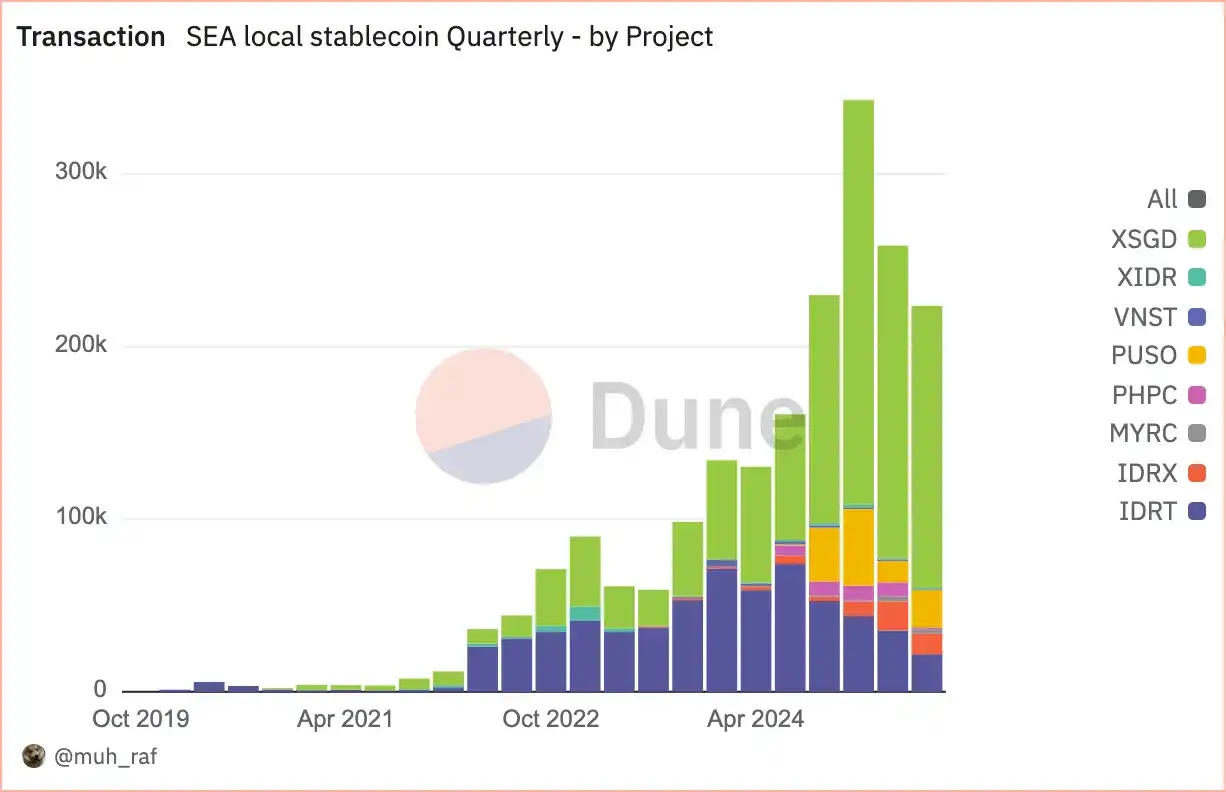
Since January 2020, the adoption rate of non-USD stablecoins in Southeast Asia has rapidly increased from 2 projects to 8 projects by 2025. This growth is attributed to increased trading volume and the use of diversified blockchain platforms.
In Q2 2025, the trading volume of non-USD stablecoins in Southeast Asia reached 258,000 transactions, with stablecoins pegged to the Singapore Dollar (especially XSGD) accounting for 70.1% of the market share, followed by stablecoins pegged to the Indonesian Rupiah (IDR) (IDRT and IDRX), which accounted for 20.3%. This reflects strong regional economic activity and regulatory support, highlighting their key role in Southeast Asia's digital economy.
Source: https://dune.com/embeds/5728202/9297229
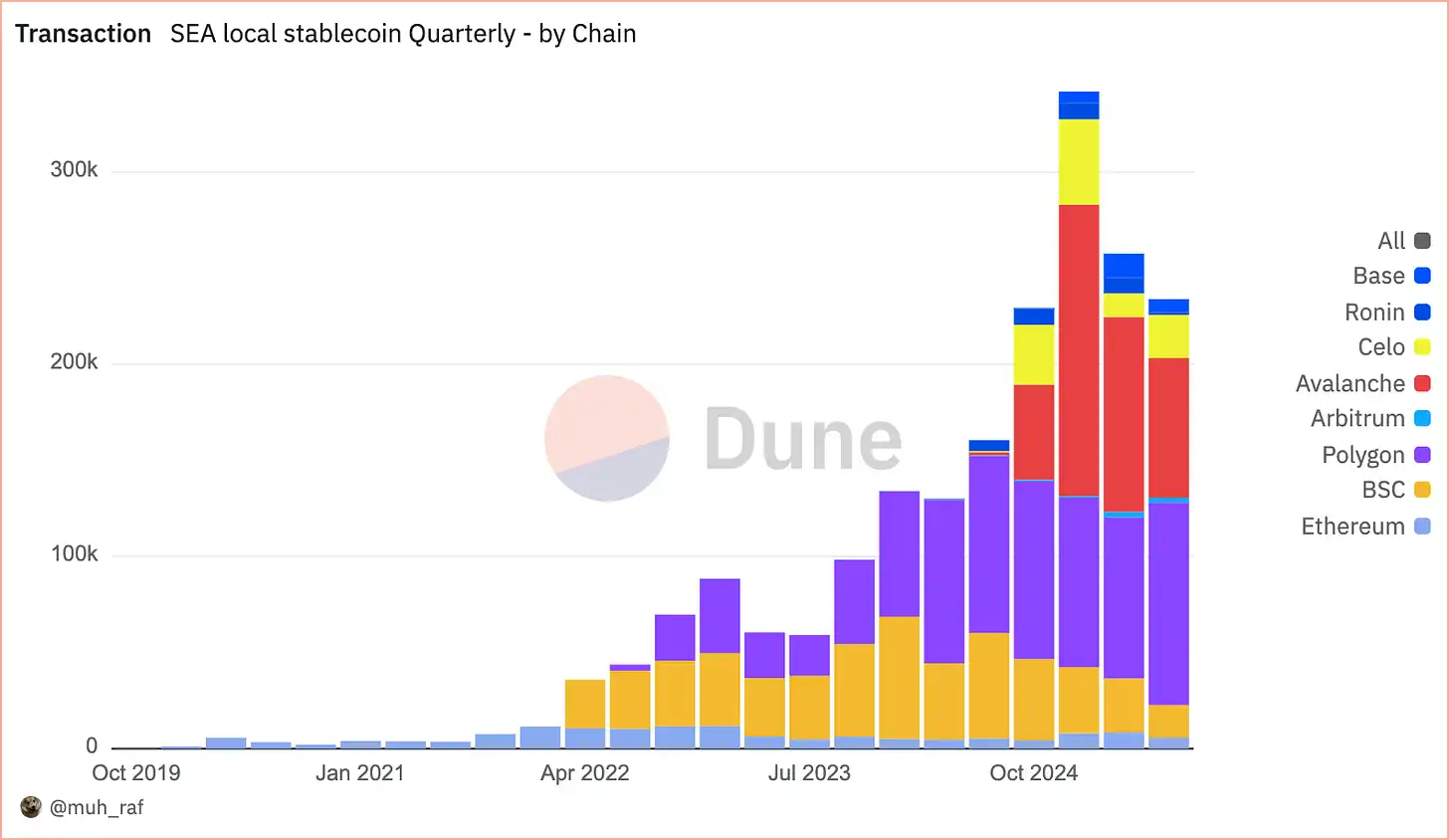
Over the past four years, since 2020, the trading volume of non-USD stablecoins in Southeast Asia has surpassed 1 million transactions, driven by widespread adoption and strong exposure to EVM chains, which continue to lead market share growth quarter by quarter. In Q2 2025, Avalanche led with a 39.4% market share (101,000 transactions), followed by Polygon (83,000 transactions, accounting for 32.5%) and Binance Smart Chain (28,000 transactions, accounting for 10.9%). The rapid rise of Avalanche is primarily attributed to the XSGD project, which is currently the only stablecoin operating on the Avalanche chain and has gained significant traction since its launch. XSGD is a stablecoin pegged 1:1 to the Singapore Dollar, issued by StraitsX, a major payment institution licensed by the Monetary Authority of Singapore (MAS).
Active Addresses
Source: https://dune.com/queries/5728541/9297706
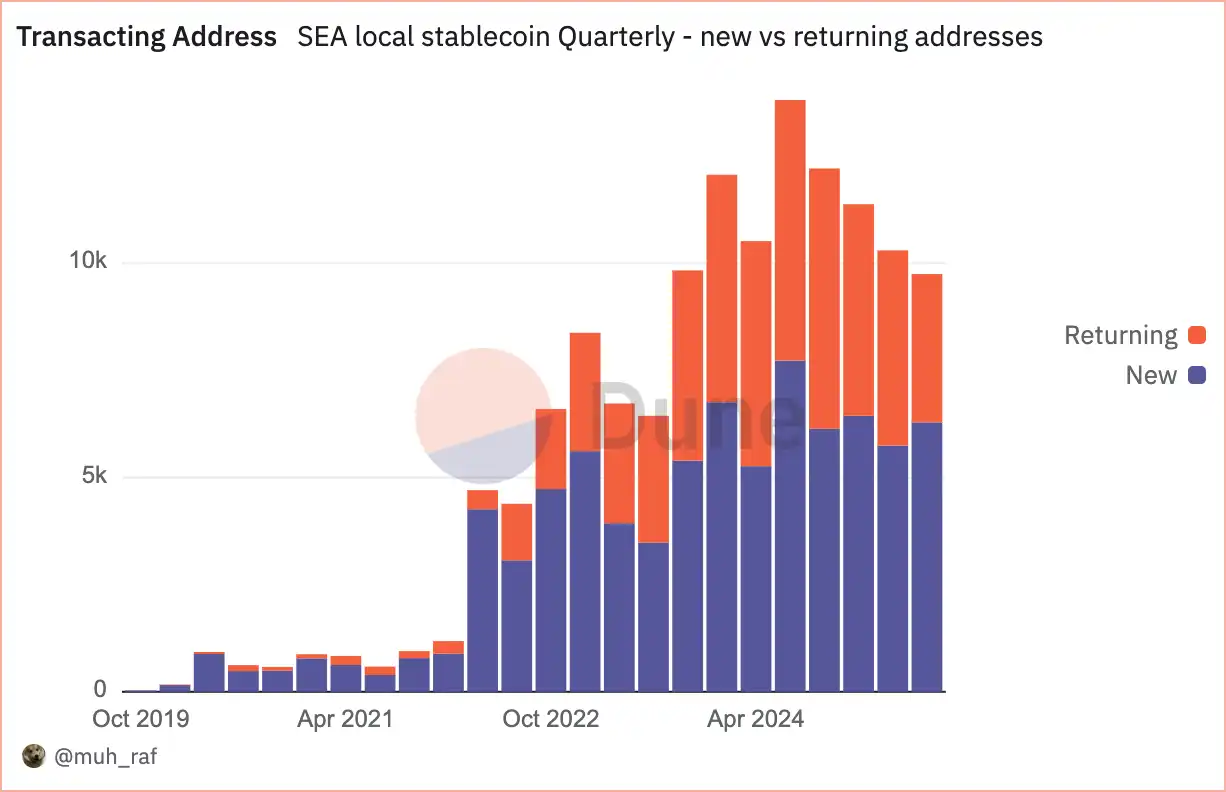
Since Q2 2025, non-USD stablecoins in Southeast Asia have seen widespread adoption, with the number of active (trading) addresses significantly increasing to over 10,000, of which 4,558 are returning addresses and 5,743 are new addresses, indicating steady growth and increased engagement among stablecoin users.
Source: https://dune.com/queries/5728383/9297467
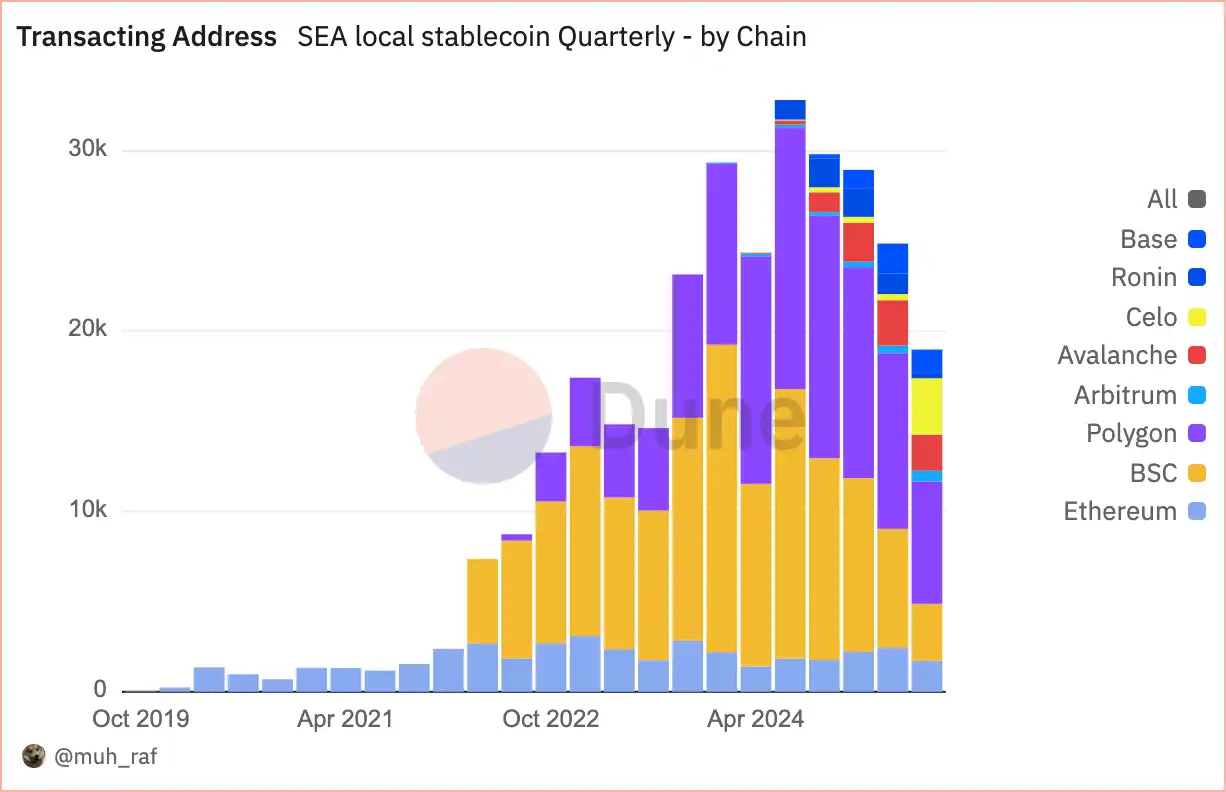
Unlike the number of transactions reflecting overall activity levels, active (trading) addresses reflect user engagement and adoption rates. In Q2 2025, among Southeast Asia's non-USD stablecoins, Polygon led with a 39.2% share, followed by Binance Smart Chain (BSC) with a 23.1% share, and Avalanche with a 10.1% share.
Note: In the "Grouped by Chain" view, addresses trading stablecoins across multiple chains (such as Polygon and Base) are counted as separate addresses on each chain, resulting in a total that is higher than the "Ungrouped" view (deduplicated data).
DEX Trading Volume
Source: https://dune.com/queries/5748360/9327460
In Q2 2025, DEX trading volume fell 66% from $404 million in Q1 to $136 million. Avalanche led with a 51% share ($69 million), followed by Polygon at 33% ($45 million) and Ethereum at 9% ($12 million). This decline highlights the trend of blockchain shifting towards scalability, with Avalanche and Polygon dominating.
Source: https://dune.com/queries/5748398/9327527
As mentioned earlier, in Q2 2025, the DEX trading volume in local currency reached $132 million, with stablecoins pegged to the Singapore Dollar dominating the Southeast Asian non-USD stablecoin market. Assets denominated in Singapore Dollars accounted for 93.1% ($127 million), followed by the Philippine Peso (PHP) at 3.9% ($5 million) and the Indonesian Rupiah (IDR) at 2.7% ($3.6 million). This underscores the dominance of the Singapore Dollar in regional DEX activity.
Southeast Asia Stablecoins: Opportunities and Challenges
Opportunities
· Enhancing Cross-Border Trade Efficiency
In 2023, intra-regional trade in Southeast Asia accounted for 22% of its total trade, but transactions are often conducted through US dollar-based correspondent banks, leading to high fees and delays of up to 2 days. Stablecoins pegged to Southeast Asian currencies offer a more efficient alternative, enabling near-instant settlements at lower costs. On this basis, the ASEAN Business Advisory Council (BAC) has adopted cross-border QR payments settled in local currencies. Collaboration between BAC and Southeast Asian stablecoin issuers is expected to further reduce remittance costs and improve exchange rates.
· Promoting Financial Inclusion
Southeast Asia has 260 million people lacking banking services or bank accounts, and non-USD stablecoins can fill the gap in financial services. Mobile-based stablecoin wallets integrated with platforms like GoPay in Indonesia or MoMo in Vietnam can facilitate low-cost remittances and microtransactions.
Challenges
· Regulatory Uncertainty and Fragmentation
The diverse regulatory frameworks in Southeast Asia create uncertainty for stablecoin issuers and users. There are significant policy differences among countries, with Singapore's policies being relatively progressive, while others have stricter regulations, which may lead to compliance challenges and uneven adoption.
Recommendation: Southeast Asian policymakers should collaborate to develop a unified regulatory framework for stablecoins, establishing clear guidelines regarding licensing, consumer protection, and anti-money laundering (AML) compliance to build trust and consistency.
· Market Volatility and Currency Peg Risks
Stablecoins pegged to regional currencies are susceptible to fluctuations in local currencies, which may undermine their stability and user confidence. Insufficient reserve backing or poor management could further exacerbate risks.
Recommendation: Stablecoin issuers should maintain transparent, fully-backed reserves and undergo regular independent third-party audits. Diversifying the basket of pegged currencies can also reduce volatility risks.
Conclusion
In Q2 2025, the Southeast Asian non-USD stablecoin market experienced significant growth, led by the only issuer pegged to the Singapore Dollar, XSGD, driven by partnerships with Grab and Alibaba. Operating on over 8 EVM chains, with 8 issuers and support for 5 local currencies. DEX trading volume reached $136 million, primarily concentrated on Avalanche and the Singapore Dollar, but down 66% from $404 million in Q1. The Monetary Authority of Singapore (MAS) has advanced a stablecoin framework for the Singapore Dollar and G10 currencies, while Indonesia and Malaysia have introduced regulatory sandboxes.
This growth highlights the potential of non-USD stablecoins in Southeast Asia to enhance cross-border trade and financial inclusion, but factors such as regulatory fragmentation, currency volatility, cybersecurity risks, and uneven digital infrastructure need to be managed carefully to achieve sustainable development.
Original Link ```
 Risk warning Risk warning


Popular articles





