








Return to the Throne: The Resurrection of Pump.fun

 At the darkest moment when the market pronounced the death penalty, Pump.fun delivered three powerful blows of capital, ecology, and mainstream recognition, staging a resurrection myth of a strong rise from the ruins and reclaiming the throne.
Author: Lex, ChainCatcher
In the world of cryptocurrency, the lifecycle of a project is often as fleeting as a shooting star, with a fall from grace seeming to happen in an instant.
In July 2025, Pump.fun, once the absolute ruler of the Solana meme ecosystem, found itself on the edge of such a cliff, with its token price plummeting over 80%, entangled in legal lawsuits, besieged by competitors, and market confidence nearly collapsing.
However, just two months later, Pump.fun not only miraculously "revived" but also returned to its throne with an unprecedented strong posture. This was not a stroke of luck, but a meticulously planned and interconnected strategic counterattack.
Through nearly $100 million in aggressive buybacks, the Project Ascend that reshaped the creator economy, and a milestone breakthrough by landing on Binance, Pump.fun staged a textbook-level self-rescue.
Abyss: Internal and External Troubles at the Darkest Hour
Every legendary prologue often begins with a journey through the darkest times. In July 2025, Pump.fun faced its "darkest hour" since its inception, with the platform simultaneously grappling with dual strangulations from the market and regulation.
Internal Trouble: Crisis of Market Trust
The free fall of the $PUMP token price was the most direct manifestation of the crisis. From a historical high of 0.00687 on July 15 to a historical low of 0.00226 on July 29, a nearly 70% drop evaporated most of its market value. Meanwhile, competitors seized the opportunity, and the market began to widely question the sustainability of the Pump.fun model, spreading panic.
External Trouble: The Damocles Sword of Regulation
Even more deadly was the risk at the legal level. A class-action lawsuit claiming up to $5.5 billion directly accused Pump.fun of operating an "unlicensed casino" and allegedly violating securities laws. To make matters worse, several exchanges in the EU suspended trading of the $PUMP token due to compliance reviews related to the MiCA legislation.
Under the dual pressures of internal and external troubles, the narrative of Pump.fun seemed to be nearing its end. However, it was precisely on this rubble that the team brewed an ambitious revival plan, the first step of which was to declare their determination to the market with real money.
1. Capital Declaration: A Buyback Storm of Nearly $100 Million
Faced with the collapse of market confidence, any pale words seemed powerless. Pump.fun chose the most direct and powerful method: to initiate an unprecedented token buyback. Starting in August, the platform allocated 100% of its daily revenue (previously 25%) to buy back and burn $PUMP tokens on the open market.
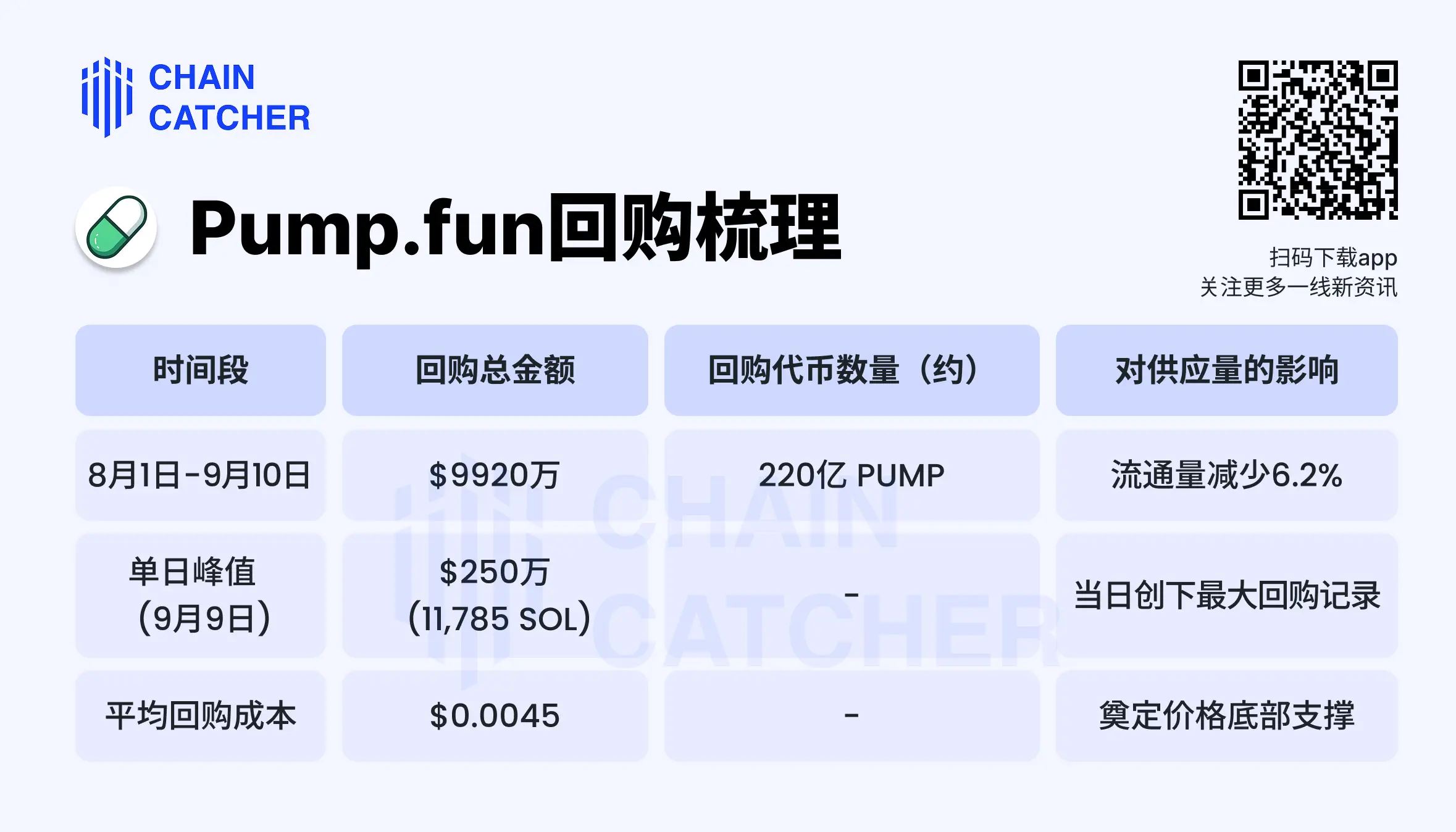
As of September 12, the circulating supply of $PUMP decreased from 35.4 billion to 33.2 billion, effectively removing 6.2% of the selling pressure from the market. Behind this aggressive buyback was the platform's strong cash flow. Pump.fun's cumulative protocol revenue had reached $808 million, far exceeding competitors like Raydium and PancakeSwap, with a single-day revenue peak of $2.28 million on August 28.
2. Ecological Reconstruction: The Alchemy of Project Ascend
If the buyback was "stanching the bleeding," then product innovation was "blood production." On September 2, Pump.fun launched the Project Ascend upgrade, fundamentally reconstructing the platform's economic model and tilting the balance towards the core of the ecosystem—the platform users.
The "Project Ascend" upgrade introduced a market-cap-based gradient fee structure, where trading fees for tokens on PumpSwap would decrease as the SOL-denominated market cap increased, from a maximum of 1.25% down to a minimum of 0.3%. Creator revenue peaked at 0.95% within the market cap range of 420-1470 SOL, while the platform fee was uniformly set at 0.05%, and liquidity provider fees were fixed at 0.2%.
Its fee structure is as follows:
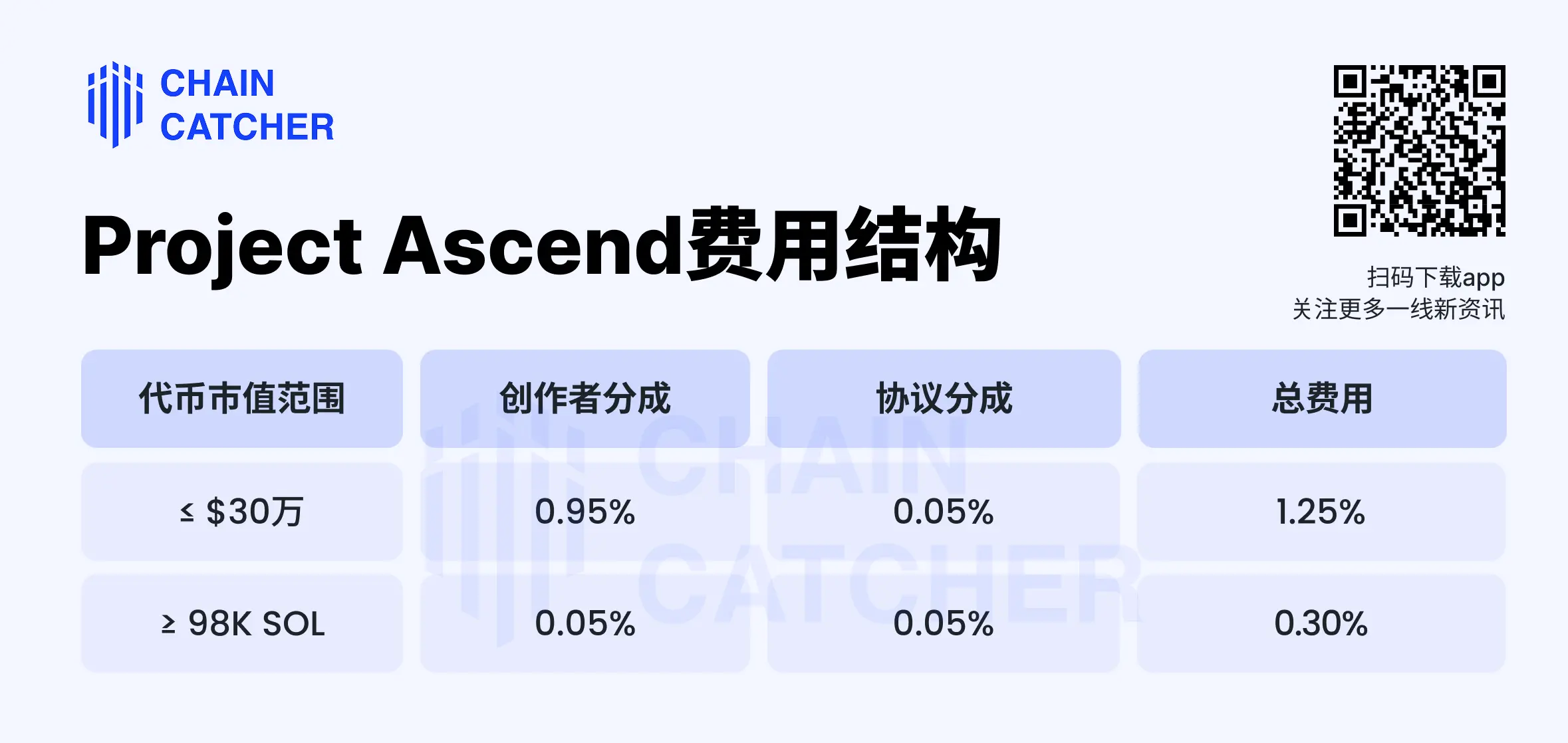
This design greatly incentivized early projects and creators, allowing them to capture the vast majority of trading fees, thus attracting a flood of innovative forces into the platform. The effects were immediate, and a creator-driven growth flywheel began to spin rapidly.
Creator Earnings Explosion:
- First-day creator earnings: $2 million
- First-week creator earnings: $15.5 million, exceeding protocol revenue of $1.5 million
- Earnings for a single creator in 24 hours: up to $80,000
- Compared to Twitch: earnings "10 times higher" for the same audience size
Platform Activity Surge:
- PumpSwap DEX single-day trading volume: reached a historical high of $878 million on September 8
- Market share: accounted for 73.6% of Solana token listings, while LetsBonk only accounted for 15.3%
- Daily average token listing volume: accounted for 91% of the entire Solana network, while LetsBonk dropped to 3%
Project Ascend not only repaired the internal incentive mechanisms of the ecosystem but also built a strong network effect moat, transforming Pump.fun from a mere meme coin issuance tool into a vibrant creator economy platform.
3. Mainstream Crowning: The Milestone of Landing on Binance
Once the internal capital and ecological issues were resolved, Pump.fun welcomed the final chapter of its revival journey: gaining full recognition from the mainstream market. On September 11, Binance announced the listing of the PUMP token, marking Pump.fun's official transition from an "experimental" on-chain protocol to a "mainstream infrastructure" endorsed by top centralized platforms.
The effect of the Binance listing was decisive:
- Price and trading volume soared: within 24 hours of listing, the $PUMP price rose by 22%, and trading volume surged to $443 million, three times the previous weekly average.
- Liquidity shift: asset liquidity rapidly migrated from the on-chain PumpSwap to mainstream exchanges like Binance, Upbit, and MEXC, paving the way for larger-scale capital inflows.
- Legitimacy and credibility crowned: landing on Binance was not only a victory for liquidity but also for credibility. It dispelled market doubts about the project's compliance and long-term viability, attracting a large number of retail and institutional investors who had previously been on the sidelines.
From the opening of deposits to the listing of trading pairs, and the gradual unlocking of subsequent derivative functions, Binance's "crowning" perfectly concluded Pump.fun's revival journey and opened a new growth narrative.
Conclusion: From Individual to Whole, The Answer to Crossing Cycles
The revival journey of Pump.fun, from being declared "dead" by the market to now returning to the throne of the Solana meme ecosystem, saw its price rebound from a low of 0.00226 to 0.0089, an increase of 294%. Behind this reversal are a series of clear strategic measures:
- Financial Commitment: Nearly $100 million in buybacks to stabilize confidence with the strongest financial strength and build a price moat.
- Product Innovation: Reshaping value distribution with Project Ascend, building a strong network effect centered around creators.
- Market Recognition: Leveraging top platforms like Binance to complete the transformation from "grassroots" to "regular army," bringing in massive liquidity.
Of course, the future of Pump.fun is not without challenges. Short-term technical corrections, unresolved legal lawsuits, and increasingly fierce market competition remain challenges it must face.
It is worth noting that Pump.fun's response strategy also reflects a broader industry trend: as market enthusiasm wanes and macro liquidity tightens, how on-chain protocols utilize their economic models and treasury for "self-rescue" is becoming an increasingly important topic. From diversified treasury management, token buybacks, to liquidity incentive adjustments and fee capture mechanism optimizations, these publicly visible proactive operations are transforming from mere "crisis management" into stress tests of whether the protocol's economic model can withstand bull and bear markets.
Pump.fun's response during this crisis provides the market with a concrete case to observe the financial and governance resilience of DeFi protocols. The self-rescue of Pump reveals that beyond products and innovation, the protocol's ability to self-reconstruct through on-chain tools and realign its interests with long-term holders is becoming a key factor in assessing its long-term value. When external narratives and liquidity recede, the intrinsic financial health and governance effectiveness of a protocol may be the core support for its ability to traverse cycles.
(This article is for reference only and does not constitute any investment advice.)
 Risk warning
 Risk warning


Popular articles





