








Aave: What is the future strategy of the king of lending?

 "If we play our cards aggressively enough, none of the existing competitors will survive."
Original Title: Aave DAO's State of the Union by ACI
Original Author: Marc Zeller, Founder of Aave Chan Initiative
Original Compilation: Azuma, Odaily Planet Daily
Editor's Note: Aave has long become the only giant in the DeFi lending market.
On September 15, Marc Zeller, founder of the Aave Chan Initiative (ACI), summarized the lessons learned from Aave's past development in a piece titled "Aave's State of the Union," analyzing Aave's current market position in lending and the DeFi industry, and proposing strategic plans for Aave's future development from multiple dimensions.
ACI has been committed to promoting Aave's development through technological innovation and community governance optimization, and Marc Zeller himself has been regarded as the most active opinion leader in Aave DAO. In the past few years, as Aave outpaced all competitors, both ACI and Marc Zeller have played a crucial role, and their attitudes have significant directional implications for Aave's future development.
The following is the original text by Marc Zeller, compiled by Odaily Planet Daily.
Rebirth from the Ruins
The Aave Chan Initiative (ACI) was launched in November 2022, at a time when the entire DeFi industry was facing a collapse. The fraudulent activities of CeDeFi entities led to the successive collapses of FTX, Celsius, and Three Arrows Capital (3AC), followed by the Anchor protocol's explosion, resulting in $6 billion in liquidations—equivalent to a quarter of Aave's historical highest TVL. In this chaos, stETH also became unpegged. Regulatory agencies seized the opportunity to crack down on the industry, attempting to eliminate it entirely.
The internal situation at Aave was equally dire. The DAO was controlled by extractive entities, teams like Gauntlet and Llama were plundering treasury resources, TVL plummeted to $5 billion, and the balance sheet showed an annual loss of up to $35 million. The founding team also faced issues such as talent loss and core member splits, and immense pressure from hostile regulators limited the team's operational capabilities.
External challenges were equally severe. Aave's open-source nature was exploited by some extractive teams, with opportunists raising funds by copying Aave's codebase and issuing their own tokens, and some ecosystems even tacitly condoned such behavior. These copycat projects often received more generous incentives and airdrops than Aave, creating a false appearance of prosperity, and when they were hacked due to incompetence or recklessness, the entire Aave ecosystem had to bear the reputational damage for their failures.
To stand out in an increasingly competitive environment, Aave V3 was launched on Layer 2, but the results were minimal. At that time, the protocol's codebase was in urgent need of improvement—while there were many excellent ideas, there was a lack of coherent implementation paths and visions. For example, features like Portals and credit delegation vaults remained in the proof-of-concept stage.
"DeFi is dead" became a consensus in the industry, and giving up the struggle while gradually depleting treasury funds seemed to be the most rational choice.
But we refused to surrender.
We left the comfort of the founding team and plunged into the battlefield of the DAO, launching the "Make Aave Great Again" initiative. This was an action taken without guarantees, entirely out of faith—no investment, no resources, and a minuscule chance of success, but it was a necessary step, so we pressed on without hesitation.
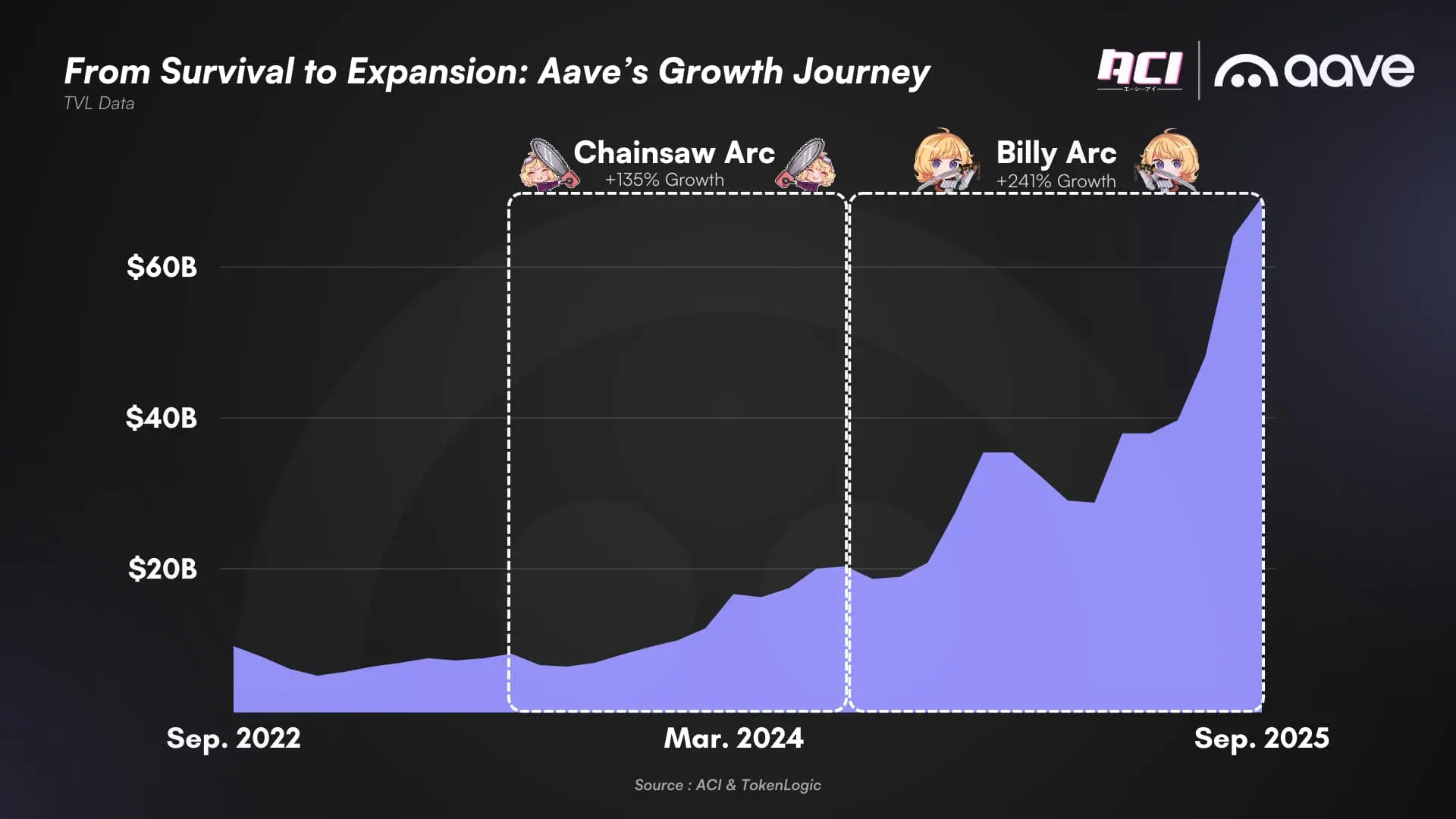
Stalemate (Chainsaw Arc)
Eighteen months after ACI's launch, extractive entities had been eliminated, resource-wasting verticals had been cut down, and the DAO had established a clear and efficient professional framework, operating in collaboration with a group of high-quality service providers within defined boundaries.
The community truly gained the power of discourse for the first time, able to directly influence Aave's future. Initiatives launched by ACI, such as Skywards, Dolce Vita, and Orbit, laid the efficient foundation for DAO processes. With the key technical support of former founding team members (now BGD Labs), the codebase continued to optimize, the protocol achieved positive returns, and regained market share in the most brutal competitive environment in history.
At that time, the competitors faced by the DAO were well-funded, with multiple protocols raising tens of millions of dollars, attempting to "devour Aave," but they failed to shake our market dominance. This was all thanks to the focus and hard work of DAO service providers, who spared no effort to ensure our success.
This period, which we call the "Chainsaw Arc," was filled with challenges. ACI was underfunded, with few supporters, facing hostility from both inside and outside, enduring fierce attacks and smears. Despite the immense challenges, looking back, David defeated Goliath, thanks to the hundreds of individual voting representatives who decided to join this initiative and turn the tide. Their contributions made everything possible; although Aave's main audience may never know their names, we sincerely thank each of them for their support.
All achievements were hard-won rather than given. We are immensely proud of Aave's outstanding accomplishments, the impressive combination of DAO service providers, and the delegated ecosystem that has made today's Aave possible.
Comfortable Status Quo
Aave DAO's current situation is relatively comfortable.
TVL (Total Value Locked), revenue, market share, lending volume—every metric confirms the success of the DAO. Aave has not only improved but has also surpassed expectations. We believe that Aave's dominant position is no longer threatened by similar competitors. The core profitable scenarios for on-chain lending—leverage (re)staking, stablecoin lending collateralized by BTC and ETH, and yield-generating collateral arbitrage trading—are now firmly dominated by Aave.
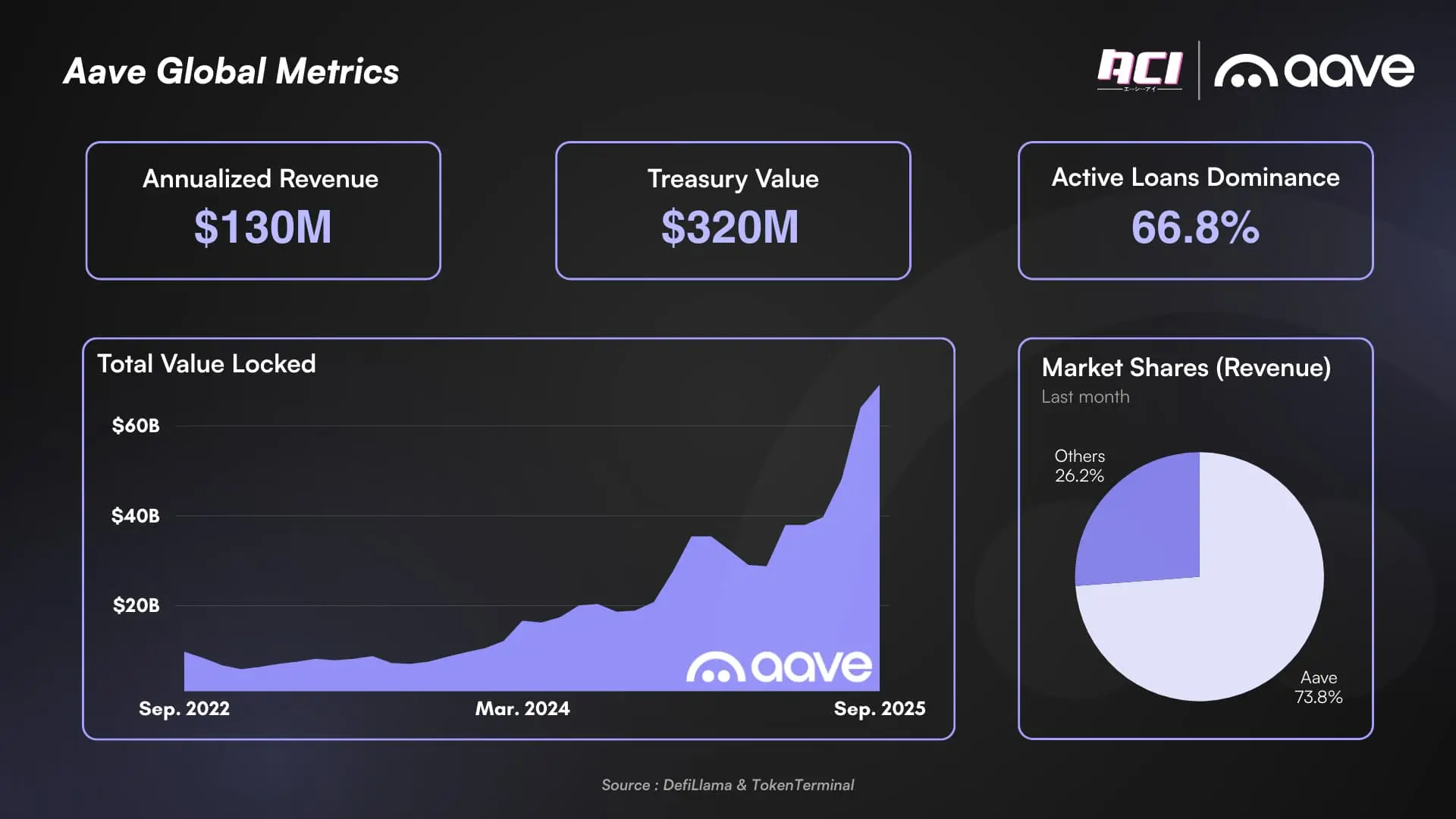
Our competitors often fall into one of three traps: TVL leasing—temporarily attracting liquidity through high native token incentives, creating a false appearance of TVL prosperity; long-tail asset collateral traps—relying on high-risk, low-liquidity fringe assets to bolster TVL; loss-making distribution protocols—signing partnerships that increase TVL but yield almost zero revenue, while diluting user returns at the cost of native token value. While these tactics can inflate their TVL, they generate little actual revenue and require high incentives in native tokens, diluting user returns.
Aave's current annual net income has surpassed the total cash reserves of all competitors. They urgently need a new round of financing to maintain operations, trapped in the dilemma of depleting reserves; meanwhile, we have abundant resource flows for further growth. If market trends reverse, the value of the token incentives they rely on will be severely impacted, while our cash remains cash—cash is king.
Moreover, one of the core commitments made at the launch of ACI—improving Aave's token economic model and empowering native assets—has begun to materialize. Aave's buyback plan has absorbed over 0.5% of the total token supply, and Aave's current revenue allows the DAO to institutionalize this plan, enhancing market confidence in the lasting value of our ecosystem.
But complacency has never been in Aave's DNA.
Optimize, Focus, Accelerate
Now is the time to shift focus from external threats to internal restructuring to drive Aave's further growth and strengthen market dominance. The first step is to conduct self-examination, assessing the strengths and weaknesses of existing strategies, and concentrating resources to move forward.
Current Layer 2 Landscape Analysis
The Layer 2 strategy formulated in the early days of Aave V2 has been a key factor in Aave's success. We deployed to the Polygon and Avalanche ecosystems as early as 2021, gaining strong ecological support and achieving growth in uncharted territory, ultimately forming a mutually beneficial pattern. However, the situation in 2025 is already different.
In past cycles, ecosystems focused on development, but recently the influence of VCs, opportunistic investors, captured DAOs, and foundations has eroded the successful formula, leading to Layer 2 fatigue—distracting efforts through a "scattergun" strategy, prioritizing short-term gains for farming users over building long-term sustainable on-chain economic value, ultimately diluting the chances of success.
In previous market cycles, various ecosystems often focused on deepening their own fields. However, in recent years, the influence of venture capital, opportunistic investors, captured DAOs, and foundations has gradually eroded this successful model, leading to the following phenomena: Layer 2 ecosystem fatigue—project parties adopting a "scattergun" strategy, spreading resources across multiple networks; value dilution—prioritizing farmers' pursuit of short-term gains rather than obtaining long-term value through building a sustainable on-chain economy; mechanism distortion—spray-and-pray schemes becoming mainstream, ultimately trapping all participants in an inefficient cycle.
The lifecycle of Layer 2 from token generation (TGE) to TVL decline is sharply shortening. Aave was mistakenly attracted by seemingly enticing but fleeting incentives—when native tokens depreciate by an order of magnitude in a short period, these incentives fade into obscurity.
Currently, over half of Aave's deployments on Layer 2 and other alternative Layer 1s lack economic viability. Data so far this year shows that 86.6% of Aave's revenue comes from the mainnet, while deployments on other chains have clearly become side tasks.
In light of this, ACI has updated its principles for new network deployments and is pleased to see competitors expend their energy and resources on what we deem future dead chains. Our service providers have limited bandwidth, and every additional workload inevitably leads to increased compensation costs.
The DAO should focus its investments on networks with key differentiated advantages: for example, CeDeFi collaborations supporting large-scale distribution protocols (such as Kraken/Ink and other projects in preparation), or networks with core native elements (like Plasma/USDT cases).
Therefore, we will soon submit a proposal to terminate Aave's operations on underperforming networks.
The Failure of Friendly Forks
The so-called "friendly fork" framework was originally Aave's response to competitors commodifying lending services and transforming themselves into neutral infrastructure, but in hindsight, it has proven to be of little benefit.
Most of Aave's "friendly forks" have performed mediocrely in terms of TVL and revenue, sometimes even being exploited by non-cooperative participants—who interpret extremely liberal terms for personal gain, causing Aave to bear the costs.
The most typical case is Spark, which has proven to be a significant harm to Aave. In addition to employing "creative accounting" methods that led to actual revenue flowing to Aave DAO being far below expectations, the platform has always been the strongest ally and main liquidity provider for our competitors.
Spark is currently providing about $600 million in USDC liquidity to our competitors, aiding them in completing the Coinbase distribution agreement. Additionally, last year they also provided double-digit liquidity as a counterparty to Ethena, saving the same competitor from being eliminated by our Merrit initiative. To mitigate the damage caused by Spark, the DAO still has to bear millions of dollars in incentive costs each year.
Other so-called "friendly forks" either contribute negligible revenue (less than 1% of our total revenue) or increase the resistance to Aave's deployment on promising networks. We must reflect on past mistakes, learn lessons from failure modes, and adjust strategies to achieve evolutionary improvement.
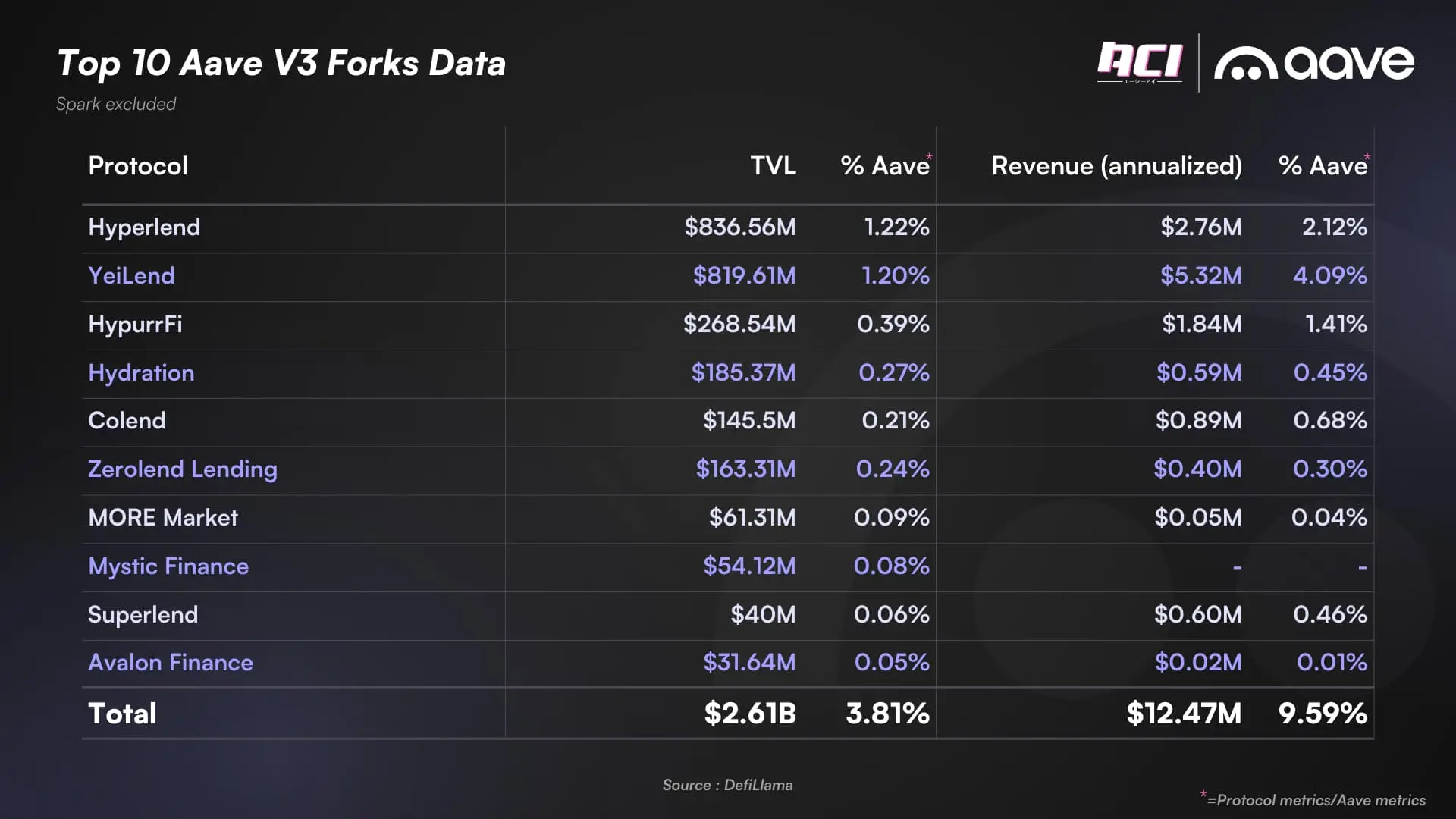
According to DefiLlama data, the total TVL of the top 10 Aave V3 fork protocols accounts for only 3.81% of Aave's, with the revenue generated equivalent to 9.59% of Aave's total revenue. The key point is that this revenue belongs entirely to the forking parties, with no contribution to Aave DAO.
Based on this, ACI officially opposes any "friendly forks" operated by third parties, unless service providers choose to fork in two specific scenarios: 1) adapting to non-DAO mainstream ecosystems (non-EVM or EVM-equivalent chains requiring custom development); 2) exploring asset types outside the current risk boundaries (such as Horizon's RWA market). These forks, existing as "side tasks," must provide higher revenue sharing and must not issue new protocol tokens to avoid diluting Aave's value.
Aave DAO must accept a reality—the Aave codebase will adhere to quality and simplification routes, which is part of the brand value itself, and certain low-potential markets can be left to competitors to distract their efforts.
Therefore, ACI will soon promote a comprehensive reform of the "friendly fork" framework.
The Failure of the Instances Model
The "Instances" model was a clever innovation in the early codebase of Aave V3—it could bypass the limitations of eMode while achieving risk isolation. By providing dedicated instances with curated asset combinations, it also became an effective narrative selling point against competitors.
However, the cost of this innovation is also significant—liquidity fragmentation leads to overall efficiency decline. Although "Prime Instances" have been successful, the current Liquid eModes model can provide all the advantages of isolated "instances" without any drawbacks.
We must acknowledge that the "Instances" model has become outdated in the new Aave V3 codebase, and no further development or growth resources should be invested in it in the future.
"Prime Instances" will continue to be retained and thrive, but their model should no longer be replicated.
Synergy of Service Provider Interests
The "Stalemate" was a necessary growing pain for Aave DAO to regain financial health after experiencing resource extraction and domination by non-allied forces.
This gave rise to a cultural characteristic that ACI has vigorously promoted—an overly conservative attitude toward resource management and reward payments.
We acknowledge that we forced most service providers to perform at their limits under limited resources, keeping them in a high-intensity work state for three years. While this was necessary, ACI has always stood alongside them through hardships, leading by example.
Now the situation has stabilized as described in this article. We believe it is time to reward these undisputed top service providers in vertical fields and ensure their long-term synergy.
The industry model has changed. The current standard compensation system includes not only revenue sharing but also a combination of native tokens and cash payments. At the same time, industry growth heavily relies on partnerships and institutional agreements—success and impact of these initiatives are easily traceable.
However, our current internal mechanism still employs fixed cash compensation (disconnected from KPIs), strictly supervised by a highly focused representative group, setting extremely high thresholds for service providers. If performance does not meet expectations, they will not hesitate to terminate contracts.
We believe it is necessary to introduce a performance compensation mechanism linked to quantifiable success metrics for some service providers.
More importantly, those service providers who shape today's Aave and are crucial to the DAO's future success must form a community of interest with the success of the AAVE token.
Therefore, we propose to explore a token vesting scheme linked to KPIs for service providers who have made AAVE the core of their business.
The ideal implementation is to allow service providers related to business growth (Tokenlogic, ACI, Aave Labs) to directly lead transactions and partner connections within an authorized framework, sharing the quantifiable benefits generated by these initiatives.
Of course, sustainable growth hinges on effective risk and technical analysis work. Therefore, we also support involving risk analysis service providers (Chaos Labs, Llamarisk, BGD Labs) in revenue-sharing mechanisms where growth is a variable.
Introducing this new model on top of the existing fixed compensation will enhance service providers' motivation, empower them to explore new growth areas, and retain top talent within the ecosystem.
ACI will soon propose a new framework for service provider compensation reform.
Transition from Low-Profit to High-Profit Business
Aave is the undisputed leader in the on-chain lending space. As mentioned earlier, we almost completely dominate the cash cow of this segment.
Despite this success, on-chain lending remains a low-margin business: 80%-95% of the revenue generated by the Aave protocol through lending volume is returned to liquidity providers (LPs), and even with a 70% market share and lending volume reaching three times historical peaks, the DAO's annual net income is only $130 million.
Clearly, pure lending business cannot allow us to achieve billion-level revenue in the short term—especially in an environment where yield compression and borrowing cost arbitrage opportunities are shrinking.
Previously, stablecoin lending rates typically ranged from 8-12%, reaching 16-20% during market booms. Long-term rates are likely to be locked in the 6-8% range. As the market matures, rates will gradually approach traditional financial levels, as the market is unwilling to pay a risk premium for on-chain lending—this will erode our profits in the long run.
GHO represents a paradigm revolution, as the protocol itself can become the main liquidity provider for GHO. The protocol does not need to pay yields to LPs but can focus on incentivizing liquidity retention, maintaining secondary market liquidity, and ensuring peg strength. Even if 50%-60% of GHO revenue is invested in this goal long-term, compared to USDC lending business, the DAO's profit margin can achieve a fourfold increase.
Aave's absolute advantage lies in: we first successfully built the lending business and then developed the stablecoin CDP business, allowing the DAO to utilize lending business revenue to support GHO growth.
Although the initial version of GHO performed poorly in terms of growth and stability, it must be acknowledged that service providers led by Tokenlogic have completed product reconstruction and growth driving through relentless efforts. Today, GHO has achieved a critical scale breakthrough and has completed CeFi integration for the first time. In the future, GHO will continue to strategically bundle key CeDeFi distribution protocols to expand adoption, and its scale advantage will provide a buffer for profitable credit strategies (following the principles of Spark's USDS strategy).
Now, GHO has been launched for two years, and after spending the first year upgrading it to a runnable state, we believe that considering its potential, regardless of its current profitability, we should continue to invest in this product for at least another year.
ACI will continue to fully support GHO growth, working hand in hand with Tokenlogic, which leads GHO's success.
Growth, Growth, and More Growth
The current market cycle is not driven by retail investors; we are experiencing unprecedented regulatory tailwinds and large-scale institutional adoption of the industry. This is a new, unknown territory that requires new rules, new methods, and new strategies to win.
In the past 18 months, a significant driver of our growth has come from key exclusive partnerships, the adoption of high-quality collateral, and strategic investments in core networks.
As mentioned earlier, Aave is in a comfort zone, so ACI's current strategy is to leverage our healthy financial status to maximize investments in growth and solidify short-term dominance. If we play aggressively enough, no existing competitors will survive, and our first-mover advantage will ensure our dominance in the medium to long term.
ACI has always maintained an extremely conservative attitude toward cash reserves, committed to building a substantial war chest for the DAO. As a result, the DAO currently holds $130 million in cash and cash-equivalent assets, and even with the initiation of a buyback plan, the treasury continues to grow.
We recommend that the DAO maintain the buyback scale at the current level (between $500,000 and $1 million per week) to convey confidence in the native token to the market while aggressively deploying reserves into distribution and growth protocols over the next 18 months.
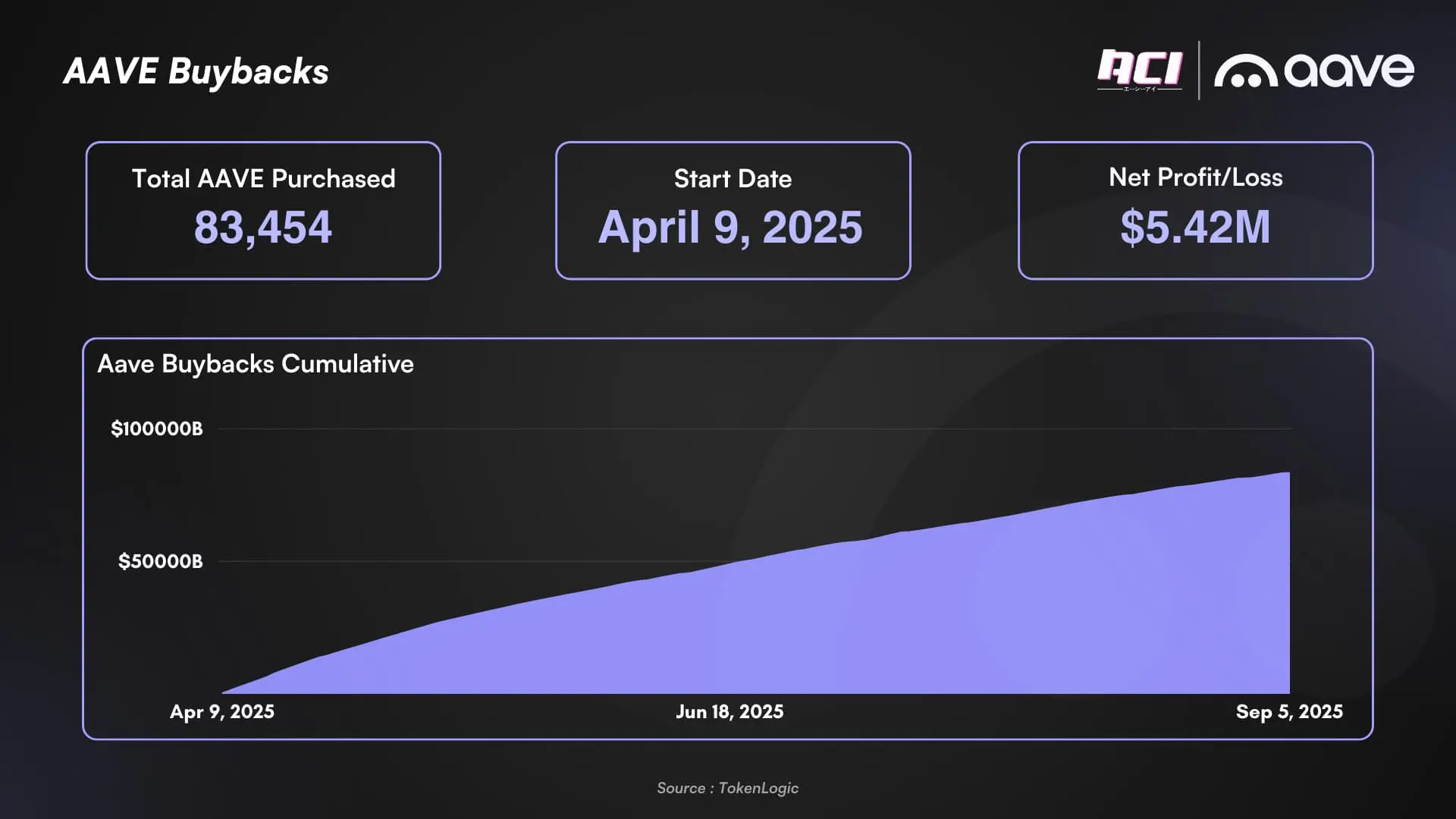
Additionally, the AAVE tokens accumulated through buybacks can work in conjunction with our substantial BTC and ETH reserves to generate healthy factors (HF) for GHO credit lines of no less than 2/2.5, used for growth protocol investments. The returns from these transactions can be used for mid-term repayment of credit lines. Continuous buybacks and revenue will naturally enhance the collateralization rate of positions, avoiding adverse consequences. Coupled with our existing cash reserves, this will provide the DAO with over $100 million in firepower, accelerating our growth and solidifying our dominance.
Such an ambitious plan requires strict safeguards and close supervision. The DAO should carefully debate this strategic vision and establish a suitable framework through voting to define, limit, allocate, and track investments.
No service provider should have free rein over such a large budget. A better solution is to form a special committee composed of relevant service providers (similar to the current AFC), operating under the supervision of independent core representatives and service providers.
ACI will soon submit a framework proposal for growth investment principles to the DAO.
Conclusion
For ACI, we are proud of the achievements made in Aave over the past three years. The industry is at a crucial crossroads, and our previous successes have given us all the trump cards—capable of expanding our dominance while pushing the protocol to new heights.
If we play our cards right, focus on optimal solutions, and discard ineffective strategies, this period will undoubtedly become the cornerstone for Aave to establish a lasting dominance in DeFi. Through strategic growth investments, synergistic service providers, and focused product development, we will solidify Aave's position as the absolute leader in DeFi for the coming years.
Using Aave is the right choice.
Click to learn about job openings at ChainCatcher
Recommended Reading:
NAKA's stock price plummeted 54% in one day; is the market starting to tire of DAT?
Is the Base chain about to issue tokens? 6 projects worth paying attention to
 Risk warning
 Risk warning


Popular articles





