Has the crypto bull market ended after the major pullback following the interest rate cut?
 Core Viewpoint

 This article整理了多位加密市场交易员和分析师对当前市场走势的看法。尽管美联储主席鲍威尔的最新讲话被市场解读为“鸽派”,进一步强化了年内降息预期,但加密市场却呈现出与美股不同的疲软迹象。
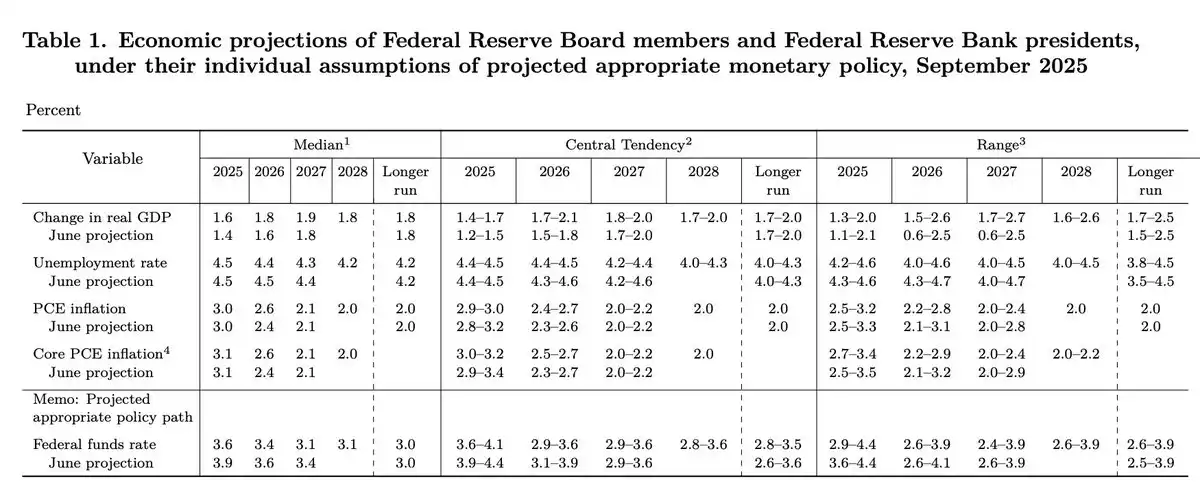
On September 24, just a week after the Federal Reserve's first interest rate cut in 2025, Chairman Powell spoke publicly again, conveying a complex and nuanced signal. He warned that the U.S. labor market is becoming weaker, the economic outlook is under pressure, while inflation remains above 2%. This "dual risk" leaves policymakers in a dilemma, stating that "there is no risk-free path to take."
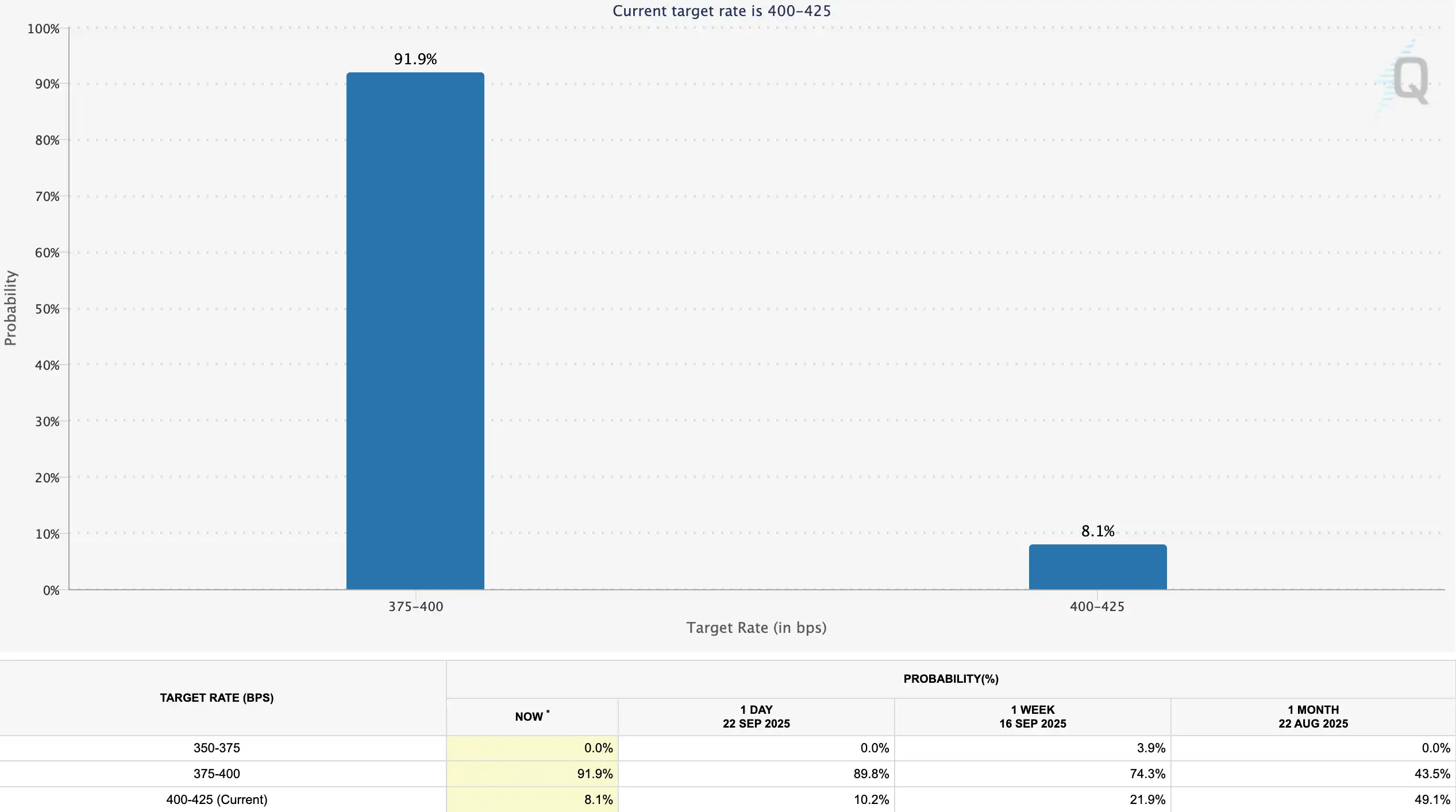
Powell also commented that stock market valuations are quite high but emphasized that this is "not a time of rising financial risks." Regarding the October meeting, Powell indicated that there is no preset policy path. The market interpreted this speech as having a "dovish tendency": after the speech, the probability of a rate cut in October rose from 89.8% to 91.9%, with the market essentially betting on three rate cuts this year.
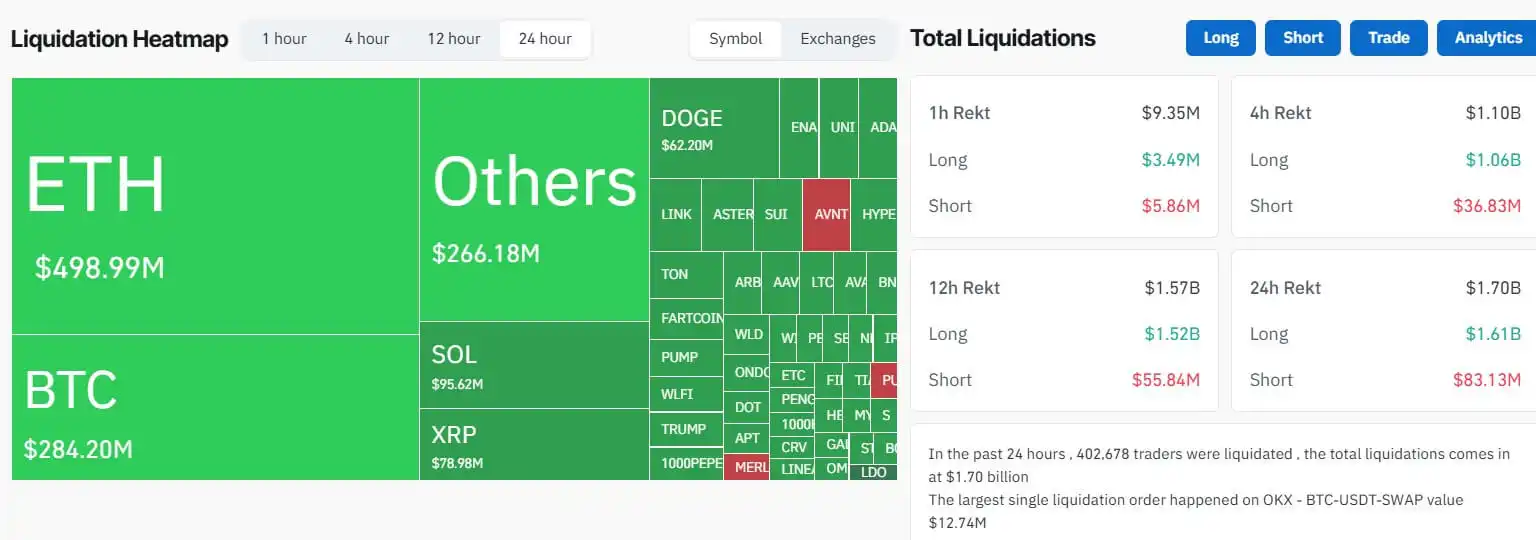
Driven by easing expectations, U.S. stocks have repeatedly hit new highs, while the cryptocurrency market has shown a starkly different picture. On September 22, the cryptocurrency market saw a liquidation amount of up to $1.7 billion in a single day, marking the largest liquidation scale since December 2024. Next, Rhythm BlockBeats compiled traders' views on the upcoming market situation to provide some directional references for trading this week.
@0xENAS
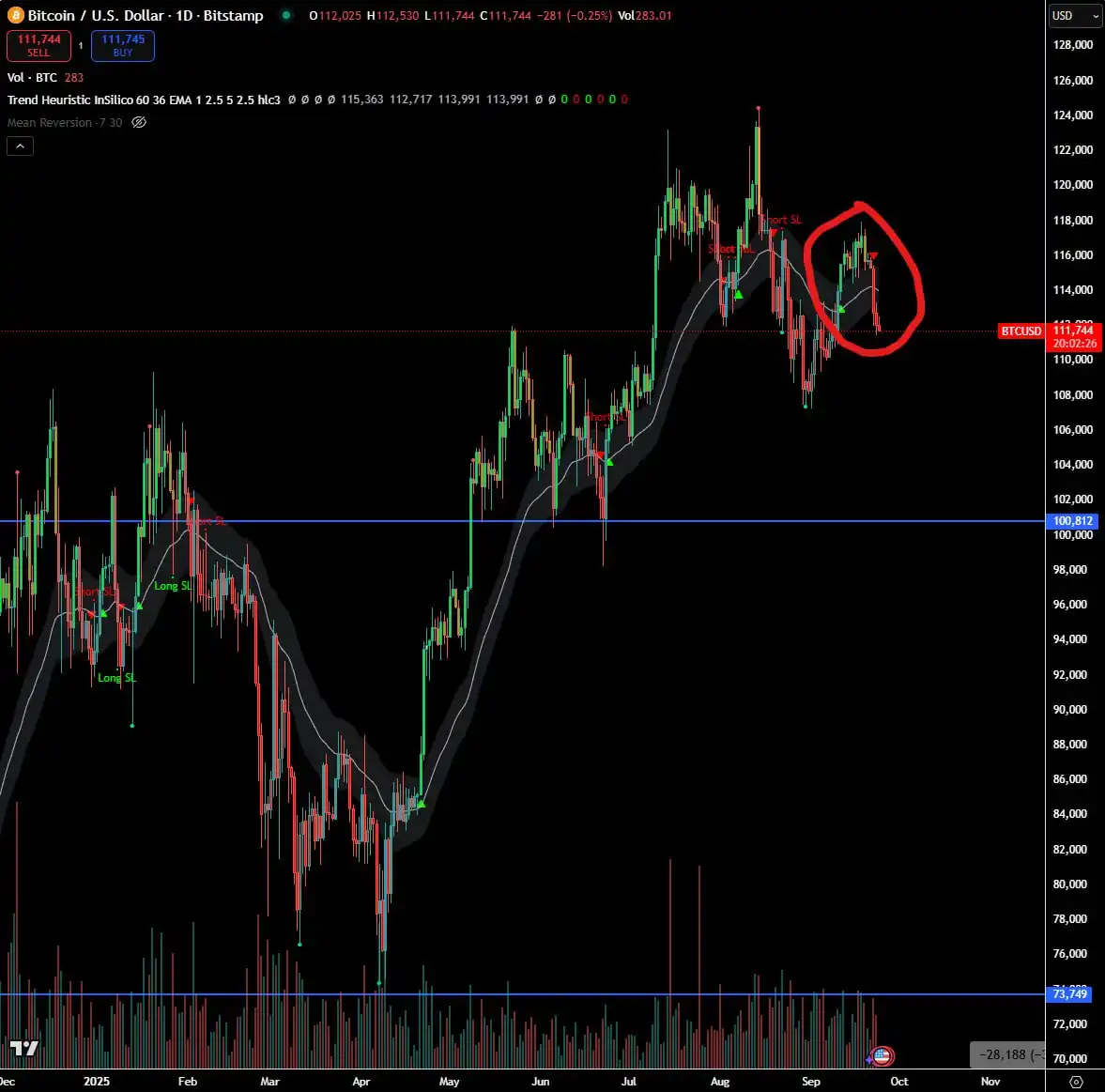
Trader dovish believes that various signs indicate the cryptocurrency market is gradually weakening.
When I re-entered the market after a two-week break, I coincided with the largest liquidation pullback of the year. As a result, those "liquidation buy orders" that historically have an 80% chance of bringing a rebound continued to decline this time—this misalignment is a very clear danger signal. The 20% failure scenario often means that there are no sufficient marginal buyers left in the market, and no one is willing to take the baton for a rebound.
I suspect that we will increasingly detach from the linkage logic of "risk assets" like U.S. stocks and begin to lose several key support levels. My observation points are: BTC breaking the $100,000 structure, ETH falling below $3,400, and SOL dropping below $160.
@MetricsVentures
We believe that the global asset bubble cycle has likely entered a warming phase, and the initiation seems to be just a matter of time. This bubble cycle occurs against the backdrop of unemployment and social division under the impact of AI, supported by the global fiscal-led economic cycle and political economic ecology, accelerated by the two major countries' common expectation to export inflation to resolve internal contradictions, which is expected to enter the public discussion in the coming months.
Looking ahead, aside from the digital currency market, which has not seen significant fluctuations for nearly a year and is a potential huge winner, the global cyclical mineral and AI derivative investment chains will continue to create excess returns. In terms of coin stocks, the successful combination of ETH's coin stock will lead to a series of imitations, and the combination of strong whales in large-cap coins and strong stocks is expected to become the most eye-catching segment in the coming months.
As competitive advantage countries begin to consider setting up investment accounts for newborns, further relaxing investment restrictions on pensions, and elevating capital markets, which have historically served as financing channels, to new heights, the bubbleization of financial assets has become a high-probability event.
We are also pleased to see the dollar market beginning to welcome the inherent volatility of digital currencies and providing ample liquidity pricing, which was unimaginable two years ago, just as the success of MSTR was a financial magic we could not predict two years ago.
In short, we are clearly optimistic about the digital currency market in the next six months, the global mineral and pro-cyclical markets in the next 1-2 years, and the AI derivative industry chain. At this moment, economic data has become less important, just as many in the crypto circle jokingly say, "economic data is always good news." In the face of the roaring historical train, embracing the bubble in line with the trend may have become the most important topic for our generation.
@Murphychen888
According to the "three-line convergence" trend, after October 30 this year, mvrv will enter a long-term oscillation downward trend, completely aligning with BTC's past four-year cycle time pattern.
However, according to this macro expectation data, the overall signal conveyed is "soft landing + inflation retreat + gradually easing monetary policy."
Although the future is unknown, if this is the case, then the four-year cycle theory may really be broken, and Bitcoin may enter an "eternal bull market."
@qinbafrank
The logic of U.S. stocks outperforming coins in a large-scale wide oscillation lies in the market's overall lingering concerns about future inflation trends. U.S. stocks are strong due to a robust fundamental AI acceleration, allowing them to withstand concerns about inflation trends and continue to surge. The issue with coins is that they rely on capital and expectations for momentum, and macro concerns will affect the flow of external funds.
Currently, the deep-seated issue in the coin market is that traditional funds entering as buyers are based on ETF and listed company purchases, while ancient whales and trend investment segments are taking profits as sellers. The market's price fluctuations, up and down, are largely driven by the competition between these two forces. In the short term, the strength or weakness of the economy, inflation trends, and interest rate expectations will all affect the speed of capital inflow from buyers, with positive expectations accelerating inflows and negative expectations stopping or even reversing outflows. As the Fed returns to rate cuts, but inflation is still slowly rising, the market naturally worries that future rate cuts will be interrupted by inflation again. In this case, the inflow of buyer funds will be affected, as can be seen from the changes in ETF net inflow scale. Meanwhile, the core mainline of U.S. stocks is about to reach a 10% penetration rate for AI, and once it surpasses this, it will enter a golden period of rapid penetration increase, as has been said, AI is accelerating to be accelerated. From this perspective, the strength and weakness are naturally reflected.
The future market trend needs to reference macroeconomic data:
- Best case: The pace and magnitude of inflation rise are below expectations, favorable for both coins and U.S. stocks.
- Moderate case: The pace of inflation meets expectations, more favorable for U.S. stocks due to stronger fundamentals, relatively good for coins but likely to be in a large-scale wide oscillation.
- Worst case: A significant inflation surprise occurs in the future, leading to corrections in both U.S. stocks and the coin market, with U.S. stocks possibly experiencing a small correction while the coin market sees a medium-level correction.
@WeissCrypto
The impact of the Federal Reserve's rate cuts on liquidity will not inject into the cryptocurrency market until mid-December. Its model shows that sideways fluctuations may continue for 30 to 60 days, with a significant bottom possibly appearing around October 17. Notably, Weiss Crypto recently predicted a peak around September 20.
@joao_wedson
Joao Wedson, founder of the blockchain analysis platform Alphractal, stated that Bitcoin is showing clear signs of cyclical exhaustion. He pointed out that the SOPR trend signal, which tracks on-chain realized profitability, indicates that investors are buying at historical highs while profit margins are shrinking. The actual price for short-term holders of Bitcoin is currently $111,400, a level that institutional investors should have reached earlier. He also noted that compared to 2024, Bitcoin's Sharpe ratio for measuring risk-reward has weakened.
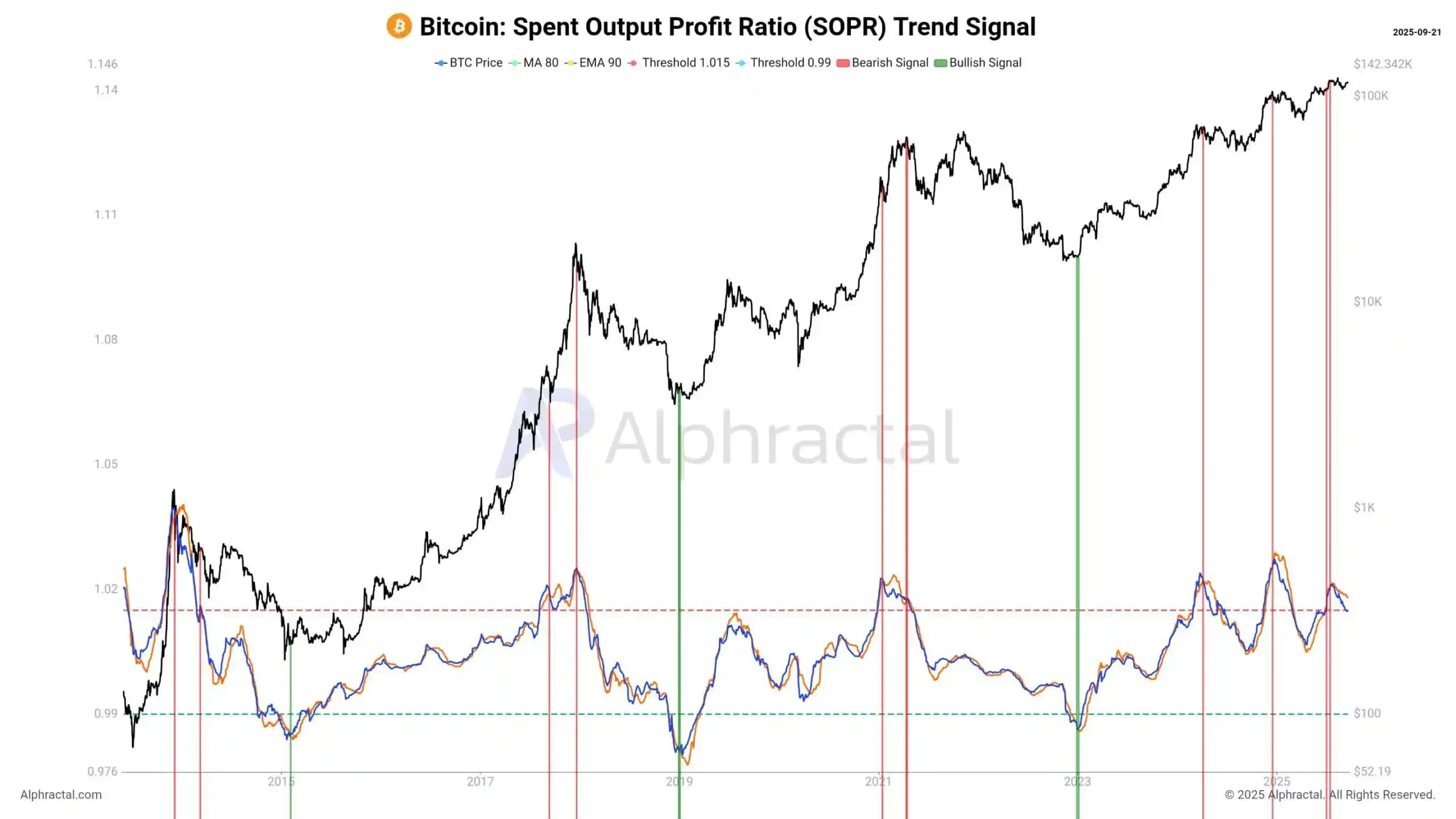
He suggested, "Those who bought BTC at the end of 2022 are satisfied with +600% returns, but those accumulating in 2025 should reconsider their strategies," while market makers tend to sell BTC and buy altcoins, which are expected to perform better in the future.
 Risk warning
 Risk warning