








ETH "Big Short" publicly challenges: Tom Lee's bullish logic is wrong, like an idiot
 Core Viewpoint

 This article is a public rebuttal by Andrew Kang, a partner at Mechanism Capital, to the bullish theory proposed by Tom Lee, chairman of BitMine, that "ETH will reach a value of $60,000." Andrew Kang believes that Tom Lee's analysis is based on a fundamental misunderstanding of the value accumulation mechanism of Ethereum and bluntly states that his theory is "one of the dumbest."
Original author: https://x.com/Rewkang/status/1970782770805813392
Compiled by|Odaily Planet Daily Azuma (@azuma_eth)
Editor's note: Since Tom Lee became the chairman of the BitMine board and promoted the continuous purchase of ETH by DAT, Tom Lee has become the industry's number one ETH bull. In various recent public appearances, Tom Lee has repeatedly emphasized the growth expectations for ETH with various logic, even boldly stating that the fair value of ETH should be $60,000.
However, not everyone agrees with Tom Lee's logic. Mechanism Capital partner Andrew Kang published a lengthy article last night, publicly refuting Tom Lee's views and bluntly mocking him as "like an idiot."
To add, Andrew Kang predicted in April this year during the overall market correction that ETH would fall below $1,000, and he has also expressed bearish views during the subsequent rise of ETH… Position determines mindset, so his stance may be at two extremes compared to Tom Lee, and it is suggested that everyone view this dialectically.

The following is the original content by Andrew Kang, translated by Odaily Planet Daily.

In the financial analyst articles I have read recently, Tom Lee's ETH theory is arguably "one of the dumbest." Let's analyze his points one by one. Tom Lee's theory is mainly based on the following key points.
- Adoption of stablecoins and RWA (real-world assets);
- "Digital oil" analogy;
- Institutions will buy and stake ETH, providing security for the network where their assets are tokenized and also serving as operating capital;
- ETH will equal the total value of all financial infrastructure companies;
- Technical analysis;
1. Adoption of Stablecoins and RWA
Tom Lee argues that: the increase in stablecoins and asset tokenization activities will boost trading volume, thereby increasing ETH's fee income. On the surface, this seems reasonable, but just a few minutes of data review will reveal that this is not the case.
Since 2020, the value of tokenized assets and the trading volume of stablecoins have grown by 100-1000 times. However, Tom Lee fundamentally misunderstands Ethereum's value accumulation mechanism ------ he misleads people into thinking that network fees will rise year-on-year, but in reality, Ethereum's fee income has remained at 2020 levels.
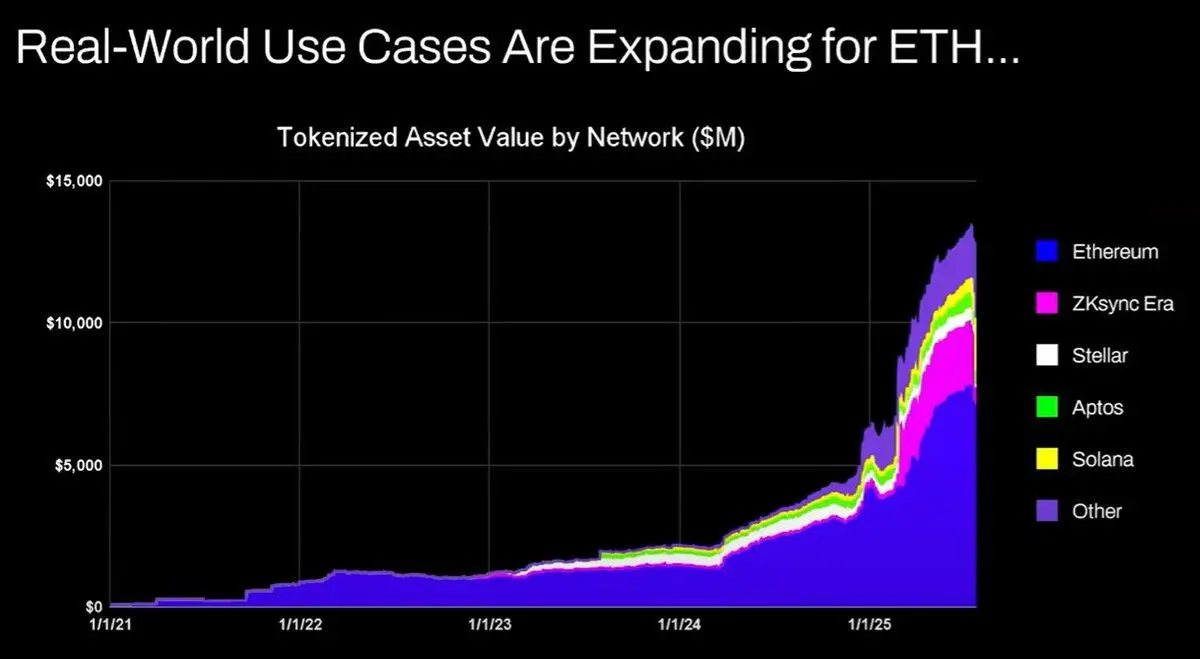
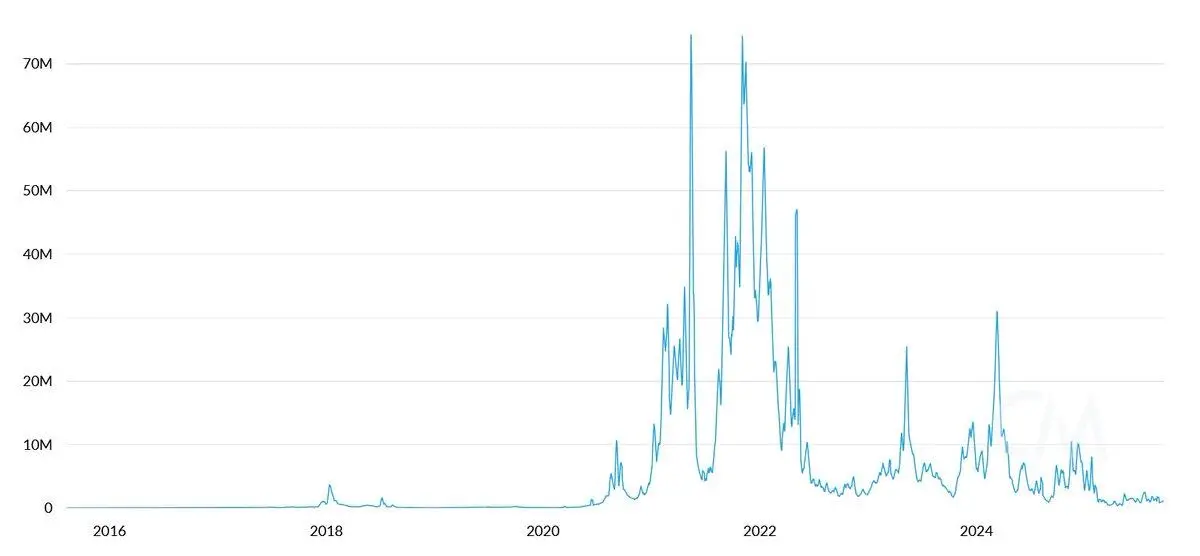
The reasons for this outcome are as follows:
- The Ethereum network will improve transaction efficiency through upgrades;
- Stablecoins and asset tokenization activities will flow to other public chains;
- The fees generated from tokenizing low liquidity assets are negligible ------ the tokenized value is not directly proportional to ETH income; people might tokenize a $100 million bond, but if it only trades once every two years, how much fee can that bring to ETH? Perhaps only $0.1, which is far less than the fee generated from a single USDT transaction.
You can tokenize assets worth trillions of dollars, but if these assets are not frequently traded, it might only add $100,000 in value to ETH.
Will blockchain trading volume and fees grow? Yes.
However, most fees will be captured by other blockchains with stronger business development teams. In the process of moving traditional financial transactions to the blockchain, other projects have seen this opportunity and are actively capturing the market. Solana, Arbitrum, and Tempo have all achieved some early victories, and even Tether is supporting two new stablecoin public chains (Plasma and Stable), hoping to shift USDT's trading volume to their own chains.
2. The "Digital Oil" Analogy
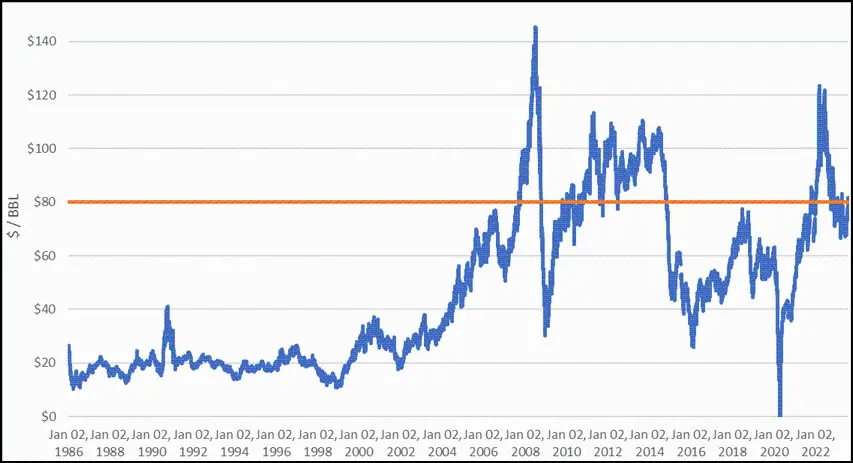
Oil is essentially a commodity. The real price of oil, adjusted for inflation, has remained within the same range for a century, occasionally fluctuating and returning to its original position.
I partially agree with Tom Lee's view, that ETH can be seen as a commodity, but that does not imply bullishness. What exactly Tom Lee wants to express here is unclear to me.
3. Institutions Will Buy and Stake ETH, Providing Security for the Network and Serving as Operating Capital
Have large banks and other financial institutions already bought ETH to include on their balance sheets? No.
Do they have plans to announce purchases of ETH? No.
Will banks hoard gasoline cans because they keep paying energy costs? No, the costs are not significant enough; they will only pay when needed.
Will banks buy stocks of the asset custodians they use? No.
4. ETH Will Equal the Total Value of All Financial Infrastructure Companies
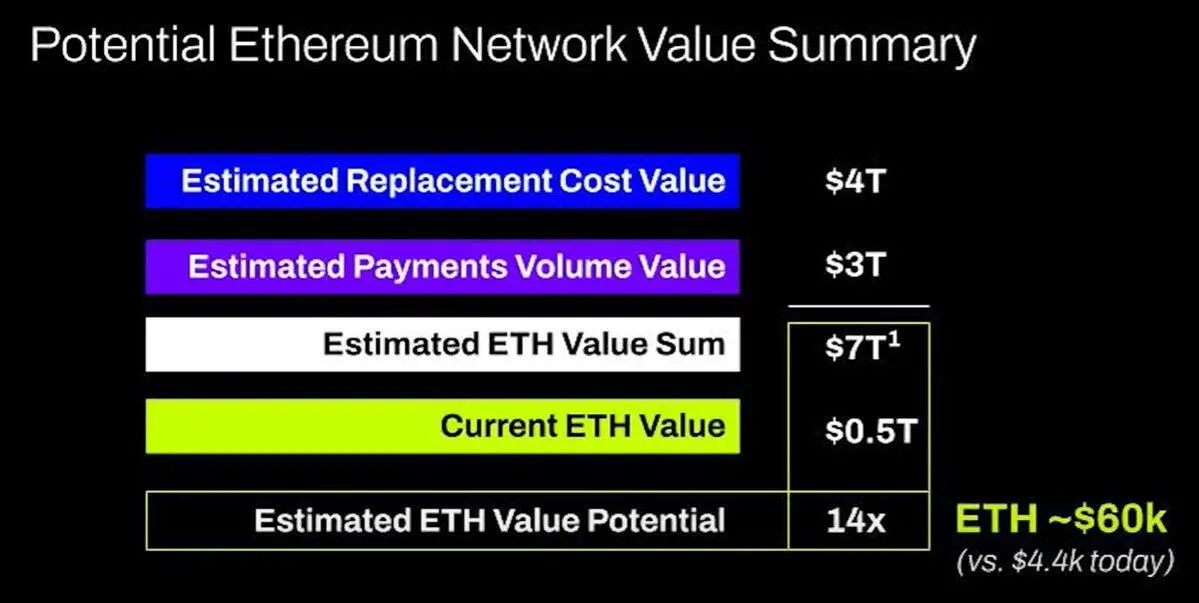
I am truly speechless. This is yet another fundamental misunderstanding of value accumulation, pure fantasy, and I can't even be bothered to criticize it.
5. Technical Analysis
In fact, I personally really like technical analysis and believe that when viewed objectively, it can provide a lot of valuable information. Unfortunately, Tom Lee seems to be misusing technical analysis to draw arbitrary lines to support his biases.
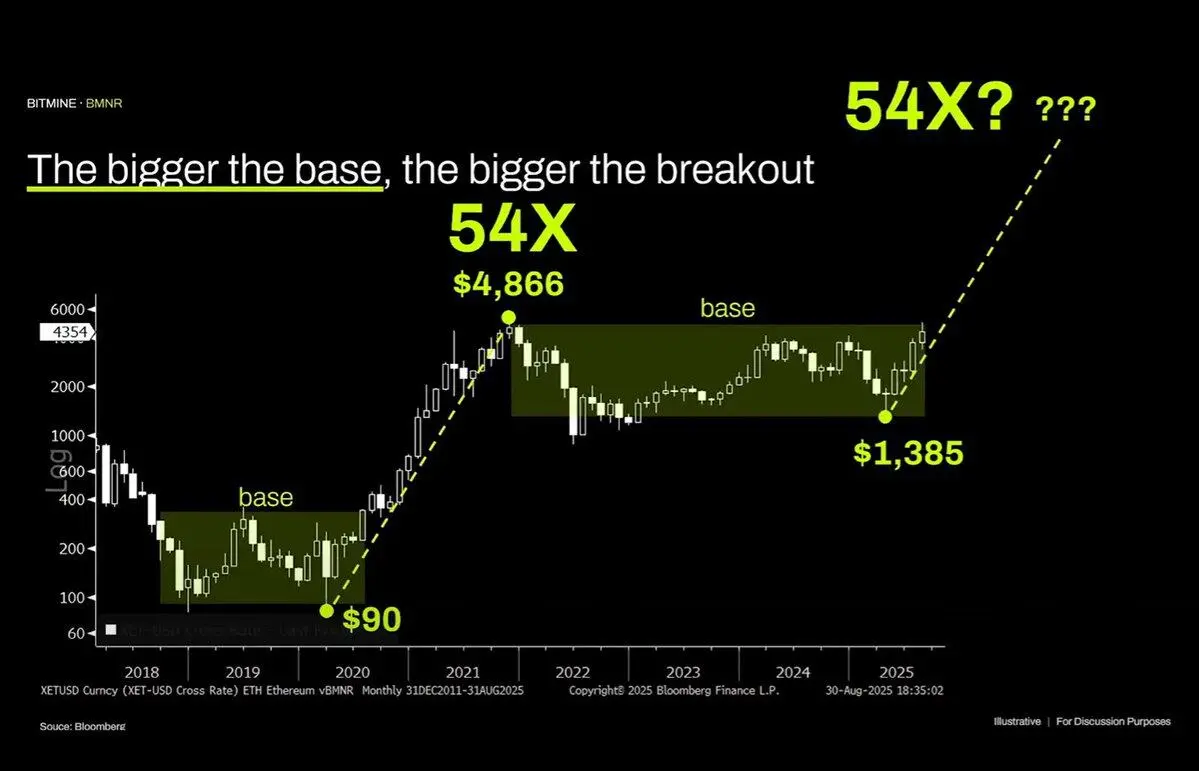
Objectively examining this chart, the most obvious feature is that ETH has been in a prolonged range for several years ------ this is no different from the wide fluctuations in oil prices over the past thirty years ------ it is merely in a range-bound oscillation, and recently it has failed to break resistance after reaching the upper end of the range. From a technical perspective, ETH actually shows bearish signals, and we cannot rule out the possibility of it oscillating in the long term between $1,000 and $4,800.
Just because an asset has experienced parabolic rises in the past does not mean that this trend will continue indefinitely.
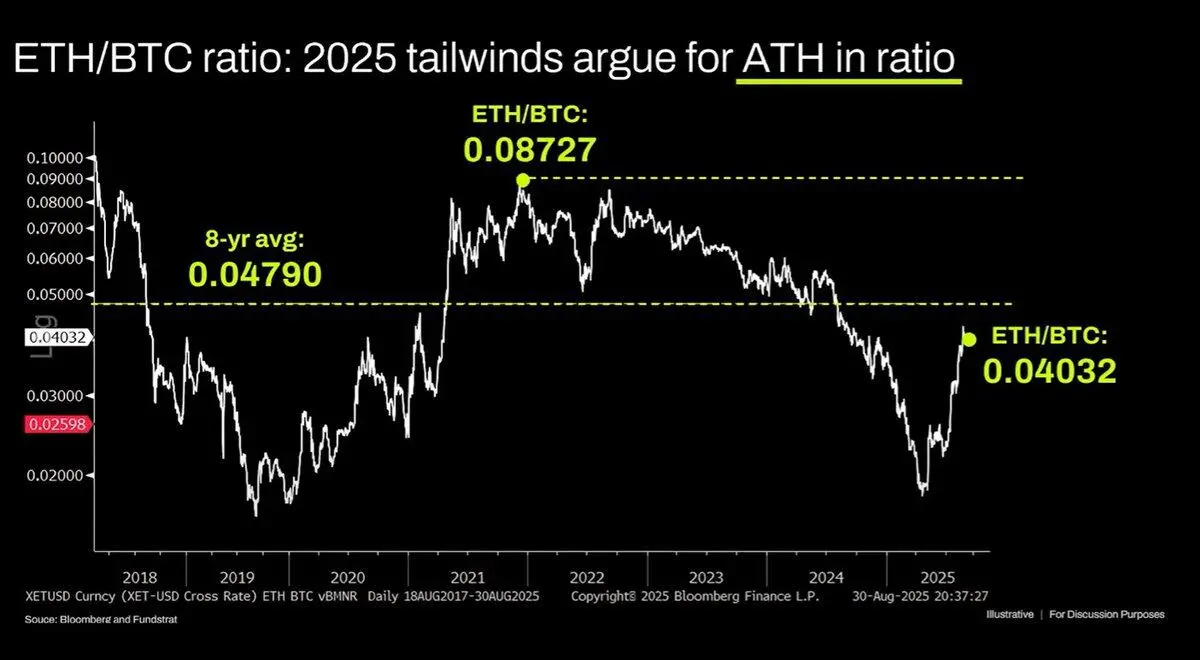
The long-term ETH/BTC chart is also misread; although it is indeed in a multi-year range, it has been constrained by a downward trend over the past three years, with the recent rebound only touching long-term support levels. This downward trend stems from the saturation of Ethereum's narrative, and the fundamentals cannot support valuation growth. And these fundamental factors have not changed substantively to date.
The valuation of Ethereum is essentially a product of a lack of financial cognition. Fairly speaking, this cognitive bias can indeed support a considerable market value (see XRP), but its support is not infinite. Macroeconomic liquidity has temporarily maintained the market cap of ETH, but unless there is a significant structural change, it is likely to fall into a prolonged period of underperformance.
```
 Risk warning Risk warning



Popular articles





