








"Naver, the 'Korean Google', acquires Upbit operator, aiming at the stablecoin business, is another big move coming?"
 Core Viewpoint

 South Korean internet giant Naver is acquiring Upbit's operator Dunamu through a share swap, aiming to integrate its vast payment ecosystem with cryptocurrency operations and jointly launch a won-pegged stablecoin to reshape the digital financial landscape in South Korea and globally.
Author: Lex, ChainCatcher
The South Korean digital finance market is undergoing a significant structural transformation. Internet giant Naver has initiated a transaction to acquire Dunamu, the operator of South Korea's largest cryptocurrency exchange Upbit, through equity swap.
This move aims to create a "super app" that integrates payment, e-commerce, and crypto trading, deeply integrating Naver Pay's annual transaction volume of 80 trillion won with Upbit, the world's fourth-largest exchange.
The core strategic goal of the transaction is to jointly promote the Korean won stablecoin business and expand into overseas markets based on this foundation. Following the announcement of the deal, the capital market reacted swiftly, with Naver's stock price soaring by 11.4%, potentially reshaping the competitive landscape of South Korean digital finance.
Core Elements of the Transaction: Strategic Integration through Equity Swap
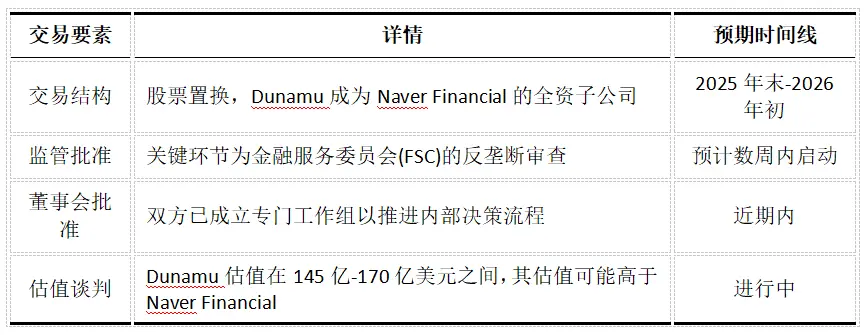
According to reports from several media outlets, including the South Korean Chosun Ilbo, this transaction adopts a stock exchange structure. Specifically, Naver's financial subsidiary Naver Financial will issue new shares to acquire all of Dunamu's issued shares, making the latter a wholly-owned subsidiary.
This structure allows for the realization of a parent-subsidiary governance model while retaining the legal entity identities and independent operations of both parties, similar to the successful case of Kakao's acquisition of Daum, and is seen as a mature model for large-scale integration in South Korea's tech industry.
The key elements of the transaction and the expected timeline are as follows:
Financial Strength Comparison and Synergy Foundation
This transaction is built on the strong financial strength of both parties. Naver Corporation, as a leading internet company in South Korea, reported revenues exceeding $2 billion in the second quarter of 2025, with a corporate value of approximately $26.86 billion. Its core financial infrastructure, Naver Pay, supports an annual payment volume of up to 80 trillion won.
On the other hand, Dunamu Inc.'s growth is equally impressive, with projected consolidated revenues of $12 billion in 2024, a year-on-year increase of 70.1%. This combination of a traditional internet giant and an emerging crypto financial platform provides a solid capital and business foundation for subsequent strategic expansion.
Strategic Significance Analysis: Building an Integrated Digital Finance Ecosystem
The deeper strategic intent of this acquisition is to construct a unified "super app" ecosystem that seamlessly connects Naver's vast user base, payment network, and Upbit's crypto trading capabilities. This integration is expected to generate multiple synergies:
- User and Traffic Interconnection: The 40 million users in the Naver ecosystem, especially the 33 million payment users of Naver Pay, will have easier access to Upbit's crypto asset services, significantly lowering the entry barrier for new users into the crypto market.
- Application Scenario Expansion: Crypto assets can be integrated into Naver's e-commerce, content consumption, and daily payment scenarios, transforming them from a single investment category into practical payment and value storage tools, thereby enhancing user stickiness across the ecosystem.
- Data-Driven Optimization: The combination of Naver's vast user behavior data and Upbit's trading data will provide strong data support for financial product design, risk control model optimization, and personalized service recommendations.
The core pivot of this strategy is the Korean won-pegged stablecoin that both parties plan to jointly launch. Based on the cooperation agreement reached in July 2025, this acquisition will significantly accelerate the research and implementation process of the stablecoin. It is expected that the stablecoin will be launched by the end of 2025 or early 2026, becoming a key bridge connecting Naver Pay's fiat system and Upbit's crypto economy.
Market analysis predicts that by 2030, the circulation of this stablecoin within the Naver Pay ecosystem is expected to generate an annual revenue of 300 billion won (approximately $215 million).
In terms of competition, Upbit's daily trading volume in the South Korean market has far exceeded that of its main competitor Bithumb. The partnership with Naver will further consolidate and expand its market dominance, and this increase in market concentration will almost inevitably trigger regulatory scrutiny regarding potential market monopoly risks.
Regulatory Environment and Policy Opportunities
The advancement of this transaction coincides with the South Korean government's more proactive and clear regulatory stance on digital assets, especially stablecoins. Under President Lee Jae-myung's pro-crypto policy direction, the Financial Services Commission (FSC) is accelerating the formulation of special legislation for stablecoins, with plans to publish a comprehensive regulatory framework in October 2025, which includes:
- Issuance Requirements: Mandatory implementation of a 100% reserve system and a minimum capital requirement of 5 billion won.
- Compliance Standards: Issuers must obtain operational licenses from the FSC and disclose monthly reserve audit reports to the public.
- Issuer Eligibility: Initially, licenses will be prioritized for traditional banks, with gradual expansion to qualified non-bank enterprises.
Currently, three major legislative proposals, namely the "Digital Asset Basic Law," "Value-Stable Asset Law," and "Payment Innovation Law," are under review in the National Assembly. Additionally, in June 2025, South Korea's eight major commercial banks announced plans to issue a Korean won stablecoin in 2026, providing a favorable market environment and compliance expectations for Naver and Dunamu's stablecoin plans.
The ruling Democratic Party established a crypto task force in September, prioritizing stablecoin legislation as part of its agenda. All of this indicates that South Korea is laying a clear policy track for the development of compliant stablecoins.
Potential Impact on the Global Stablecoin Landscape
The influence of this acquisition may extend beyond South Korea's borders, impacting the global competitive landscape for stablecoins:
- Promoting Market Diversification: The current dominance of dollar-pegged stablecoins like USDT and USDC may be disrupted. A stablecoin backed by the sovereign currencies of major economies and jointly launched by top tech and crypto companies will provide a strong non-dollar alternative to the market and may encourage other regions (such as Japan and the EU) to accelerate the development of local stablecoins.
- Exporting Regulatory Models: South Korea's high-standard regulatory model of "100% reserves, FSC licensing, monthly disclosure" may serve as an important reference for major economies like the U.S. and the EU that are still exploring regulatory pathways, promoting the unification and standardization of global stablecoin regulation.
- Enhancing Asia's Industry Position: This transaction will create the largest integrated digital finance platform in Asia, further strengthening Asia's central position in the global fintech and Web3 innovation wave.
Risk Assessment and Challenges to Address
- Regulatory Risk: The FSC must find a delicate balance between supporting financial innovation and preventing market monopolies. The combination of Upbit's existing market dominance and Naver's ecosystem advantages may raise concerns about excessive market concentration, making antitrust review a key step in determining the success of the transaction.
- Technical Integration Challenges: Deeply integrating Naver Pay's centralized traditional payment system with Upbit's blockchain-based crypto infrastructure presents significant challenges in technology, compliance, and user experience, requiring substantial resources to ensure the security, stability, and seamless connection of the systems.
- Internal and External Competitive Pressure: On a global scale, the new entity will face direct competition from international platforms like Binance and Coinbase. Domestically, its main competitor Kakao will also inevitably take countermeasures. Therefore, the new entity must quickly establish a clear differentiated competitive advantage.
Conclusion
Naver's acquisition of Dunamu is a landmark event in the history of South Korea's digital finance development. This transaction not only has the potential to create one of Asia's largest integrated digital finance platforms but may also play a key role in the global competitive landscape for stablecoins.
With the launch of the Korean won stablecoin and the implementation of overseas expansion plans, South Korea's position in the global digital finance innovation field is expected to be significantly enhanced. However, the success of this plan ultimately depends on the effective integration of two complex ecosystems and the successful navigation of stringent regulatory scrutiny.
For investors, the upcoming months will be crucial, as regulatory approvals, the specific integration plans announced by both parties, and the dynamic changes in the competitive landscape will be key indicators to assess whether this digital finance experiment can successfully reshape the digital payment landscape in South Korea and globally.
(This article is for reference only and does not constitute any investment advice)
 Risk warning Risk warning


Popular articles





