Boros: Pendle continues to expand its secret weapon in the yield trading landscape
 Core Viewpoint

 Boros draws on Pendle's successful model to standardize and tokenize the funding rate, a stable cash flow that has long been overlooked in the perpetual contract market, making it a brand new, tradable, and hedgable interest rate asset in the DeFi space.
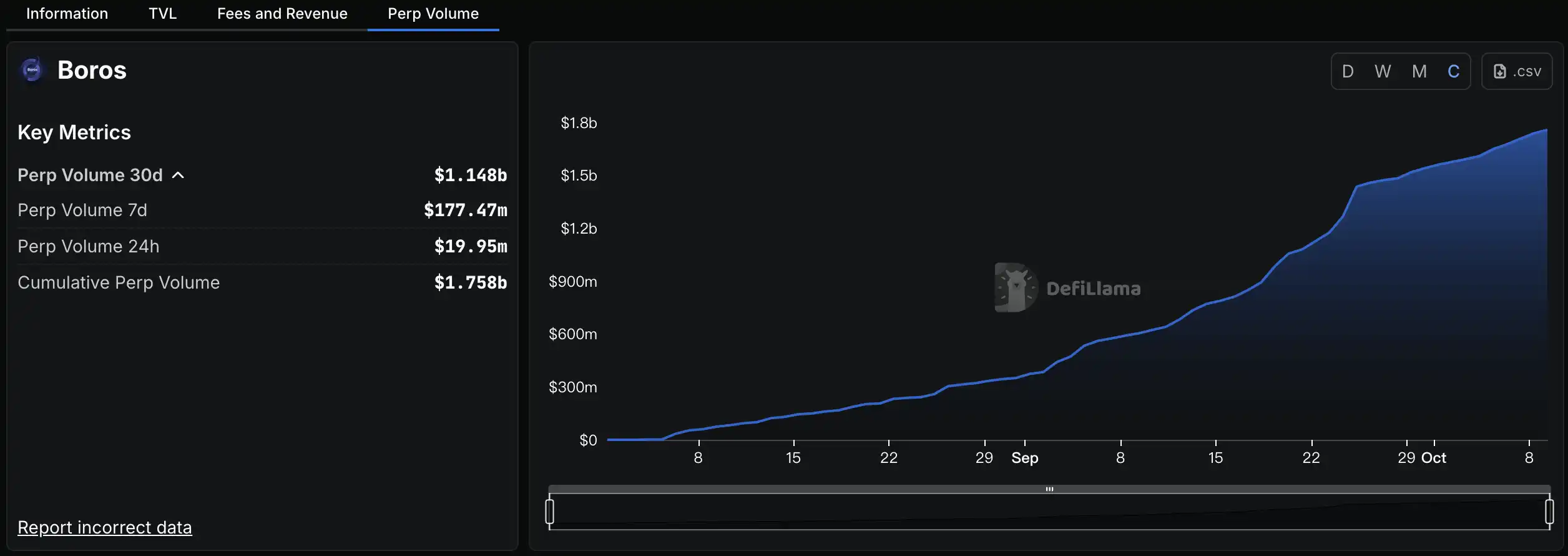
In the past two years, the Pendle protocol has made fixed income a standard feature in the DeFi industry through the PT/YT mechanism. This year, it's the turn of the new product Boros, which brings the funding rates from perpetual contracts— a long-overlooked yet stable cash flow— onto the blockchain. It is important to emphasize that Boros itself is not a decentralized trading platform for perpetual contracts, but rather elevates the largest "interest brick" in contract trading into the main hall of DeFi. In one sentence, Boros is about breaking down the funding fees that users pay/receive in perpetual contracts into a separately tradable and hedgable on-chain asset. Shortly after its launch, Boros demonstrated impressive performance— in September, the trading volume of Binance ETH funding rates exceeded $2.2 billion, BTC trading volume exceeded $600 million, and the cumulative nominal transaction volume surpassed $2.8 billion; after connecting to the BTC/ETH funding rate market on Hyperliquid on September 12, it not only provided substantial liquidity and trading volume, but also directly opened up cross-exchange hedging/arbitrage paths.
Just as PT dominated the DeFi fixed income track, achieving a TVL of over $10 billion, Boros is likely to establish consensus on this new track of funding rates, which is crucial to CeFi.
What is Boros: An On-Chain "Funding Rate Trading Platform"
Boros is an on-chain funding rate trading platform launched by the Pendle team on Arbitrum. Its core mechanism is to convert the funding rate income streams from the perpetual contract market into tradable Yield Units (YU). Each YU represents the right to receive or pay funding rate income/expenses calculated based on nominal principal before maturity; for example, 1 YU-ETH corresponds to "the funding rate income calculated based on 1 ETH principal until maturity." Readers familiar with Pendle can think of YU as a specialized anchor for funding rates, similar to YT.
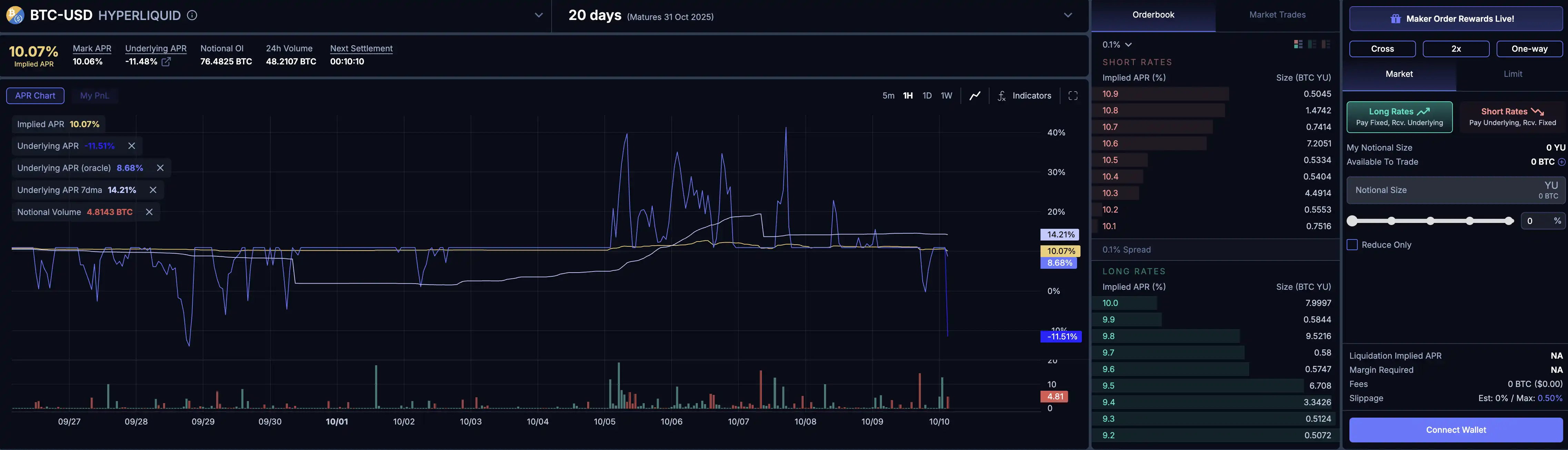
First, let's clarify what the funding rate is: perpetual contracts have no expiration date, and to keep the contract price close to the spot price, trading platforms periodically settle an "interest" between longs and shorts (commonly every 1/4/8 hours). When the contract price is higher than the spot price, longs pay shorts; when the contract price is lower than the spot price, shorts pay longs. The size of the rate is determined by market supply and demand and is usually expressed on an annualized basis. For any holder, this represents a continuous cash flow that can directly consume or increase your strategy returns.
As for Boros's interest trading, it operates in an order book + margin format, providing an experience more akin to a futures trading platform, allowing users to go long or short on funding rates. Currently, Boros has launched on the Arbitrum mainnet, supporting funding rate trading for the BTC/ETH perpetual contract market (integrated with Binance and Hyperliquid's BTC/ETH market). Users can place orders to trade YU on Boros to gain long or short exposure to the future funding rates of the corresponding assets.
Why It Matters: The Blank Space in a Trillion-Dollar Market and the Pendle Puzzle
The scale of perpetual contracts in the crypto market is enormous: daily trading volume reaches $150-200 billion (equivalent to annualized hundreds of trillions), with open interest (OI) often exceeding hundreds of billions. However, the funding rates (i.e., the interest paid by long and short positions) associated with this scale have been an overlooked income stream: previously, there was a lack of standardized tools for users to hedge or trade it. This has led to two problems: first, although funding rates have a stable source (the perpetual contract market generates them 24/7), they are highly volatile and uncontrollable, making them an uncertain factor in many quantitative and arbitrage strategies; second, the lack of hedging tools has prevented some institutional funds and strategies from entering the market confidently, limiting the depth of the DeFi interest rate market. The emergence of Boros fills this gap— it standardizes, tokenizes, and supports the clearing of funding rate income traditionally managed off-chain, incorporating this discrete income curve into the standard landscape of DeFi, which is of great significance.
Historical data on funding rates (annualized yields) for ETH perpetual contracts across different trading platforms shows that not only do significant differences often exist between platforms, but they also frequently experience sharp fluctuations. In fact, there are indeed players in the industry who arbitrage funding rates across perpetual contract platforms. However, for a long time, these differences and fluctuations could not be smoothed out or exploited through on-chain tools, and Boros provides a standardized solution for this: allowing arbitrageurs and risk managers to enter this market, encouraging funding rates across platforms to converge towards rational levels.
For Pendle itself, Boros is also an indispensable piece of the puzzle. Pendle has been committed to building a complete on-chain yield curve, previously covering the fixed rate domain through PT/YT products, while funding rates belong to highly volatile short-term rates. Boros introduces this floating rate into the Pendle family, extending its product line to a broader range of interest rate categories and filling a market gap. Boros has attracted a large number of users and funds for trading in a short period, with cumulative trading volume exceeding $700 million and nominal open interest surpassing 10,000 ETH. It can be said that the introduction of funding rate trading has brought Pendle a second growth curve, broadening its revenue sources and influence.
More broadly, Boros takes the funding rates that could only be balanced within centralized trading platforms and brings them onto the blockchain, attracting more types of funds to participate in DeFi. This is especially a "dream tool" for some strategies and institutions that rely on funding rate income. For example, protocols like Ethena, which employ delta-neutral strategies. Ethena issues a decentralized stablecoin, USDe, using volatile assets like BTC and ETH as collateral, holding spot on one hand while shorting perpetual contracts on trading platforms to hedge, thus achieving price neutrality and earning income through funding rates. Of course, this situation can also apply to many crypto hedge funds. Boros provides a key "shock absorber" for such protocols and institutions.
As summarized by Pendle's official statement, Boros can bring at least three aspects of value to such protocols: first, it allows protocols to actively adjust their funding rate exposure based on their judgment (going long or short on funding rates); second, it effectively hedges funding rate risks, avoiding extreme fluctuations impacting the yield curve; third, it makes yields more predictable and stable, reducing uncertainty. With Boros, the funding rate exposure of Ethena, which approaches a $10 billion scale, can finally be managed through on-chain tools, greatly enhancing the ability of protocols like Ethena to maintain stable returns in various market environments, while further lowering the barriers for traditional financial institutions to enter the crypto industry.
What Can Be Done: Lock Costs, Earn Flexibility, Bet on Price Differences
Locking Funding Costs— By utilizing Boros, you can lock the funding rate costs of perpetual contract positions into a fixed value, avoiding uncertain expenses caused by market fluctuations. For example, if you hold a long position in BTC/ETH perpetual contracts on a trading platform but are concerned about high positive funding rates eroding your profits, you can short the corresponding amount of YU on Boros to fix the future funding rate you will have to pay. Shorting YU is equivalent to borrowing the funding rate income at a fixed rate in advance, while the actual floating funding rate in the market will belong to you— this way, regardless of how the funding rate changes in the future, your total funding cost is fixed, akin to buying a rate insurance. This is particularly important for large institutions executing carry strategies (such as spot long + perpetual short to earn funding rates): they can lock in the income or cost of the "funding leg" of the carry strategy through Boros, eliminating interest rate volatility risks and holding positions until maturity. On the other hand, if you hold a short position in the perpetual market and continuously earn funding rates, you can also go long on YU in Boros to lock in profits, avoiding income shrinkage due to future declines in funding rates.
Pure Yield Betting— Besides hedging, Boros also provides traders with a channel to speculate on funding rate trends. If you anticipate that the funding rate in a certain market will rise in the near future (for example, during a bull market when trading is hot, leading to higher funding rates due to longs competing to go long), you can go long on YU in Boros, effectively buying a long position on the funding rate of that market. As long as the actual funding rate trend aligns with your expectations, the floating income you gain from your YU position will exceed the fixed cost locked in when you bought it, thus netting you the spread. Conversely, if you expect the funding rate to decline or even turn negative (for example, as short-selling sentiment rises and long positions become insufficient), you can short YU, betting on the decline in rates and profiting from it. Since funding rates are often highly sensitive to market sentiment and capital demand, their fluctuations can sometimes exceed the price movements of the corresponding assets themselves. Therefore, effectively utilizing the long and short tools provided by Boros to trade purely around interest rate fluctuations may yield greater flexible returns than directly trading the underlying assets. This opens up new arbitrage opportunities for advanced traders and hedge funds.
Arbitrage and Spread Trading— Additionally, Boros has opened the door to cross-market rate trading. Users can trade multiple assets or funding rates from different sources on the platform, taking advantage of the relative differences between them for arbitrage. For example, historical data shows that the funding rates for BTC and ETH perpetual contracts often exhibit a see-saw phenomenon, allowing traders to go long on one asset's YU while shorting another asset's YU, purely betting on the changes in the funding rate difference between the two without exposing themselves to any unilateral price risk. Similarly, the differences in funding rates between different trading platforms also present arbitrage opportunities— as Boros integrates more perpetual rates from various trading platforms, users can even converge cross-platform spreads by going long and short on funding rates for the same asset from different sources on Boros. This mechanism is expected to unify and stabilize interest rates in the crypto market, providing professional market-making and arbitrage teams with ample risk-free profit opportunities.
In summary, Boros connects the previously fragmented funding rate market, allowing various structured interest rate trading strategies to flourish: whether locking in basis, cross-market arbitrage, or building your own interest rate swap portfolio, all can be realized in Boros.
Next Steps: Starting from Arbitrum, Making Funding Rates a Standard Product
Currently, the Boros protocol is successfully operational and gaining momentum: in its first month, the platform's open interest (OI) surpassed $61.1 million, with cumulative nominal trading exceeding $1.3 billion, generating a net income of $730,000 for the protocol. The liquidity vaults are often emptied within minutes whenever new quotas are opened. Pendle co-founder TN Lee stated that the team will continuously monitor growth and gradually increase system capacity, introducing larger capital flows, including support for institutional hedging needs.
Looking ahead, Boros plans to gradually expand its coverage of the global perpetual rate market. The official roadmap indicates that in addition to the current BTC and ETH, it will support funding rates for more large-cap assets like SOL and BNB, and plans to integrate with trading platforms like Bybit. In the future, users may be able to trade perpetual funding rates from multiple sources directly on Boros, achieving true network-wide interest rate swaps. As the market categories expand and trading depth increases, Boros is highly likely to become a standardized pricing venue for funding rates, introducing a new interest rate benchmark curve to DeFi.
It is worth mentioning that Boros has not issued new tokens but continues Pendle's consistent value capture model: distributing 80% of the platform's generated fee income to vePENDLE holders. This means that long-term participants in the Pendle ecosystem can directly share in the income generated by Boros's growth, providing more substantial value support and cash flow for the Pendle token.
In conclusion, the significance of Boros lies in standardizing the previously fragmented and hard-to-manage funding rates across various trading platforms into on-chain tradable, hedgable, and liquid interest rate assets; it provides DeFi with unified pricing and liquidity for funding rates, while also opening a transparent and auditable hedging channel for CeFi/TradFi, allowing TradFi institutions to manage volatility and duration in a familiar way and at a lower cost. As more assets and trading platforms are integrated, Boros is expected to grow into a pricing hub and industry benchmark for funding rates, truly transforming this long-overlooked cash flow into a public infrastructure of the market.
 Risk warning Risk warning